
[Gynecomastia]Which medicationscan cause gynecomastia?
Hello, this is Dr. Kukhan Lee
from Lesarts Plastic Surgery.
Gynecomastia, or male breast enlargement, is more common than expected.
It refers to a condition where the male chest appears enlarged.
In many cases, the chest protrudes similarly to female breast tissue.
According to studies, approximately 30–60% of men may experience gynecomastia.
Many patients experience this condition at least once during their lifetime.
This makes gynecomastia a relatively common condition in clinical practice.

Gynecomastia prevalence among male patients – Lesarts Plastic Surgery
Approximately 9% to 25% of all
gynecomastia cases are known to be
associated with various types of medications.
During actual gynecomastia consultations and examinations,
we always make sure to check
whether patients are currently taking medications.
From simple nutritional supplements
to medications used for treating
or managing chronic medical conditions,
it is not difficult to meet patients
who are taking a wide range of drugs.
Some patients are already aware
that certain medications may increase
the risk of developing gynecomastia.
However, many others continue taking them
without knowing anything about
this possible connection.
In this article, based on published studies
regarding medication-induced gynecomastia,
I will summarize several medications
that show relatively strong associations
with the condition.
The study I referenced was based on
the FAERS database, the adverse event reporting system
managed by the U.S. FDA.
It analyzed more than 30,000 reported gynecomastia cases
documented between 2004 and 2023.
Through this data, we can better understand
which medications show stronger associations
and when symptoms most commonly appear.

Medications associated with an increased risk of gynecomastia — Lesarts Plastic Surgery
The following medications have been reported
to show relatively strong associations
with the development of gynecomastia.
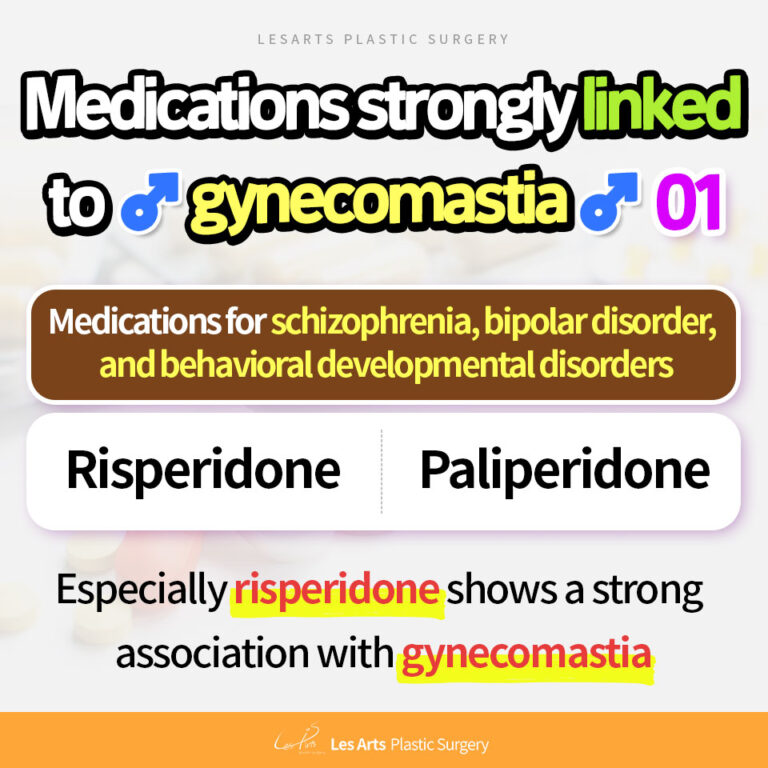
Risperidone
Paliperidone
Dutasteride
Finasteride
Spironolactone
Montelukast
Medication-induced gynecomastia – Dr. Kukhan Lee at Lesarts
Among these medications, Risperidone and Paliperidone
are antipsychotic medications commonly prescribed
in the field of psychiatry.
They are used not only
for treating schizophrenia,
but also for bipolar disorder
and developmental behavioral disorders.ㅠ
In particular, Risperidone accounts for
a significant portion of reported cases,
and is known to have
a relatively strong association
with the development of gynecomastia.
One especially important point
is their use in adolescent patients.
Among medications prescribed
to patients under the age of 18,
these drugs have shown
a relatively higher risk
of developing gynecomastia.
★ If a patient is currently taking
these medications, it is important
to continuously monitor for physical changes
together with parents or guardians. ★
In some cases, gynecomastia symptoms
may appear only after
a considerable amount of time has passed.
Because of this,
long-term observation and follow-up
are especially important.

The relationship between hair loss medications and gynecomastia — Dr. Kukhan Lee
Finasteride and Dutasteride were originally developed
as medications for treating
benign prostatic hyperplasia.
However, in recent years,
they have become more widely used
for treating male pattern hair loss.
Many people are familiar with these medications
through brand names such as
Propecia and Avodart.
Because these medications are now
commonly taken by many patients,
more individuals are visiting clinics
already aware of their possible association
with gynecomastia.
However, there are still many cases
where patients continue taking them
without knowing about this connection.
In many cases, symptoms begin appearing
relatively early after starting the medication.
Since hair loss medications are often taken
for extended periods of time,
★ even after gynecomastia surgery,
continuous monitoring for recurrence
or physical changes remains important. ★
The relationship between blood pressure medications and gynecomastia — Lesarts Plastic Surgery
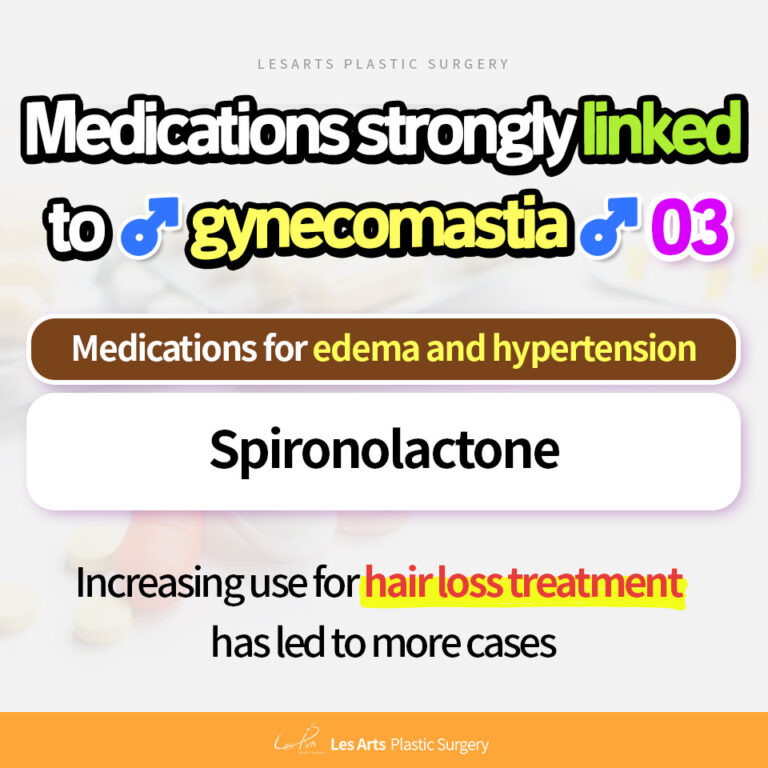
Spironolactone is a diuretic medication
commonly used to treat
edema and high blood pressure.
In recent years,
its use has also increased
for certain types of hair loss treatment.
This medication has also been reported
to have an association
with the development of gynecomastia.
Therefore, if you are currently taking it,
careful and ongoing observation
is recommended.

The relationship between asthma medications, allergy medications, and gynecomastia — Dr. Kukhan Lee
Montelukast is a medication commonly used
to treat asthma
and various allergic conditions.
Although the frequency of occurrence
is considered relatively low,
reports have suggested a possible association
between long-term use
and the development of gynecomastia.
For this reason,
monitoring for physical changes
is recommended during prolonged use.
In addition, antipsychotic medications
such as Olanzapine,
as well as cholesterol-lowering medications
such as Atorvastatin,
have also been reported
to show potential associations
with gynecomastia.
Because even commonly prescribed medications
may sometimes be related
to the development of gynecomastia,
if you begin taking a new medication,
it may be helpful to observe
whether any physical changes appear
before and after starting treatment.

Early signs of medication-induced gynecomastia — Lesarts Plastic Surgery
Most cases of medication-related gynecomastia
tend to appear during
the early stages of medication use.
Common symptoms may include
changes in chest size,
pain, tenderness, nipple discharge,
or general chest discomfort.
Because of this,
it is important to develop the habit
of checking for physical changes
by comparing your condition
before and after taking medication.
Many people tend to think
of gynecomastia simply
as a body shape concern.
However, in some cases,
it may be closely associated
with medications currently being taken.
If you are currently taking medication,
it is generally recommended
to first confirm whether
there is a possible connection
with the medication,
rather than stopping it immediately.
If necessary, consulting
with your prescribing physician
is the more appropriate approach.
Even small physical changes noticed early
may become important clues
when determining future treatment directions.
If you notice changes
that feel different from usual,
I recommend not overlooking them
and having them properly evaluated.