Abdominoplasty - Cesarean Scar Overhang Correction: Improving Sagging Above a C-Section Scar
Hello, I am Dr. Kukhan Lee,
a board-certified plastic surgeon.
Pregnancy and childbirth can bring
significant changes to a woman’s body.
For women who have delivered by C-section,
the concern is often not limited
to the surgical scar itself.
Many patients experience stress
when the skin above the scar folds
or sags downward, making
the lower abdomen appear more prominent.
Even after losing pregnancy weight,
the stretched abdominal skin and abdominal wall
often do not fully return
to their pre-pregnancy condition.
Despite consistent exercise
and careful dietary management,
localized skin laxity
and abdominal protrusion
can remain difficult to improve.
As a result, many women begin
to consider surgical correction
to address these concerns.
Today, I would like to share
the case of a patient who visited us
due to sagging above a C-section scar
and concerns about
her overall abdominal contour.
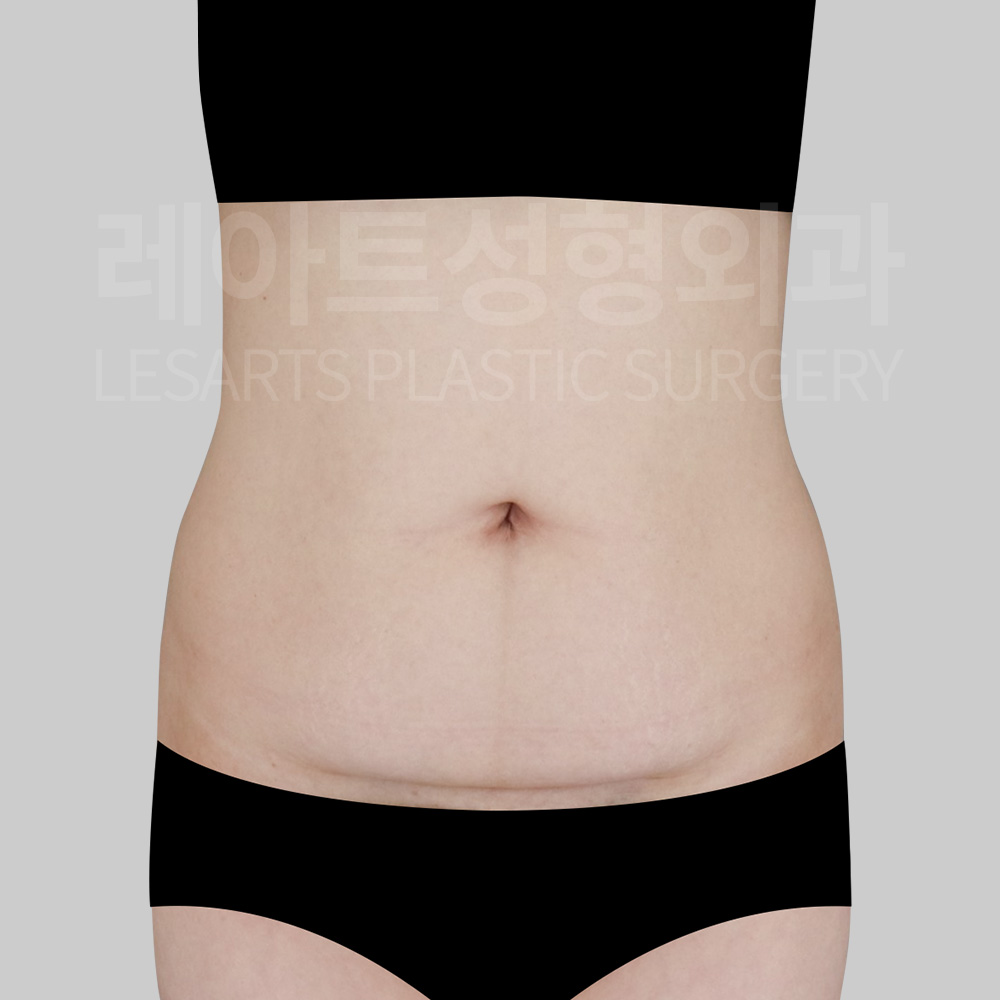
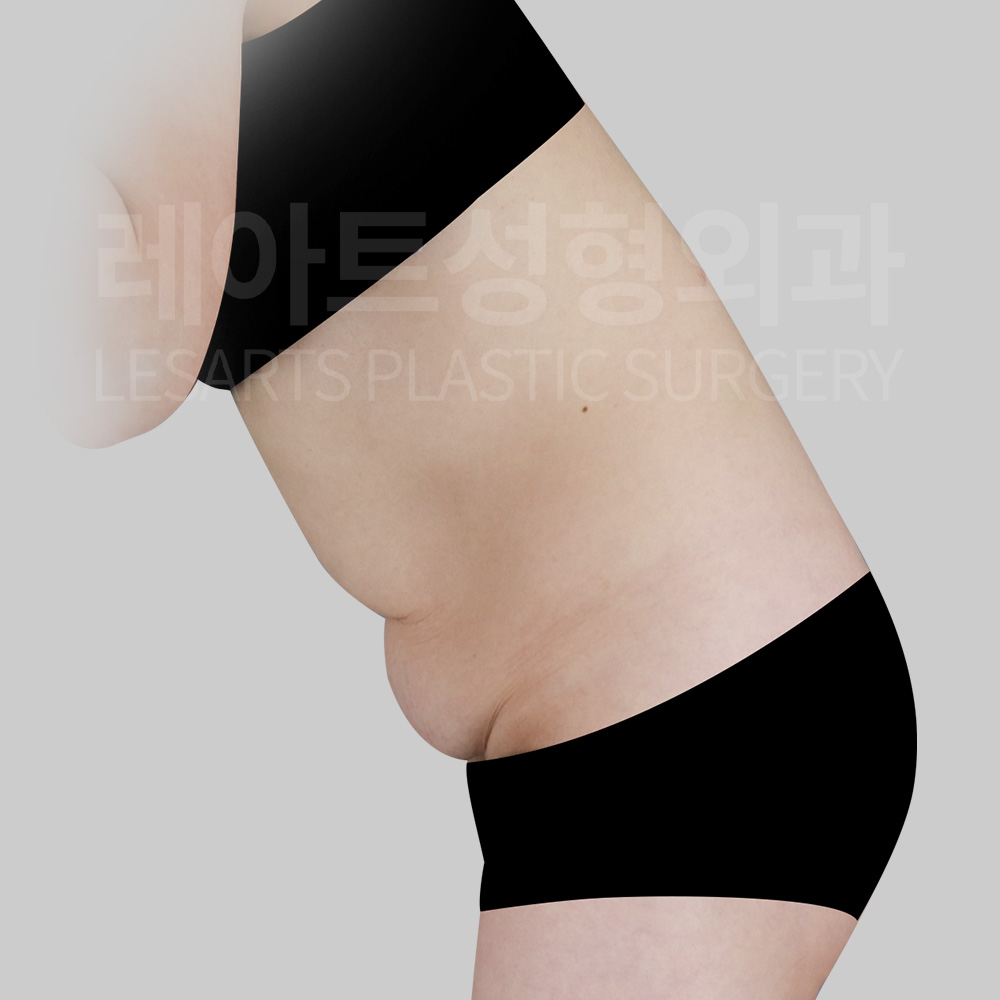
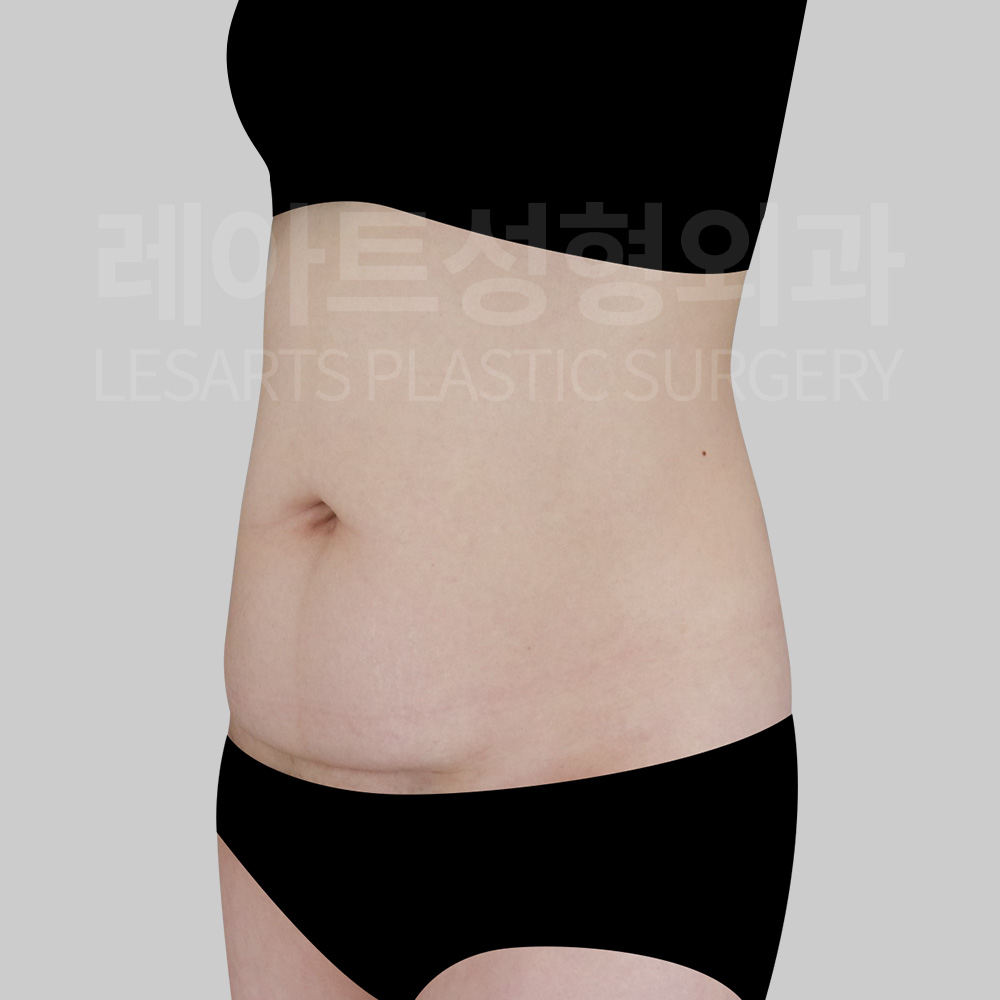
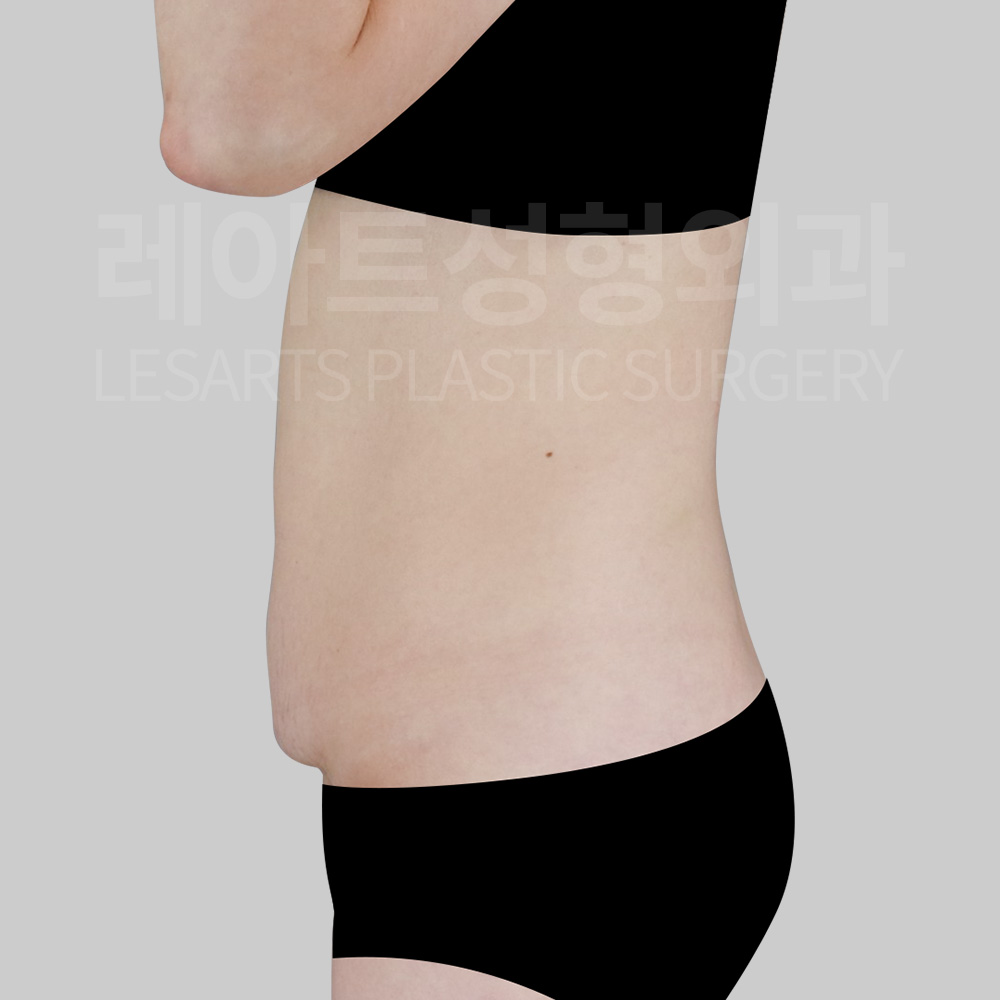
This patient was a woman in her 40s,
standing 154 cm tall
and weighing 45 kg at presentation.
She had delivered both of her children
via Cesarean section,
and experienced a weight gain
of approximately 16 kg during pregnancy.
After childbirth, however,
she successfully returned
to her current weight
and had maintained it consistently
through ongoing self-care and management.
Despite these efforts,
her primary concern was
the sagging lower abdominal skin
that had developed above
her C-section scar.
Even after weight loss,
she continued to notice
a folded appearance of the lower abdomen,
and also wished to improve
the overall abdominal protrusion
and disrupted body contour.
On physical examination,
the C-section scar
was positioned relatively high,
but there were no signs
of hypertrophic scarring or keloid formation.
However,
a significant amount of
lower abdominal skin laxity
was present above the scar,
with generalized skin looseness extending
around the navel and upper abdomen.
In addition,
both rectus diastasis
and fascial laxity
were identified in the upper
and lower abdominal regions.
Although the patient had
an overall slender body frame,
fat accumulation appeared
relatively more pronounced
in the abdominal area.
When planning an abdominoplasty,
one of the most important considerations
is not only the extent
of skin laxity,
but also whether the patient can comfortably accept
the resulting scar position and scar length.
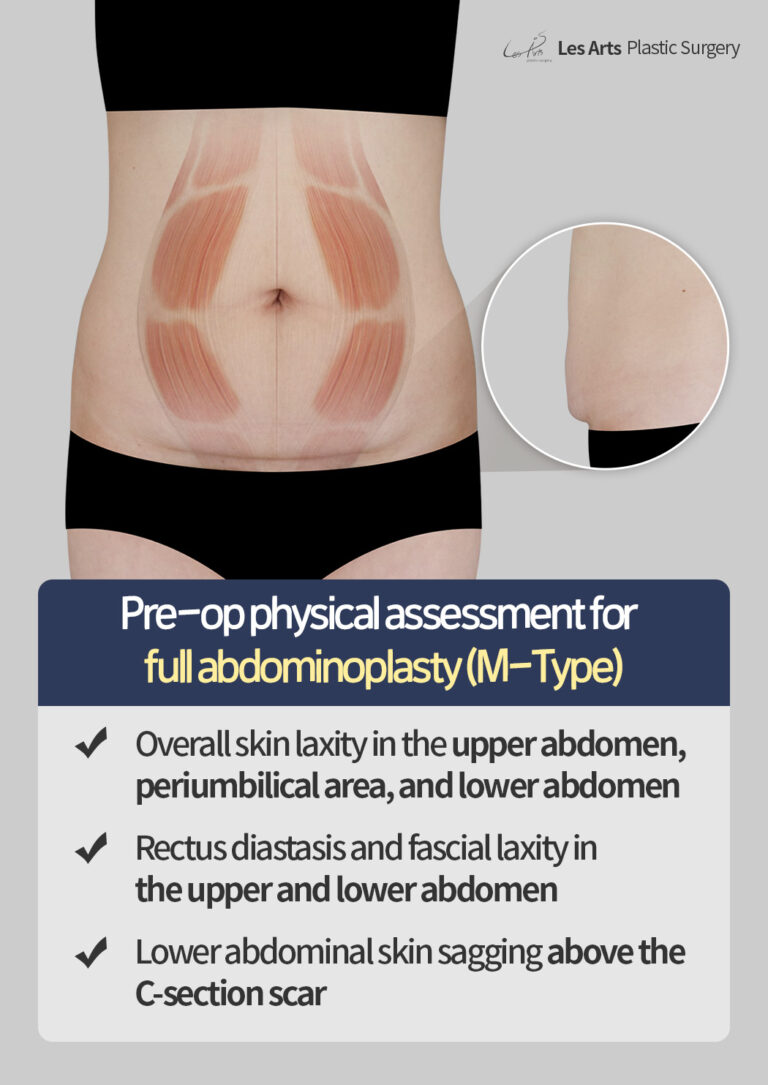
Preoperative Physical Examination for Full Abdominoplasty – Lesarts Plastic Surgery
In this case,
the skin laxity was not limited
to the lower abdomen alone,
but extended into
the upper abdominal area as well.
In addition,
rectus diastasis
was identified throughout
both the upper
and lower abdomen.
For this reason,
an M-type full abdominoplasty
was considered the more appropriate option.
However,
at the time of consultation,
the patient’s primary concern
was improving the protrusion
of the lower abdomen.
As a result,
she was initially considering
an S-type mini abdominoplasty.
We carefully explained that
even with a mini abdominoplasty,
the resulting scar length
would not be significantly shorter
than expected.
At the same time,
the correction would be limited
primarily to the lower abdomen.
Therefore,
if a similar scar length
was ultimately unavoidable,
it would be more beneficial
to address a broader area
and maximize overall improvement
and patient satisfaction.
Based on this assessment,
we planned to perform
an M-type full abdominoplasty
combined with
abdominal liposuction.
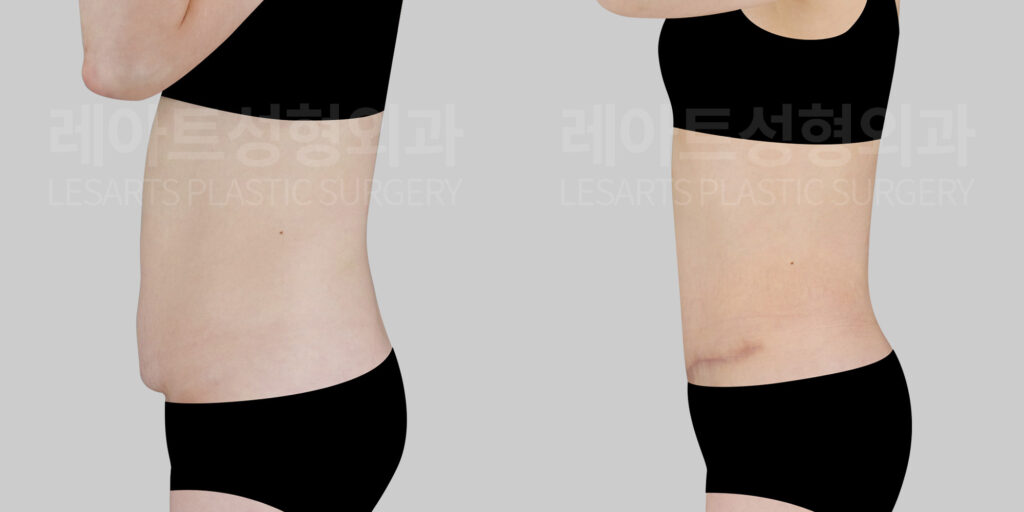
Improvement of C-Section Scar Indentation – Dr. Kukhan Lee, Lesarts Plastic Surgery
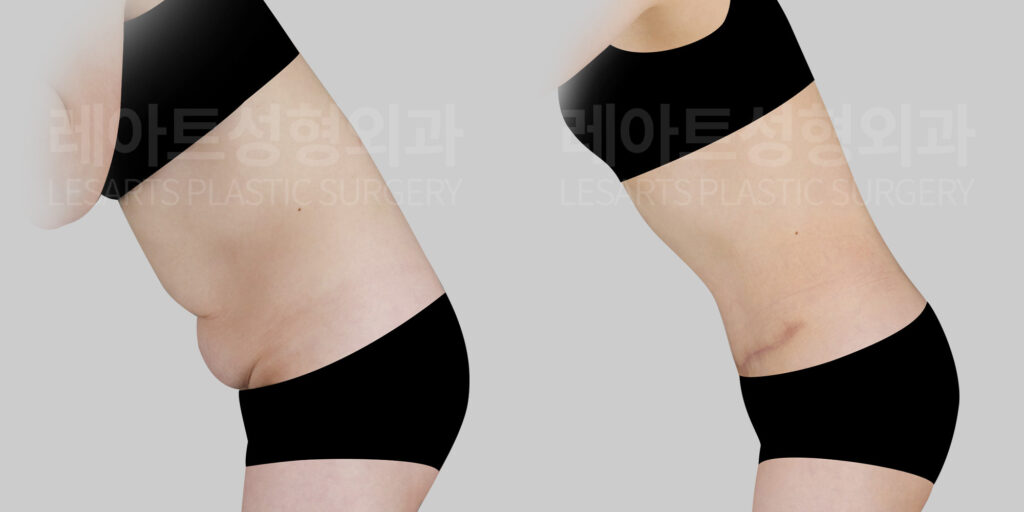
Abdominal Skin Tightening Through Abdominoplasty – Lesarts Plastic Surgery
This patient is now
5 months after abdominoplasty.
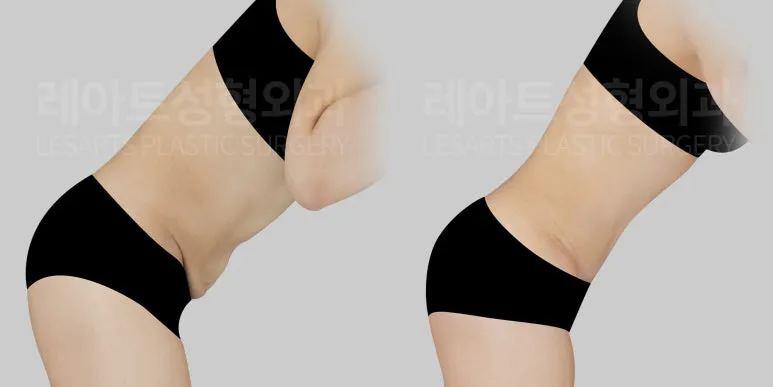
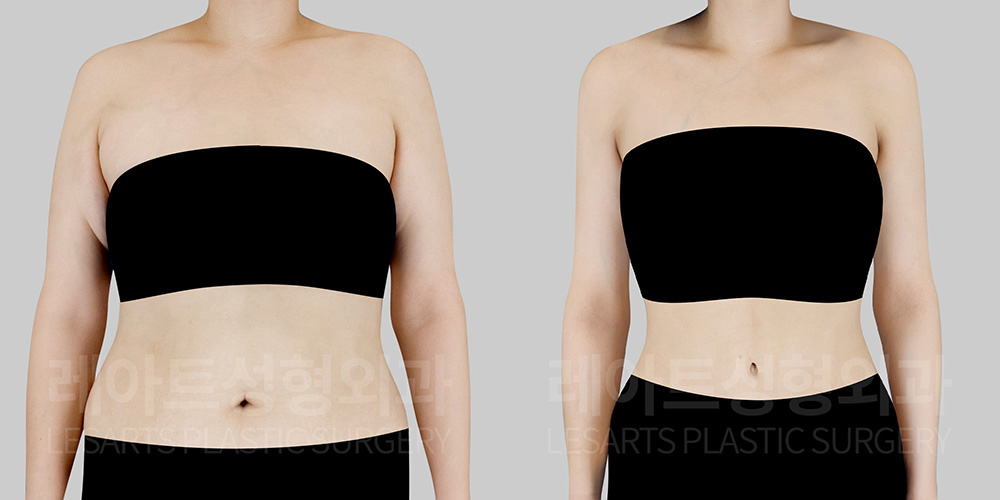
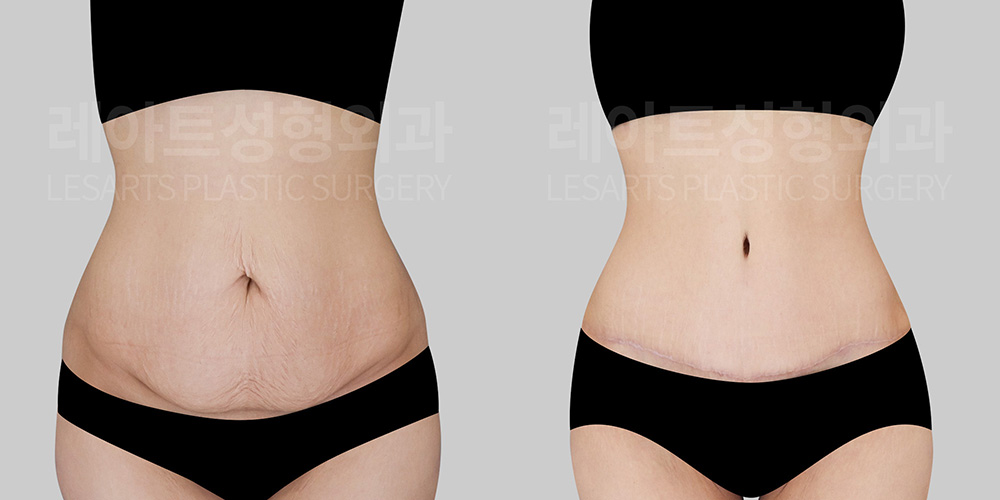
The sagging skin above the C-section scar,
which had been her primary concern
before surgery,
has been corrected smoothly,
creating a much more refined
and balanced lower abdominal contour.
During the surgical planning stage,
we also considered the possibility
that the existing C-section scar
might not be completely removable.
Fortunately,
the previous scar was able
to be excised and improved
as part of the procedure.
As a result,
we were able to create
a more natural-looking
and aesthetically balanced
lower abdominal line.
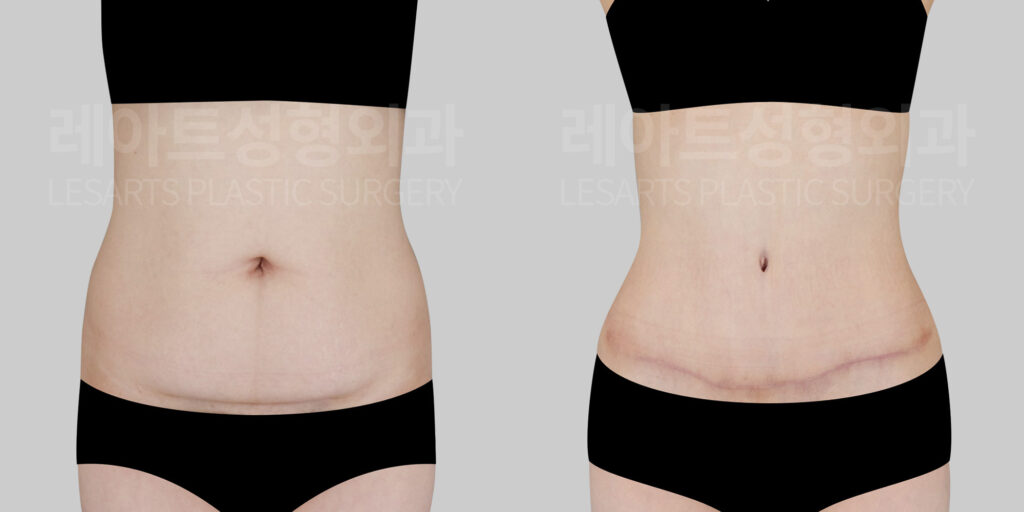
Lifting Sagging Skin Above a C-Section Scar – Dr. Kukhan Lee, Lesarts Plastic Surgery
In addition,
as the rectus diastasis
was successfully repaired,
the abdomen, which previously appeared
to protrude outward,
developed a noticeably firmer
and more toned contour.
The overall abdominal shape
appears flatter,
more balanced,
and significantly improved
in terms of definition.
The navel was also reshaped
into a vertically oriented
oval configuration,
creating a more refined
and natural appearance.
Both its position
and overall proportion
show a more harmonious
and aesthetically balanced result
compared with before surgery.
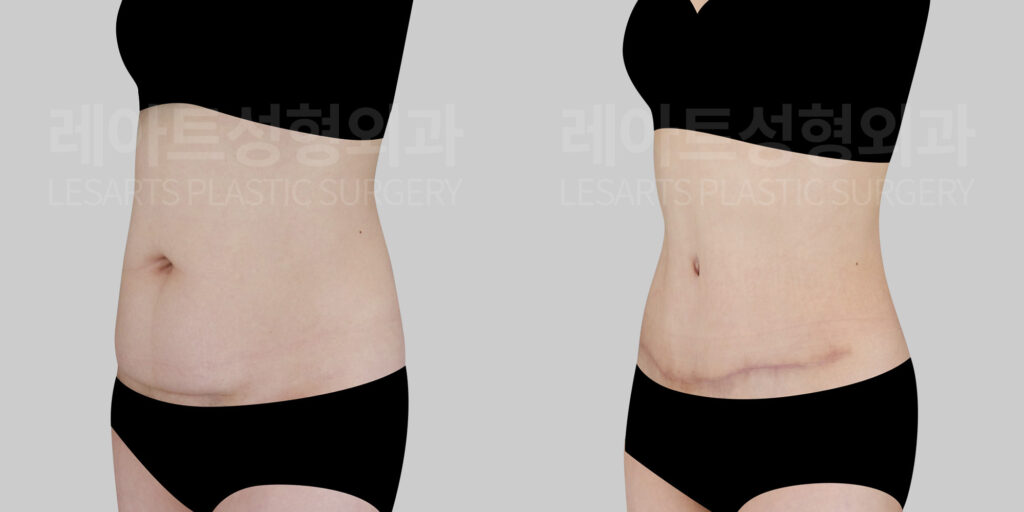
C-Section Scar Removal Before & After Abdominoplasty – Dr. Kukhan Lee, Lesarts Plastic Surgery
The addition of abdominal liposuction
also played an important role
in refining the final result.
By reducing excess fat
and enhancing contour definition,
the procedure helped create
a smoother waistline
and a more refined
abdominal silhouette.
When combined with
abdominoplasty,
the improvement was not limited
to skin tightening alone,
but extended to the overall body contour,
contributing to a higher level
of patient satisfaction.

Abdominoplasty Scar Position and Recovery – Lesarts Plastic Surgery
The patient is currently
5 months after abdominoplasty,
which is still a relatively early stage
in the scar maturation process.
At this point,
the surgical scar remains
somewhat noticeable.
However,
abdominoplasty scars
typically continue to improve over time,
gradually becoming lighter,
softer,
and less conspicuous
as healing progresses.
For this reason,
the patient is expected
to experience further improvement
in the months ahead.
What was particularly encouraging
in this case
was the patient’s commitment
to maintaining her weight
and healthy lifestyle habits
even before surgery.
As a result,
both her recovery
and postoperative body contour maintenance
have remained remarkably stable.
If she continues
with the same level of care,
the outcome is expected
to become even more natural
and satisfying over time.
Following pregnancy
and a Cesarean section,
changes in the abdomen
are often not simply related
to body weight.
In many cases,
they involve a combination of
stretched skin,
changes in the abdominal wall,
and weakening of
the underlying support structures.
Therefore,
if abdominal sagging
or protrusion persists
despite dedicated efforts
with exercise and weight management,
a properly planned abdominoplasty
may provide
a more comprehensive
and lasting correction.
Most importantly,
the goal is not simply
to remove excess skin.
Successful abdominoplasty
requires careful consideration of
each patient’s body shape,
the extent of skin laxity,
and even the position
and visibility of the scar,
to create a result that appears
both natural
and aesthetically balanced.