
M-Type Abdominoplasty After Liposuction: 5-Month Results for Sagging Skin
Why can abdominoplasty be more complex after previous abdominal liposuction?
Previous liposuction can create adhesions and scar tissue between the skin and underlying tissues.
These adhesions may limit skin movement, making adhesiolysis necessary during abdominoplasty
to reposition the skin safely and improve sagging and wrinkles.
[ Learn More About Abdominoplasty at Lesarts Plastic Surgery ]
Written by Dr.Kukhan Lee, Lesarts Plastic Surgery
This article was written directly by the attending surgeon.
※Unauthorized reproduction, editing, or redistribution is prohibited.※
When patients are concerned about a protruding abdomen
and are considering surgical correction,
abdominal liposuction is often one of the first procedures considered.
If excess fat is the main cause of abdominal fullness,
liposuction alone can often reduce overall volume
and improve the abdominal contour with satisfying results.
However, when large-volume liposuction is performed
due to significant fat accumulation,
or when skin elasticity has decreased due to pregnancy or aging,
the skin may not contract sufficiently after fat removal.
As a result, sagging skin or wrinkles
may actually become more noticeable.
In particular, if previous liposuction has caused
adhesions and scar tissue to form
between the skin and subcutaneous tissues,
a later abdominoplasty can become more technically challenging.
When performing abdominoplasty after previous liposuction,
the scar tissue created by the earlier procedure
must be carefully considered.
Firm adhesions can restrict skin mobility,
so adhesiolysis may be required
to release the tissues and allow the skin
to be repositioned in the desired direction.
This additional step can increase
both the complexity and duration of surgery,
making careful tissue dissection especially important.
If the adhesions are not released sufficiently,
it may be difficult to pull the skin downward
as much as needed.
On the other hand, overly aggressive adhesiolysis
can compromise blood circulation to the skin,
increasing the risk of skin damage
and, in severe cases, skin necrosis.
For this reason, it is important to determine
a safe surgical range by considering
the extent of the previous procedure,
the severity of adhesions,
and the amount of available skin.
In this case, we will review a patient
who underwent an M-type full abdominoplasty
together with revision abdominal liposuction
to improve abdominal wrinkles and skin sagging
that developed after childbirth and previous abdominal liposuction.
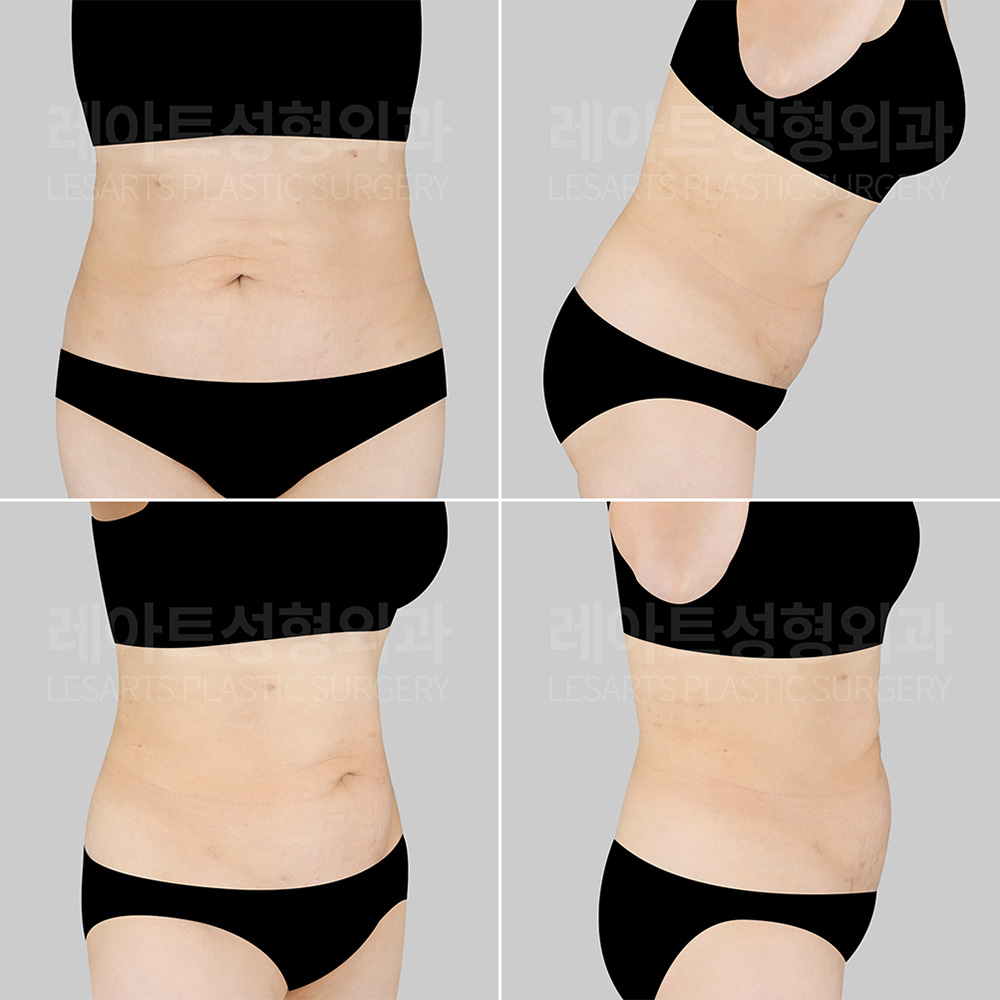
Preoperative Assessment for Abdominoplasty
The patient was a woman in her 40s
who had given birth to two children through vaginal delivery.
At the time of her visit, she was 153 cm tall and weighed 56 kg.
Her weight had increased to only about 60 kg during pregnancy,
so she had not experienced significant weight fluctuations.
However, one year before visiting our clinic,
she had undergone abdominal liposuction at another clinic
to improve areas that exercise and diet alone could not address.
Although the procedure reduced her overall abdominal volume,
wrinkles that developed in the upper abdomen
and sagging skin around the belly button remained a concern.
Physical examination revealed firm adhesions
throughout the skin and subcutaneous tissues
as a result of the previous liposuction.
These adhesions had also caused irregularities
on the surface of the abdomen,
with particularly deep wrinkles above the belly button.
To improve both the upper abdominal wrinkles
and the sagging skin, an M-type full abdominoplasty
appeared to be necessary.
However, several important factors needed to be considered
before proceeding with surgery.
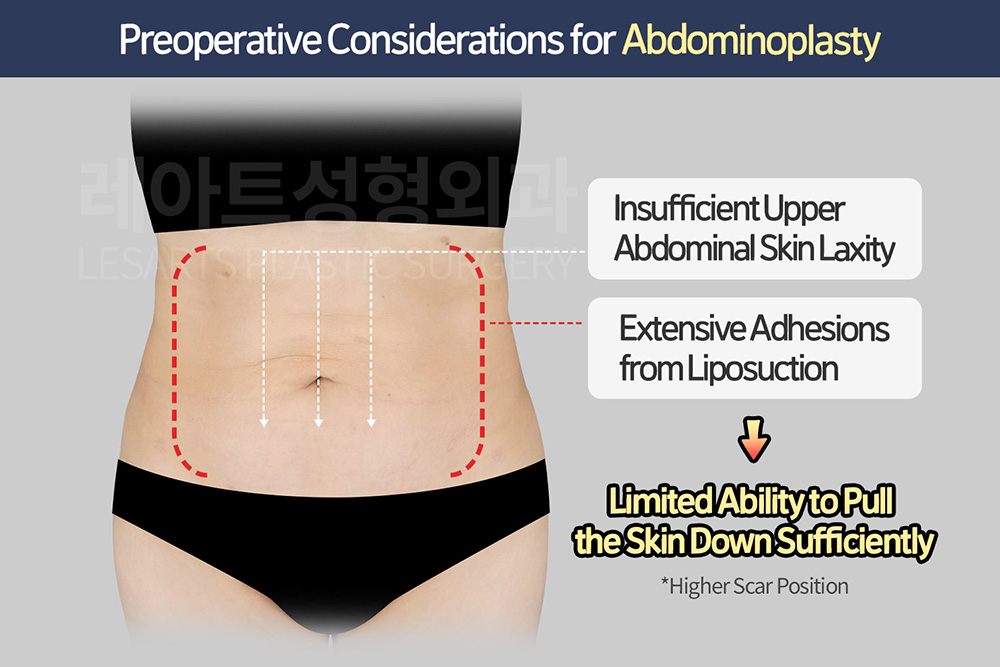
Preoperative Considerations for Abdominoplasty – Dr. Kukhan Lee, Lesarts Plastic Surgery
The first consideration was the limited amount
of excess skin in the upper abdomen.
Because the patient had not experienced significant weight changes during pregnancy
and did not have a large amount of excess skin overall,
we expected some limitations in removing the lower abdominal skin
and pulling the upper abdominal skin sufficiently downward.
The second consideration was the extensive adhesions
caused by the previous liposuction.
Adhesiolysis would be necessary
to allow the skin to move to the desired position.
However, even with sufficient release of the adhesions,
there could still be limitations in fully stretching
and repositioning the skin as intended.
Under these circumstances, the abdominoplasty scar
could also be positioned slightly higher than usual.
For this reason, we carefully explained these possibilities before surgery
and discussed the expected results and realistic limitations
with the patient in detail.
Some residual subcutaneous fat was also present.
To improve the overall abdominal contour
while releasing as much of the existing adhesion as safely possible,
we also planned revision abdominal liposuction.
5-Month Results After Abdominoplasty and Revision Abdominal Liposuction
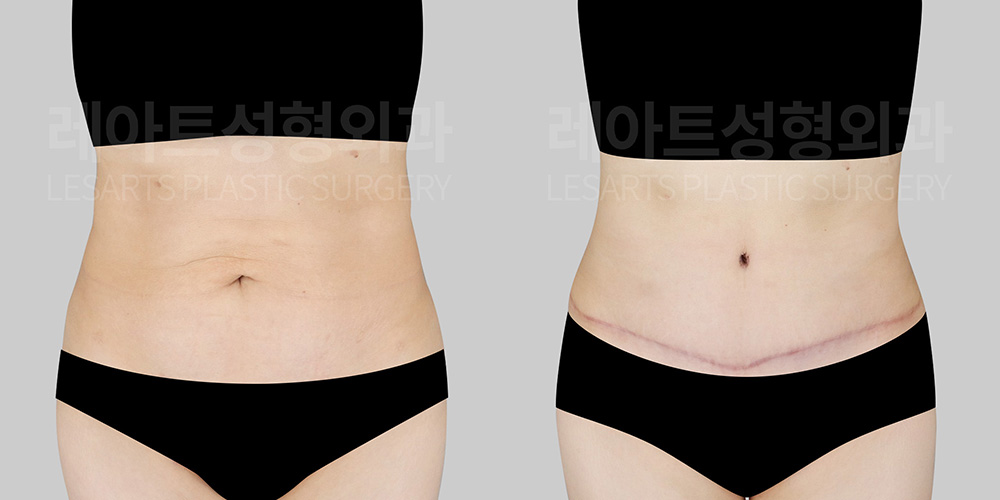
Abdominoplasty and Revision Liposuction Before and After – Dr. Kukhan Lee, Lesarts Plastic Surgery
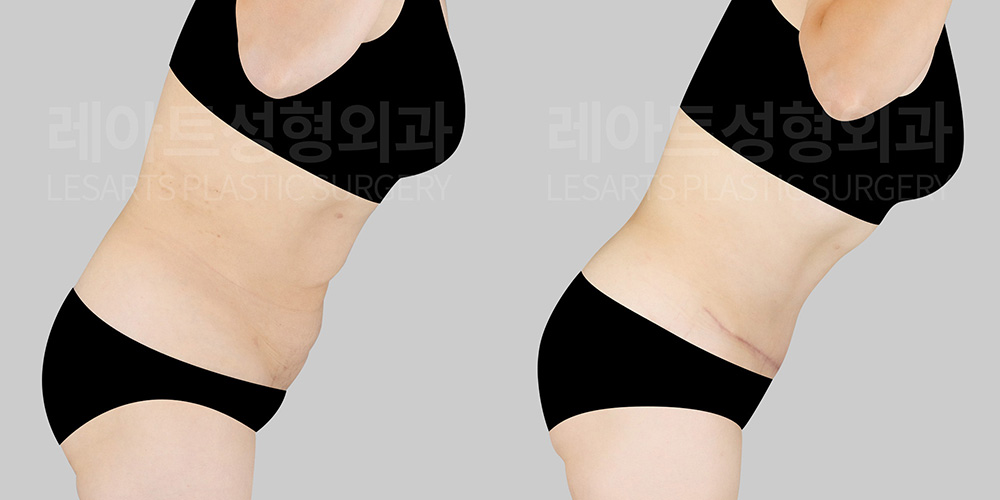
Changes in Sagging Abdominal Skin Before and After Abdominoplasty – Dr. Kukhan Lee, Lesarts Plastic Surgery
The most noticeable improvement was in the deep wrinkles
and sagging skin of the upper abdomen,
which had been the patient’s main concern before surgery.
The skin and subcutaneous tissues that had become firmly adhered
due to the previous liposuction were carefully released.
By releasing these adhesions and sufficiently repositioning the skin,
the overall skin condition and abdominal contour improved
from the upper abdomen down to the lower abdomen.

Wrinkles, Skin Sagging, and Adhesion Release After Abdominal Liposuction (Abdominoplasty) – Lesarts Plastic Surgery

Abdominoplasty with Release of Anterior Abdominal Adhesions – Lesarts Plastic Surgery
At 5 months after surgery, most of the swelling
has already subsided.
However, lymphatic circulation and tissue recovery
are not yet considered fully complete at this stage.
As healing continues, the tissues may gradually become softer,
and some of the remaining contour irregularities
may improve further over time.

Abdominoplasty Scar Position in a Patient with Limited Excess Skin – Dr. Kukhan Lee, Lesarts Plastic Surgery
From the patient’s perspective, the abdominoplasty scar
was positioned within an area that could be concealed by underwear,
so it did not cause significant discomfort or dissatisfaction.
From the surgeon’s perspective, however,
a lower scar position would have been preferable if possible.
In this case, the patient had limited excess skin
and significant adhesions caused by previous liposuction.
Therefore, rather than pulling the skin excessively
just to position the scar lower,
leaving the scar at its current position was considered
the safest and most realistic option.
Although the scar remained somewhat red at 5 months,
continued scar care and regular scar treatments
are expected to help it gradually fade and stabilize over time.
Because every patient has a different abdominal condition
and surgical history, the same surgical approach
cannot be applied to everyone.
It is important to evaluate not only the patient’s main concern,
but also skin elasticity and excess skin, fat distribution,
pregnancy history, previous surgeries, and the degree of adhesions.
The surgical plan should be determined only after carefully assessing
what can realistically be improved with abdominoplasty
as well as the limitations of the procedure.
In particular, if you are concerned about sagging skin, wrinkles,
or an uneven abdominal contour after previous abdominal liposuction,
simply removing additional fat may not be the best solution.
Instead, the current condition of the skin and subcutaneous tissues
should be carefully evaluated to determine
the most appropriate surgical approach for your individual condition.
We hope this case provides helpful information
for those with similar concerns
who are considering abdominoplasty.
FAQ
Q1. Can abdominoplasty improve sagging skin after abdominal liposuction?
Yes. If the skin does not contract sufficiently after liposuction,
abdominoplasty can remove and reposition excess skin to improve sagging, wrinkles, and overall abdominal contour.
Q2. Why are adhesions important when performing abdominoplasty after liposuction?
Previous liposuction can create firm adhesions between the skin and subcutaneous tissues.
These adhesions may restrict skin movement and often need to be carefully released during surgery.
Q3. What is adhesiolysis during abdominoplasty?
Adhesiolysis is the surgical release of scar tissue and adhesions formed after previous procedures.
It helps improve tissue mobility so the abdominal skin can be repositioned more effectively.
Q4. Can the abdominoplasty scar be higher after previous liposuction?
Yes. If there is limited excess skin or significant adhesion from previous surgery,
the scar may need to be positioned slightly higher to avoid excessive tension and maintain surgical safety.
Q5. Can residual abdominal irregularities continue to improve after 5 months?
Yes. At 5 months, most swelling may have subsided, but tissue recovery and lymphatic circulation may still be continuing.
Some remaining firmness or contour irregularities may gradually improve over time.
▼ Visit Lesarts Plastic Surgery in Gangnam, Seoul, Korea ▼