
Gynecomastia Medical Column: “I Lost More Than 20 kg, but My Chest Became Saggier” — An Unexpected Concern After Weight Loss, Surgical Treatment and Strategies for Overcoming the Dilemma
Why can gynecomastia and sagging chest skin remain after major weight loss?
Major weight loss can reduce chest fat, but enlarged glandular tissue does not disappear through diet or exercise.
At the same time, previously stretched skin and supporting tissues may not fully contract,
leaving residual breast tissue and sagging skin even after significant weight loss.
Written by Dr. Jihoon Moon, Lesarts Plastic Surgery
This medical column was written directly by the attending surgeon.
※ Unauthorized reproduction, editing, or redistribution is prohibited. ※
Weight loss is both a significant challenge
and a meaningful achievement for your health and appearance.
First of all, sincere congratulations
to those who have successfully achieved massive weight loss
of more than 20 kg.
However, even after such a difficult weight-loss journey,
many patients visit our clinic with unexpected concerns
or problems that still remain.
“I lost 20 kg, so why does my chest still look the same?”
Or,
“After losing weight, the skin on my chest started sagging
like a deflated balloon.”
These are concerns we commonly hear.
In this article, we will take a closer look
at the mechanisms behind gynecomastia and skin sagging
after massive weight loss,
as well as the treatment dilemmas surgeons may face
and the strategies used to address them.
1. Why Doesn’t the Chest Return to Normal After Weight Loss?
It is easy to think,
“My chest became larger as I gained weight,
so if I lose weight, it should naturally return to normal.”
Unfortunately, the physiological mechanisms of the human body
are not quite that simple.

Gynecomastia and Weight Loss – Dr. Jihoon Moon, Lesarts Plastic Surgery
① The Role of Aromatase in Fat Tissue
As body weight increases, body fat also increases.
Fat tissue contains an enzyme called aromatase,
which converts the male hormone testosterone
into the female hormone estrogen.
As a result, weight gain can relatively increase
the proportion of estrogen in the body.
This increased estrogen activity may stimulate
male glandular breast tissue
and contribute to its growth.
② Irreversible Changes in Glandular Breast Tissue
Once glandular breast tissue has enlarged,
it does not disappear simply by losing fat
through diet or exercise.
Body fat may decrease,
but the enlarged glandular tissue can remain in the chest
as a firm, palpable mass.
③ Laxity of Cooper’s Ligaments and the Dermis
While a large amount of fat keeps the chest enlarged,
the Cooper’s ligaments that support the breast
and the collagen and elastin fibers within the dermis
can become excessively stretched.
If a significant amount of fat is then lost rapidly,
the stretched skin may remain like a “deflated balloon,”
causing the chest to sag downward.
*If the nipples point diagonally downward rather than straight ahead
while standing upright, this may indicate sagging of the breast skin (breast ptosis).
2. Simon Classification and the Characteristics of Gynecomastia After Massive Weight Loss
Gynecomastia can be classified using the Simon classification
according to the degree of breast enlargement
and the severity of skin sagging.

External Assessment of Gynecomastia Symptoms (Simon Grade) – Dr. Jihoon Moon, Lesarts Plastic Surgery
| Classification | Characteristics |
|---|---|
| Simon I | Mild increase in glandular and fatty tissue without skin sagging |
| Simon IIa ★ Most Common | Moderate increase in glandular and fatty tissue with little to no skin sagging |
| Simon IIb | Moderate increase in glandular and fatty tissue with mild to moderate skin sagging |
| Simon III | Severe increase in glandular and fatty tissue with significant skin sagging (female breast-like appearance) |
Among patients who visit a gynecomastia clinic,
Simon Grade IIa is the most common.
However, patients who have experienced massive weight loss
of more than 20 kg are often diagnosed
with Simon Grade IIb or III.
Gynecomastia accompanied by significant skin sagging
cannot be improved through medication or exercise alone,
making surgical treatment the primary option.
3. The Surgeon’s Dilemma: Complete Removal vs. Skin Sagging
When performing gynecomastia surgery
after massive weight loss,
the surgeon faces an important dilemma.
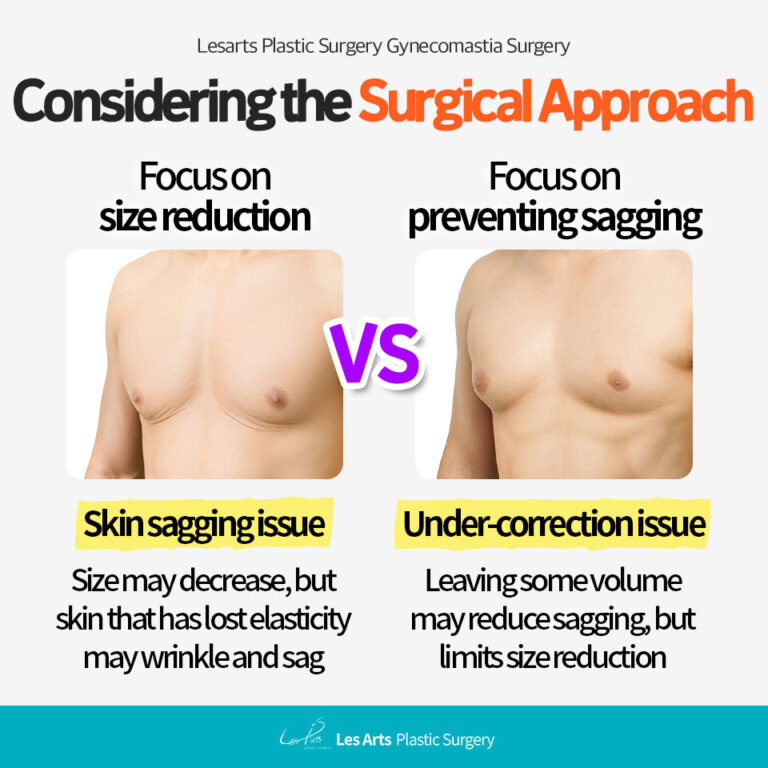
Considerations Before Choosing a Gynecomastia Surgery Approach – Lesarts Plastic Surgery
✔ When Fat and Glandular Tissue Are Removed as Completely as Possible
As volume is removed from the chest,
the previously stretched skin may lose its support
and begin to wrinkle and sag downward.
Some patients may feel distressed, saying,
“My chest and nipple-areola area are flatter now,
but the loose, wrinkled skin still bothers me.”
✔ When Some Tissue Is Preserved to Prevent Skin Sagging (Undercorrection)
Leaving some tissue behind can help maintain chest volume
and reduce the appearance of sagging.
However, because some of the glandular and fatty tissue
responsible for the gynecomastia remains,
patients may feel dissatisfied, saying,
“I had surgery, but my chest still looks prominent.”
Resolving this dilemma requires careful preoperative evaluation,
a strategic surgical approach,
and thorough communication between the surgeon and patient.
4. Step-by-Step Solutions and Preventive Measures for Skin Sagging
So, how can this dilemma be managed
to achieve the best possible outcome?
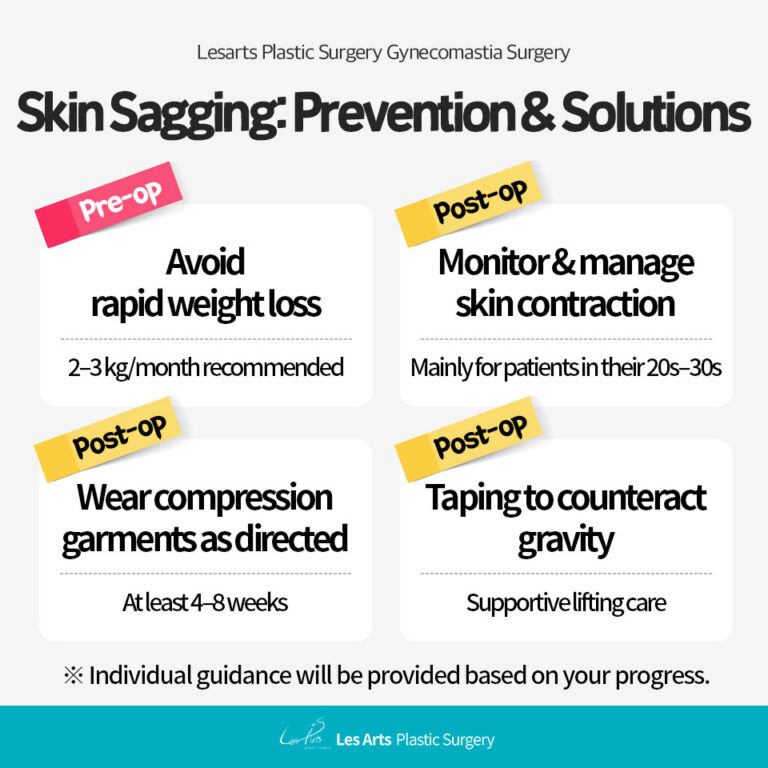
Gynecomastia Surgery and Skin Sagging – Lesarts Plastic Surgery
① Evaluating the Patient’s Age and Skin Elasticity
Younger patients, particularly those in their 20s to early 30s,
generally have a greater natural ability
for the skin to remodel and contract.
Even if the skin appears somewhat loose immediately after surgery,
proper postoperative care may help the skin gradually tighten
and adapt to the new chest contour over time.
② Active Use of a Compression Garment
For patients undergoing gynecomastia surgery after massive weight loss,
a compression garment plays an important role
not only in controlling swelling but also in supporting chest contour recovery.
After glandular tissue and fat are removed,
a potential empty space, or “dead space,” remains beneath the skin.
To help the skin adhere properly to the underlying chest muscle
and stabilize in its new position,
a compression garment should generally be worn for at least 4–8 weeks
according to the surgeon’s instructions.
③ Suspension Taping
For several weeks after surgery,
special suspension tape may be applied
to lift and support the skin of the lower chest.
By reducing the downward effect of gravity,
this non-surgical supportive method can help
the sagging skin settle into a higher position during recovery.
④ Controlling the Pace of Weight Loss (Preoperative Prevention)
If you are currently losing weight
and planning to undergo gynecomastia surgery,
gradual weight loss of approximately 2–3 kg per month
is generally recommended rather than rapid weight loss.
Controlling the pace of weight loss gives the dermal layer
more time to contract gradually
and may help reduce the risk of skin sagging after surgery.
See Before and After Results of Gynecomastia Surgery with Sagging Skin
▼▼▼
https://lesartsps.com/category/gynecomastia/
5. The Last Resort: A Cautious Approach to Chest Lift Surgery (Mastopexy)
If skin laxity is too severe
to improve sufficiently with the conservative approaches described above,
a chest lift may be considered
to directly remove excess skin
and reposition the nipple to a higher position.
However, this procedure should be considered very carefully,
as there are several important limitations
and precautions to understand.

Chest Lift After Gynecomastia Surgery – Dr. Jihoon Moon, Lesarts Plastic Surgery
Important Considerations Before a Chest Lift
1. Long Scars
A chest lift inevitably leaves a long linear scar
around the lower chest or inframammary area.
Although the procedure can improve sagging,
the resulting visible scar may reduce overall satisfaction
with the surgical outcome.
2. Avoid Combining It with the Initial Surgery
Even when significant skin sagging is expected before surgery,
it is generally preferable not to perform a chest lift
at the same time as the initial gynecomastia surgery
(gland excision and liposuction).
After the initial surgery, the skin should be given time
to contract and settle for at least 6–12 months.
If significant sagging still remains after this period,
a chest lift may then be considered
as a secondary procedure.
3. Not Covered by Insurance
Standard gynecomastia surgery, including gland excision,
may be covered by Korea’s National Health Insurance
and private indemnity insurance when certain criteria are met.
However, a chest lift is classified as a cosmetic procedure
and is generally not eligible for insurance coverage.
6. Conclusion
Gynecomastia and sagging skin after massive weight loss
are not simply problems caused by excess fat.
For patients who have already achieved significant weight loss,
they can feel like the final challenge
remaining after a long journey.
In patients with Simon Grade IIb or III gynecomastia,
skin elasticity, residual fat volume, and glandular tissue size
can vary significantly from person to person.
Therefore, treatment should not focus solely
on how much fat or glandular tissue should be removed.
It is important to consult an experienced medical team
that can anticipate the skin’s potential for postoperative contraction
and develop a systematic postoperative care plan
using methods such as compression garments and suspension taping.
After working so hard to achieve a healthier body,
you should not have to continue worrying about your chest.
Visit a specialized clinic for a thorough evaluation
and an accurate diagnosis of your condition.
FAQ
Q1. Why can gynecomastia remain after losing more than 20 kg?
Weight loss reduces fat, but enlarged glandular breast tissue does not disappear through diet or exercise.
As a result, a firm mass or chest fullness may remain even after significant weight loss.
Q2. Why can the chest become more saggy after major weight loss?
When the chest has been enlarged for a long time, the skin and supporting tissues can become stretched.
After a large amount of fat is lost, the remaining skin may not fully contract and can sag downward.
Q3. Which Simon grades are common after major weight loss?
Patients who have lost a large amount of weight are often diagnosed with Simon Grade IIb or III
because gynecomastia may be accompanied by mild to significant skin sagging.
Q4. How can skin sagging be managed after gynecomastia surgery?
Depending on skin elasticity, postoperative management may include wearing a compression garment for about 4–8 weeks
and using suspension taping to support the skin while it reattaches and contracts.
Q5. When is a chest lift considered after gynecomastia surgery?
A chest lift may be considered when severe excess skin remains despite sufficient healing
and conservative management.In general, it is preferable to observe skin contraction for
at least 6–12 months after the initial gynecomastia surgery before considering a secondary lift.
▼ Visit Lesarts Plastic Surgery in Gangnam, Seoul, Korea ▼