
Thigh Liposuction: What Is the Most Important Reason for Liposuction?
What is one of the most important benefits of thigh liposuction beyond reducing fat?
Thigh liposuction can provide visible contour improvement that motivates patients to maintain healthier habits.
Using the new body line as motivation for ongoing weight management can help maintain the results over time.
Written by Dr. Yongseung Seo, Lesarts Plastic Surgery
This article was written directly by the attending surgeon.
※ Unauthorized reproduction, editing, or redistribution is prohibited. ※
Liposuction is an effective way to reduce volume
in areas of concern and refine body contours.
However, focusing only on the immediate change
means overlooking an important part of the procedure.
One of the meaningful benefits of liposuction
is the motivation it can provide for weight management.
Seeing a noticeable change in an area
that remained resistant despite repeated efforts
can become a powerful source of motivation.
“I finally feel like maintaining my body is worth the effort.”
This sense of confidence can encourage patients
to make real changes to their eating habits
and daily lifestyle patterns.
On the other hand, if the factors that contributed to weight gain
remain unchanged after liposuction,
the newly created contours may gradually become less defined over time.
For this reason, maintaining the results
and using them as motivation for continued weight management
can be just as important as the procedure itself.
The patient featured today visited Lesarts Plastic Surgery
after noticing that her thighs had become larger
along with a recent increase in body weight.
Her main goal was to reduce the overall size
and volume of her thighs.
[Patient Information]
Age: Mid-20s
Height: 161 cm
Weight: 65.4 kg
BMI: 25.2 kg/m²
Body Fat Percentage: 33.1%
※ Liposuction results may vary between individuals,
even among patients with similar body measurements.

Preoperative Assessment for Thigh Liposuction
[Consultation and Diagnosis]
“I want to reduce the overall size of my thighs.
Especially, I want a straighter inner thigh line.”
The patient’s main goals were to reduce overall thigh volume
and create a smooth, straight contour along the inner thighs.
She was also concerned about scarring
and wanted to minimize the number and size of incisions.
On visual examination, there was a significant amount of fat
not only along the inner thighs but also around the knees.
The inner thighs remained in contact from the upper thighs down to the knees,
creating a heavy and congested appearance without a visible thigh gap.
Prominent outer thigh fat, commonly known as saddlebags,
made the thighs appear even wider.
This outer fullness also made the legs appear shorter,
further emphasizing the overall thickness of the thighs.
In addition, rounded fat protruding from the front of the thighs
contributed to a thicker and shorter-looking leg contour.
[Ultrasound Examination]
Outer thighs (saddlebags): 40/30 mm
Inner thighs: 20/21 mm
Front thighs: 15/17 mm
Back thighs: 10/11 mm
Knees: 16/14 mm
Because there was a substantial amount of fat throughout the thighs,
we expected noticeable contour improvement from liposuction.
However, muscle also accounted for a relatively large proportion
of the overall thigh volume.
We therefore explained that achieving extremely thin,
“stick-thin” thighs through liposuction alone would be difficult.
The patient also had irregular eating habits
due to frequent late-night work.
We explained that if these lifestyle patterns continued,
the remaining fat cells could enlarge again after liposuction,
or fat could accumulate in other areas and affect the new contour.
For this reason, we recommended using the improved thigh line
as motivation to continue managing her weight after surgery.
We also explained that if maintaining a healthy diet
would be extremely difficult under her current circumstances,
postponing surgery until her lifestyle improved could be a better option.
After discussing these factors,
the patient made the final decision to proceed with surgery.
[Thigh Liposuction Design Considering Overall Fat Volume and a Straight Leg Line]
Because reducing the overall size of the thighs
was one of the patient’s main goals,
we planned to remove as much excess fat as safely possible.

Outer Thighs (Saddlebags)
Because ultrasound showed the greatest amount of fat
in the outer thighs, we focused on reducing this area
to create a smoother line from the knees to the pelvis.
The goal was to significantly reduce overall thigh volume
while creating a more balanced silhouette.
However, removing too much fat from the area
where the thighs meet the buttocks can create an indentation
and make the boundary between the thighs and buttocks too noticeable.
This may visually shorten the legs
and actually make the thighs appear thicker.
For this reason, we intentionally preserved some fat
to maintain a smooth transition from the thighs to the buttocks.
We also explained that because of the existing asymmetry
in fat distribution, slight differences between the left and right sides
could remain even after surgery.
Inner Thighs and Knees
Because the upper inner thighs had substantial fat
and relatively thin skin, we explained that wrinkles
could develop after fat removal.
The patient preferred greater fat reduction even if some wrinkling occurred,
with the option of considering skin-tightening treatments afterward
if necessary.
Since she wanted a smooth, straight inner thigh line,
we planned to reduce as much fat as possible
from the upper inner thighs and around the knees.
However, some fat was preserved around the mid-inner thigh
where complete removal could create an abrupt or angular contour,
particularly near the transition between muscle structures.
This approach was designed to create a smooth line
from the upper inner thigh down to the knee.
Front Thighs
We planned to reduce the fat protruding from the front of the thighs
along with the fat above the knees
to create a smoother overall leg contour.
Minimal Incisions
Because the patient was concerned about scarring,
the procedure was performed through minimal incisions
placed where they could be concealed by underwear.
The incision sites were positioned above both groin areas
and near the tailbone.
[Thigh Liposuction Before and After Comparison]
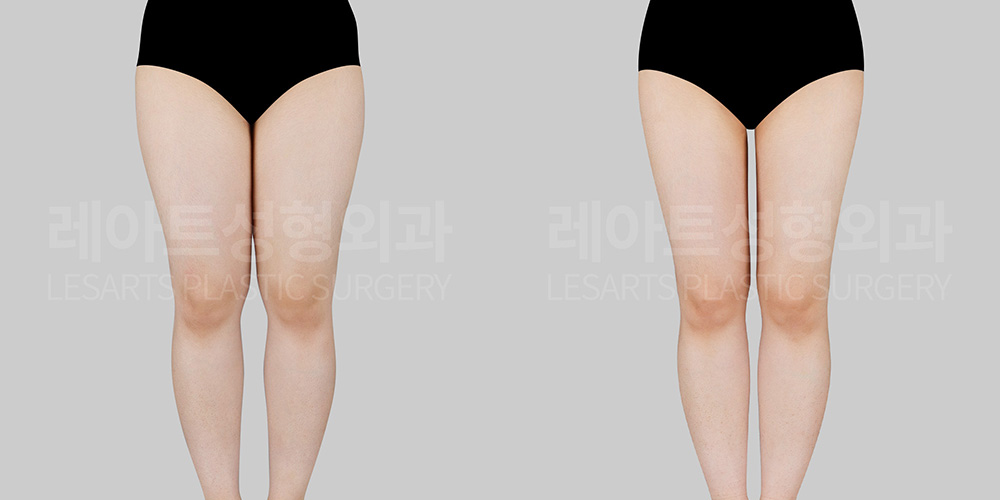

Before surgery, the inner thighs were in constant contact.
After thigh liposuction, a visible gap formed between the inner thighs,
reducing the heavy appearance and creating a smoother, straighter leg line.
The incision scars are also concealed beneath the underwear
and are not visibly exposed.
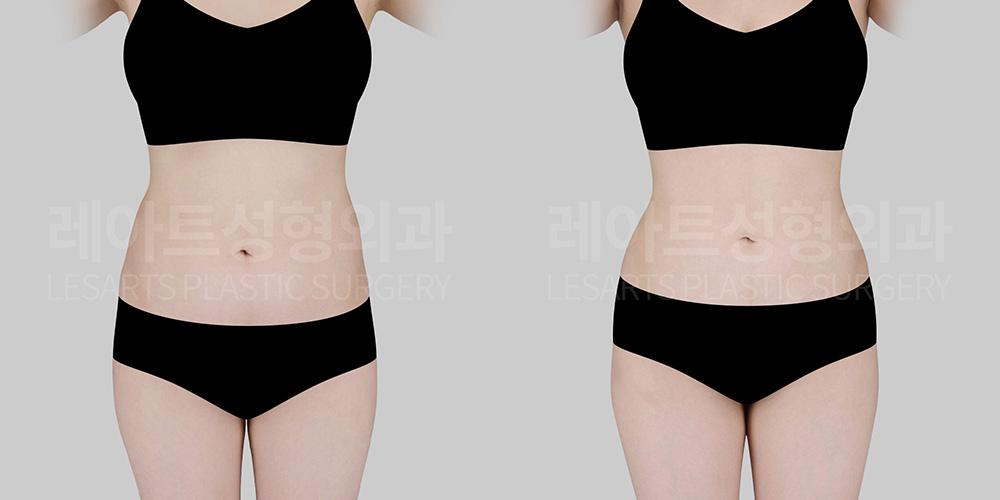
the contour from the knees to the pelvis
became noticeably smoother and more balanced.

he prominent fat at the front and back of the thighs
had previously made the legs look thicker
and even somewhat muscular.
After liposuction, these contours became smoother,
giving the thighs a noticeably slimmer appearance.
Although the pre-existing asymmetry of the outer thighs
could not be completely corrected as expected,
fortunately, no sagging developed along the inner thighs.
Because this patient naturally had a relatively high amount of muscle,
it was difficult to achieve extremely thin thighs
or a perfectly smooth front and back contour.
However, compared with before surgery,
the overall thigh line became significantly slimmer.
See More Thigh Liposuction Results for Muscular Thighs
▼▼▼
As in this case, many patients visit our clinic
because they are concerned about increased thigh volume
that developed along with weight gain.
However, the true value of liposuction is not only
the visible change in body contour,
but also the motivation that change can provide.
Using the improved appearance as a starting point
to identify the causes of weight gain
and continue consistent weight management
is the key to maintaining a beautiful contour over time.
If you have been concerned about the shape of your thighs for a long time,
you do not have to figure it out on your own.
Feel free to contact Lesarts Plastic Surgery
for a thorough evaluation and detailed consultation.
FAQ
Q1. Can thigh liposuction reduce the overall size of the thighs?
Yes. By selectively removing excess fat from areas such as the inner thighs, outer thighs, front thighs, and knees,
thigh liposuction can reduce overall volume and create a slimmer contour.
Q2. Can thigh liposuction create a straighter inner thigh line?
Yes. Carefully reducing fat from the inner thighs and around the knees can help create a smoother, straighter line.
The surgical plan should also consider muscle structure and skin condition.
Q3. Is removing as much thigh fat as possible always better?
No. Some fat may need to be preserved to maintain smooth transitions between the thighs, hips, and knees.
Excessive removal can create unnatural indentations or irregular contours.
Q4. Can thigh liposuction make muscular thighs extremely thin?
Not always. If muscle makes up a significant portion of thigh volume,
liposuction can reduce the surrounding fat but cannot reduce the muscle itself.
The final result depends on both fat and muscle distribution.
Q5. Why is weight management important after thigh liposuction?
Remaining fat cells can enlarge if weight is gained after surgery, and fat may also accumulate in other areas.
Maintaining healthy eating and lifestyle habits helps preserve the improved thigh contour over time.
▼ Visit Lesarts Plastic Surgery in Gangnam, Seoul, Korea ▼