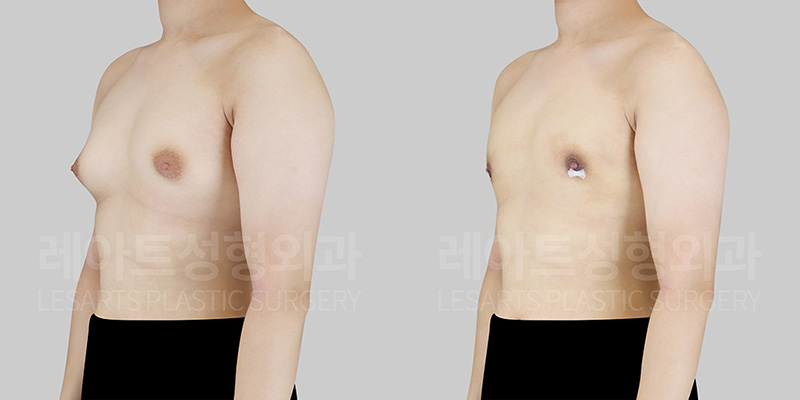
[Gynecomastia]3-month progress after surgery for Simon grade IIb gynecomastia
Hello, this is Dr. Kukhan Lee
from Lesarts Plastic Surgery.
As winter passes
and the weather
gradually becomes warmer,
consultations about
male chest concerns
naturally begin to increase.
During winter,
thicker clothing
makes chest volume
less noticeable
in daily life
for most patients.
However,
as lighter clothing
becomes more common,
the chest contour
appears more prominent
and noticeable visually.
Especially when wearing
t-shirts or thin shirts,
protrusion becomes visible.
The areolar area
may also appear
slightly raised or bulging.
This often causes
discomfort and stress
in everyday situations.
When patients visit,
we first perform
a physical examination.
An ultrasound assessment
is also conducted
to evaluate internal structure.
This helps determine
the degree of
glandular development
and distribution
of fat tissue
within the chest.
Based on findings,
the severity
of enlargement
and degree of
skin laxity
are carefully evaluated.
The Simon classification
is then applied
to assess gynecomastia grade.
Finally,
an appropriate
surgical plan
is designed
according to
each patient’s condition.
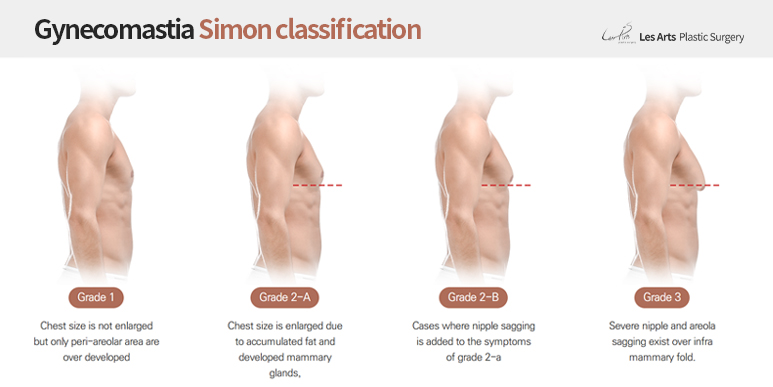
Simon classification for gynecomastia – Lesarts Plastic Surgery
Most patients
typically fall into
Simon grade IIa category.
Therefore,
before-and-after cases
are relatively easy to find.
In contrast,
grades IIb or III
involve skin laxity.
These cases
are less common,
with fewer references available.
As a result,
many patients
are curious about
actual postoperative
progress and outcomes
in these advanced stages.
In this case,
we will review
a patient with
gynecomastia
accompanied by
noticeable skin laxity.
We will examine
the 3-month progress
after surgical treatment.
The patient
was a male
in his twenties.
He had experienced
significant weight
fluctuations in the past.
At the time of visit,
his height was
approximately 170 cm.
His weight
was around
80 kilograms.
Previously,
his weight
had reached
up to
110 kilograms
before reduction.
Through exercise
and dietary control,
he successfully lost weight.
Although overall
body shape improved,
chest enlargement remained.
Persistent chest protrusion
led him
to seek consultation.


Physical examination of Simon grade IIb gynecomastia – Dr. Kukhan Lee, Lesarts Plastic Surgery
On examination,
moderate to severe
breast enlargement was observed.
Reduced skin elasticity
was also noted
during the assessment.
Bilateral breast ptosis
was present,
indicating tissue descent.
The left breast
showed more pronounced
ptotic changes overall.
Skin elasticity
was generally decreased
across the chest area.
The diagnosis
was true gynecomastia,
classified as Simon grade IIb.
However,
the Simon classification
includes subjective interpretation.
In some cases,
this condition
may approach grade III severity.
Both breast size
and degree of
sagging were significant.
To correct this,
subcutaneous mastectomy
was primarily considered.
In principle,
a chest lift procedure
can be combined
to address
excess skin
and ptosis simultaneously.
However,
the patient’s young age
was carefully considered.
It was explained
that skin excision
may leave longer scars.
Taking this into account,
subcutaneous mastectomy
was performed first.
If skin laxity
remains problematic,
secondary correction
can be considered
as a staged
surgical approach.


Taping method to reduce sagging after gynecomastia surgery – Lesarts Plastic Surgery
After surgery,
taping was applied
to both sides
to reduce
skin laxity
and support adaptation.
This helps
the skin adjust
more effectively
to the new
postoperative contour
over time.
Since the left side
had more severe ptosis,
special attention was given.
It was explained
that residual skin folds
may remain on the left.
This possibility
was discussed thoroughly
before proceeding with surgery.

Changes in chest size after gynecomastia surgery – Dr. Kukhan Lee, Lesarts Plastic Surgery

Before-and-after photos of gynecomastia surgery – Dr. Kukhan Lee, Lesarts Plastic Surgery
This is the
3-month postoperative
follow-up period.
Although
it is still early
to determine final results,
the overall
chest contour
has improved significantly
compared to
the preoperative
condition.
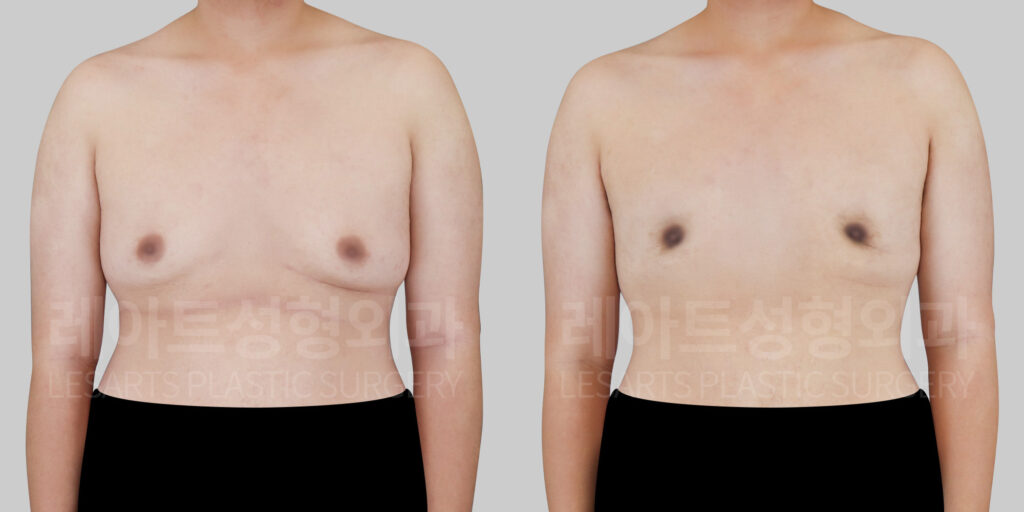
3-month progress after Simon grade IIb gynecomastia surgery – Dr. Kukhan Lee, Lesarts Plastic Surgery
Despite limited
skin elasticity
before surgery,
postoperative taping
helped the skin
gradually adapt.
As a result,
the nipple
and areola position
shifted slightly upward,
creating a lifting
effect overall.
This contributed
to a more
masculine chest contour.
The previously enlarged
areola size
also showed
a partial
but noticeable
reduction.
In particular,
the lower chest
volume was
effectively corrected,
resulting in
improved proportions.

Difference in T-shirt fit before and after gynecomastia surgery – Dr. Kukhan Lee, Lesarts Plastic Surgery

Change in chest protrusion before and after gynecomastia surgery – Dr. Kukhan Lee, Lesarts Plastic Surgery
The patient
also perceived
significant improvement
in daily comfort
and overall
body image.
Previously,
the contact point
under clothing
was centered
around the areola
region.
Now,
this contact point
has shifted upward
toward the upper chest,
reducing discomfort
when wearing thin clothing.
However,
due to greater
left-side hypertrophy
and ptosis,
some residual
skin folds remained.
Compared
to the right side,
a difference
may still be noticeable
in certain conditions.
These folds
often improve gradually
over time.
With consistent
chest muscle training,
further improvement
in contour
and balance
can be expected.
When planning surgery
for Simon grade IIb
or grade III cases,
the main concern
is residual
skin laxity.
However,
with proper technique
and postoperative care,
meaningful improvement
can sometimes be achieved
without skin excision.
As the weather
becomes warmer,
chest concerns
tend to become
more noticeable
in daily life.
If gynecomastia
causes discomfort,
seeking consultation
is recommended
for accurate diagnosis
and personalized treatment.