[Abdominoplasty]3 Months After L-Type Extended Abdominoplasty
Hello, I am Dr. Kukhan Lee,
a board-certified plastic surgeon.
Pregnancy and childbirth bring
many changes to a woman’s body.
As weight increases and later decreases,
the skin and muscles
often do not return completely
to their original state.
Even among women who successfully lose weight
through consistent exercise
and dietary management after childbirth,
many continue to struggle with
abdominal sagging
or a protruding abdominal contour.
These changes are often not caused
simply by excess body fat.
In many cases,
they result from
stretched abdominal skin
and rectus diastasis
that developed during pregnancy.
In this case,
we introduce a patient
who underwent an
L-Type Extended Abdominoplasty
to address abdominal skin laxity
and rectus diastasis
that developed following
significant weight gain during pregnancy.
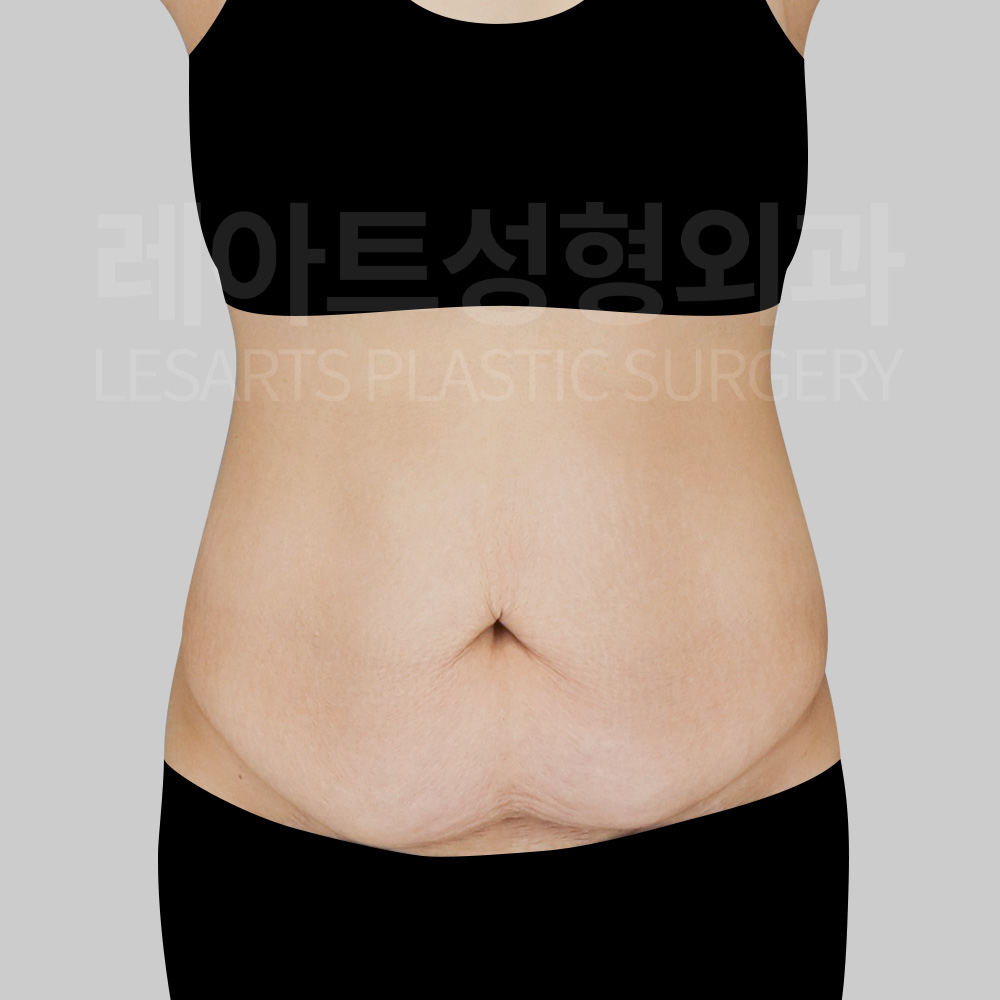
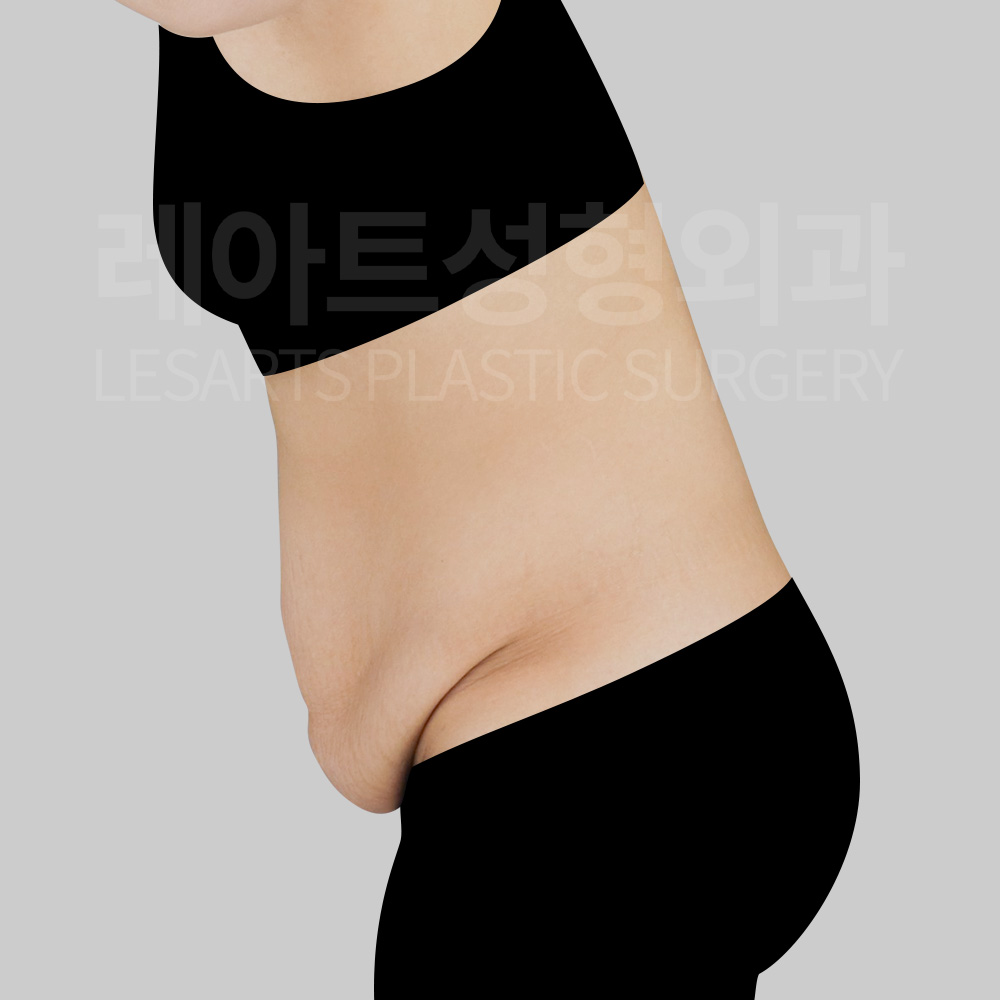
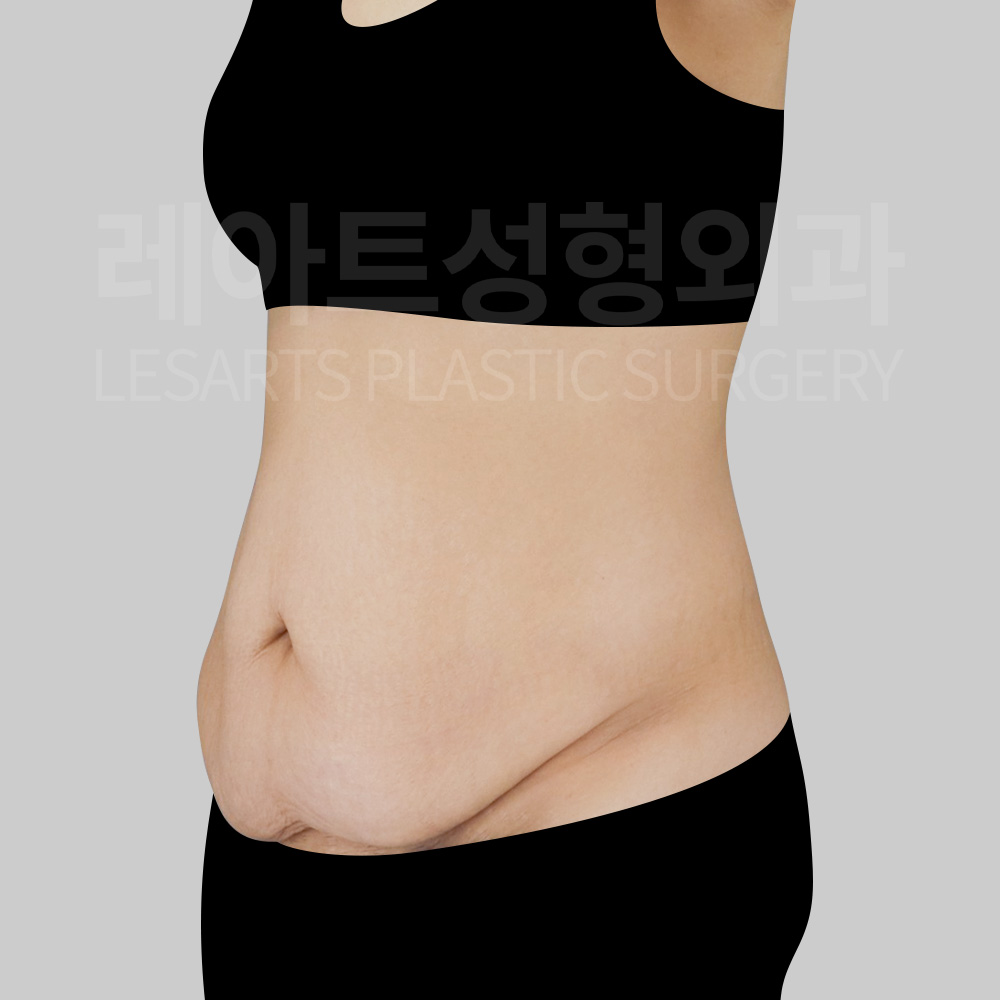

Abdominal Condition After Three Vaginal Deliveries
The patient was a woman
in her 30s,
measuring 164 cm in height
and weighing 64 kg
at the time of consultation.
She had given birth
to three children.
During her pregnancies,
her weight had increased
to a maximum of 99 kg.
Following childbirth,
she successfully reduced her weight
to her current level
through consistent exercise
and dietary management,
and was planning
additional weight loss.
The primary reason
for seeking consultation
was the excess skin laxity
throughout the abdomen,
the resulting skin folds,
and the fullness
along the bikini line.
In addition,
despite a reduction
in overall body fat,
she remained concerned about
the persistent abdominal protrusion
and the imbalance
of her overall body contour.
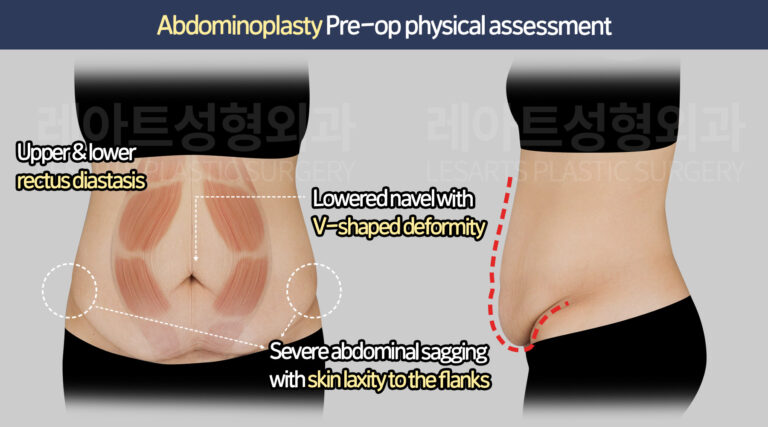
Preoperative Physical Examination Before Abdominoplasty
On physical examination,
significant skin laxity
was observed in both
the upper and lower abdomen.
Due to the excess skin
of the upper abdomen,
the position of the navel
had shifted downward.
As the surrounding skin stretched,
the umbilicus had developed
a distorted appearance,
forming a characteristic
“S-shaped” contour.
In the lower abdomen,
excess skin protruded
above the bikini line.
This skin laxity extended
across both pelvic regions
and continued toward
the flanks.
In addition,
rectus diastasis
caused the entire abdomen
to appear rounded
and protruded forward.
The separation was sufficiently severe
to be palpated
throughout both
the upper and lower abdomen.
The surgical plan focused not only on
correcting abdominal laxity,
but also on creating
a more natural body contour.
To minimize contour irregularities
that can occur after
abdominoplasty
and to improve
the overall silhouette,
abdominal liposuction
was planned simultaneously.
Considering the extent
of the skin laxity,
an L-Type Extended Abdominoplasty
was determined to be
the most appropriate approach.
Because the umbilicus
would be repositioned
during the procedure,
correction of the previously
distorted navel shape
was also included
in the surgical plan.
In addition,
the laxity of the
rectus fascia
and the rectus diastasis
that developed during pregnancy
and weight gain
were considered
important issues requiring correction.
In particular,
the patient had previously undergone
treatment for keloid scars,
and was concerned that
a long surgical scar
might also develop
into a keloid.
However,
there were clear limitations
to improving her condition
through non-surgical methods alone.
After thoroughly explaining that
consistent scar management
and appropriate treatment
could help reduce the risk
of keloid formation,
and that active treatment options
would remain available
even if scar-related changes occurred,
the surgery was performed.
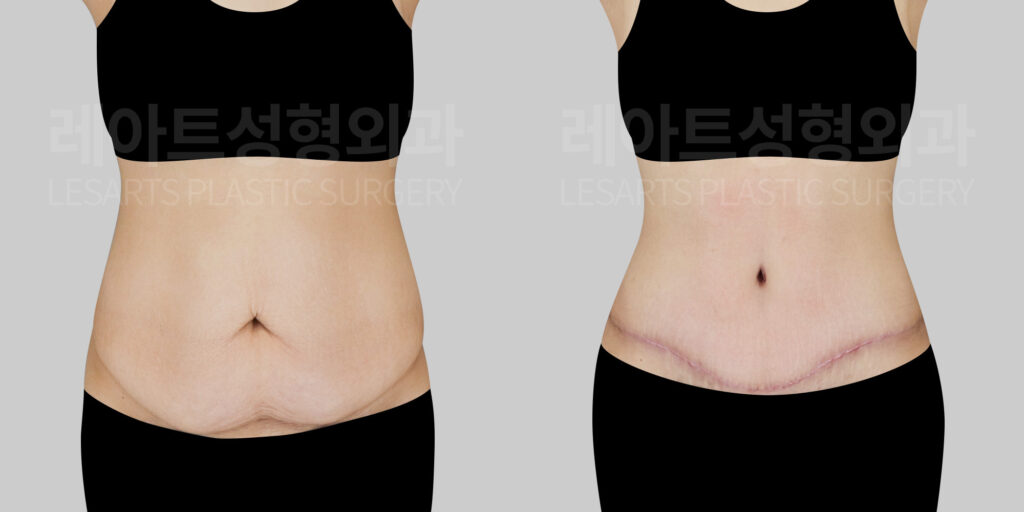
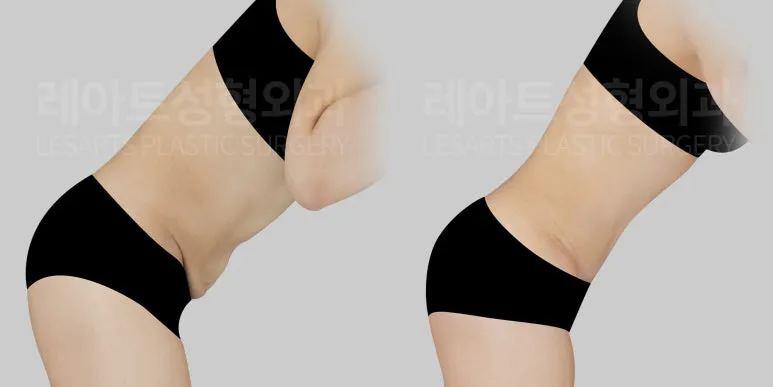
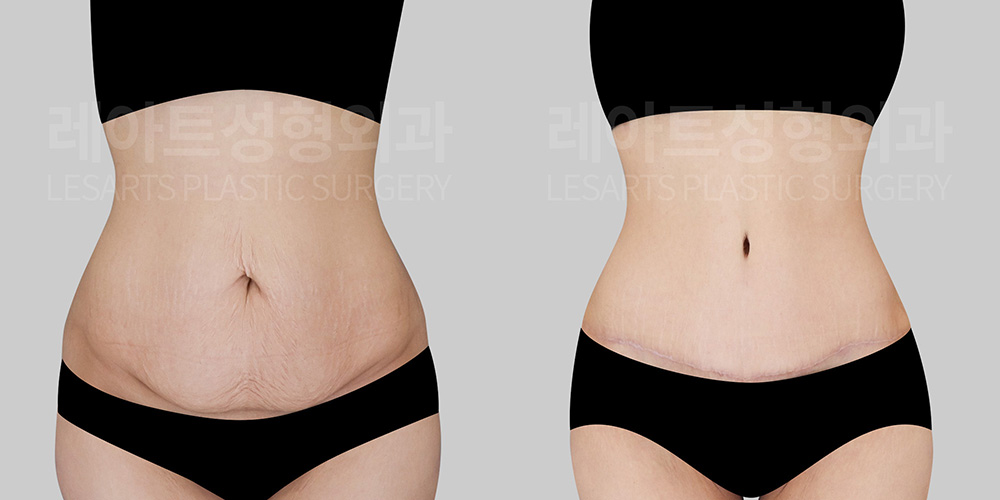
Before-and-After Comparison of Extended Abdominoplasty – Dr. Gukhan Lee | Lesarts Plastic Surgery
3 Months After
Extended Abdominoplasty
The abdominal skin laxity
that was present before surgery
has been corrected overall.
Both the upper and lower abdomen
now demonstrate
a firmer contour
compared to before surgery.
In addition,
the position of the umbilicus,
which had been pulled downward,
has been naturally restored,
resulting in
improved overall proportions.
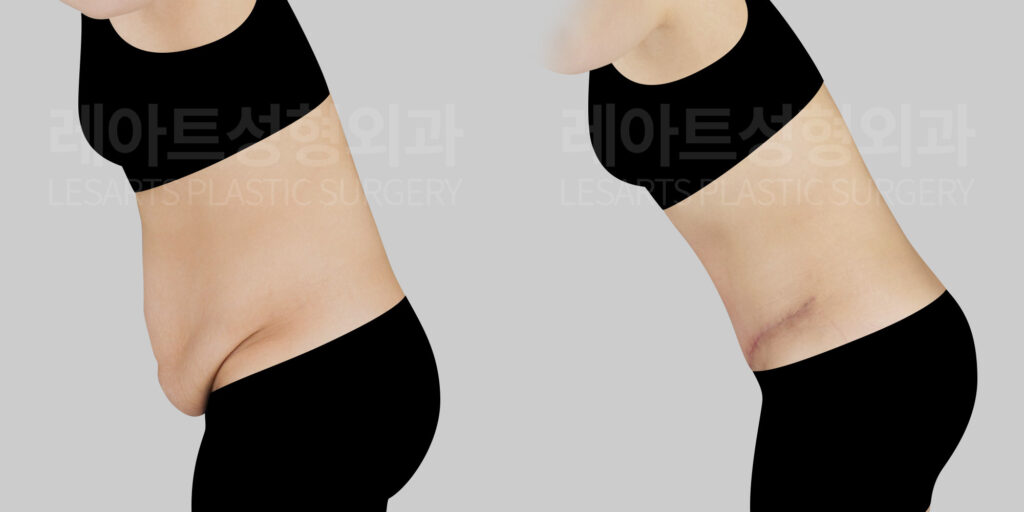
Lesarts Abdominoplasty Abdominal Lifting and Rectus Diastasis Repair – Dr. Gukhan Lee | Lesarts Plastic Surgery
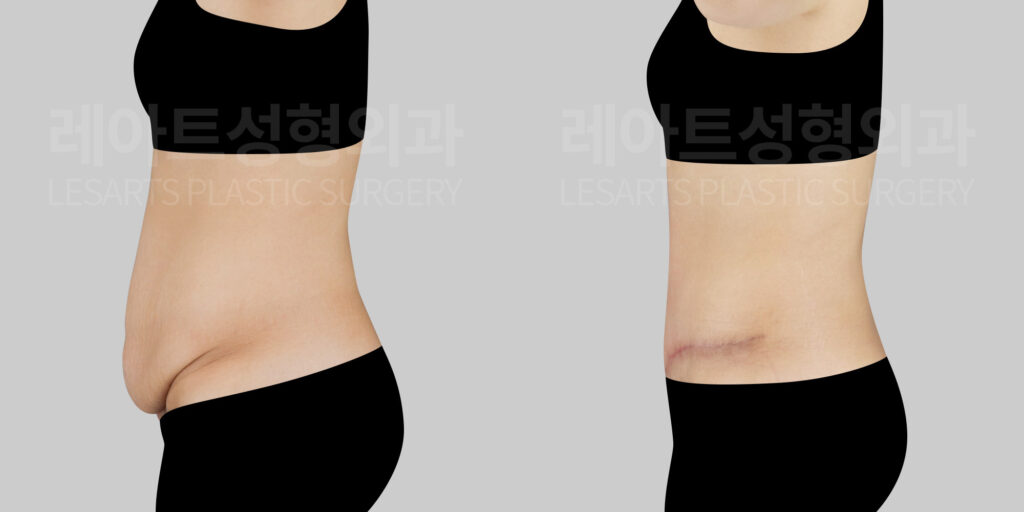
Before and After Postpartum Abdominoplasty (3 Months Post-Op) – Dr. Kukhan Lee, Lesarts Plastic Surgery
As the rectus diastasis
was corrected,
the abdomen,
which previously appeared
rounded and protruded forward,
developed a flatter
and firmer contour.
Although the scar length
became somewhat longer,
the excess skin laxity
that extended toward
both flanks
was effectively corrected,
resulting in
a more refined
abdominal silhouette.
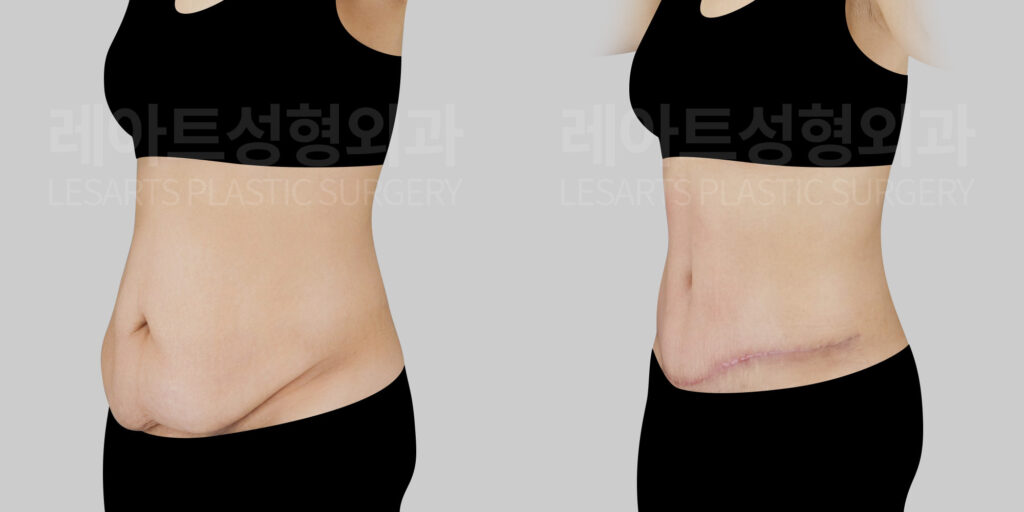
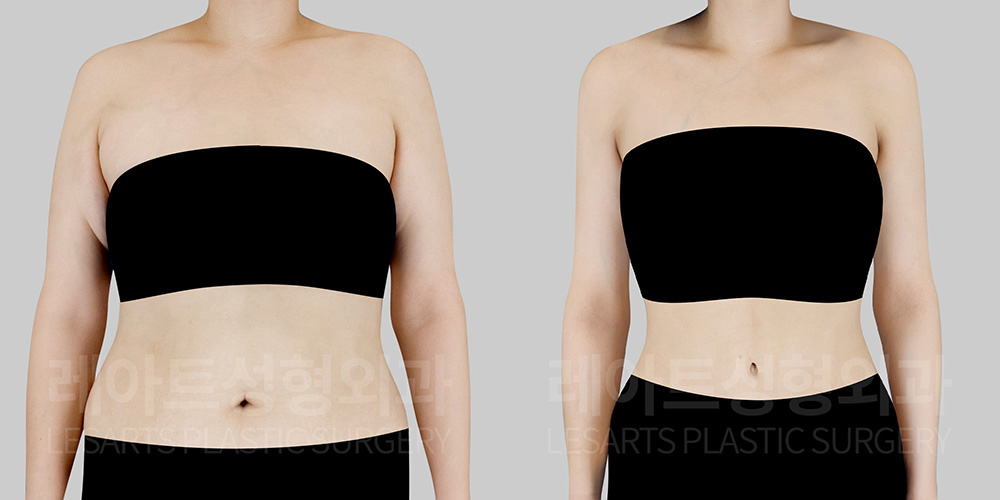
Improvement of Sagging Abdominal Skin with Abdominoplasty – Dr. Gukhan Lee | Lesarts Plastic Surgery
In addition,
through the liposuction
performed together with
the abdominoplasty,
the waistline
and flank contours
became more naturally defined.
As a result,
the overall body contour
also showed
a satisfying improvement.
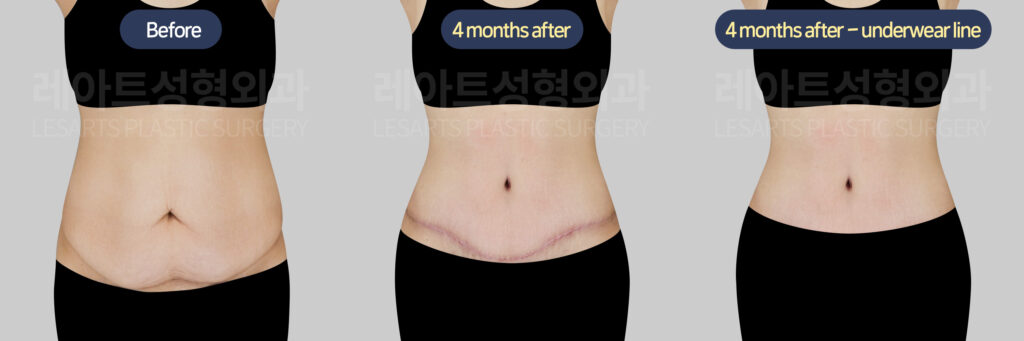
Scar Length and Position After Extended Abdominoplasty – Dr. Gukhan Lee | Lesarts Plastic Surgery
However,
as the patient is only
slightly more than
three months postoperatively,
some aspects of recovery
are still ongoing.
The scar maturation process
appears to be progressing
at a relatively slow pace,
with residual redness
and some areas of
hyperpigmentation
still present around the scar.
Although there are
some localized areas
where the scar appears thicker,
the excessive elevation
characteristic of a keloid scar
has not been observed.
With continued scar management
and regular treatment,
further improvement
can reasonably be expected.
In addition,
some tissue stiffness remains
due to residual BioBond.
If combined with
radiofrequency treatments,
massage,
and consistent exercise,
the abdominal contour
is expected to become
even softer
and more natural
over time.
Abdominoplasty
is one of the most effective
surgical options
for correcting
excess abdominal skin
and rectus diastasis
that develop following
pregnancy
or significant weight changes.
While the presence of a scar
must certainly be considered,
for patients experiencing
substantial discomfort
or concerns related
to abdominal laxity,
the level of satisfaction
can often outweigh
that drawback.
In this case as well,
the procedure successfully improved
the abdominal laxity
and rectus diastasis
that could not be corrected
through exercise
and dietary management alone.
As a result,
the patient was able
to regain
a firmer abdomen
and a more balanced
body contour.
If you are experiencing discomfort
due to abdominal laxity,
or are considering
abdominoplasty,
we encourage you
to undergo a thorough consultation
and evaluation
to determine the treatment option
most appropriate
for your condition.