[Abdominoplasty]Skin Laxity Following Pregnancy, Childbirth, and Abdominal Surgery: Four Months After M-Type Full Abdominoplasty
Hello, I am Dr. Kukhan Lee,
from Lesarts Plastic Surgery.
The appearance of the abdomen
does not change solely
through weight gain
or weight loss.
Pregnancy, childbirth,
rapid weight fluctuations,
and a history of previous surgeries
or procedures
can all work together
to alter the structure
of the abdominal skin,
fat layers,
and underlying muscles.
When multiple factors
are involved,
dietary control and exercise alone
often have limitations,
and medical intervention
may be necessary.
In this case,
we will introduce a patient
whose abdominal deformity
developed through
the combined effects
of pregnancy, childbirth,
and prior abdominal surgery,
and was improved through
M-Type Full Abdominoplasty
combined with Liposuction.
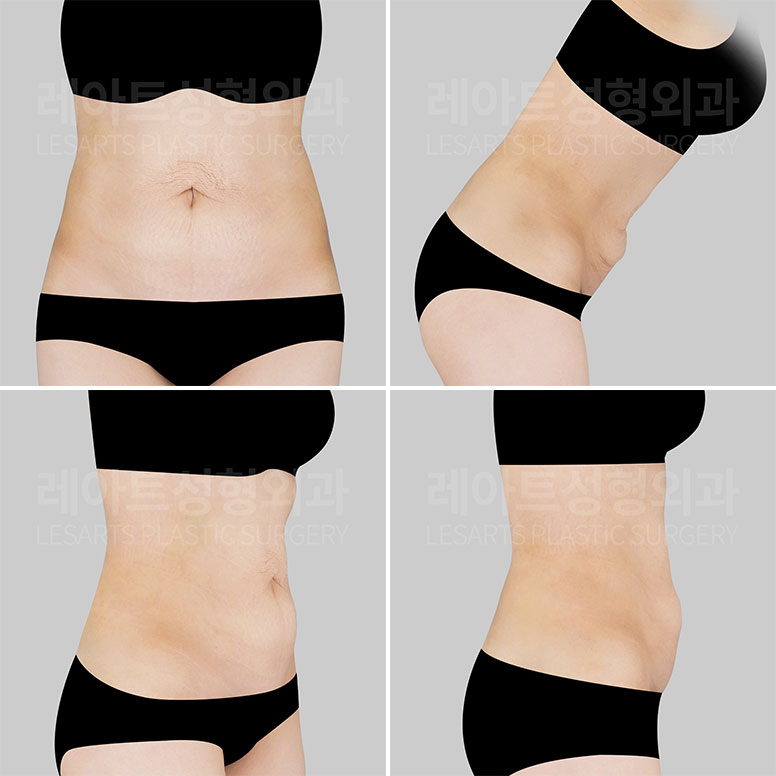
Preoperative Physical Examination for M-Type Full Abdominoplasty – Lesarts Plastic Surgery
The patient in this case
was a woman in her 40s,
measuring 164 cm in height
and weighing 64 kg,
who visited our clinic
seeking improvement
in her overall abdominal contour.
She had experienced
two pregnancies,
including one vaginal delivery
and one cesarean section.
During pregnancy,
her weight increased
to approximately 80 kg,
and she had previously delivered
a relatively large infant
with a birth weight of 4.6 kg.
Following childbirth,
she had maintained
her current weight
relatively well.
She also had a history
of prior abdominal surgery
performed through
an umbilical incision,
and reported that
the appearance of her navel
had changed following
the procedure.
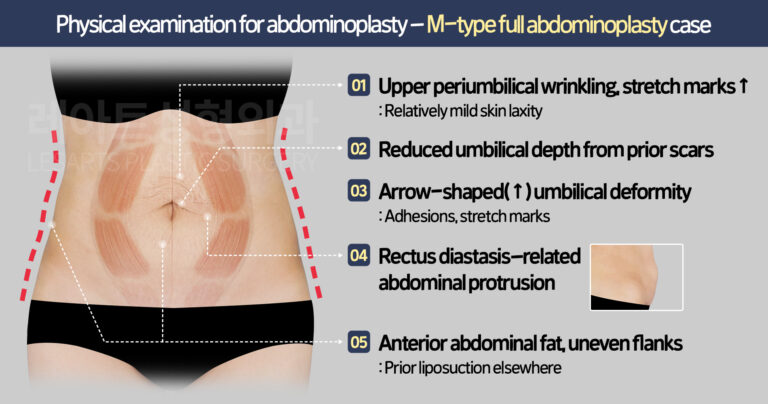
Preoperative Assessment for Abdominoplasty – Lesarts Plastic Surgery
Physical examination revealed
fine wrinkles and multiple Stretch Marks
across the upper abdomen,
above the umbilicus.
In contrast,
the degree of actual skin laxity
was relatively mild.
Rather,
this patient presented with
widespread stretch marks
distributed throughout
the skin that had lost elasticity,
resulting in the formation
of superficial wrinkles.
Regarding the umbilicus,
a previous surgical scar
made the navel appear
relatively shallow,
while scar tissue
and stretch marks together
created an arrow-shaped deformity.
When the abdomen undergoes
significant expansion during pregnancy,
changes in the skin
are often accompanied by
Rectus Diastasis.
In particular,
extensive stretch marks
located above the umbilicus
may strongly suggest
the presence of
Rectus Diastasis.
In this patient,
palpation confirmed
separation of the rectus muscles
around the umbilical area,
which contributed to
a rounded abdomen
with a noticeable forward projection.
Subcutaneous fat
was primarily distributed
throughout the anterior abdomen,
and partial Liposuction
was considered beneficial.
In addition,
a previous limited liposuction procedure
performed elsewhere
had resulted in
some irregularity
along the lateral abdominal contour,
which was also planned
for correction.
Based on clinical evaluation
and consultation,
an M-Type Full Abdominoplasty
was considered necessary
to improve the wrinkles
and skin deformity
above the umbilicus,
which represented
the patient’s greatest concern.
An S-Type Mini Abdominoplasty
would not have allowed
sufficient advancement
of the upper abdominal skin,
making it difficult to achieve
the desired improvement.
However,
the most challenging aspect
of surgical planning
was the limited amount
of excess upper abdominal skin.
Although the wrinkles
and stretch marks
made the skin appear
significantly redundant,
much of the deformity
was actually attributable to
loss of elasticity
and scar-related changes,
rather than true skin excess.
Consequently,
there was a practical limitation
to the amount of tissue
that could be advanced surgically.
The existing cesarean section scar
was relatively well healed,
and if feasible,
the plan was to remove
the previous scar
during the abdominoplasty.
However,
depending on the available skin laxity,
complete excision
of the old scar
might not be possible.
In such circumstances,
a new abdominoplasty scar
could form above
the existing scar,
and the final scar position
might ultimately be higher
than expected.
These possibilities
were thoroughly discussed
with the patient.
After sufficient consultation,
an M-Type Full Abdominoplasty
combined with Abdominal Liposuction
was performed.
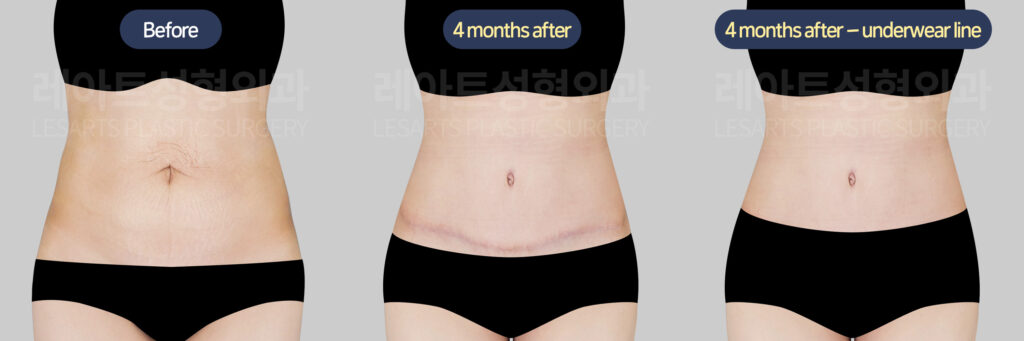
Four Months After Abdominoplasty
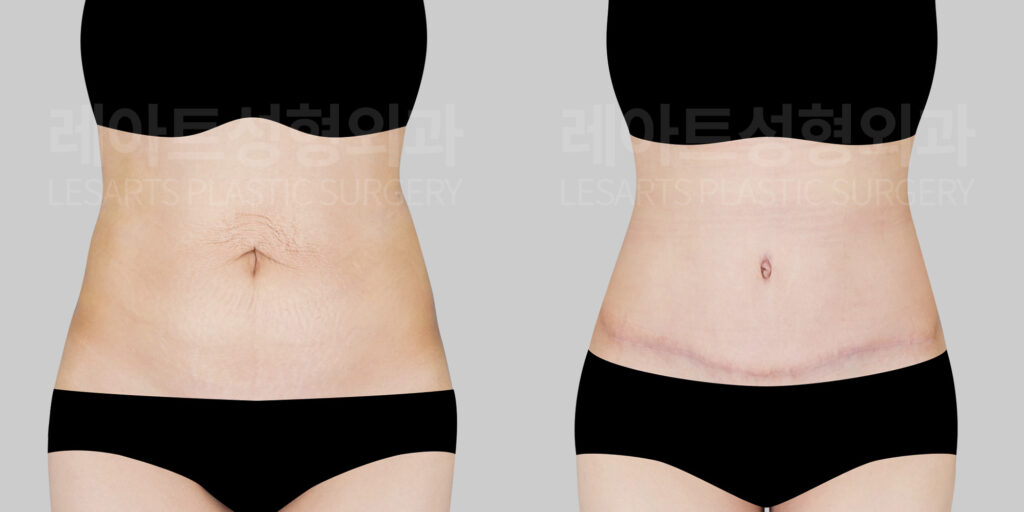
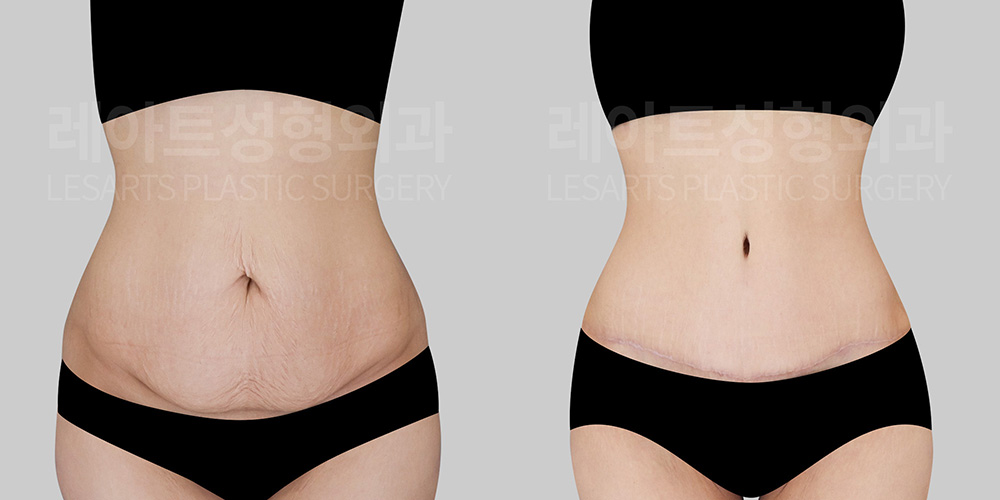
Removal of Stretch Marks and Upper Umbilical Wrinkles Through Abdominoplasty – Dr. Kukhan Lee | Lesarts Plastic Surgery
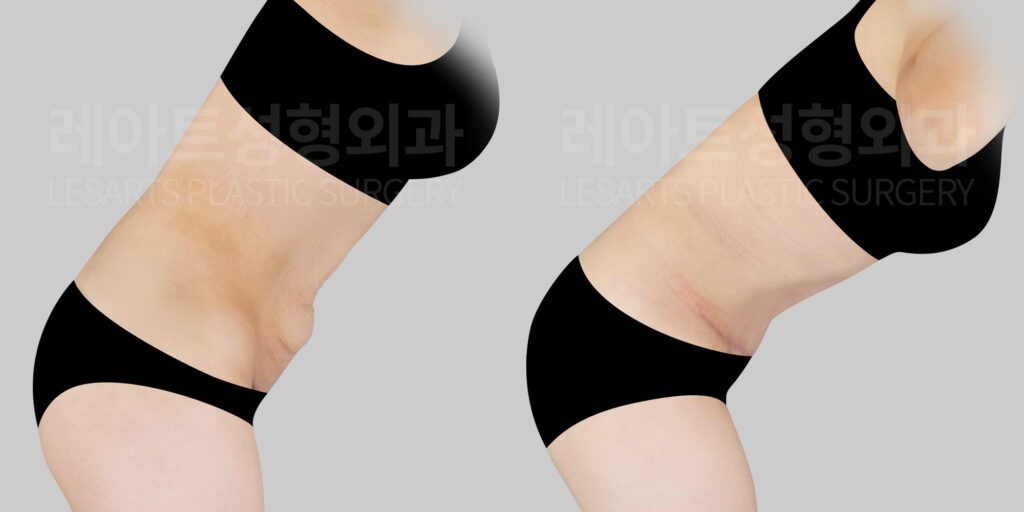
Comparison of Skin Laxity Before and After Full Abdominoplasty – Lesarts Plastic Surgery
The most noticeable change
following Abdominoplasty
was the improvement
in the wrinkles
and distorted tissues
located above the umbilicus.
During surgery,
adhesions surrounding
the umbilical area
were found to be
much more severe
than initially expected.
However,
after meticulous release
and revision of the scar tissue,
the abdominal skin
was advanced downward
and securely repositioned,
resulting in a smoother
and more refined
abdominal contour.
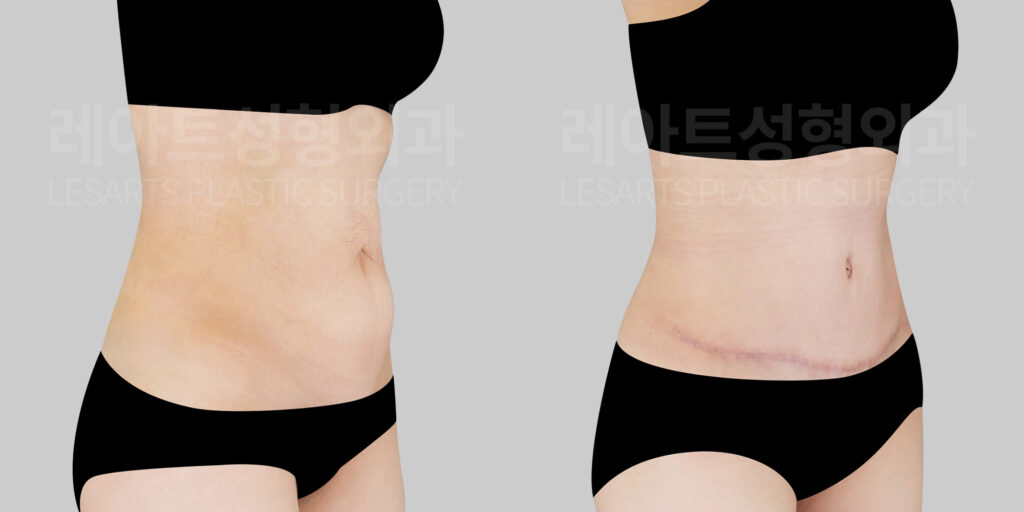
Incision Placement and Scar Location Following Full Abdominoplasty – Dr. Kukhan Lee | Lesarts Plastic Surgery
The scar position,
which had been one of
the primary concerns
before surgery,
also demonstrated
a favorable outcome.
The previous Cesarean Section Scar
was successfully removed,
and the Abdominoplasty Scar
was positioned
relatively low
and remained stable.
At four months
after surgery,
the scar is progressing through
an appropriate maturation process.
With continued scar management
and additional treatments,
it is expected to become
less noticeable
over time.
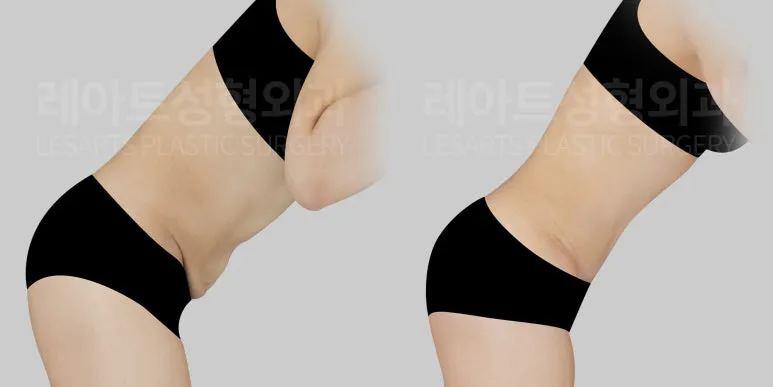
Improvement of Abdominal Wall Protrusion Through Abdominoplasty – Dr. Kukhan Lee | Lesarts Plastic Surgery
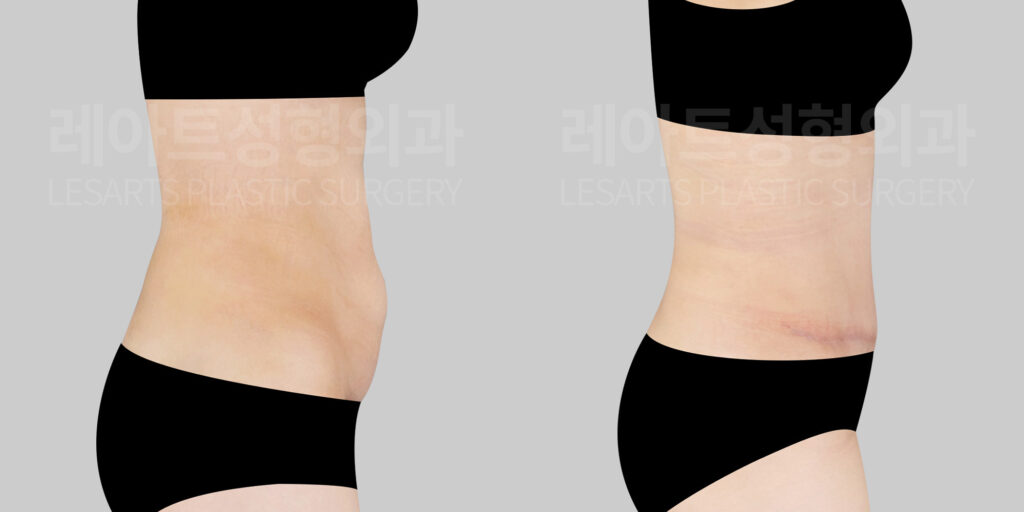
Before-and-After Changes Following Abdominoplasty – Dr. Kukhan Lee | Lesarts Plastic Surgery
The areas treated with
Liposuction have also shown
favorable improvements.
The anterior abdomen
and lateral contours
appear smoother
and more naturally refined.
Since Bio-Bond Formation
has not yet completely resolved,
further improvement
can still be anticipated
through continued postoperative care
and regular exercise.
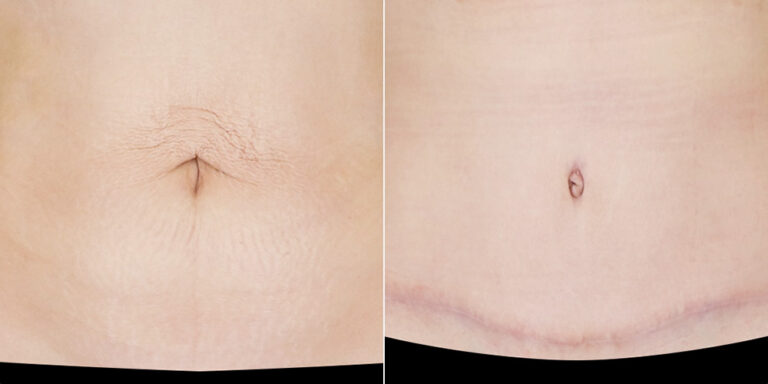
Correction of Upper Umbilical Wrinkles After Childbirth – Dr. Kukhan Lee | Lesarts Plastic Surgery
For the umbilicus,
existing scar tissue
was removed as much as possible,
and the navel was reconstructed
into a new shape,
resulting in a more natural appearance
than before surgery.
However,
because of scarring
from the previous procedure,
the umbilicus still appears
somewhat shallow,
with limited depth remaining.
This issue may improve further
through additional scar management
and injection therapy,
and it had already been discussed
as an anticipated limitation
during the preoperative consultation.
Changes in the abdomen
can arise from a single cause,
but in many patients,
including this case,
multiple factors contribute
simultaneously.
Pregnancy,
childbirth,
Rectus Diastasis,
and previous surgical scars
often work together
to create abdominal deformities.
Therefore,
it is important not only
to evaluate skin laxity,
but also to comprehensively assess
fat distribution,
muscle integrity,
scar tissue,
and skin elasticity
before establishing
an appropriate surgical plan.
Even when patients share
similar abdominal concerns,
the optimal treatment approach
may differ,
depending on the underlying causes
and pattern of deformity.
If the appearance
of your abdomen
has not improved
despite exercise
or weight management,
an accurate evaluation
can help determine
the specific causes involved
and guide you toward
the most suitable treatment option.
During an Abdominoplasty Consultation,
we can discuss your current condition
and expected improvements
in greater detail.