[Abdominoplasty] 6-Month Recovery After L-Type Extended Abdominoplasty
Hello, this is Dr. Kukhan Lee
from Lesarts Plastic Surgery.
Before the warmth of spring
has even fully settled in,
summer already begins
approaching much sooner than expected.
As the season changes
and clothing becomes lighter,
people naturally become
more conscious of
their body silhouette.
Especially after childbirth,
changes in body shape often remain
a lasting concern,
because even with consistent exercise
and careful diet management,
the results may not improve
as much as expected.
For those feeling frustrated
by an abdominal contour
that does not easily change,
despite continuous effort,
or exhausted by repeated weight fluctuations
through childcare and daily life,
today’s abdominoplasty case
may be helpful.
This patient was a woman
in her 40s
who had delivered two children
through natural childbirth.
At the time of consultation,
her height was 165 cm,
and her weight was approximately 65 kg.
During pregnancy,
her weight had increased
to nearly 80 kg.
After childbirth,
she consistently maintained
a weight around 55 kg
through regular exercise
and ongoing self-management.
However, despite her efforts,
the abdominal sagging
and protruding contour
did not improve easily
and had become
a major source of stress.
As her weight recently increased again,
her concerns regarding
the abdomen became even greater,
which ultimately led her
to visit our clinic
for abdominoplasty surgery.
She had no significant history
of previous surgeries,
and during the physical examination,
an increase in
the subcutaneous fat layer
was observed throughout the abdomen.
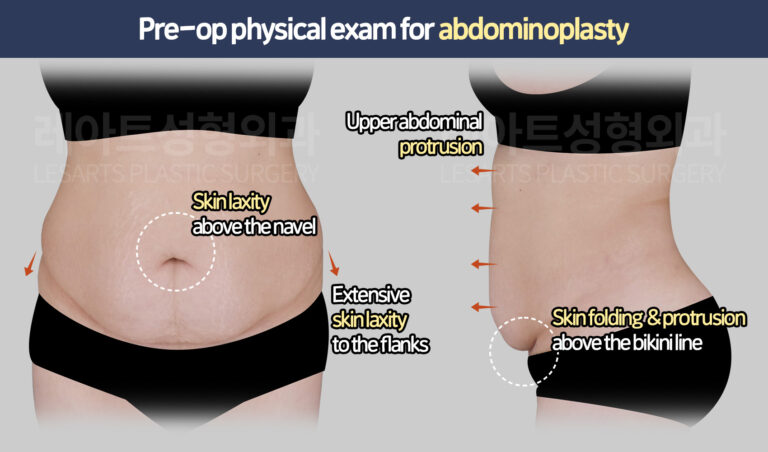
Pre-operative physical examination before abdominoplasty surgery
The patient’s abdominal contour
showed a rounded protrusion
extending from the upper abdomen.
Pronounced skin laxity
above the belly button
was also clearly observed.
The belly button itself
appeared horizontally stretched,
while the lower abdomen
showed protruding fullness
with excess skin folding
above the bikini line.
In addition,
overall skin laxity extending
toward the flank area was observed,
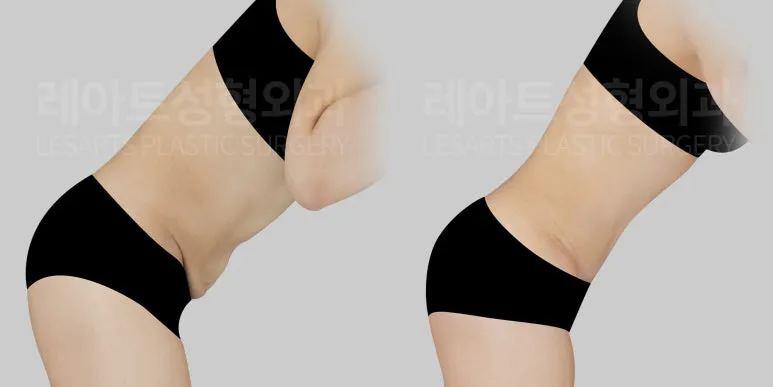
and when bending forward,
the sagging of the lower abdomen
became even more noticeable.
Because the subcutaneous fat layer
was relatively thick,
it was difficult to clearly confirm
the presence of rectus diastasis
through palpation alone.
However, in patients
who have experienced multiple childbirths,
relaxation or separation
of the rectus fascia
is commonly accompanied,
and if identified during surgery,
it is corrected simultaneously.
The surgical plan first involved
performing abdominal liposuction
to reduce the accumulated
subcutaneous fat throughout the abdomen
and create a smoother body contour.
Afterward,
an L-type extended abdominoplasty
was planned
to correct the skin laxity
extending toward the flanks.
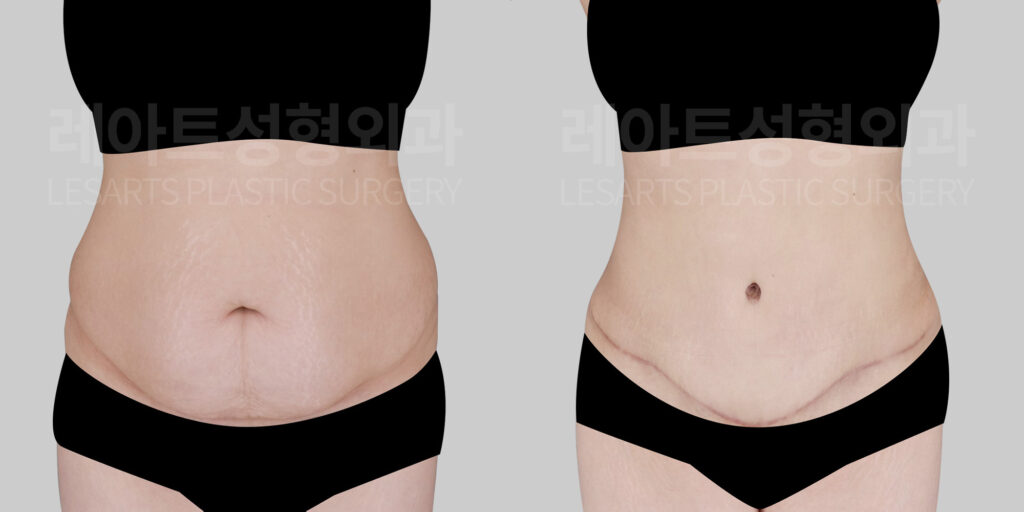
Before & After Extended Abdominoplasty — Dr. Kukhan Lee at Lesarts Plastic Surgery
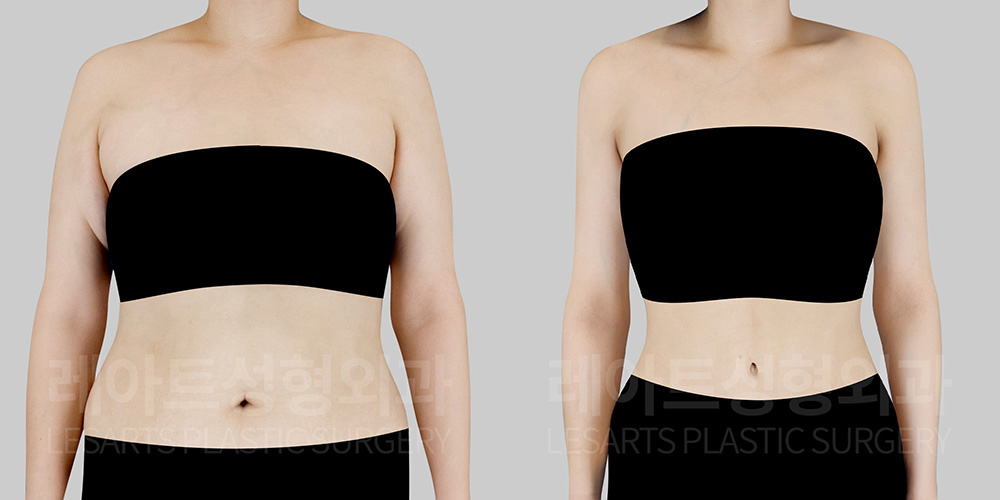
This is the patient’s condition
at 6 months after abdominoplasty surgery.
The abdomen and side contours
appear noticeably more refined
through the effects of
abdominal liposuction.
In particular,
the line extending
from the flanks to the pelvis
was restored more naturally,
creating a more balanced
and feminine silhouette.
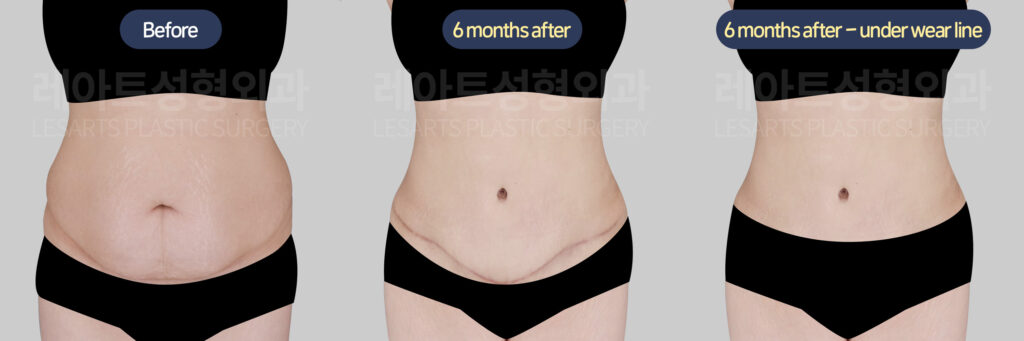
Scar length and location after extended abdominoplasty — Dr. Kukhan Lee at Lesarts Plastic Surgery
Although the abdominoplasty scar
is still relatively noticeable
at this stage,
the recovery process
has remained stable,
without signs of scar widening
or raised scar formation.
In cases of abdominoplasty,
the scar is generally expected
to gradually fade over time.
At this stage
(approximately 6 months after surgery),
consistent scar care
and regular moisturizing management
are especially important.
For this reason,
we explained that combining
daily self-care
with periodic in-clinic
laser treatments
may help improve
the overall appearance of the scar.
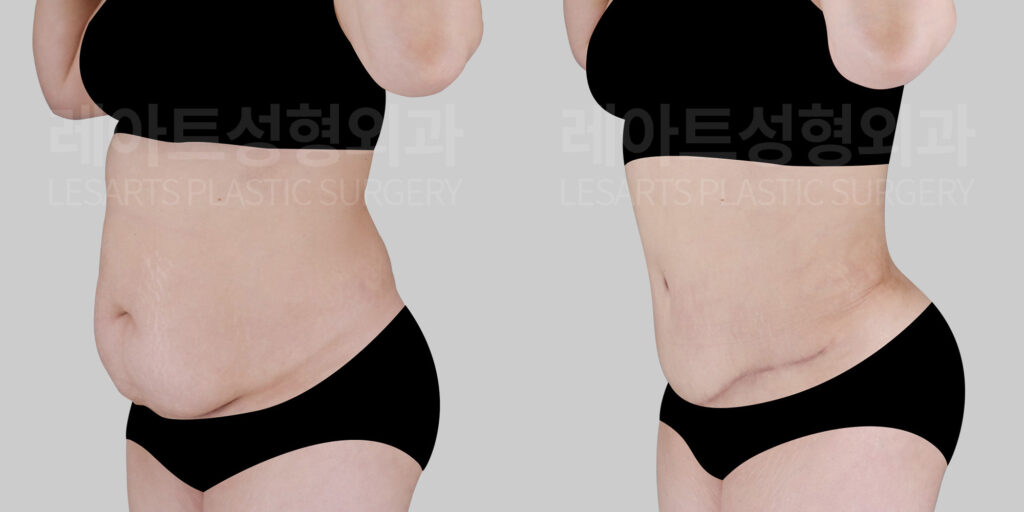
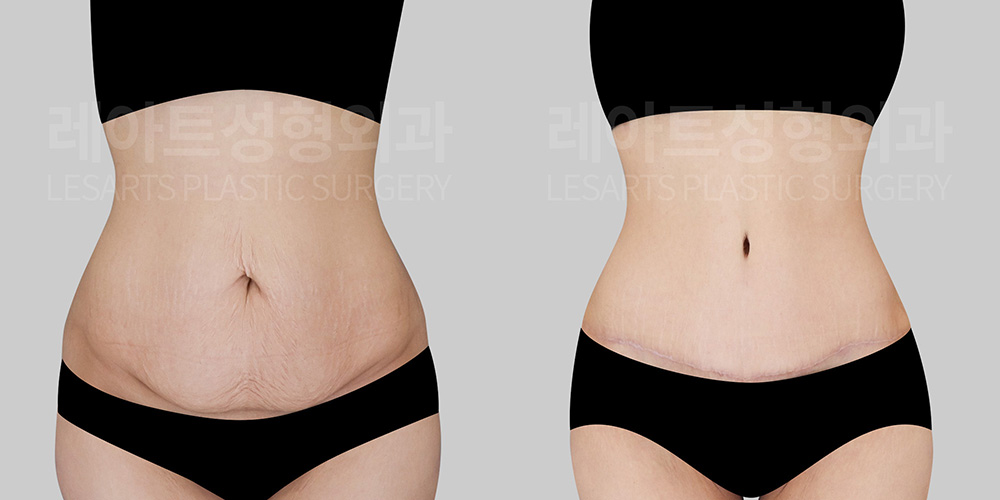
Before & After Full Abdominal Liposuction and Abdominoplasty — Dr. Kukhan Lee at Lesarts
The skin laxity
in the upper abdomen
was effectively corrected,
and the loose skin
that had sagged above
the belly button
was also naturally refined.
The shape of the belly button
is gradually becoming
more stable as well,
and as the hyperpigmentation improves,
an even more natural-looking result
can be expected over time.
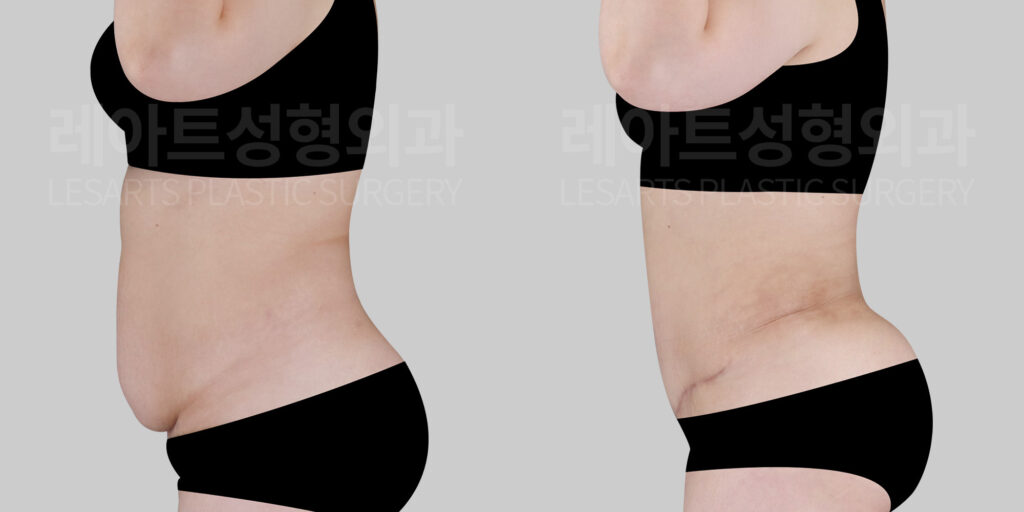
Improvement of abdominal sagging through abdominoplasty surgery — Lesarts Plastic Surgery
The folded skin
that previously overlapped
above the bikini line
in the lower abdomen
was corrected smoothly
without remaining step-off irregularities.
Because this patient required
a relatively extensive correction range,
the incision scar extending
toward the flank area
may feel somewhat disappointing.
However,
the absence of noticeable
dog ear deformities
on both sides
was considered
a very satisfying outcome.
Although the patient’s weight
had increased by approximately 2 kg
compared to before surgery,
the abdominal contour
continued to maintain
a balanced appearance
without skin folding
or significant sagging.
With continued exercise
and consistent dietary management,
even more satisfying long-term results
are expected moving forward.
Abdominoplasty
and abdominal liposuction
should not be viewed
as the final step
toward an ideal body contour,
but rather as
the beginning of a new process.
Because abdominoplasty surgery
is a procedure chosen
while accepting the burden of scarring,
post-operative scar management,
weight control,
and regular exercise
must all be maintained together
in order to preserve
satisfying long-term results.
If you are concerned
about changes in your abdominal contour,
we welcome you
to visit Lesarts Plastic Surgery
at any time.
We will provide consultation
and treatment planning
tailored to your body shape.