
[Gynecomastia]Why Does My Chest Hurt? Understanding Gynecomastia-Related Chest Pain
Can Gynecomastia Cause Chest Pain?
Yes. Pain and tenderness around the nipple are common reasons
many men first seek medical evaluation for Gynecomastia.
Hello, I am Dr. Jihoon Moon
from Lesarts Plastic Surgery.
Some men notice a sharp, tingling sensation around the nipple
whenever it brushes against clothing, while others experience a dull ache
with only gentle pressure. Concerned that it could be a serious condition,
they often search online and eventually come across the term Gynecomastia.
Many people think of Gynecomastia as simply a cosmetic condition
that causes the chest to appear more prominent. Even when they feel
a lump beneath the nipple, they often assume it is just fat or weight gain,
rather than recognizing it as enlarged glandular tissue.
However, Gynecomastia can sometimes cause pain or tenderness.
Many patients also tell us, “It doesn’t hurt now, but I remember
having a painful lump during puberty.” Changes in symptoms over time
like these are actually quite common.

Surprisingly, Pain and Tenderness are often the very symptoms
that finally lead many patients to visit the clinic.
In this article, we will explain why chest pain develops
in men with Gynecomastia, why breast asymmetry may occur,
and which medical conditions should always be considered
before confirming the diagnosis.
1. Why Does Gynecomastia Cause Chest Pain? Rapid Growth of Glandular Tissue
Chest pain in Gynecomastia most commonly occurs while
the glandular tissue is actively growing.
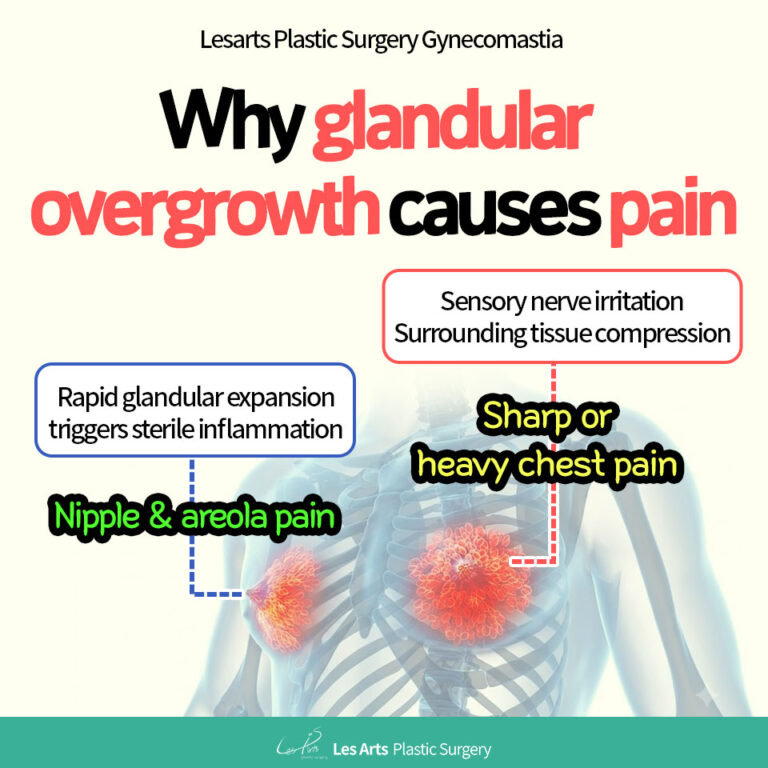
During this stage, the enlarging tissue irritates nearby nerves and compresses surrounding structures,
leading to pain and tenderness.
Men naturally have small amounts of immature Glandular Breast Tissue.
Under normal circumstances, this tissue remains inactive because Testosterone suppresses its growth.
However, when hormonal balance changes and the effects of Estrogen become relatively stronger,
the glandular tissue begins to grow rapidly. This period of active proliferation
is when pain most commonly develops.
Nerve Irritation and Pressure on Surrounding Tissue
As glandular tissue enlarges, nearby sensory nerves become irritated.
The expanding tissue also pushes against the surrounding fibrous tissue and fat,
creating pressure that may cause a sharp, tingling sensation or a dull ache.
A Mild Inflammatory Response
Rapid tissue expansion may also trigger a mild sterile inflammatory response.
As a result, the nipple and areola become more sensitive,
and even light contact with clothing may cause noticeable tenderness.
Many patients tell us,
“I remember having a painful lump during puberty many years ago.”
This is actually very common.
Approximately 70–80% of adolescent boys experience Physiologic Gynecomastia
caused by temporary hormonal imbalance during puberty.
The enlarged glandular tissue usually regresses naturally within three years,
and the associated pain gradually disappears.
For this reason, pain experienced during puberty
is usually unrelated to symptoms that develop later in adulthood.
In summary, chest pain is often a sign that Glandular Breast Tissue
is actively responding to hormonal stimulation and growing.
Once the tissue enters the chronic or Fibrotic Phase,
the pain gradually subsides, leaving only the enlarged chest contour.
2. Bilateral vs. Unilateral Gynecomastia
How Does Glandular Tissue Differ?
Most cases of Gynecomastia are bilateral, but some men develop enlargement on only one side.
The difference is largely related to how each side responds to hormonal stimulation.
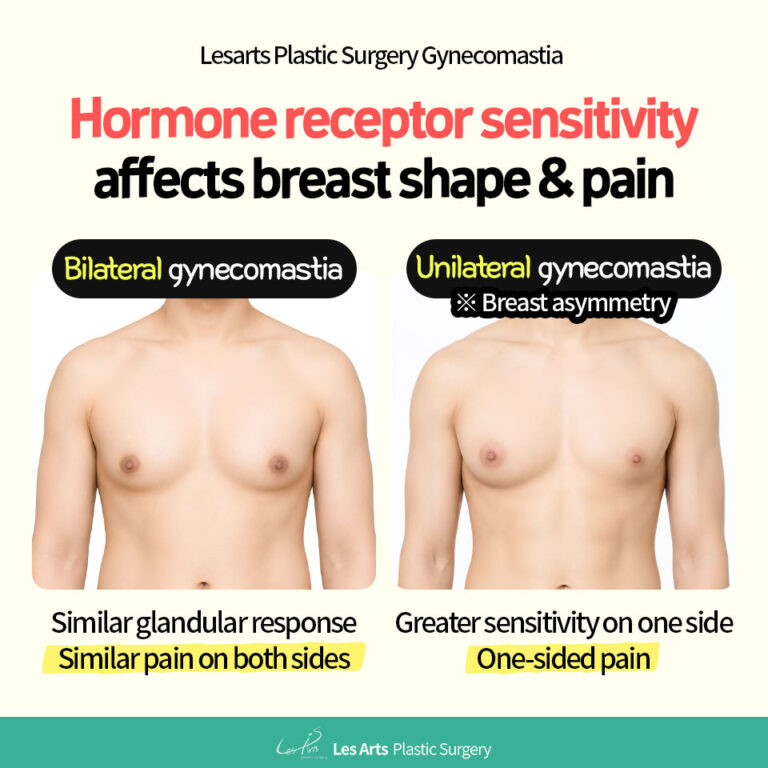
Bilateral Gynecomastia accounts for approximately 70–80% of all cases.
Because the underlying cause is usually a systemic hormonal change, such as puberty
or certain medications, both breasts tend to enlarge in a relatively symmetrical pattern.
The Glandular Breast Tissue typically measures between 2 and 4 cm,
or even larger on both sides, and pain or tenderness often develops
beneath both areolas at a similar intensity.
Unilateral Gynecomastia, on the other hand, accounts for approximately 20% of cases.
These patients notice that only one side becomes enlarged,
or that pain develops in just one breast.
Many patients ask,
“If hormones circulate throughout the entire body, why does only one side grow?”
The answer lies in the difference in Hormone Receptor Sensitivity.
One side of the glandular tissue may respond much more strongly
to the effects of Estrogen than the other.
3. Key Diagnostic Points That Should Never Be Overlooked
Not every painful breast lump in men is Gynecomastia.
When chest pain or a palpable lump develops, a physical examination and breast ultrasound are
essential to identify the underlying cause and rule out more serious conditions.
There are three key diagnostic points that should always be evaluated.

1. True Gynecomastia vs. Pseudo-Gynecomastia
The first step is determining whether the enlargement is caused by
Glandular Breast Tissue or simply by excess fat.
True Gynecomastia results from hormonal stimulation
that causes glandular tissue to enlarge.
Patients typically have a firm, rubbery lump beneath the nipple,
and pain or tenderness is common during the active growth phase.
In Pseudo-Gynecomastia, however,
there is no enlargement of glandular tissue.
Instead, the breast appears enlarged
because of excess fat accumulation,
which is more common in overweight men.
The tissue usually feels soft and diffuse,
without a distinct lump beneath the nipple,
and pain is generally absent.
2. Unilateral Breast Lump: Always Rule Out Male Breast Cancer
Although Male Breast Cancer accounts for less than 1%
of all breast cancer cases, it remains an important condition
that should never be overlooked.
Whenever a lump is found in only one breast,
careful evaluation is necessary
to distinguish it from Gynecomastia.
A Gynecomastia lump is usually located
directly beneath the nipple and areola,
with a smooth, rounded border.
It is typically movable on examination
and often becomes tender
while the glandular tissue is actively growing.
3. Medication-Induced Gynecomastia and Metabolic Conditions
Certain medications
can stimulate glandular tissue growth
and lead to both breast enlargement and pain.
Common examples include
Finasteride for hair loss,
Spironolactone for hypertension,
Cimetidine for gastric disorders,
as well as Anabolic Steroids
used illegally for bodybuilding.
These medications can suppress Testosterone
or increase the relative effects of Estrogen,
triggering the development of Gynecomastia.
When medication is the underlying cause,
pain often improves after the drug
is discontinued or replaced.
However, once the glandular tissue
has entered the Fibrotic Phase,
the enlarged tissue itself
does not disappear spontaneously.
4. Conclusion: Pain Is Your Body’s Warning Signal—Don’t Ignore It
Chest pain and tenderness in men are often clear signs that
glandular breast tissue is actively responding to hormonal changes.
While temporary pain during puberty may resolve naturally,
persistent or newly developed symptoms deserve proper medical evaluation.
Pain and tenderness in the male chest
are often evidence that Glandular Breast Tissue
is enlarging in response to hormonal imbalance.
Fortunately, temporary pain associated with Physiologic Gynecomastia
during puberty usually resolves naturally.
As hormone levels stabilize,
the enlarged glandular tissue gradually regresses,
and the associated symptoms typically disappear over time.
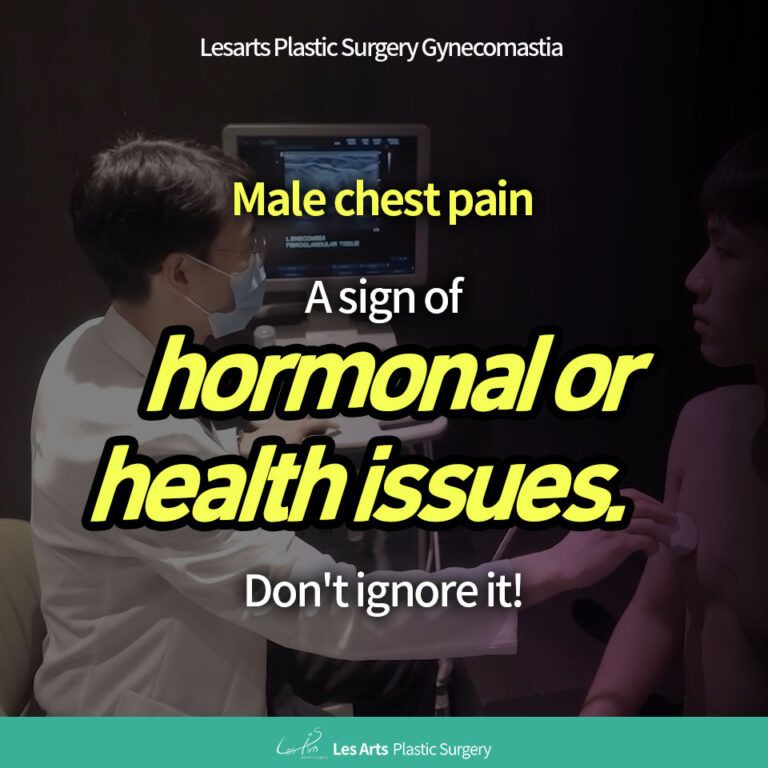
However, if you suddenly develop chest pain
or noticeable breast asymmetry during adulthood,
it may be a sign
of an underlying hormonal imbalance
or another medical condition
that should not be overlooked.
There is no need
to feel embarrassed
or simply endure the symptoms.
A comprehensive Breast Ultrasound Examination
can accurately assess the size and condition
of the Glandular Breast Tissue,
help distinguish Gynecomastia
from other breast conditions,
and guide you toward
the most appropriate treatment,
providing the fastest
and safest path
to relieving your symptoms.
▼ Visit Lesarts Plastic Surgery in Gangnam, Seoul, Korea ▼