
[Gynecomastia]"My Chest? It Started Back in School..."The Hidden Origin of Gynecomastia in Your 20s and 30s:The Connection Between Pubertal Body Changes and Gynecomastia
Hello, this is Dr. Jihoon Moon
from Lesarts Plastic Surgery.
When I begin a consultation
with a man in his 20s
or early 30s regarding
gynecomastia,
there is one question
I almost always ask first.
“When did you first notice it?”
More often than not,
the answer is remarkably similar.
“Probably sometime in middle school
or high school.
Maybe even late elementary school.
Back then,
I just thought I was overweight.
I even lost a lot of weight
during military service,
but while the rest of my body changed,
my chest stayed exactly the same.”
In reality,
the overwhelming majority of adult men
who seek treatment for
gynecomastia
have roots that trace back
to adolescence.
What once seemed like
a temporary source of embarrassment
during school years,
or simply a consequence of
being overweight,
often persists long after
puberty has ended.
But why does this happen?
Why do these changes remain
firmly established into adulthood
instead of disappearing naturally
with growth and weight loss?
The answer lies in
the complex hormonal changes
that occur during puberty.
During this period,
the body undergoes dramatic shifts
in both hormone production
and body composition.
In particular,
being overweight during adolescence
can influence these hormonal pathways
in ways that increase the likelihood
of developing persistent
gynecomastia.
Today,
we will take a closer look at
the dynamic hormonal changes
that occur during puberty,
and explore the medical mechanisms
through which adolescent obesity
can contribute to
long-lasting or permanent
gynecomastia.
Causes of Adolescent Gynecomastia – Jihoon Moon | Lesarts Plastic Surgery
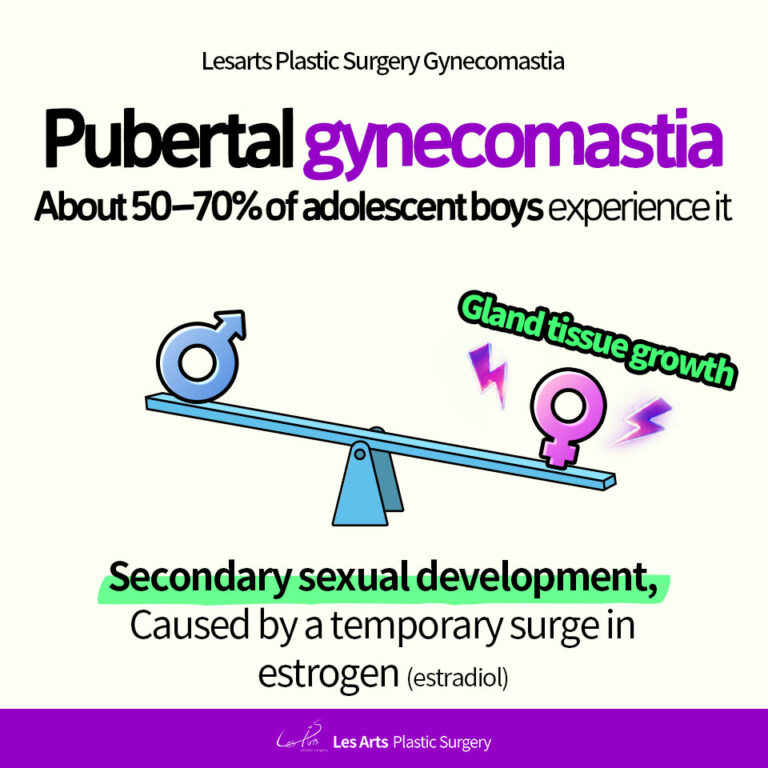
1.Physiologic Gynecomastia During Puberty:
The Hormonal Seesaw and the Emergence of Glandular Tissue
Puberty,
the period of secondary sexual development,
is one of the most dramatic
hormonal transition phases
in a male’s lifetime.
During this time,
the body begins producing
significantly higher levels of
testosterone,
the hormone responsible for
the development of masculine features.
However,
there is another important fact
that is often overlooked.
During puberty,
the male body also experiences
a temporary increase in
estradiol,
a form of estrogen.
Under normal circumstances,
the effects of testosterone
greatly outweigh those of estrogen,
preventing any noticeable changes
in breast tissue.
But during early to mid-puberty,
typically between the ages of
12 and 15,
the testes and adrenal glands
are still maturing.
As a result,
the production rates of these hormones
do not always remain perfectly balanced.
This creates a temporary
“hormonal seesaw,”
where estrogen activity
may briefly become
relatively more influential.
When this occurs,
the increased estrogen stimulation
can affect dormant
glandular tissue
within the male chest.
This stimulation may trigger
temporary glandular enlargement,
leading to what is known as
physiologic gynecomastia.
In other words,
the breast tissue itself
is responding to a normal,
though temporary,
hormonal imbalance
that occurs during development.
Physiologic gynecomastia
is extremely common.
Studies suggest that
approximately 50–70% of adolescent boys
experience some degree of breast tenderness,
nipple sensitivity, palpable breast tissue,
or mild breast enlargement
at some point during puberty.
For most adolescents,
this is simply a normal part
of the developmental process
rather than a sign of disease.

Why Pubertal Gynecomastia Persists Into Adulthood – Jihoon Moon | Lesarts Plastic Surgery
2.When a Temporary Change Becomes Permanent:
The Role of Fibrosis
Under normal circumstances,
as puberty progresses into
its later stages,
typically by the age of
17 or 18,
testosterone
gradually establishes
clear hormonal dominance.
As this occurs,
the temporary stimulation caused by
elevated estrogen activity
begins to fade.
The enlarged glandular tissue
that developed during puberty
usually undergoes
a natural process of regression,
shrinking over time
until little or no trace remains.
For most adolescent boys,
this is exactly what happens.
The problem arises
when the glandular tissue
fails to regress.
In some individuals,
even after hormone levels
have normalized,
the enlarged tissue remains
and continues into adulthood.
The key mechanism behind
this transition from
a temporary hormonal change
to permanent gynecomastia
is known as fibrosis.
Fibrosis occurs when
dense collagen-rich connective tissue
develops within and around
the enlarged glandular tissue.
This process is more likely
to occur when:
-Hormonal imbalance persists
for an extended period
-Breast tissue is unusually sensitive
to estrogen stimulation
-Glandular proliferation remains active
for longer than normal
As the tissue continues
to receive hormonal stimulation,
collagen fibers gradually accumulate
and become intertwined
with the glandular structures.
Over time,
the tissue becomes firmer,
denser,
and increasingly resistant
to natural regression.
Once significant fibrosis develops,
the enlarged glandular tissue
essentially becomes
a permanent anatomical structure.
At that point,
even if hormone levels become
completely normal in adulthood,
the tissue typically does not
shrink or disappear on its own.
This is one of the main reasons
many men in their 20s and 30s
still describe a chest contour
that has remained unchanged
since middle school
or high school.
In many of these cases,
the issue is no longer
an active hormonal imbalance.
Rather,
it is the presence of
fibrotic glandular tissue
that became permanently established
during adolescence.
The Relationship Between Adolescent Obesity and Gynecomastia – Jihoon Moon | Lesarts Plastic Surgery
3.The Vicious Cycle of Adolescent Obesity and Gynecomastia:
The Aromatase Paradox
As childhood and adolescent obesity
continue to rise,
we are seeing an increasing number
of adult men whose
gynecomastia
can be traced back
to being overweight during puberty.
This relationship involves
far more than simply
accumulating fat
in the chest area.
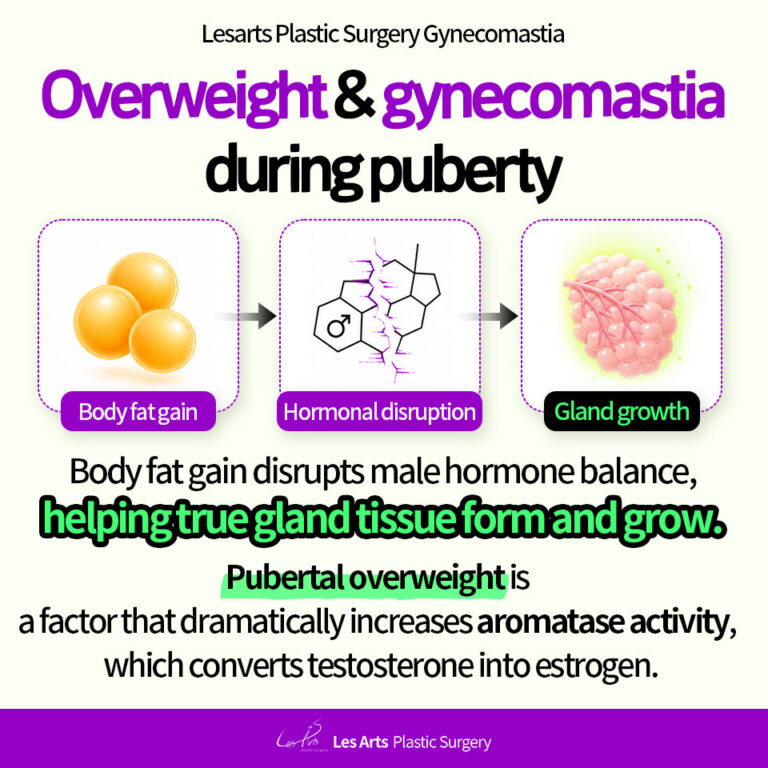
Excess body fat itself
can directly influence
the hormonal environment,
contributing not only
to chest fullness,
but also to the growth of
true glandular tissue.
At the center of this process
is an enzyme known as
aromatase.
Aromatase is responsible for
converting testosterone
into estrogen.
When an adolescent boy
becomes overweight or obese,
overall body fat increases,
and aromatase activity
throughout the body
also rises significantly.
As a result,
a greater proportion of
the testosterone being produced
during puberty
is converted into estrogen.
This creates an important problem.
The developing breast tissue
is no longer exposed solely
to the temporary hormonal imbalance
that naturally occurs during puberty.
Instead,
it receives a second source
of estrogen stimulation
generated by excess body fat.
In other words,
the glandular tissue is subjected to
a double hormonal influence:
-The natural hormonal fluctuations
of puberty
-Additional estrogen production
driven by increased aromatase activity
within adipose tissue
Because of this,
glandular enlargement
can become more extensive
and progress more rapidly
than it would in
normal-weight adolescents.
The problem does not end there.
The fat cells accumulated
within the chest region
may also create
a local biological environment,
often referred to as
a microenvironment,
that interferes with
the normal regression process
of glandular tissue.
Instead of allowing
the enlarged tissue
to shrink naturally
once hormone levels stabilize,
this environment may help sustain
or prolong its presence.
As a result,
adolescent obesity
can create a vicious cycle.
It promotes the growth of
glandular tissue
while simultaneously reducing
the likelihood that the tissue
will regress naturally.
This is one of the key reasons
why some men continue to experience
persistent gynecomastia
well into adulthood,
even after substantial weight loss
later in life.

Gynecomastia and Weight Loss – Jihoon Moon | Lesarts Plastic Surgery
4.When Weight Loss Isn’t Enough:
Why the Chest Remains the Same
Even After Military Service
For most adult men struggling with
gynecomastia,
the first solution that comes to mind
is aggressive weight loss
combined with intensive chest training.
Many dedicate countless hours
to cardiovascular exercise,
strict dietary control,
and strength training.
The area around
the nipple and areola
continues to protrude,
or the chest maintains
an unusual contour
that appears inconsistent
with the rest of the body.
This experience often becomes
a major source of frustration.
The reason lies in
the fundamental difference between
pseudogynecomastia (fat-based enlargement) and
true gynecomasti (glandular enlargement).
Weight loss can reduce
the size of fat cells
surrounding the chest.
However,
it cannot eliminate
fibrotic glandular tissue
that has already formed.
When glandular tissue
has become permanently established
through adolescent hormonal imbalance,
obesity-related estrogen exposure,
and subsequent fibrosis,
it no longer behaves
like ordinary body fat.
No amount of dieting,
cardio training,
or calorie restriction
can cause this tissue
to burn away.
This explains why
many men become discouraged
after successfully losing weight
yet still seeing
the same chest contour
they struggled with years earlier.
Interestingly,
the effect may become
even more noticeable
in dedicated gym-goers.
As the pectoralis major muscles
develop through
consistent chest training,
the enlarged glandular tissue
can be pushed forward
by the growing muscle beneath it.
As a result,
the protrusion around
the nipple area
may appear even more prominent,
despite improvements
in overall physique.
This paradox is one of the most common reasons
why men with longstanding
true gynecomastia
feel that exercise alone
never fully resolves
their concerns.
When Can You Train Your Chest After Gynecomastia Surgery? – Jihoon Moon | Lesarts Plastic Surgery
5.Conclusion:
It’s Time to Leave Those Adolescent Frustrations Behind
For many men,
gynecomastia that began
during adolescence
left more than a physical change.
It often became
a lasting source of emotional stress
during one of the most sensitive periods
of personal development.
The teenage years
are a time when identity,
confidence,
and self-image
are being formed.
As a result,
the impact of gynecomastia
can extend far beyond
the appearance of the chest itself.
Even after becoming adults,
many men find that
the problem never truly disappeared.
The habit of hunching the shoulders,
avoiding tight clothing,
or feeling uncomfortable
under the gaze of others
may continue long after
their school years have ended.
If the gynecomastia experienced
by men in their 20s and 30s
originated from
pubertal hormonal imbalance
and adolescent obesity,
then the condition is often the result of
biological processes
that were largely beyond
their control.
In many cases,
it is not simply a matter of
willpower,
discipline,
or effort.
For this reason,
continuing to struggle alone
is rarely the most productive path.
Instead,
a meaningful first step
toward treatment
is obtaining an objective evaluation
of what is actually present
inside the chest.
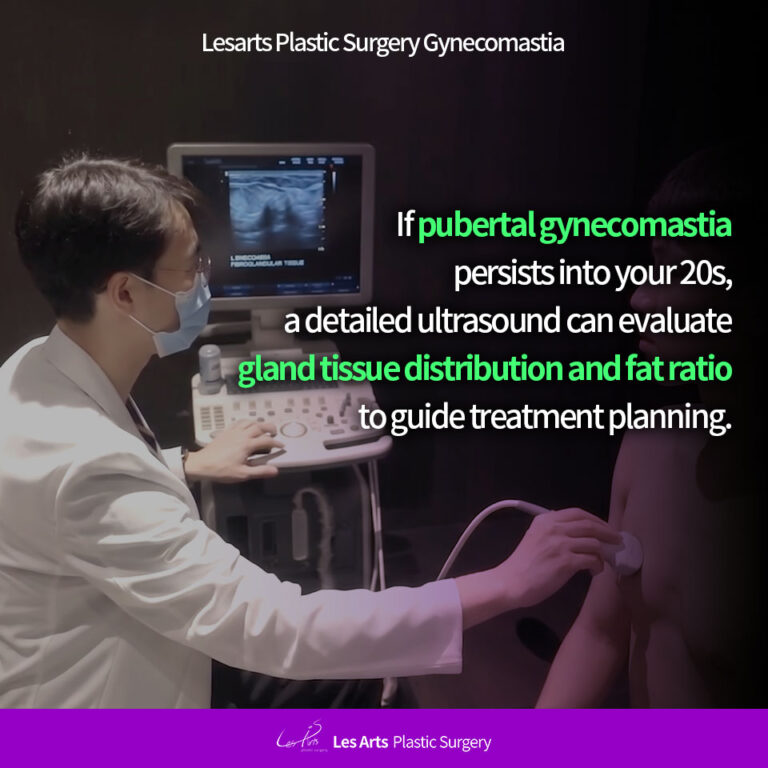
Through a detailed
ultrasound examination,
it is possible to assess
-the distribution of glandular tissue
-the proportion of fatty tissue
-the structural characteristics
contributing to the chest contour
With a clear understanding
of these factors,
patients can make informed decisions
about the most appropriate
treatment strategy.
Sometimes the most important step
is not immediately pursuing treatment,
but finally understanding
the true cause
of a concern that has followed you
since adolescence.