
[Gynecomastia]"Summer Surgery?!"Should Gynecomastia Surgery Really Be Avoided During Summer?
Hello, this is Dr. Jihoon Moon
from Lesarts Plastic Surgery.
As summer begins,
there are a few questions
I hear much more often
in the consultation room.
“Doctor, it’s getting hot outside.
If I have surgery now,
won’t my wound heal poorly or become infected?”
“I tend to sweat a lot.
Would it be better to avoid surgery during the summer?”

Is Summer Gynecomastia Surgery Safe? – Dr. Jihoon Moon | Lesarts Plastic Surgery
To begin with,
there is absolutely no
medical reason to avoid
gynecomastia surgery
during the summer.
In other words,
there is no need
to postpone surgery
until autumn or winter
and continue living with
unnecessary stress
because of the season.
In this article,
I will explain the truth behind
the long-standing myths
that make patients hesitate about
summer gynecomastia surgery,
from a medical perspective.
Gynecomastia Scar Care – Dr. Jihoon Moon | Lesarts Plastic Surgery
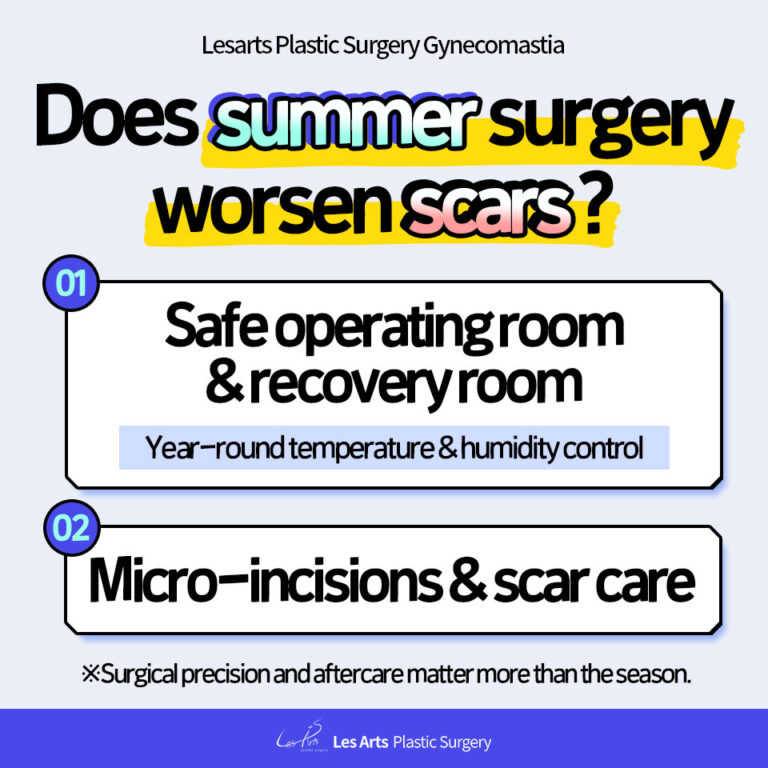
1. “Will Surgery in Summer Cause Wound Problems?”
A Common Myth Dispelled by Modern Medicine
The concern I hear most often
is about inflammation
and scarring.
In the past,
when air conditioning
and sanitation systems
were not as advanced,
it is true that
Korea’s hot and humid summers
could make wound care
more challenging.
However,
modern medical environments
are completely different.
Strictly Controlled Clinical Environments
Operating rooms
and recovery facilities
maintain consistent temperature
and humidity levels
throughout the year.
Regardless of the season,
surgery is performed
in a safe and comfortable environment.
Advances in Medical Technology
and Wound Care Materials
Modern gynecomastia surgery
is performed through
small incisions,
and today’s antibiotics
and waterproof dressings
are highly effective.
Wound protection techniques
have advanced to the point
where patients can typically shower
within two to three days
after surgery.
As a result,
the likelihood of wound complications
caused by external weather conditions
is extremely low.
Therefore,
when it comes to
gynecomastia surgery,
the outcome is influenced
far more by
how well the patient follows
postoperative instructions
(particularly avoiding alcohol
and smoking),
and how precisely
the surgeon performs the procedure
while minimizing tissue trauma,
than by the season itself.

Summer Gynecomastia Surgery and Sweating – Dr. Jihoon Moon | Lesarts Plastic Surgery
2. “I Sweat More Than Most People”
The Truth About Heat Sensitivity, Sweating, and Postoperative Care
Some gynecomastia patients
hesitate to undergo surgery
during the summer because
they sweat excessively
or tend to feel hot more easily
than others.
For those who experience
more body heat
or increased sweating,
it is natural to wonder,
“Could sweat coming into contact
with the surgical area
cause problems?”
However,
this is also something
that can be adequately managed
with proper medical care.
Medical Fact Check
Sweat itself
is a sterile secretion.
Sweating heavily
does not automatically lead
to bacterial infection
or inflammation.
The real concern arises when
excessive sweating causes
the surgical dressing
to become detached,
or when the area remains
moist for an extended period,
allowing normal skin bacteria
to multiply.
Today,
for patients who sweat heavily,
dressings with excellent
breathability and waterproof properties
are commonly used,
and detailed instructions
are provided regarding
how to care for the area
if sweating occurs after surgery.
Therefore,
having a tendency
to sweat more than average
is not a reason
to avoid surgery,
nor is it an absolute factor
that significantly increases
the risk of complications.

Compression Garment Duration After Gynecomastia Surgery – Dr. Jihoon Moon | Lesarts Plastic Surgery
3. The Burden of Compression Garments
Manageable with Air Conditioning and Functional Fabrics
Another practical reason
patients hesitate to undergo
surgery during the summer
is the inconvenience of wearing
a compression garment
for about a month after
gynecomastia surgery.
Of course,
wearing a compression garment
in the middle of summer
can feel somewhat uncomfortable.
However,
most indoor environments
where people spend their time today,
including workplaces,
homes,
and public transportation,
are equipped with air conditioning.
As long as excessive outdoor activity
is avoided,
the heat associated with
wearing a compression garment
can generally be managed
during daily indoor activities.
In addition,
the compression garment
must be worn 24 hours a day
for the first two weeks
after gynecomastia surgery.
From the third week onward,
patients can spend part of the day
without wearing it,
which significantly reduces
the inconvenience.
Moreover,
modern medical compression garments
prescribed by hospitals
are made from functional fabrics
with excellent breathability
and moisture-wicking properties.
As a result,
they are more comfortable
to wear during the summer
and dry quickly after washing.
Naturally,
this also helps reduce
the risk of sweat-related odor.
In addition,
unlike the thick
and stiff outerwear
commonly worn during winter,
summer clothing is typically made from
lightweight and soft materials.
This can actually reduce
unnecessary pressure
and friction
on the surgical area
after gynecomastia surgery.

Summer Precautions After Gynecomastia Surgery – Dr. Jihoon Moon | Lesarts Plastic Surgery
4. Conclusion:
There Is No Reason to Keep Delaying Surgery Because of Summer
For men living with
gynecomastia,
summer itself can be
a season of significant stress.
While others comfortably wear
a single lightweight T-shirt,
many patients feel compelled
to wear thicker
or darker clothing
to hide the appearance
of their chest.
The emotional burden of
walking with rounded shoulders
and constantly worrying
about how others may perceive them
is difficult to understand
unless you have experienced it yourself.
Avoiding surgery during summer
is simply an old misconception
without medical basis.
If surgery is performed
in a modern medical environment,
and postoperative instructions
are followed properly,
the season itself has no impact
on the success of
gynecomastia surgery.
“The best time for surgery
is not determined by the season.
It is the moment
when the patient truly wants
to make a change.”
With summer vacation
or school break approaching,
postponing surgery
until autumn or winter
simply because the weather is hot
only extends the emotional stress
for that much longer.
Rather than continuing
to delay seeking treatment,
I hope this summer
can become a turning point—
one that allows you to move forward
with greater confidence
and comfort.