
[Gynecomastia]Returning to Exercise After Gynecomastia Surgery: Trust Your Muscle Memory and Don't Be Afraid to Take a Short Break
Hello, this is Dr. Jihoon Moon
from Lesarts Plastic Surgery.
For men who train professionally
or view exercise as far more
than a casual hobby,
the idea of stopping workouts
can feel far more frightening
than simply taking a break.
Many fitness enthusiasts
who visit our clinic
experience significant stress
because of gynecomastia.
Yet despite that discomfort,
they often hesitate
when considering surgery.
One concern comes up
more than any other:
“If I can’t work out
for a month after surgery,
won’t I lose all my muscle?”
This fear of muscle loss
often becomes
one of the biggest reasons
patients delay
gynecomastia surgery,
even when the condition itself
is already affecting
their confidence
and quality of life.

Exercise After Gynecomastia Surgery – Jihoon Moon | Lesarts Plastic Surgery
However, today,
I would like to explain
why this concern is,
from a medical perspective,
largely unnecessary.
In reality,
the short recovery period
following gynecomastia surgery
is not a time
when you lose everything
you have worked for.
Rather,
it should be viewed as
a temporary and strategic pause.
A brief period away
from intense training
does not erase years
of consistent effort,
nor does it permanently diminish
the muscle you have built.
Instead,
this recovery period
allows your body to heal properly
while revealing the chest contour
that was previously concealed
beneath excess glandular tissue
and fatty tissue.
In other words,
the goal is not
to sacrifice muscle.
It is to remove
the structures that prevent
your true pectoral definition
from being fully visible.
What may feel like
a step backward today
is often a strategic retreat
that ultimately allows
a stronger,
more defined,
and more masculine chest appearance
to emerge in the months ahead.
Exercise Restriction After Gynecomastia Surgery – Jihoon Moon | Lesarts Plastic Surgery
1.The Truth About Muscle Atrophy
and the Science of Muscle Memory
The first concern
that should be addressed
is the fear of
muscle atrophy.
After gynecomastia surgery,
patients are typically advised
to avoid heavy weight training
for approximately four weeks.
During this period,
some individuals may notice
that their physique appears
smaller or less defined
when looking in the mirror.
This often leads to concerns that
hard-earned muscle mass
is rapidly disappearing.
From a medical perspective,
however,
the changes seen during
this short recovery period
are not usually the result of
significant muscle loss.
In most cases,
what patients are observing
is a temporary reduction in
intramuscular glycogen stores
and water content within
the muscle cells.
As these levels decrease,
muscles may appear
slightly flatter
or less full than usual,
creating the impression of
dramatic muscle loss.
Importantly,
this is very different from
the actual destruction
or disappearance
of muscle fibers.
It should be noted that
when training cessation extends
beyond approximately four weeks,
a gradual reduction in
muscle fiber diameter
and true muscle mass loss
may begin to occur.
For most patients recovering from
gynecomastia surgery,
however,
the temporary appearance changes
during the early healing phase
are far less significant
than they initially seem.
This is where the concept of
muscle memory
becomes especially important.
The body retains adaptations
developed through years
of consistent training,
allowing muscle size
and performance to return
much more rapidly
once exercise is resumed.
For that reason,
a short recovery period
should not be viewed as
losing progress,
but rather as a necessary investment
in achieving a healthier
and more refined chest contour.

Muscle Loss, Muscle Atrophy,
and Muscle Memory – Lesarts Plastic Surgery
The concept we should focus on
is muscle memory.
Your muscles remember
where they have been before.
Through years of
consistent resistance training,
muscle fibers acquire
additional myonuclei,
specialized cellular structures
that play a critical role
in muscle growth and adaptation.
Importantly,
these myonuclei do not disappear
during a short recovery period.
A temporary break of several weeks
after gynecomastia surgery
is generally not enough
to eliminate
the cellular foundation
built through long-term training.
Once the surgical area
has healed sufficiently
and exercise is resumed,
these retained myonuclei
allow protein synthesis
to accelerate rapidly.
As a result,
the return to
muscle hypertrophy
often occurs much faster
than the original process
of building muscle
for the first time.
This is one of the reasons
many athletes and experienced lifters
regain lost size and performance
surprisingly quickly
after a period of inactivity.
2.Why Returning to Exercise
Too Early Can Be Harmful
Immediately after
gynecomastia surgery,
the body enters
an active healing phase.
During this period,
inflammation,
tissue repair,
and wound remodeling
occur simultaneously
as the body works
to recover from surgery.
Applying excessive stress
to the chest muscles
or performing activities
that significantly increase
blood pressure during this stage
can interfere with
the normal healing process.
For this reason,
returning to intense training
too soon may create
two major problems
that can negatively affect
both recovery
and the final surgical result.
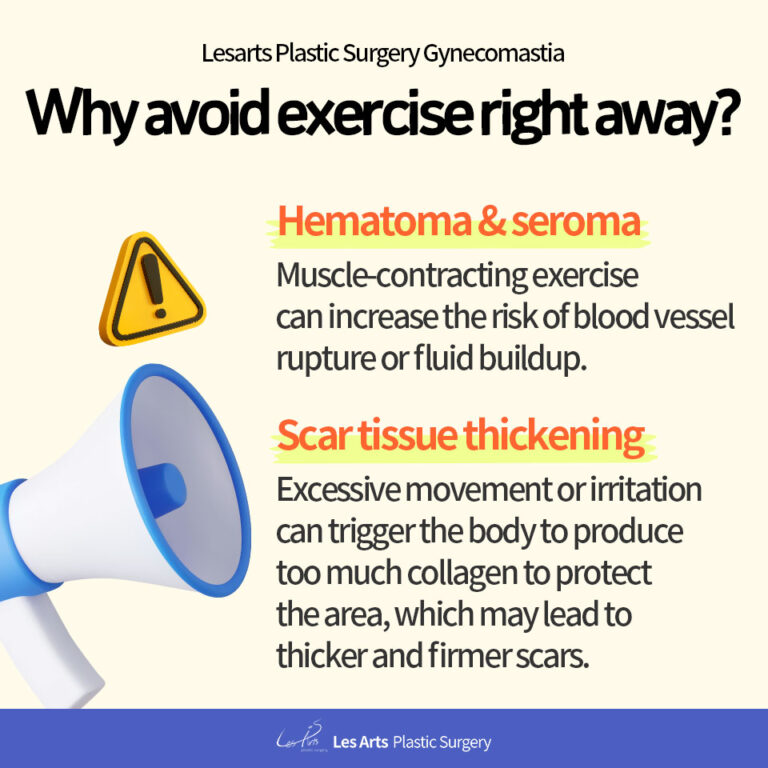
Why Exercise Restriction Is Necessary After Gynecomastia Surgery – Lesarts Plastic Surgery
The first concern is
hematoma and seroma formation.
Immediately after
gynecomastia surgery,
the space previously occupied by
the enlarged glandular tissue
remains temporarily empty.
If vigorous exercise
or forceful chest muscle contraction
occurs during this period,
small blood vessels may reopen,
or tissue fluid may accumulate
within the surgical space.
As a result,
healing can be delayed,
and in more severe cases,
additional treatment may be required
to remove accumulated blood
or fluid collections.
The second concern is
the development of
hypertrophic scar tissue.
When people think about scars,
they often focus only on
the external incision line.
However,
the more important changes
frequently occur beneath the skin.
As the surgical area heals,
the body continuously produces
new collagen fibers
to stabilize the tissue.
If excessive movement,
mechanical stress,
or repeated stimulation occurs
during this critical phase,
the body may respond by producing
an excessive amount of collagen.
This can lead to
thicker and firmer scar tissue
than originally intended.
When this occurs,
the tissue may not settle naturally,
resulting in a chest that feels
tight,
stiff,
or less mobile.
Some patients may even experience
a sensation of tightness
or a foreign-body feeling
during exercise and movement.
Paradoxically,
for patients seeking
the best possible chest definition
and smooth, natural movement,
the fastest route to recovery
is often temporary restraint.
Allowing the tissues
adequate time to stabilize,
heal,
and mature naturally
creates the foundation for
a smoother contour,
better mobility,
and a more refined
long-term surgical result.
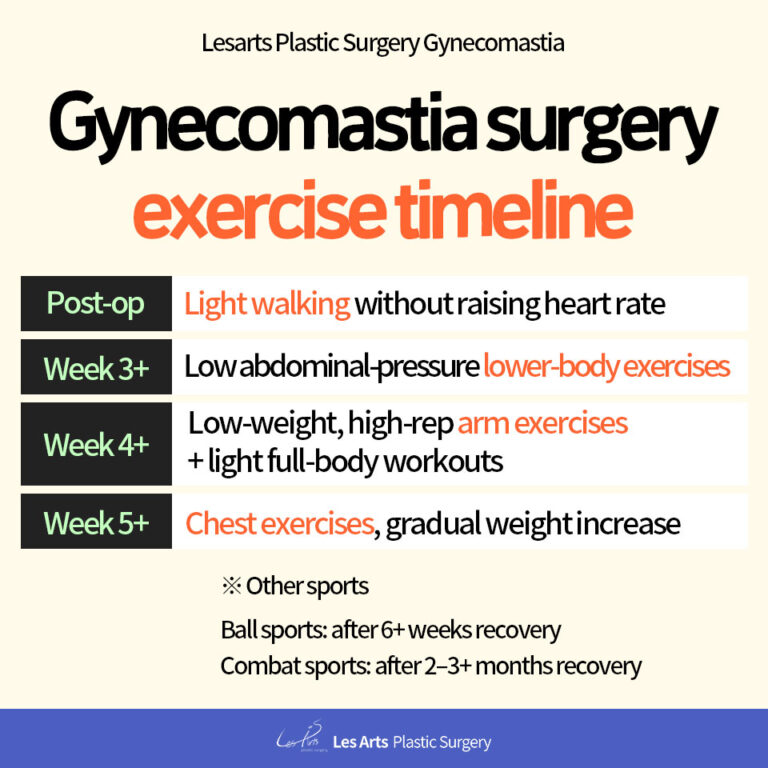
When Can You Train Your Chest After Gynecomastia Surgery? – Jihoon Moon | Lesarts Plastic Surgery
3.Step-by-Step Timeline
for Returning to Weight Training
Let’s take a closer look
at a practical timeline for
returning to exercise after
gynecomastia surgery.
The first activity permitted
is light walking.
Beginning the day after surgery,
gentle walks can help improve
lower-body circulation,
reduce overall swelling,
and decrease the risk
of blood clot formation.
For this reason,
light walking is generally preferred
over complete inactivity,
and it is something
I strongly encourage
for my patients.
However,
high-intensity cardiovascular exercise
that significantly elevates
heart rate or causes
heavy sweating
should generally be avoided
for at least two weeks.
Week 3: Lower-Body Isolation Training
By the third week,
carefully selected lower-body exercises
may become possible.
Movements such as
leg extensions
and leg curls,
which minimize involvement
of the upper body,
can provide reassurance
for patients concerned about
temporary muscle loss.
Exercises such as
squats
and deadlifts,
however,
still require caution.
Because these movements
create substantial intra-abdominal pressure
and involve significant
upper-body stabilization,
they are generally recommended
after four weeks or later.
Whenever the upper body
is heavily engaged,
tension may also be transmitted
to the surgical area.
Week 4:
Gradual Return to Full-Body Training
Around week four,
patients may gradually increase
their overall training volume.
Lightweight,
high-repetition exercises such as
-Lat pulldowns
-Row variations
-Biceps exercises
-Triceps exercises
may be introduced cautiously.
During this phase,
particular attention should be paid
to excessive stretching
of the chest region.
The underlying tissues
are still adapting,
and aggressive stretching
may place unnecessary stress
on the healing structures.
Week 6: Return to Chest Training
The moment most patients
have been waiting for
is the return to chest workouts.
Exercises such as
-Bench press
-Dips
are generally recommended
after approximately six weeks.
By this point,
the space created during
gland excision
has typically stabilized
and undergone substantial healing.
Initially,
it is advisable to begin
with an empty barbell
or very light resistance.
Patients should monitor
for discomfort,
tightness,
or unusual pain
before progressively increasing load.
The principle of
gradual progressive overload
remains essential.
Increasing resistance
by approximately 5–10%
per week allows the tissues
to continue adapting safely.
4.Ball Sports
and Combat Sports
For patients who enjoy sports
outside of weight training,
the return timeline
may be slightly longer.
Sports such as
-Soccer
-Basketball
involve frequent physical contact
and increase the risk
of direct impact
to the surgical area.
For this reason,
a minimum recovery period
of approximately six weeks
is generally recommended.
Activities involving
significant upper-body rotation,
such as
-Tennis
-Golf
may also place tension
on healing tissues
and surgical scars.
Likewise,
swimming requires extensive
shoulder mobility
and prolonged stretching
of the chest muscles,
which can increase traction forces
across the operative site.
For combat sports,
including Brazilian Jiu-Jitsu,
close physical contact
and substantial chest compression
are unavoidable.
Because of these demands,
returning after approximately
two to three months,
once recovery has reached
a more stable phase,
is generally considered
the safest approach.
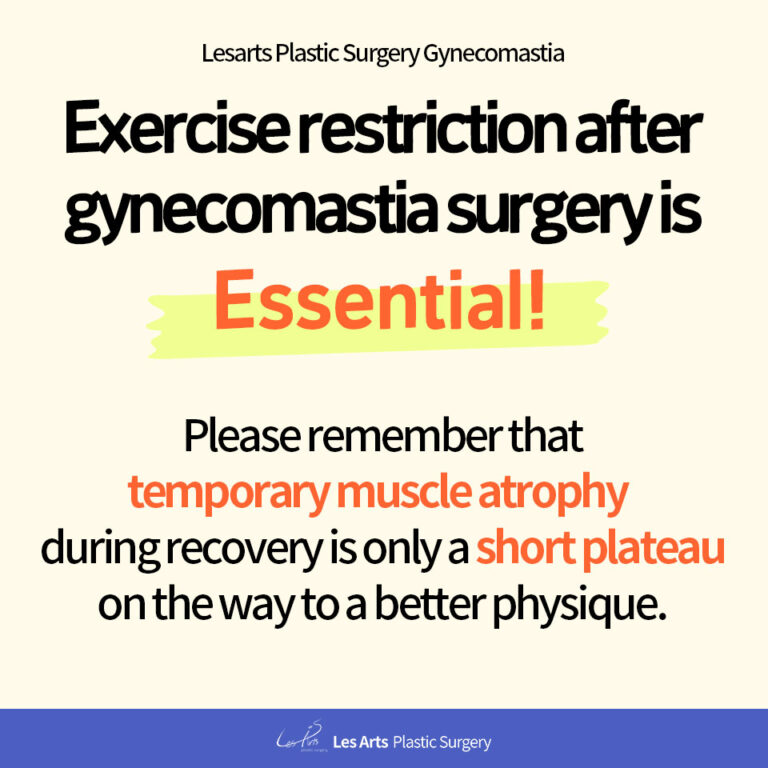
Recovery After Gynecomastia Surgery – Lesarts Plastic Surgery
5.Conclusion
The goal of
gynecomastia surgery
is not simply
to remove excess fat
and glandular tissue.
Its true purpose
is to reconstruct
a flatter,
firmer,
and more masculine
chest contour.
Any temporary appearance of
muscle atrophy
during recovery
should be viewed
as a short transitional phase
on the path back to
muscle growth and training.
In contrast,
returning to exercise
too aggressively
before healing is complete
can create far greater problems.
Attempting to train through
active inflammation,
or risking complications such as
hematoma
and seroma formation,
may ultimately compromise
the surgical outcome.
Excessive early strain
can contribute to
thickened scar tissue,
contour irregularities,
or even asymmetry,
potentially diminishing
the chest contour
that surgery was intended to create.
For this reason,
patience during recovery
is not a setback.
It is an essential part
of achieving the best possible result.
If you follow
your surgeon’s guidance
and return to training
in a gradual,
structured manner,
your chest will have
the opportunity to heal properly
while preserving
the long-term benefits
of surgery.
With a safe recovery
and a thoughtful return
to exercise,
you can ultimately enjoy
greater confidence,
improved chest definition,
and the true satisfaction
that comes from training
with a chest contour
that finally reflects
the effort you have invested.