
Gynecomastia Surgery: The Golden Balance of Liposuction and Gland Excision, and the Art of Sculpting
Hello, this is Dr. Jihoon Moon
from Lesarts Plastic Surgery.
Patients considering
gynecomastia surgery
often hear the explanation that
“Gynecomastia is caused by
excessive growth of glandular tissue.”
After hearing this,
many ask a simple question:
“If that’s the case,
isn’t removing the gland alone enough?”
The answer is not that simple.
The true goal of
gynecomastia surgery
is not merely removing
an enlarged glandular mass.
Creating a flatter,
firmer,
and more masculine chest contour
requires a broader approach
based on body sculpting.
Successful treatment depends on
how the entire chest contour
is reshaped,
rather than how much tissue
is simply excised.
Today,
we will take a closer look at
the relationship between
gland excision
and liposuction,
two essential components
of modern gynecomastia surgery.
We will also discuss
how zone-specific
contour sculpting techniques
can improve surgical precision
and contribute to
a more natural
and aesthetically balanced result.

Gynecomastia Surgery Technique – Jihoon Moon | Lesarts Plastic Surgery
1.Why Liposuction Must Be Performed Together
Gynecomastia
can generally be classified into
three categories:
-True gynecomastia
(primarily glandular tissue)
-Pseudogynecomastia
(primarily fatty tissue)
-Mixed gynecomastia
(a combination of both)
Among these,
the most commonly encountered type
in clinical practice
is mixed gynecomastia.
As the glandular tissue
enlarges abnormally,
fat often accumulates
around the surrounding chest area,
creating a combination
of gland and fat excess.
This is why treatment planning
cannot focus on
the gland alone.
What Happens If
Only the Gland Is Removed?
If surgery targets
only the firm glandular tissue
that can be felt beneath the nipple,
several aesthetic problems
may occur.
One possible outcome is
a crater deformity,
where the area previously occupied
by the gland becomes
visibly sunken.
Another concern is that
the transition between
the remaining fatty tissue
and the excised area
may become more noticeable,
resulting in an unnatural
chest contour.
For this reason,
successful gynecomastia surgery
requires careful balancing of
gland excision
and liposuction.
The goal is not simply
to remove tissue,
but to create a smooth,
masculine chest contour
without abrupt transitions
or contour irregularities.

The Importance of Liposuction in Gynecomastia Surgery – Lesarts Plastic Surgery
In gynecomastia surgery,
liposuction serves
two primary purposes.
First,
it reduces the thickness
of the fatty layer
surrounding the glandular tissue.
By thinning this layer,
the surgeon can obtain
a clearer surgical field
during gland excision
while also helping
to minimize bleeding
throughout the procedure.
Second,
liposuction allows
the overall chest thickness
to be reduced evenly.
This helps create
a smooth transition
between the area
where the gland is removed
and the surrounding tissues,
forming what surgeons often describe as
a natural gradation effect.
In other words,
the initial liposuction phase
serves as the foundation
for creating a flatter chest.
The secondary liposuction performed
after gland excision
functions as a refinement process,
carefully sculpting the contour
to achieve a smoother
and more natural result.
2.Tailoring Surgical Strategy According to Simon Grade
The Simon Classification
is one of the most important tools
used to evaluate
the severity of gynecomastia.
It plays a significant role
in determining the balance between
liposuction
and gland excision
during surgical planning.
Among all classifications,
Simon Grade II
represents the largest patient group.
Within this category,
the surgical approach
can differ considerably
depending on whether
skin laxity is present.
For this reason,
successful treatment requires
not only removal of excess tissue,
but also careful assessment of
skin quality,
chest contour,
and overall body proportions
before deciding on
the most appropriate strategy.
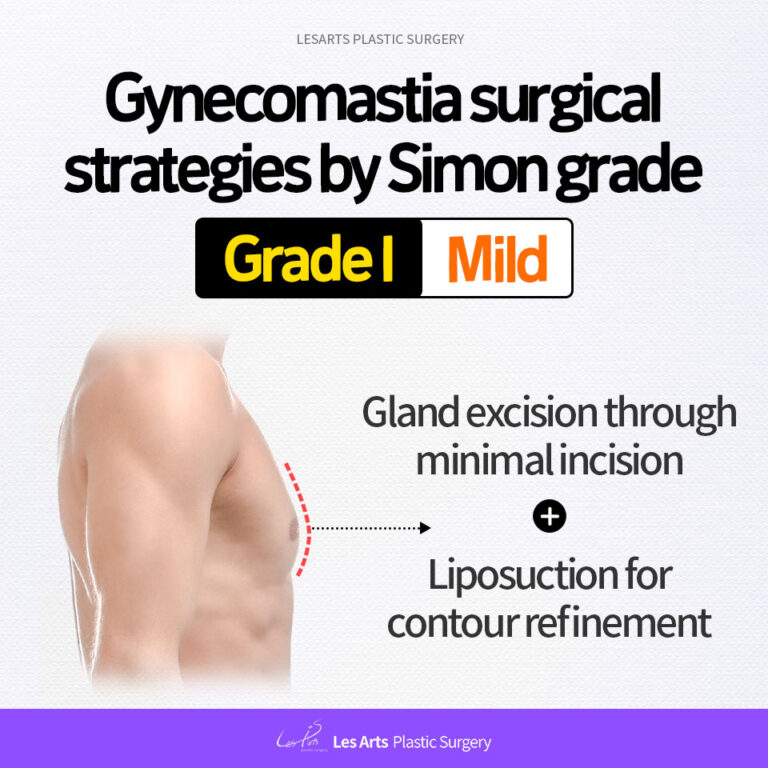
Simon Grade I Gynecomastia Surgery – Jihoon Moon | Lesarts Plastic Surgery
Grade I (Mild Gynecomastia)
This stage is characterized by
glandular tissue enlargement
that is primarily confined
to the area surrounding
the nipple-areolar complex.
Because the enlargement
is relatively localized,
the core treatment strategy
focuses on minimal-incision
gland excision.
In many cases,
carefully removing
the enlarged glandular tissue
through a small incision
can achieve significant improvement
in chest contour.
In addition,
a limited amount of
liposuction
around the surrounding area
is often sufficient
to smooth transitions
and enhance the final result.
By combining
targeted gland removal
with conservative contouring,
a flatter and more masculine
chest appearance
can usually be achieved
without extensive tissue removal.
Grade II (Moderate Gynecomastia)
In Simon Grade II,
the enlargement extends beyond
the nipple region,
resulting in increased volume
throughout the chest.
Because the presentation
can vary considerably,
this category is commonly divided
into two separate subgroups,
each requiring a different
surgical strategy.

Simon Grade IIa Gynecomastia Surgery – Jihoon Moon | Lesarts Plastic Surgery
Grade IIa (Moderate Gynecomastia
Without Skin Laxity)
In Simon Grade IIa,
chest enlargement is clearly visible,
but there is no significant
skin sagging or excess skin.
Because the skin retains
adequate elasticity,
the primary objective
is to reduce the overall
chest volume evenly
while preserving
a natural chest contour.
At this stage,
extensive liposuction
plays a particularly important role.
The initial goal is
to flatten the chest contour
by reducing excess fatty tissue
throughout the entire chest area.
Once the surrounding fat layer
has been sufficiently refined,
the remaining glandular tissue
can be identified more clearly
and removed with greater precision.
This sequence allows
for smoother contour transitions
and helps prevent
abrupt irregularities
between treated and untreated areas.
When performed appropriately,
the skin can adhere naturally
to the underlying muscle layer,
creating a flatter,
firmer,
and more masculine chest contour.
For this reason,
patients with Simon Grade IIa
often achieve a high level
of postoperative satisfaction
through the combination of
strategic liposuction
and precise gland excision.
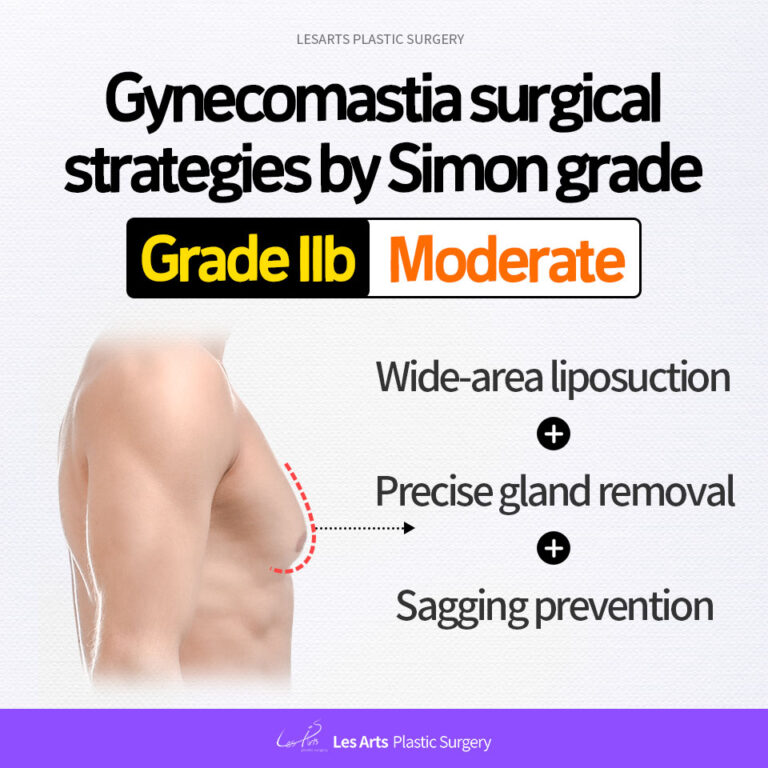
Surgical Management of Gynecomastia with Mild Chest Sagging – Jihoon Moon | Lesarts Plastic Surgery
Grade IIb (Moderate Gynecomastia
with Mild Skin Laxity)
In Simon Grade IIb,
patients present with
both noticeable chest enlargement
and mild skin laxity.
At this stage,
successful treatment requires
more than simply removing
glandular tissue
and excess fat.
The key objective is
to encourage the skin
to contract naturally
after surgery,
allowing the chest to heal
with a smooth
and masculine contour.
For this reason,
surgical planning must consider
not only volume reduction,
but also the skin’s ability
to retract and adapt
to the newly contoured chest.
If skin contraction
is not adequately supported,
patients may experience
residual looseness
or contour irregularities
despite successful tissue removal.
Accordingly,
various supportive measures
may be incorporated
throughout the recovery process
to help minimize
postoperative skin laxity
and promote more favorable
skin retraction.
The treatment strategy
for Simon Grade IIb
therefore focuses on
balancing three important elements:
-Adequate fat reduction
-Precise gland excision
-Optimization of postoperative
skin contraction and contour healing
When these factors
work together effectively,
patients can achieve
a flatter chest appearance
while maintaining
a natural skin contour.
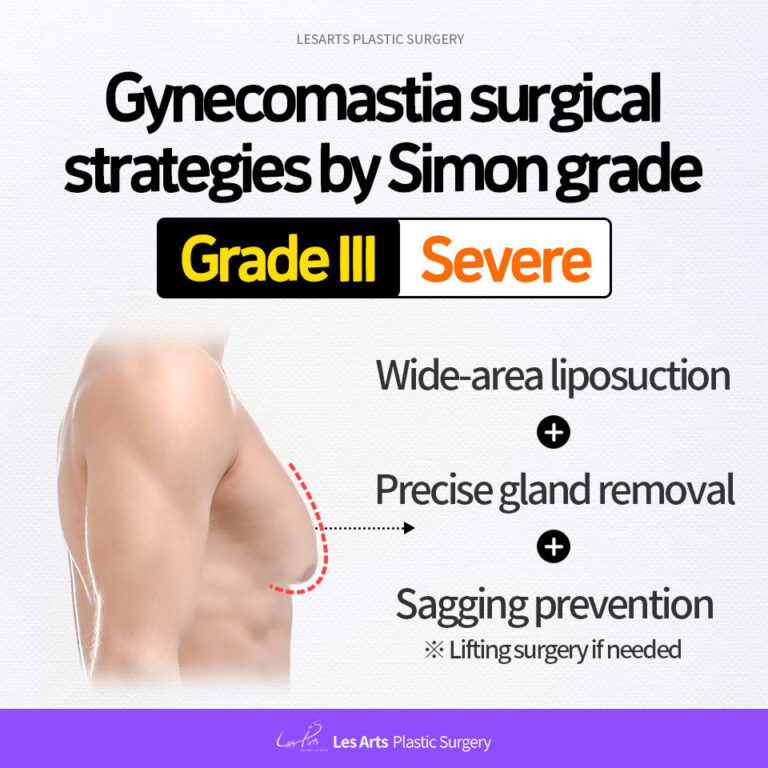
Simon Grade III Gynecomastia Surgery – Jihoon Moon | Lesarts Plastic Surgery
Grade III (Severe Gynecomastia)
Simon Grade III
is characterized by
significant chest enlargement
accompanied by
visible skin laxity.
At this stage,
treatment becomes
considerably more complex
than in mild or moderate cases.
Comprehensive liposuction
and thorough gland excision
remain essential components
of the procedure.
However,
when excess skin cannot adequately retract
after tissue removal, additional skin excision
may be necessary to fully reconstruct
the chest contour.
The goal is not only to reduce chest volume,
but also to restore a flatter, firmer,
and more masculine appearance.
Regardless of the severity grade,
one principle remains constant:
Gland excision must be thorough,
and liposuction must be precise.
Successful gynecomastia surgery
depends on achieving
the proper balance
between complete gland removal
and meticulous contour refinement.
3.Four-Zone Chest Sculpting
The male chest
should never be viewed
as a single flat surface.
Instead,
it can be divided into
four distinct treatment zones.
By approaching each zone
individually and strategically,
surgeons can create
more than simply
a flatter chest.
This method allows
the natural contours
of the underlying musculature
to become more visible,
resulting in a more defined,
three-dimensional,
and masculine chest appearance.
In modern gynecomastia surgery,
the objective is not merely
the removal of excess tissue.
The true goal is
precise chest sculpting,
where each zone contributes
to a balanced
and aesthetically refined result.

Key Treatment Zones in Gynecomastia Surgery – Lesarts Plastic Surgery
Zone 1: Nipple and Areolar Region
This is the area where
glandular tissue
is most heavily concentrated.
One of the greatest challenges
in this zone is achieving
complete gland excision
while preventing
postoperative depression
beneath the areola.
To accomplish this,
a thin layer of fat
is intentionally preserved
as a protective cushion,
while the glandular tissue
is removed thoroughly.
This area requires
a high level of surgical precision
and experience.
Zone 2: Lateral Chest Contour
This zone corresponds to
the outer border of
the pectoralis major muscle.
If excess fat remains here,
the chest may appear
wider and less defined
when viewed from the front.
Careful contouring
along the transition
toward the underarm area
helps create
a stronger and more masculine
chest silhouette.
Zone 3: Upper Chest and Anterior Axillary Area
This region includes
the junction between
the chest and underarm.
Excess fat in this area
can sometimes resemble
an accessory breast contour.
By refining this zone,
the upper chest appears firmer,
and shirts fit more naturally
without fullness
along the upper chest border.
Zone 4: Inframammary Region
This area beneath the chest
is one of the primary contributors
to a feminine chest contour.
Careful removal of fat
along the lower chest border
helps eliminate
the appearance of
an inframammary fold.
The goal is to create
a smooth transition
between the chest
and upper abdomen,
resulting in a flatter
and more masculine profile.
4.Conclusion
Gynecomastia surgery
is not merely a procedure
for removing excess tissue.
It also contains
an artistic component
focused on reconstructing
and refining
the masculine chest contour.
Thorough gland excision
forms the foundation
of successful treatment.
However,
the ultimate quality
of the final result
often depends on
how precisely
the surrounding fat
is sculpted and blended
to reveal the natural contours
of the chest musculature.
For patients considering
gynecomastia surgery,
it is important to focus
not only on tissue removal,
but also on how
a more masculine chest shape
can be created
to complement
their individual body proportions.
A detailed consultation
with an experienced surgeon
is essential for developing
the most appropriate
contouring strategy.