One Week After Mini Liposuction (Fat Extraction Injection): Recovery Mechanism & Golden-Time Care Guide
Hello, this is Dr. Jihoon Moon
from Lesarts Plastic Surgery.
Mini liposuction
(fat extraction injection)
is a highly refined procedure
that simultaneously removes fat physically
while also promoting
the breakdown of surrounding fat layers.
In particular,
the first week after treatment
is an especially dynamic period,
during which the body
begins adapting
to its new contour,
while injured tissues
actively begin the healing process.
It is also the stage
when many patients begin noticing
encouraging changes,
often saying,
“It already feels like
the size has decreased.”
Today,
I would like to explain
the physiological changes
that occur during this period,
along with important care guidelines
for achieving
more refined and stable results.
1. One week after mini liposuction (fat extraction injection) — What happens inside the body?
Swelling After Fat Extraction Injection — Lesarts Plastic Surgery
Bruising, swelling,
and the “law of gravity”
In most cases,
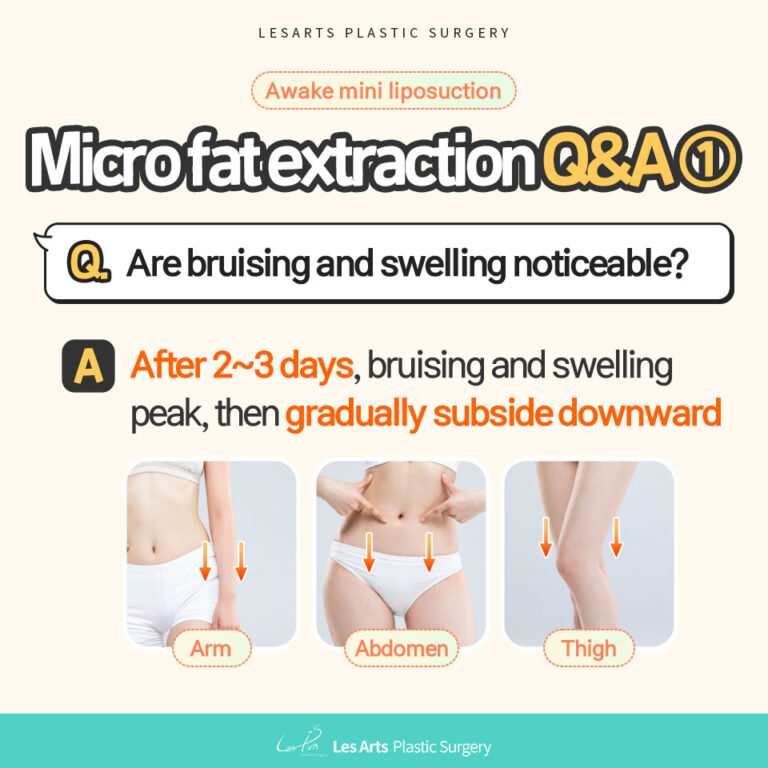
bruising and swelling
become most noticeable
approximately 2–3 days
after the procedure.
Although these symptoms
gradually begin to decrease
after reaching their peak,
some swelling and bruising
generally remain present
even around
the 7-day mark.
One particularly interesting point
is that bruising and swelling
do not always remain
directly within the treated area.
Instead,
they often migrate downward.
For example,
after arm mini liposuction,
swelling and bruising
may move closer
toward the elbow area.
After thigh treatment,
they may descend
toward the knees.
And after abdominal treatment,
they may spread
toward the pelvis
or groin region.
This occurs because
tissue fluid and blood components
naturally shift downward
under the influence of gravity
as they are absorbed by the body.
In other words,
this is a completely natural part
of the healing process.
Bio-Bond After Fat Extraction Injection — Dr. Jihoon Moon at Lesarts
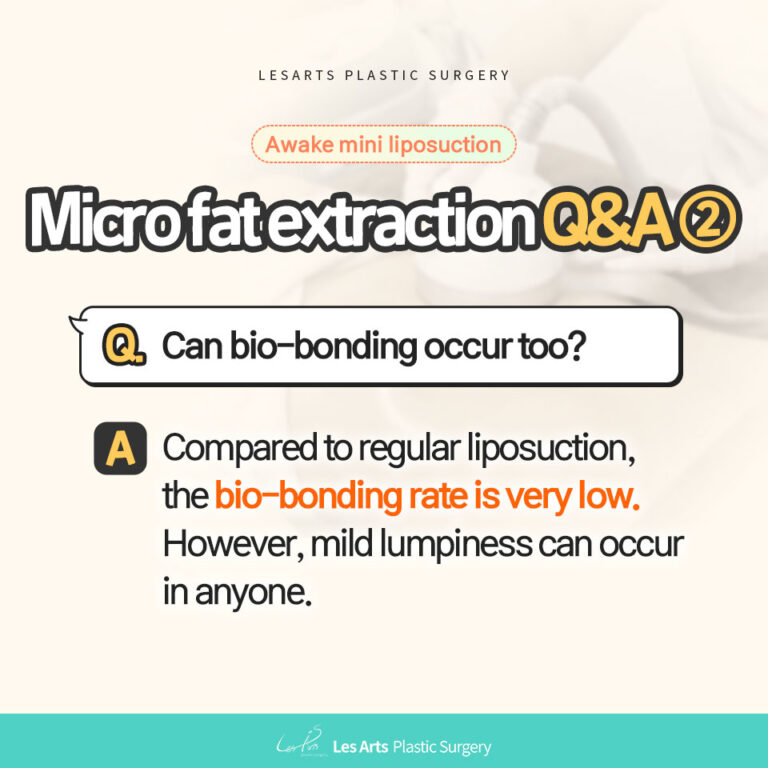
What is a Bio-bond,
and how often does it occur?
After fat extraction injection procedures,
patients often ask,
“Why does the treated area
feel firm or lumpy?”
This temporary firmness
is referred to as
a Bio-bond.
A Bio-bond forms
when fibroblasts gather
along the pathway
where the liposuction cannula passed,
producing collagen
as the tissues reconnect
during healing.
In other words,
it is a temporary process
of mild fibrosis and tissue adhesion.
Compared to
traditional large-volume liposuction,
the incidence of Bio-bond formation
after mini liposuction
or fat extraction injection
is significantly lower.
However,
small areas of firmness
can still occur in anyone,
and this is also considered
part of the process
through which the contour
becomes firmer and more defined.
※ Management TIP:
If necessary,
radiofrequency treatment
may be performed
at approximately 2 weeks
and 4 weeks after the procedure
to improve blood circulation
and help maintain
tissue flexibility.

Recovery Period After Fat Extraction Injection — Dr. Jihoon Moon at Lesarts
Liposuction vs. Fat Extraction Injection:
Differences in recovery speed
Compared to
traditional liposuction surgery,
which typically requires
sedation anesthesia and incisions,
fat extraction injection procedures
generally involve less swelling
and a significantly faster recovery process.
Most patients are able
to return to daily activities
immediately after the procedure.
By approximately 4 weeks,
around 90% of the overall swelling
has usually subsided,
allowing patients
to clearly appreciate
the refined contour
and overall shape
of the final line.
Stitch Removal After Fat Extraction Injection — Lesarts Plastic Surgery
2. The art of wound care: Early stitch removal and UV protection
At our clinic,
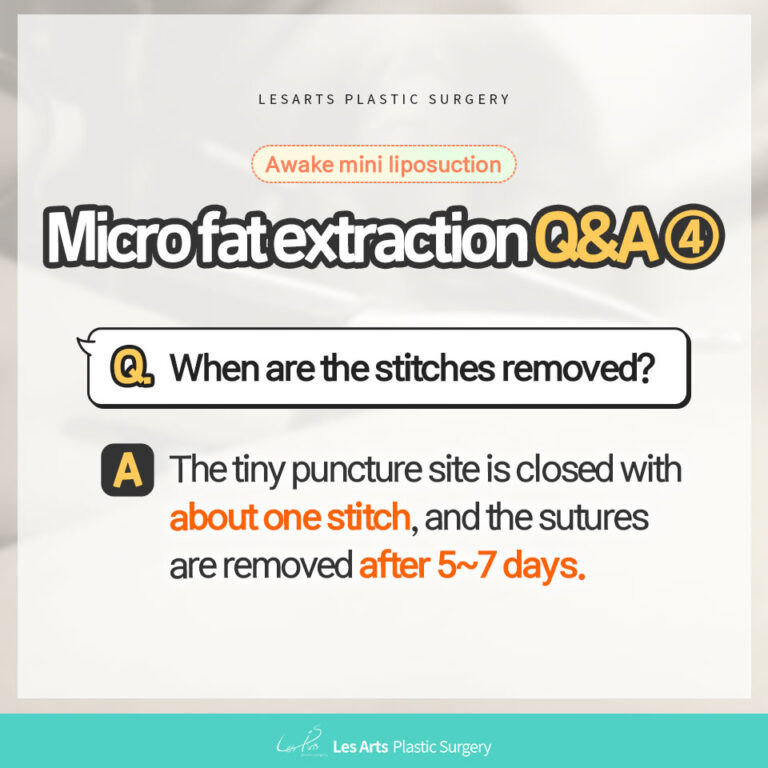
the tiny puncture sites
where the cannula entered
during the procedure
are typically closed
with a single stitch.
Stitch removal
is usually performed
approximately 5–7 days
after the procedure.
Because the wound itself
is extremely small,
it is generally
sufficiently healed by then,
and early stitch removal
helps minimize
the possibility of visible scarring.
However,
the treated skin remains
temporarily sensitive,
due to repeated friction
from the cannula movement
during the procedure.
For this reason,
even after stitch removal,
patients are advised
to continue applying
hydrocolloid dressings
(such as DuoDERM)
for an additional
1–2 weeks.
This process is very important,
as it creates
a moist healing environment,
supports skin regeneration,
and helps prevent
post-inflammatory pigmentation
by blocking UV exposure.
In fact,
pigmentation changes
have been reported
not only from sunlight,
but also from indoor lighting exposure.
Therefore,
consistent use
of sunscreen protection
for an adequate period of time
is strongly recommended.

Precautions After Mini Liposuction — Dr. Jihoon Moon at Lesarts
3. Nutritional strategies
and restrictions to accelerate recovery
Recommended calorie intake
and macronutrient ratio
Balanced nutrition
is essential
for tissue regeneration
in areas where fat was removed.
Extreme fasting
can actually delay
the recovery process
of Bio-bond healing.
For approximately
1–2 weeks after the procedure,
adequate calorie intake
is strongly recommended.
Men: 2,200–2,800 kcal/day
Women: 1,600–2,200 kcal/day
The recommended
macronutrient ratio is:
-40% carbohydrates
-40% protein
-20% fat
Protein:
Because protein serves
as the primary material
for damaged tissue regeneration,
patients are encouraged
to consume sufficient amounts
of foods such as:
-Chicken breast
-White fish
-Egg whites
Carbohydrates:
Rather than refined sugars
and processed flour,
complex carbohydrates
such as brown rice
and sweet potatoes
are recommended,
as they help stabilize
insulin levels
and may reduce
the likelihood
of fat re-accumulation.
※ Foods to avoid※
Sodium is one of
the biggest enemies
during swelling recovery.
Foods such as:
-Soups
-Stews
-Salted or fermented side dishes
can cause the body
to retain excess fluid,
delaying swelling reduction.
For at least one week,
a low-sodium diet
is recommended.
The harmful effects
of alcohol and smoking
(Absolutely prohibited)
Alcohol
Alcohol dilates blood vessels,
which can worsen swelling
and increase body temperature,
potentially triggering
additional inflammatory reactions.
Smoking
Nicotine constricts blood vessels,
reducing blood flow
to the treated area
and limiting the delivery
of oxygen and nutrients.
This not only delays
wound healing,
but may also lead
to darker, more noticeable scarring.
The first week after treatment
is only the beginning
of visible change.
This stage should be understood
as a promising early sign
before the final result
fully settles into place.
While many patients notice
early size reduction
within just one week,
the body is still
in a transitional stage,
where swelling and tissue adhesion
coexist simultaneously.
Over approximately 4 weeks,
around 90% of the swelling
gradually subsides,
and the contour settles naturally
through the body’s own
healing mechanisms.
Rather than becoming overly sensitive
to short-term changes
during the first week,
patients are encouraged
to trust the medical guidance provided
and allow the body
sufficient time to heal naturally.
Because even the best procedure
can achieve more satisfying results
when combined with
consistent and dedicated aftercare.