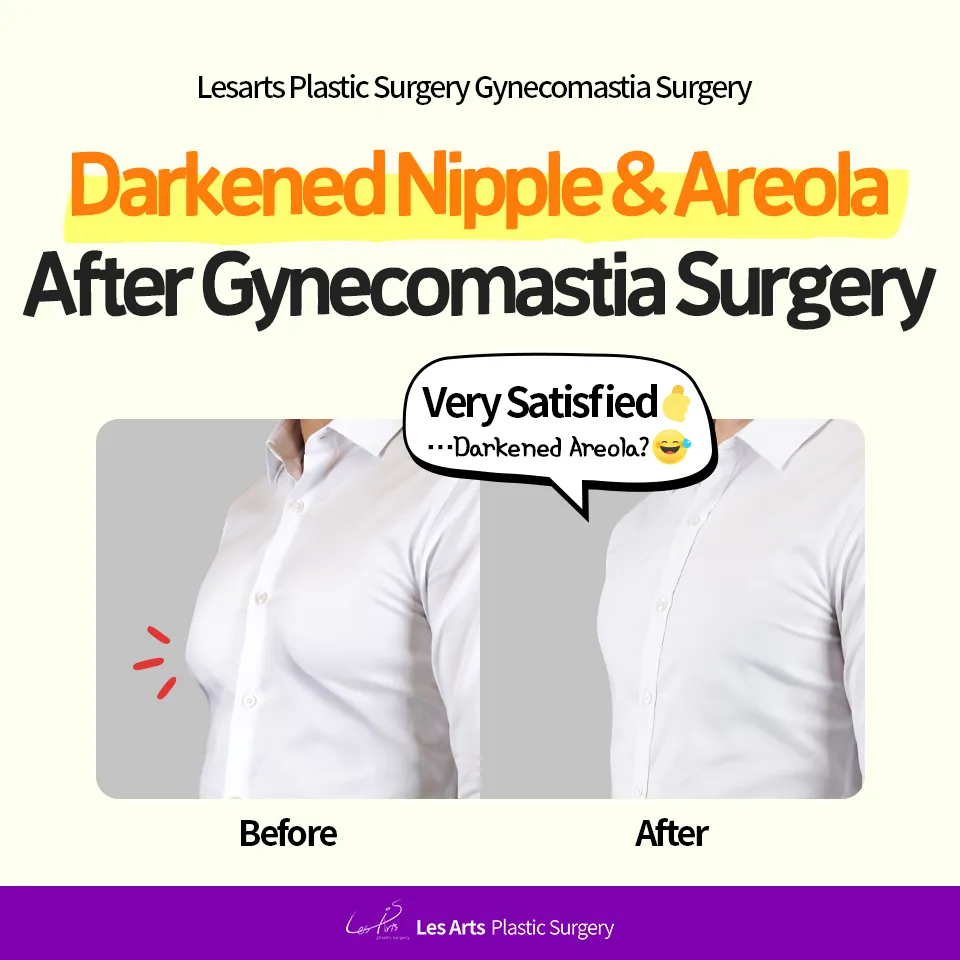
[Gynecomastia]Could I Have Gynecomastia?A Self-Assessment Guide for Men Concerned About Chest Enlargement
Hello, this is Dr. Jihoon Moon
from Lesarts Plastic Surgery.
When meeting with patients
in the clinic each day,
I often notice
an interesting pattern.
Men who visit our clinic
generally fall into
two distinct groups.

Gynecomastia Consultation – Dr. Jihoon Moon | Lesarts Plastic Surgery
The first group consists of men who have suffered significant stress
because of their chest appearance for many years,
and finally arrive with a firm determination,
believing that it is time to free themselves
from that burden and undergo treatment.
In fact, the overwhelming majority of patients
who visit our clinic belong to this category.
They are men who spent years avoiding thin T-shirts
despite feeling comfortable wearing shorts,
and who never felt at ease visiting public bathhouses
or swimming pools.
After enduring these frustrations for so long,
they finally gather the courage
to seek treatment.
On the other hand, the second group is a little different.
“Doctor, do I actually have Gynecomastia?
Or am I simply overweight?
I came because I wanted to find out
whether there is a real problem.”
These patients often begin the consultation
with that question.
Today, before visiting a clinic,
I would like to help you evaluate
your own body and daily experiences
with greater confidence through the
10-Point Gynecomastia Self-Assessment Scale.
Rather than focusing on complex medical explanations,
this guide summarizes the practical physical changes
and psychological signals most commonly reported
by patients in the clinic,
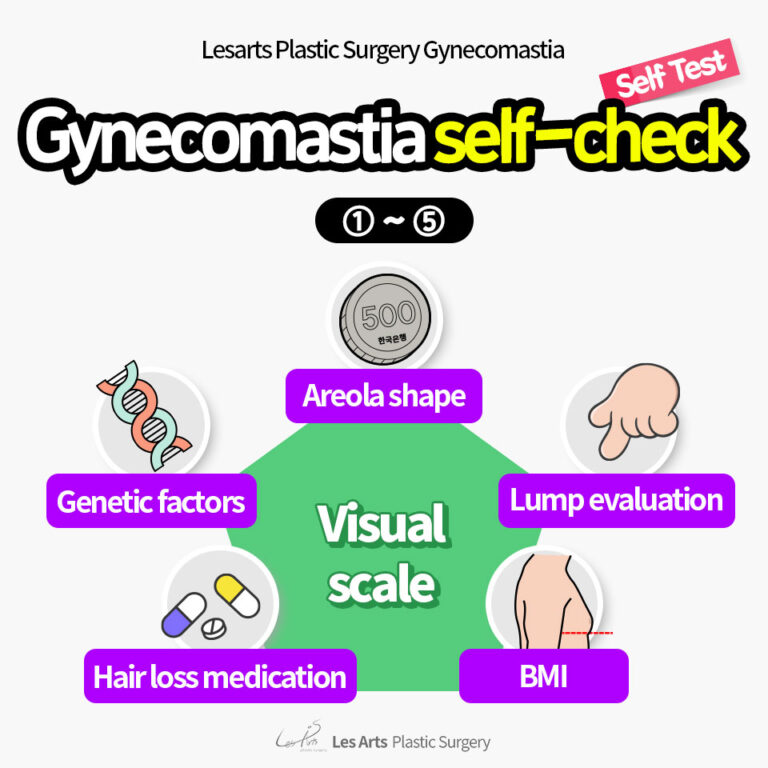
organized into five physical indicators
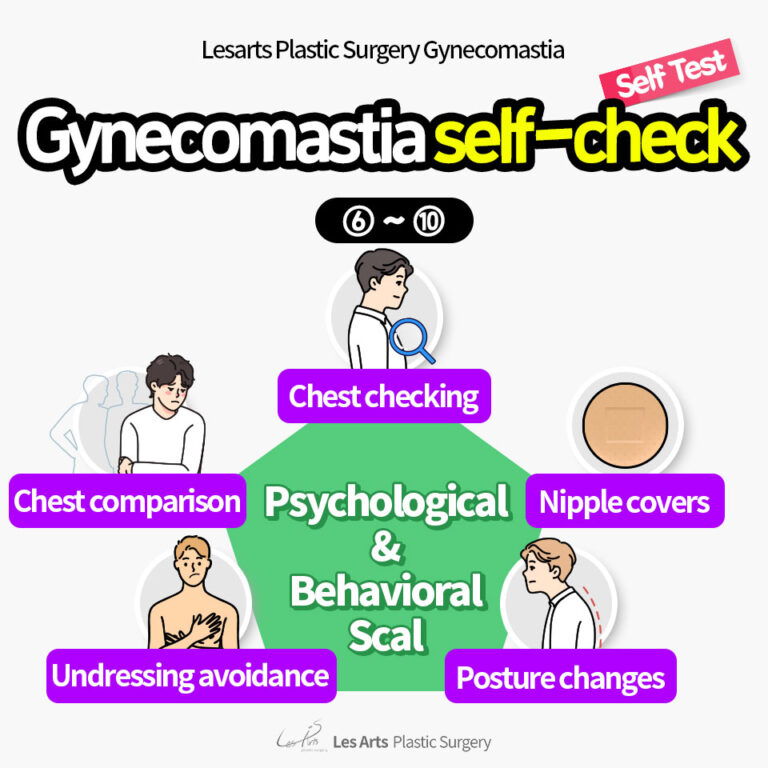
and five psychological and behavioral indicators.
※ Review items ① through ⑩
and check each statement that applies to you.
[Part 1] Five Physical Indicators You Can See and Feel
Let us begin with the physical changes and characteristics
that can be identified intuitively,
simply by looking in the mirror
or examining your chest by hand.
Gynecomastia Self-Assessment – Dr. Jihoon Moon | Lesarts Plastic Surgery
① The areola is larger than a 500-won coin and appears protruded.
Place a Korean 500-won coin
(approximately 26.5 mm in diameter)
over your chest.
If the areola is clearly larger than the coin,
or noticeably projects outward,
the possibility of enlarged
glandular tissue
should be strongly considered.
② A firm lump can be felt beneath the nipple.
While standing comfortably and relaxed,
gently grasp the area around the
nipple and areola with your thumb
and index finger,
then press toward the center.
Unlike simple obesity,
where only soft fat tissue is felt,
a firm lump resembling
rubber clay or citrus peel
beneath the nipple
may indicate the presence of
glandular tissue
that cannot be reduced through exercise alone.
③ Your chest appears enlarged despite having a normal BMI.
Even when maintaining
a completely normal body weight
and BMI,
you may still find yourself thinking,
“Do I need to lose more weight?”
“Should I train my chest harder?”
If the fullness around the
nipple and areola remains
despite repeated dieting efforts,
the cause is likely not body fat,
but enlarged glandular tissue.
④ Changes in chest appearance developed after taking medication.
If your chest shape
has changed recently,
it may be worth reviewing
your current medications.
In particular,
if you noticed increased fullness
or tenderness in the chest
after starting hair-loss medications
such as Finasteride
or Dutasteride,
there is a possibility that
hormonal effects have stimulated
the glandular tissue.
⑤ Other men in your family have prominent chests.
Genetic predisposition
can also play a role in
Gynecomastia.
Although excess weight
is strongly associated
with the condition,
some individuals are genetically prone
to accumulating fat around the chest
and developing enlarged
glandular tissue.
If your father, brothers,
or other male relatives
have noticeably prominent chests,
your own likelihood of having
Gynecomastia
may be relatively higher.
[Part 2] Five Psychological and Behavioral Indicators That Influence Daily Life
People naturally become
highly aware of areas
they feel self-conscious about.
Take a moment to consider
whether your thoughts
and behavior patterns
resemble the situations
described below.
Preoperative Evaluation for Gynecomastia – Lesarts Plastic Surgery
⑥ When looking at other men, your eyes are drawn to their chest first.
When passing someone on the street
or meeting another man for the first time,
you instinctively find yourself
looking at his chest before anything else.
You may catch yourself thinking,
“He’s only wearing a thin T-shirt,
yet his chest looks completely flat.”
Or,
“He may be overweight,
but his chest doesn’t protrude.
Meanwhile, both my abdomen
and chest stand out.”
Without realizing it,
you repeatedly compare
your own chest shape
with those of other men.
⑦ When viewing shirtless men on social media or in the media, you focus primarily on their chest.
Whether browsing online communities,
social media,
or watching videos,
you pay far more attention
to chest shape and projection
than to overall muscle mass
or body proportions.
Rather than appreciating
their physique as a whole,
you automatically compare
their chest appearance
with your own.
⑧ You cannot comfortably wear thin clothing without nipple covers.
When wearing light T-shirts
or shirts during spring and summer,
you feel unable to leave home
without using nipple covers
or choosing thicker clothing.
Even with nipple covers,
the chest projection itself
often remains visible,
causing significant stress
whenever you get dressed.
As a result,
you may find yourself
consistently choosing
dark-colored
or oversized clothing.
⑨ People often tell you to “stand up straight.”
Because you unconsciously try
to conceal your chest,
you may habitually roll
your shoulders forward
and adopt a hunched posture.
If people frequently say things like,
“Why is your posture so slouched?”
or
“Straighten your shoulders
and stand confidently,”
it may indicate that
Gynecomastia
is already affecting
your posture and body language.
⑩ You strongly avoid saunas, public baths, or swimming pools—even where nobody knows you.
This goes beyond simply feeling embarrassed
around acquaintances.
Even when traveling,
or visiting a public bath,
sauna,
or water park
where nobody knows you,
you still feel conscious
of other people’s attention
and avoid these environments altogether.
The act of removing your shirt
in front of strangers
becomes a significant
psychological barrier.
[Scoring System] Assessing Your Likelihood of Gynecomastia
Count the total number
of statements among the ten items above
that apply to you.

Gynecomastia Self-Test – Dr. Jihoon Moon | Lesarts Plastic Surgery
◈ 0–2 Items Checked (Low Concern) ◈
There is a high possibility
that your symptoms are related to
simple fat accumulation
(Pseudogynecomastia)
or are only temporary in nature.
However,
if you can feel a firm
glandular lump,
or have noticed significant changes
after starting medication,
a detailed evaluation is still recommended.
◈ 3–5 Items Checked (Suspicion Stage) ◈
There is a significant possibility
that you have Gynecomastia
requiring medical evaluation.
At this stage,
physical changes are often accompanied by
psychological discomfort
and increasing self-consciousness
in daily life.
A detailed ultrasound examination
to assess the thickness of the
glandular tissue
is strongly recommended.
◈ 6 or More Items Checked (High Probability / Treatment Consideration Stage) ◈
Clinically,
the likelihood of Gynecomastia
is very high.
In many cases,
the condition has already been affecting
quality of life
and limiting daily activities
for a considerable period of time.
Rather than continuing
to struggle with the issue alone,
this is the point at which
seeking professional evaluation
and discussing treatment options
becomes worthwhile.
Conclusion
If reviewing these ten questions
helped you realize,
“Maybe this wasn’t caused by
a lack of effort or self-discipline,
but by a genuine medical condition
called Gynecomastia,”
then you have already taken
the first important step.
When you visit the clinic,
you will not be met with
a complicated or intimidating process.
In a comfortable setting,
we simply perform
a high-resolution breast ultrasound
to accurately measure
the thickness of the
glandular tissue
down to the millimeter.
Once you clearly understand
the condition of your body,
many of the uncertainties surrounding
treatment decisions
naturally become easier to navigate.
We hope this
10-Point Gynecomastia Self-Assessment Scale
serves as a helpful guide
toward taking that first step
through the clinic door.