
[Gynecomastia]Adolescent Gynecomastia:Is Waiting Always the Best Answer?
Hello, this is Dr. Jihoon Moon
from Lesarts Plastic Surgery.
Gynecomastia is not a condition
that affects only adult men.
In recent years,
more middle school
and high school boys
have been visiting clinics
because of concerns about
the appearance of their chest.
When adolescent gynecomastia
develops during puberty,
it carries significance beyond
a simple physical change.
The condition can influence
body image,
self-confidence,
and even social relationships
during a particularly sensitive stage
of emotional development.
For many teenagers,
chest enlargement becomes
a source of embarrassment,
leading them to avoid
certain clothing,
sports activities,
or situations where
their body may be exposed.
Today,
we will discuss
gynecomastia in adolescents,
with a particular focus on
the important information
that parents should understand
when evaluating this condition.
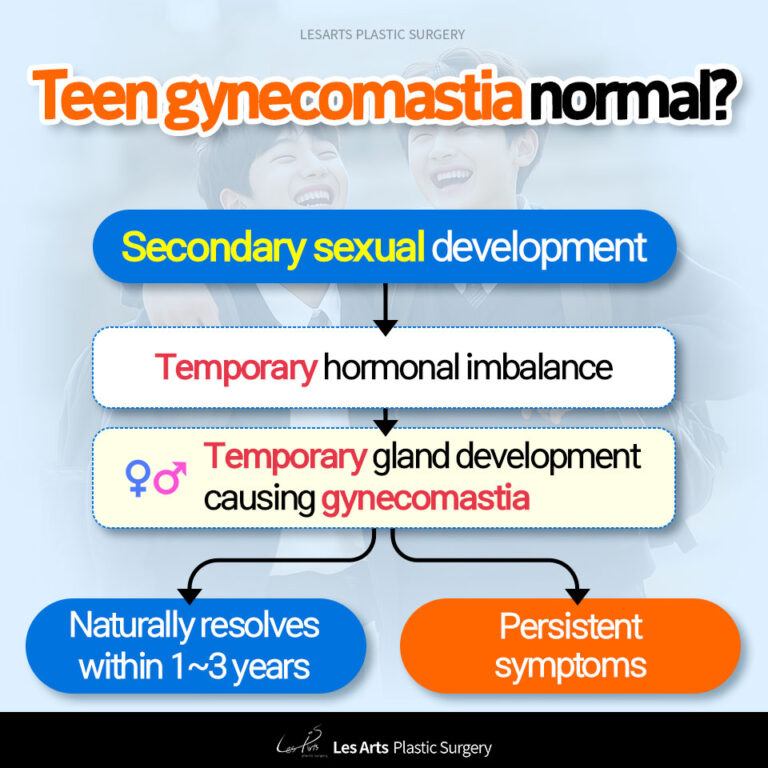
Causes of Adolescent Gynecomastia – Jihoon Moon | Lesarts Plastic Surgery
Is Pubertal Gynecomastia Normal?
The short answer is yes.
Pubertal gynecomastia
is a very common physiological condition
that occurs during adolescence.
As secondary sexual characteristics develop,
the balance between
male hormones and female hormones
can temporarily fluctuate.
During this period,
the glandular breast tissue
may enlarge temporarily,
resulting in visible chest prominence.
In most cases,
these hormonal changes
gradually stabilize over time,
and the enlarged tissue
naturally regresses within
approximately one to three years.
This is why many parents
and teenagers are told that
“it will improve with time.”
While this statement
is often correct,
it is important to understand
that it does not apply
to every patient.
Some cases do not resolve naturally.
For a subset of adolescents,
gynecomastia persists
beyond the expected observation period
and remains as a long-term condition
rather than a temporary
hormonal change.
Identifying these patients early
and monitoring their progress appropriately
is an important part
of managing adolescent gynecomastia.

Will Adolescent Gynecomastia
Resolve Naturally? – Jihoon Moon | Lesarts Plastic Surgery
The likelihood of
natural resolution decreases significantly
when any of the following
clinical findings are present:
– A firm glandular mass
can be felt beneath the nipple,
often accompanied by tenderness
– The chest enlargement
has remained unchanged
for more than six months,
or continues to increase in size
– Noticeable asymmetry exists
between the left and right sides
– Persistent pain or tenderness
occurs even at rest
or when pressure is applied
In these situations,
simple observation alone
may not be sufficient.
A more detailed evaluation
is often recommended
rather than relying solely on
the expectation that
the condition will improve with time.
For this reason,
“waiting and watching”
is not always the best answer.
Under current Korean
health insurance guidelines,
adolescent gynecomastia
is generally observed
for at least six months
before reassessment.
This recommendation exists
to avoid unnecessary treatment
for cases that may resolve naturally,
and it serves as
a reasonable medical standard.
However,
real-world clinical experience
often presents a more complex picture.
By the time many adolescents
and their parents
seek medical consultation,
the emotional stress
associated with the condition
has already accumulated significantly.
In addition,
clinical experience suggests that
when a patient presents
with clearly visible
gynecomastia at the initial visit,
substantial improvement
over the following six months
is often less common
than many families expect.
In other words,
while observation remains important,
waiting alone does not always
provide a solution.

Diagnosis and Treatment of
Adolescent Gynecomastia – Jihoon Moon | Lesarts Plastic Surgery
For adolescent boys,
gynecomastia
is far more than
a simple cosmetic concern.
In many cases,
the emotional burden
is much greater
than parents initially realize.
Common signs of stress include:
-Avoiding changing clothes
during physical education classes
-Avoiding swimming pools,
public baths,
or situations involving
body exposure
-Wearing multiple layers of clothing
or insisting on loose-fitting garments
-Becoming excessively conscious
of comments, attention,
or teasing from peers
-Developing habits such as
hunching the shoulders
or bending forward
to conceal the chest
Over time,
these behavioral changes
can contribute to
social withdrawal
and reduced self-confidence.
From a parent’s perspective,
it may sometimes seem difficult
to understand why the issue
causes such significant distress.
However,
for the adolescent experiencing it,
the concern is often
very real and deeply personal.
The teenage years are a critical period
for the development of
self-image and self-esteem.
Because of this,
relying solely on the passage of time
may not always be the best approach.
When significant psychological stress
is already present,
delaying proper evaluation
can sometimes leave
lasting emotional effects
that extend far beyond
the physical symptoms themselves.

Risk of Recurrence After Gynecomastia Surgery – Jihoon Moon | Lesarts Plastic Surgery
Should Gynecomastia Surgery Be Delayed?
Understanding the Misconception About Regrowth
One of the most common concerns
among parents of adolescent patients is:
“If surgery is performed
during the growth period,
won’t it come back again?”
This concern is understandable.
From a theoretical perspective,
hormonal fluctuations continue
throughout adolescence,
which means that
the possibility of additional
glandular tissue growth
cannot be completely excluded.
However,
from a clinical standpoint,
meaningful regrowth of
glandular breast tissue
after gynecomastia surgery
is extremely uncommon.
In reality,
there are several factors
that deserve greater consideration:
-The risk of recurrence is low
-The patient’s current stress level
is often very high
-Postoperative follow-up
and ongoing monitoring
remain available after treatment
For this reason,
even after stitch removal,
patients are advised
to continue applying
hydrocolloid dressings
(such as DuoDERM)
for an additional
1–2 weeks.
This process is very important,
as it creates
a moist healing environment,
supports skin regeneration,
and helps prevent
post-inflammatory pigmentation
by blocking UV exposure.
For this reason,
it is worth carefully considering
whether it is truly beneficial
to postpone treatment
because of a relatively unlikely event,
while allowing significant
and immediate emotional distress
to continue.
Why Early Evaluation Matters
In many cases,
earlier evaluation of
adolescent gynecomastia
is advantageous.
For adolescent patients,
the timing of the first consultation
can be particularly important.
Under current health insurance criteria,
a period of observation
of at least six months
is generally required
before surgical treatment
can be reconsidered.
As a result,
the longer the initial consultation
is delayed,
the further the potential timing
of treatment may also be postponed.
This is why
early assessment does not necessarily mean
immediate surgery,
but it can provide valuable time
for diagnosis,
monitoring,
and appropriate treatment planning.

When Is the Right Time for Adolescent Gynecomastia Surgery? – Jihoon Moon | Lesarts Plastic Surgery
While every patient requires
individual consideration,
one of the most important factors
influencing the treatment timeline is
“When was the patient first evaluated
for gynecomastia?”
In many cases,
the timing of the initial consultation
directly affects
the overall treatment schedule.
Therefore,
if gynecomastia is suspected
and psychological distress
is already affecting daily life,
obtaining an accurate diagnosis
as early as possible
is often the most practical choice.
The Importance of Parents’ Role
For adolescents with
gynecomastia,
the support of parents
is particularly important.
Many teenage boys
do not openly discuss
changes in their bodies,
even with family members.
Some dismiss the issue by saying,
“It’s probably just because
I gained weight.”
Others struggle silently,
become increasingly withdrawn,
or rely on inaccurate information
found online.
In these situations,
parents can play
an essential role.
The goal is not
to become overly worried,
but also not to dismiss
the concern too quickly.
Helping a child receive
an objective medical evaluation
is often the most helpful approach.
The first step
is understanding what kind of discomfort
the child is experiencing,
and creating an environment
where honest and meaningful conversations
can take place.
Conclusion
Adolescent gynecomastia
is often a normal part
of physical development,
and in many cases
it improves naturally over time.
However,
there are also patients
for whom treatment
is genuinely necessary.
The key is not simply
to wait or rush into treatment,
but to determine
whether the condition
is progressing normally
or requires further evaluation.
Early assessment,
appropriate observation,
and individualized treatment planning
remain the most important steps
in helping adolescents
navigate this condition successfully.

Diagnosis and Surgical Treatment of Gynecomastia in Middle and High School Boys – Jihoon Moon | Lesarts Plastic Surgery
There are three key points that parents and patients
should remember about adolescent gynecomastia:
-Not every case of gynecomastia
resolves naturally
-The emotional stress experienced
by the adolescent is often
far greater than it appears
-Early diagnosis plays
an important role in determining
the appropriate timing of treatment
Most importantly,
the possibility of recurrence,
while often a major concern,
should be viewed realistically.
Allowing a teenager to continue
suffering significant emotional distress
because of a relatively unlikely recurrence
may not always be
the most reasonable approach.
Gynecomastia
is not simply a cosmetic issue.
During adolescence,
it can have a meaningful impact
on self-esteem,
body image,
social confidence,
and overall quality of life.
For this reason,
obtaining an accurate diagnosis early
and considering appropriate treatment
when necessary
can be an important step
toward improving both physical
and emotional well-being.
The goal is not
to rush into surgery,
but to understand the condition clearly,
monitor it appropriately,
and intervene at the right time
when treatment is genuinely needed.
That approach often provides
the most practical
and meaningful support
for adolescents struggling with
gynecomastia.