
[Gynecomastia] “Does Stopping Exercise Cause Gynecomastia?” — Chest Changes in Middle-Aged Men: Gynecomastia or Simple Fat Gain?
Hello, this is Dr. Jihoon Moon
from Lesarts Plastic Surgery.
Men who were once deeply committed
to weight training in their younger years
often say something similar
as they enter middle age.
“My chest muscles used to look defined,
but these days my chest seems to be sagging.”
Behind this statement lies more than
a simple cosmetic concern.
What many are truly worried about is:
“Could this actually be gynecomastia?”
To answer directly,
simply stopping exercise
does not automatically cause
everyone to develop gynecomastia.
However,
changes that
“appear similar to gynecomastia”
are actually very common.
Today,
I would like to explain
why this happens from anatomical, hormonal,
and lifestyle-related perspectives.
1. When muscle decreases, the chest begins to “sag” — A structural change
The pectoralis major muscle,
developed through weight training,
does not simply increase
chest “volume.”
It also acts
as an internal structural frame,
supporting the chest skin
and fat layer from underneath.

Chest Changes After Stopping Exercise — Lesarts Plastic Surgery
When exercise is maintained consistently,
the volume
of the pectoralis major muscle
remains preserved,
keeping the chest skin
relatively firm and supported.
However,
after stopping exercise,
the following changes
often occur sequentially:
① Decrease in muscle mass (muscle atrophy)
② Reduction in skin support
③ Downward shifting of the remaining fat layer
As a result,
the chest may begin
to appear as though
it is “drooping downward.”
This closely matches
what many patients describe as:
“My chest used to feel firm,
but now it feels soft and saggy.”
An important point is that,
at this stage,
it may still
not technically be
true gynecomastia.
2. Increased body fat — Pseudogynecomastia
More important than
simply stopping exercise
is the increase in overall body fat.
As men enter middle age,
their basal metabolic rate
naturally decreases compared to younger years,
physical activity levels decline,
and lifestyle and eating habits often change,
making fat accumulation easier.
In particular,
men tend to accumulate fat
primarily around:
-The abdomen
-The flanks
-The chest
When fat increases in the chest area,
the volume enlarges
and gradually sags downward
under the influence of gravity,
making the nipple and areola region
appear fuller and thicker.
Visually, this appearance can look
very similar to gynecomastia.
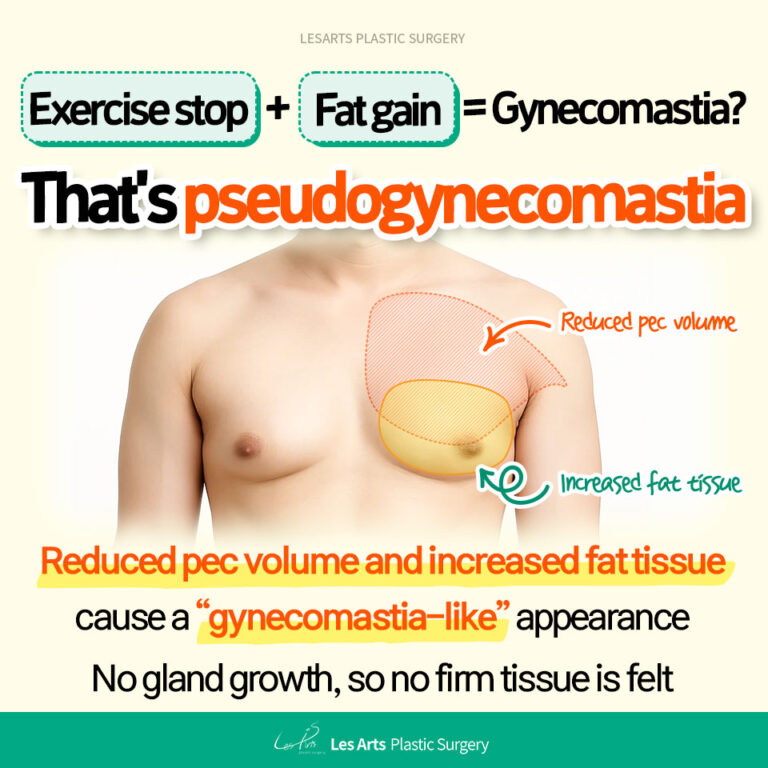
Gynecomastia and Body Fat — Dr. Jihoon Moon at Lesarts Plastic Surgery
In these cases,
the issue is not
the growth of glandular tissue, but rather
an increase in body fat.
Medically,
this condition is referred to as pseudogynecomastia.
There is also a characteristic difference
upon physical examination.
True gynecomastia glandular tissue
typically feels firm and disk-shaped
directly beneath
the nipple and areola.
In contrast,
pseudogynecomastia
generally feels softer
and more evenly distributed
throughout the chest.
In other words,
when exercise is discontinued,
the volume of the pectoralis muscle decreases,
while fat tissue increases,
causing the chest to merely appear similar
to gynecomastia.
3. True gynecomastia — The influence of hormonal changes
Then why does actual gynecomastia occur?
The key lies in the hormonal balance between
Testosterone (the male hormone) and Estrogen (the female hormone)
As men enter middle age,
several physiological changes naturally occur:
-Decrease in testosterone
-Increase in body fat
-Increased activity
of the enzyme aromatase
within fat tissue
This enzyme, called aromatase,
converts testosterone into estrogen.

Middle-Aged Gynecomastia Caused by Hormonal Changes — Lesarts Plastic Surgery
In other words,
as body fat increases,
male hormone levels decrease,
while female hormone activity
relatively increases.
This creates
a hormonal environment
in which glandular tissue
can actually begin to grow.
In these situations,
the condition is diagnosed not as
simple fat accumulation,
but as
true gynecomastia.
Clinically,
this condition often presents
with characteristic features.
A firm tissue mass
may be felt
beneath the nipple
and areola region.
When pressed,
patients may experience:
-Mild tenderness
-Discomfort
-Or in severe cases, pain so sensitive
that patients describe it as
“painful even with slight contact”
Visible asymmetry
between the left and right chest may also develop.
However,
it is also common
for patients to have
little to no noticeable pain,
or no clearly palpable lump at all.
Therefore,
although these changes
may initially appear
to be caused simply
by stopping exercise,
the underlying issue
is often related
to hormonal imbalance.
4. Hair-loss medications and gynecomastia — An often overlooked factor
In recent years,
one contributing factor
has become noticeably more common.
That factor is
the use of hair-loss prevention medication.
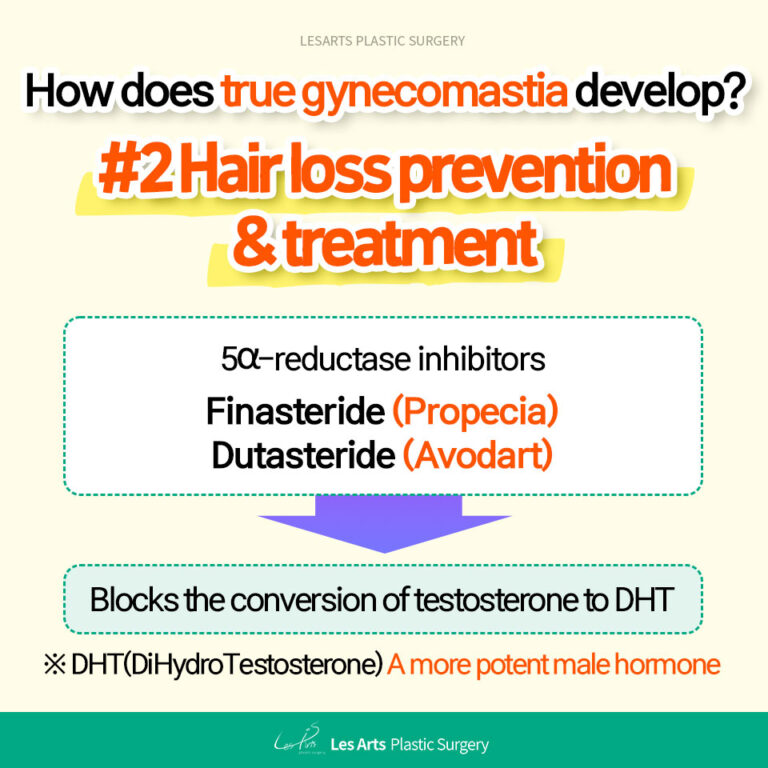
The Relationship Between Hair-Loss Medication and Gynecomastia — Dr. Jihoon Moon at Lesarts Plastic Surgery
Hair-loss medications
can generally be divided
into two major categories
based on their mechanism of action.
1) 5-alpha reductase inhibitors (5α reductase inhibitors)
Representative medications include:
-Finasteride (Propecia)
-Dutasteride (Avodart)
These medications work by inhibiting
the conversion of testosterone into DHT (dihydrotestosterone),
which is a more potent form
of male hormone.
Because DHT
is considered one of the primary causes
of male-pattern hair loss
(and benign prostatic hyperplasia),
these medications are widely used
as core treatment agents.
2) Vasodilators (vasodilators)
The most representative example is Minoxidil.
Originally developed
as a blood pressure medication,
Minoxidil increases scalp blood flow,
helping improve
the follicular environment,
which is why it later became
widely used for hair-loss treatment.
Among these two categories,
the group associated
with gynecomastia is the 5α reductase inhibitor class.
(In other words, Minoxidil itself
is not associated with gynecomastia.)
In actual clinical practice,
when taking a detailed medical history,
it is not uncommon
to find patients
who noticed gradual chest changes
after beginning
hair-loss prevention medication.
5. Why previous weight-training experience
can make chest changes appear even more noticeable
Interestingly,
the more extensively
someone exercised in the past,
the more obvious
these changes may appear.
There are several reasons for this.

Loss of Chest Muscle and Gynecomastia — Lesarts Plastic Surgery
1) Contrast effect
Past: A firm, muscular chest
built through training
Present: Muscle loss
combined with increased fat accumulation
Because the contrast
between these two states
is so significant,
the change often feels
far more dramatic.
2) Skin laxity
When chest muscles
were previously well-developed,
the skin was stretched
to accommodate that volume.
As muscle mass decreases,
the remaining skin may become loose,
making the chest appear
more sagging
than would occur
from simple fat gain alone.
In fact, when skin laxity accompanies gynecomastia,
the condition may progress
to a higher Simon grade classification.
3) Fat redistribution
After stopping exercise,
fat tends to accumulate
more easily
around the chest area
compared to before.
6. Common misunderstandings patients often have
One statement
frequently heard in clinic is:
“People who exercised a lot
when they were younger
seem to develop gynecomastia
more easily as they age.”
This statement
is only partially true.
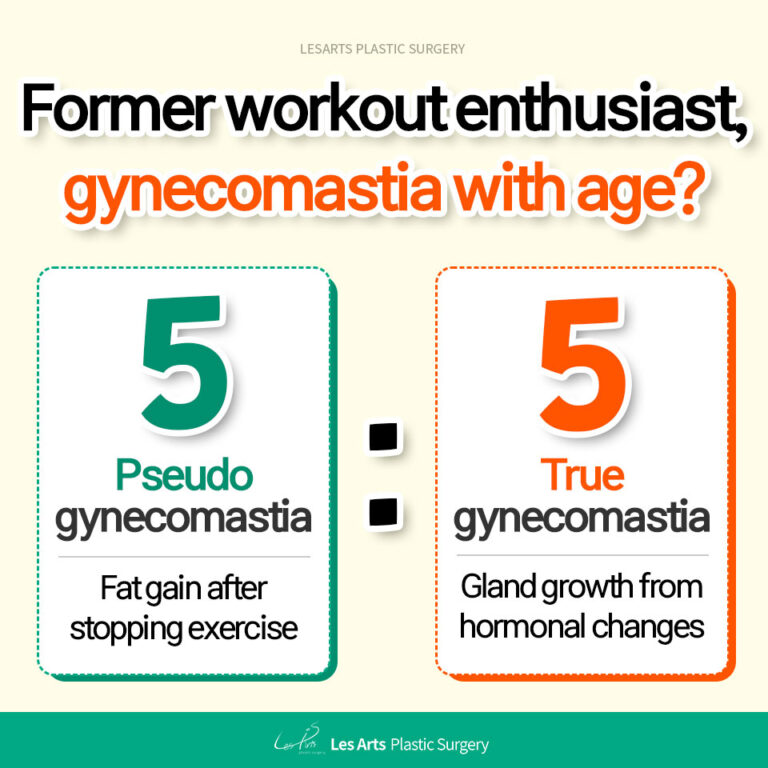
That is because
pseudogynecomastia
caused simply by increased body fat
is fundamentally different from
true or mixed-type gynecomastia,
where actual glandular tissue growth
is also present.
Causes of Gynecomastia in Middle-Aged Men — Lesarts Plastic Surgery
To explain it more accurately,
after stopping exercise,
body fat increases,
causing the chest
to either appear similar
to gynecomastia,
or in some cases,
leading to the actual development
of new-onset gynecomastia.
Another common misconception is:
“If I start exercising again,
it will go away.”
Of course, exercise may help
during the early stages.
However,
once glandular tissue
has already proliferated,
exercise alone
is often not enough
to fully resolve the condition.
And if the patient
is also taking
hair-loss medication,
the altered hormonal environment
may continue to persist,
making improvement
through exercise alone
even more difficult.
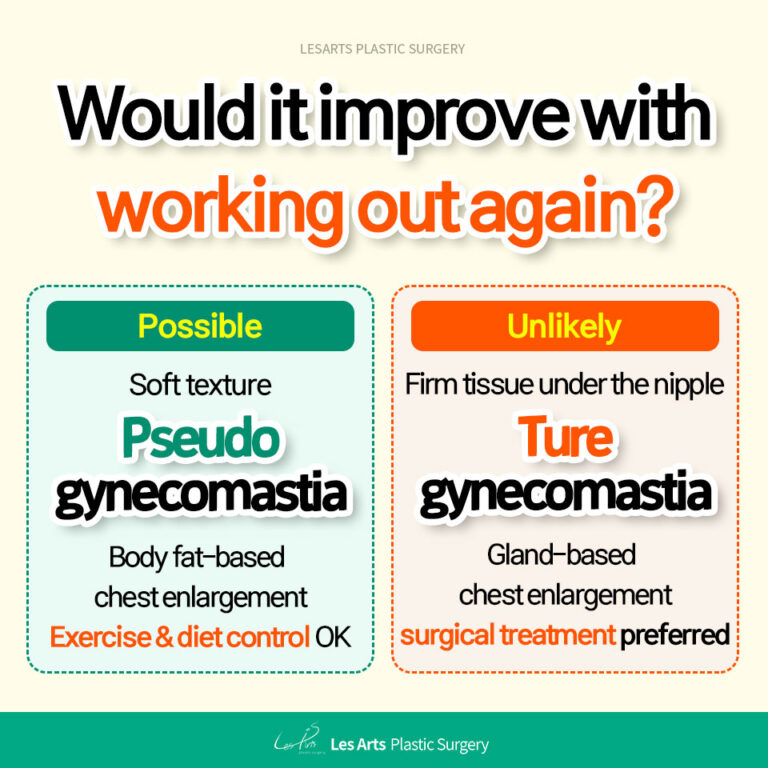
How to Improve Gynecomastia Symptoms — Dr. Jihoon Moon at Lesarts Plastic Surgery
7. How should it be distinguished and approached?
The most important step
is accurately identifying
what type of change
is actually occurring.
1) Primarily body-fat related
-Overall weight gain
-Soft texture upon palpation
→ In these cases, there is often room for improvement through:
-Weight reduction
-Exercise
-Dietary control
2) Presence of glandular tissue
-Firm tissue beneath the nipple
-Persistent chest shape over time
→ In these situations, surgical treatment is generally considered
the more appropriate option.
8. Conclusion — What is the true nature of a chest that “looks like gynecomastia”?
Changes in chest appearance
among middle-aged men
rarely occur
from a single cause alone.
Instead, multiple factors
often interact simultaneously,
including:
-Muscle loss
-Increased body fat
-Hormonal changes
-Skin laxity
-Hormonal balance changes
related to hair-loss medication use
Therefore,
simply concluding that
“I developed gynecomastia
because I stopped exercising”
is not entirely accurate.
What truly matters
is determining whether
the current condition
is caused by:
-Simple fat accumulation
or
-Actual gynecomastia
involving glandular tissue.
Choosing the appropriate approach
based on that distinction
is the most realistic way
to reduce unnecessary worry
and avoid ineffective trial and error.