[Abdominal liposuction]Liposuction in Your 40s: Why Results Differ — The Truth About Fibrosis & Skin Elasticity
Hello, this is Dr. Pyongrim Choi
from Lesarts Plastic Surgery.
During liposuction consultations,
many women in their 40s and older
often say things like,
“It feels much harder
to lose weight now
compared to when I was younger.”
“I’m worried
that my skin may sag more
after surgery.”
As women enter their 40s,
the body naturally goes through
many physical changes.
In particular,
hormonal changes
and a decline
in basal metabolic rate
often cause fat
to accumulate more easily
around the abdomen,
even when eating
the same amount as before.
In fact,
even when the same amount of fat
is removed through liposuction,
the overall “feel”
of the surgical results
can differ significantly with age.
The reason for this difference
is not simply
the amount of fat itself,
but rather changes
in fibrosis
and skin elasticity.
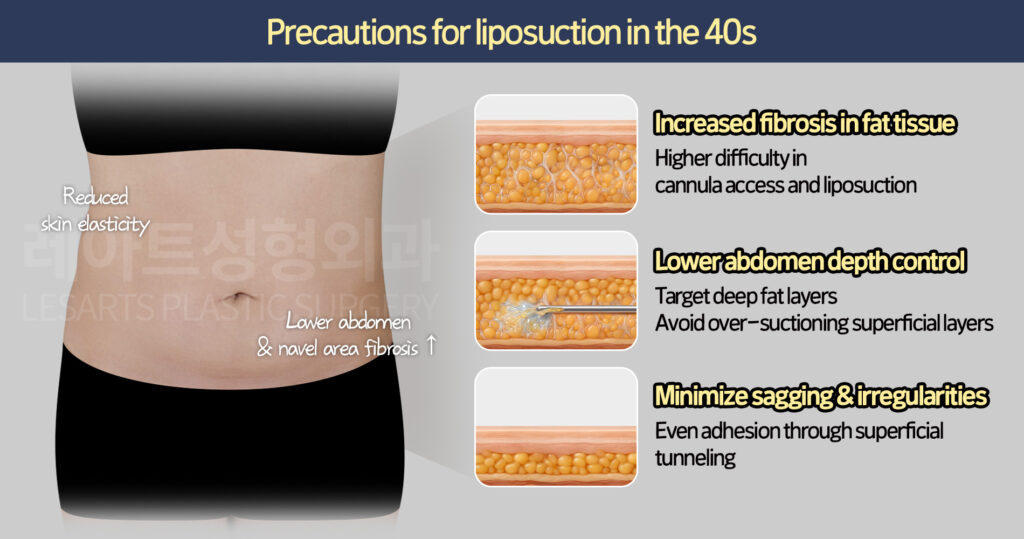
Important considerations for liposuction in patients over their 40s
1. Why liposuction results change after the age of 40
Increased fibrosis
As we age,
the fat layer no longer consists
only of fat cells.
Fibrous connective tissue
gradually increases over time.
Because of this change,
the fat layer becomes firmer,
making fat extraction
more technically difficult.
It also becomes harder
to remove fat evenly
during cannula movement.
As a result,
some areas may respond less effectively,
and achieving smooth, uniform reduction
becomes more challenging structurally.
Reduced skin elasticity
After the age of 40,
collagen levels gradually decrease,
and the skin’s ability
to contract also declines.
Because of this,
even with the same amount
of fat removal,
the risk of skin laxity increases,
and surface irregularities
may become more noticeable.
2. Important strategies for abdominal liposuction in patients over their 40s
The abdomen contains variations
in skin elasticity, skin thickness,
and fibrosis levels
depending on each specific area.
For this reason,
the liposuction approach
must differ by region.
In particular,
the lower abdomen
and the area around the belly button
contain relatively higher amounts
of fibrosis,
while also showing
reduced skin elasticity.
These areas require careful attention
to minimize contour irregularities
caused by uneven adhesions.
For this reason,
the deeper fat layer
should be adequately reduced
to decrease overall volume,
while the superficial fat layer
must be approached carefully
to avoid excessive fat removal.
In areas with more fibrosis,
strong tissue resistance
also makes surgical access harder.
Because of this,
aggressive fat removal
should be minimized,
and uniform fat extraction
through multi-directional
cross-tunneling techniques
is important
to preserve an even fat layer thickness,
helping minimize
skin laxity and contour depressions.
Abdominal liposuction strategy
through an actual patient case
Mid-40s female / 159 cm / 57.5 kg / BMI 22.7
Patient concern:
Wanted improvement
of the protruding abdomen,
especially around the belly button,
and hoped to achieve
a more defined waistline.
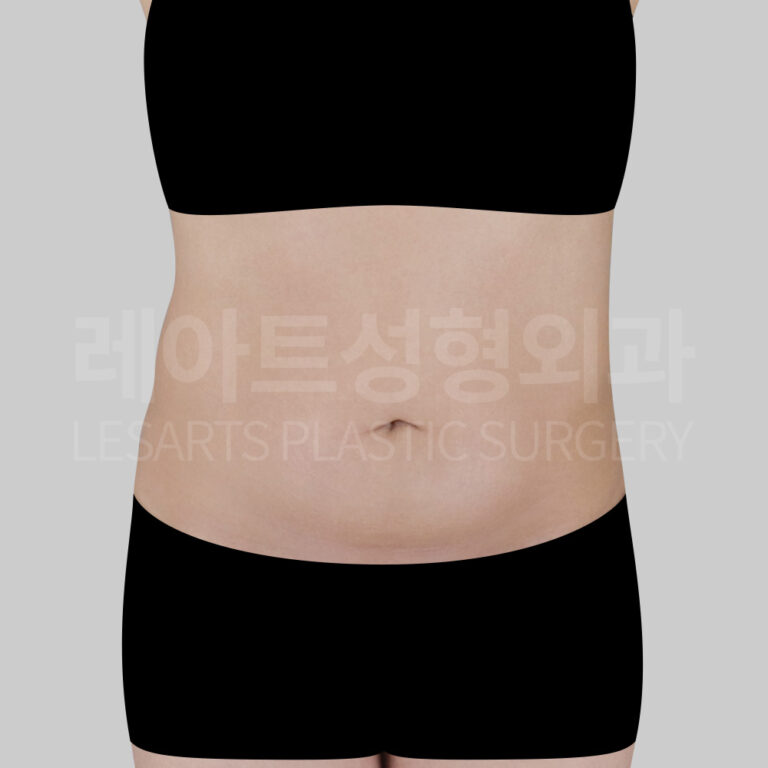
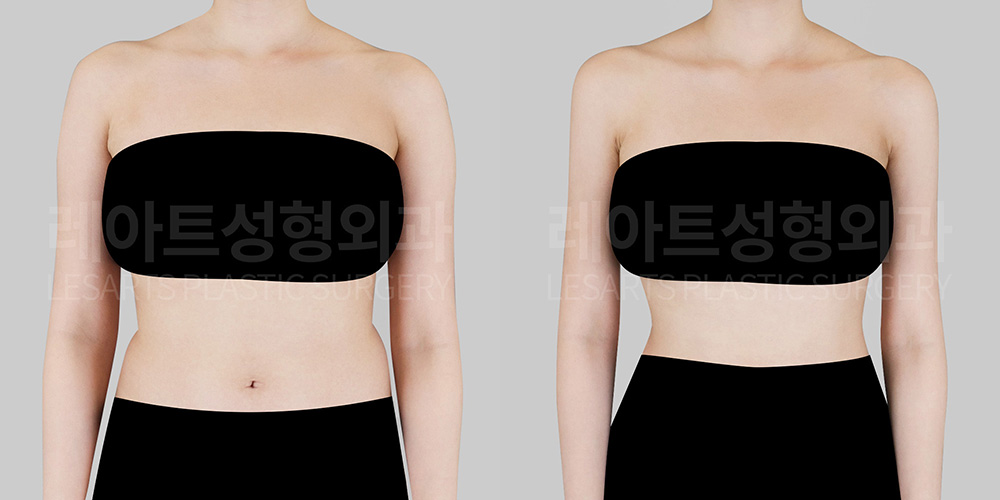
Pre-operative diagnosis before abdominal liposuction at Lesarts — Front view
Pre-operative abdominal liposuction photos — Front view
When viewed from the front,
the waistline appeared relatively straight
down toward the panty line,
with limited natural curvature.
In addition,
the lateral pelvic area
appeared somewhat hollow,
indicating the need
for overall improvement
of the side body contour.
Because the pelvic contour
appeared sunken,
fat grafting
to the pelvis
and hip joint area
was also considered necessary
for achieving better balance
in the overall silhouette.
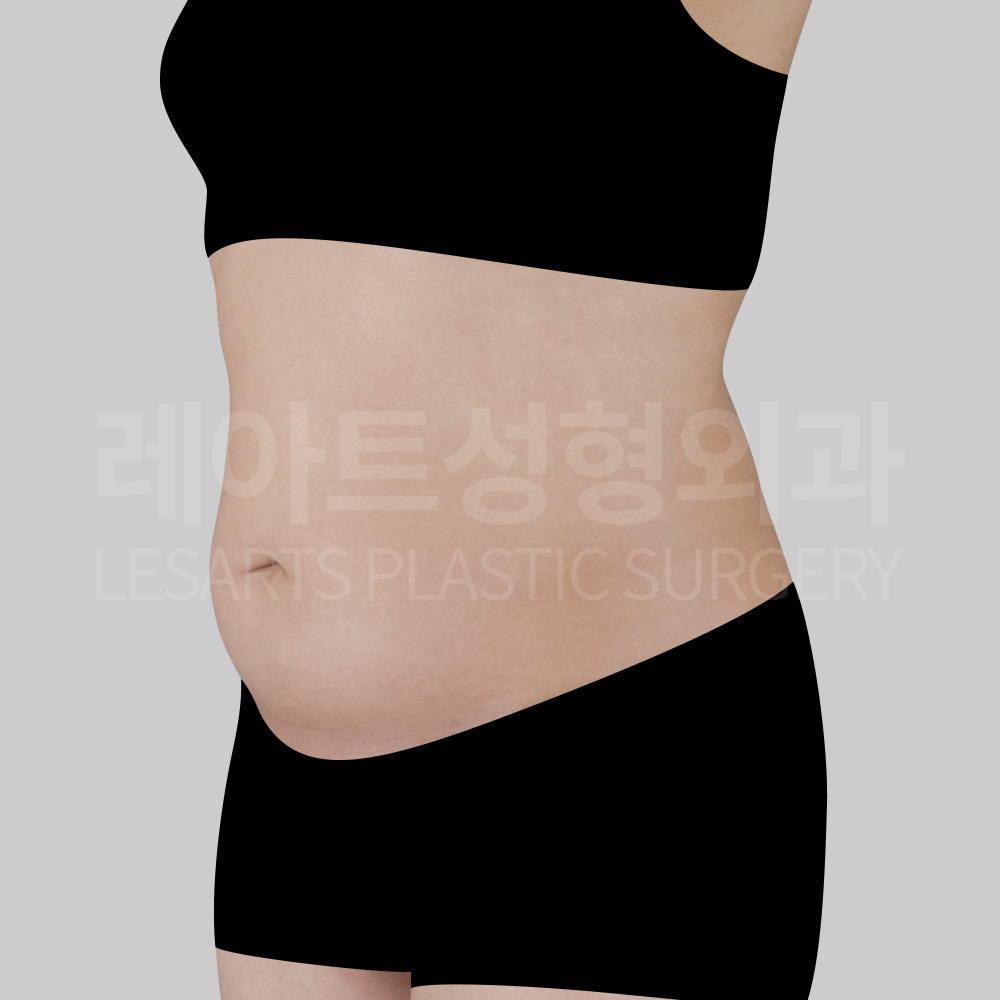
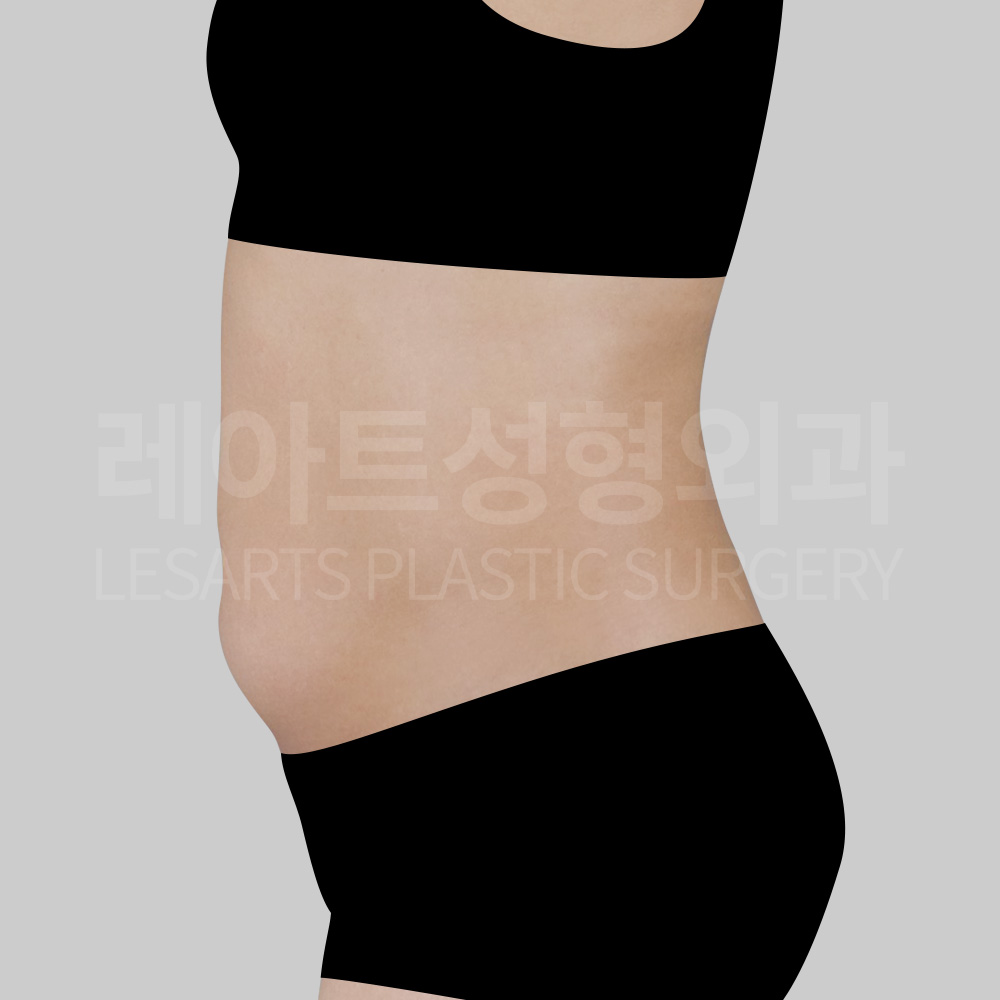
Pre-operative diagnosis before abdominal liposuction at Lesarts — Side view
Pre-operative abdominal liposuction photos — 45-degree side view / 90-degree side view
When viewed from the side,
both the 45-degree
and full side-view photos
showed overall abdominal protrusion
throughout the front abdomen.
In particular,
the lower abdomen
around the belly button
appeared more prominent,
indicating the need
for contour improvement.
However,
the rib line itself
was relatively protruded anatomically,
meaning that after liposuction,
the rib contour could appear
more noticeable than before.
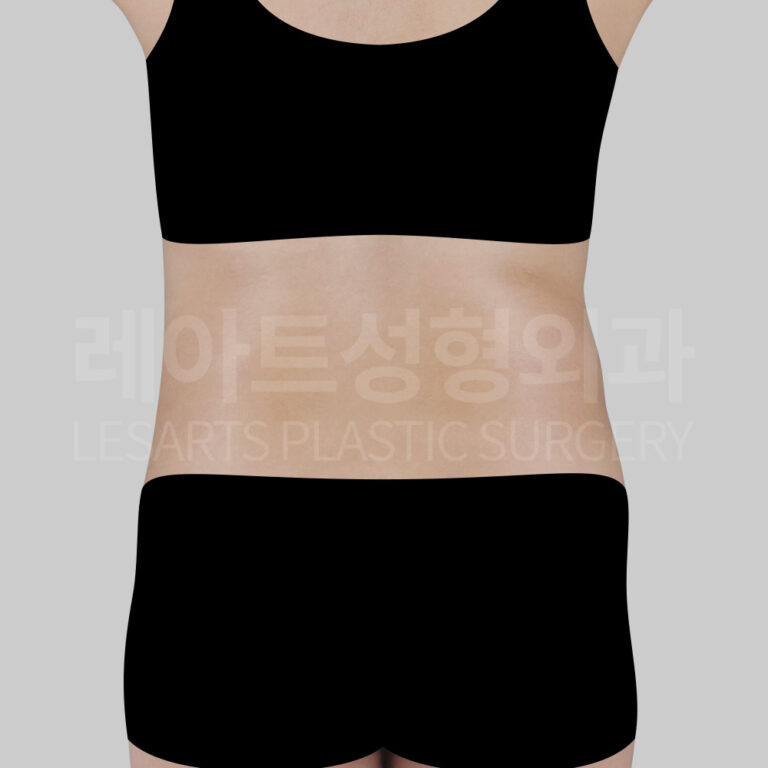
Pre-operative diagnosis before abdominal liposuction at Lesarts — Back view
In the back-view photos,
prominent love handles
above the panty line
were clearly visible,
along with hollowing
around the hip joint area.
Because of this,
improvement of the straight
waist contour line
was considered necessary.
Surgical plan:
Full abdominal liposuction
combined with fat grafting
to the pelvis
and hip joint areas.

Back-view comparison after recovery from abdominal liposuction — Dr. Pyongrim Choi at Lesarts
9 months after abdominal liposuction surgery
Waistline improvement
In areas where fat volume
was greater than fibrosis,
maximum fat reduction
was carefully performed
to create a more natural
and defined waist contour.
In addition,
fat grafting
to the pelvic
and hip joint areas
helped visually enhance
the waistline even further,
creating a more balanced
and feminine silhouette.
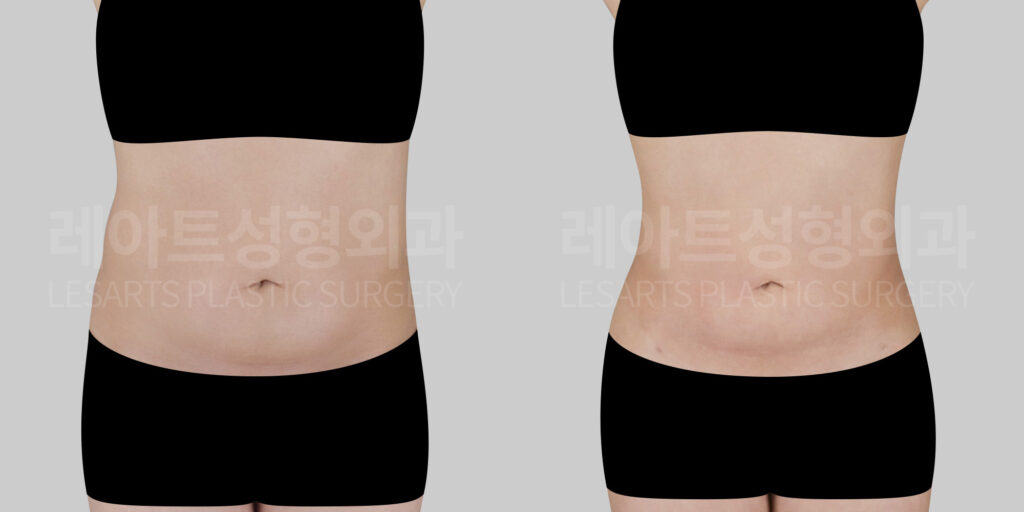
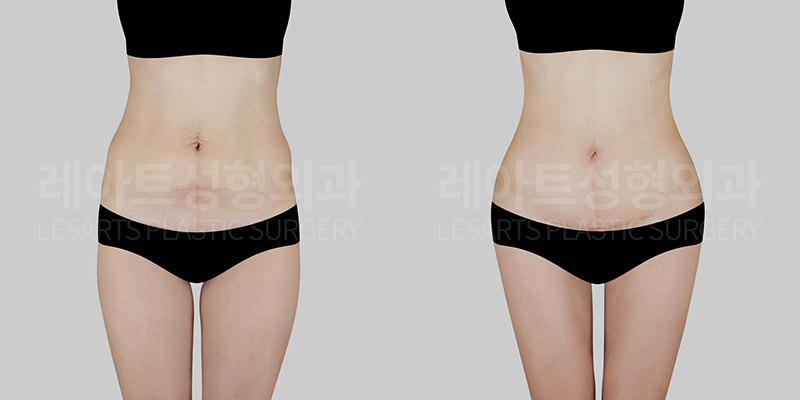
Before & After Abdominal Liposuction in a Patient in Her 40s — Dr. Pyongrim Choi at Lesarts Plastic Surgery
Improvement of the lower abdomen
and refinement around
the belly button area
The lower abdomen
and the area surrounding
the belly button
showed increased levels
of fibrosis.
Because of this,
the deeper fat layer
was reduced more aggressively,
while a portion
of the superficial fat layer
was intentionally preserved
to help minimize
contour irregularities
that could develop
from uneven adhesions.
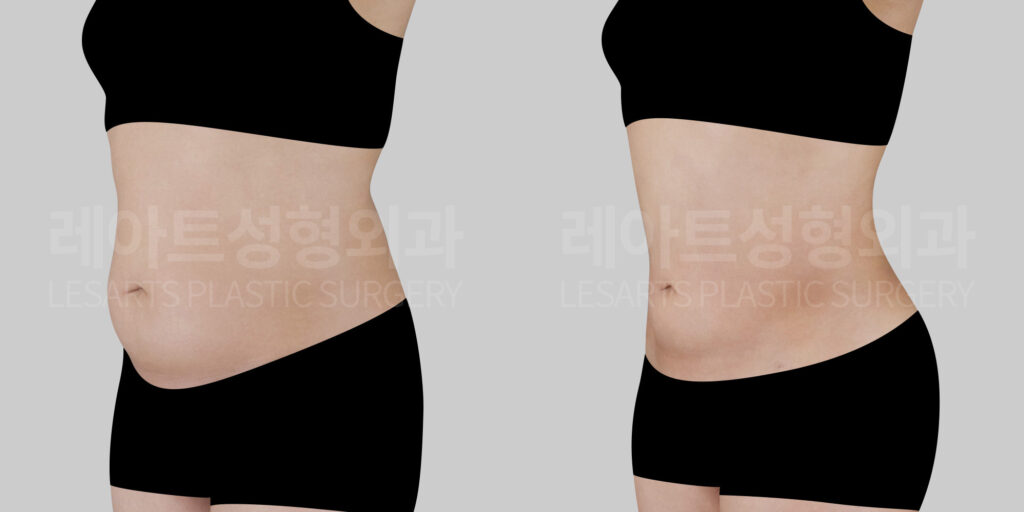
Checking skin laxity before & after abdominal liposuction — Lesarts Plastic Surgery
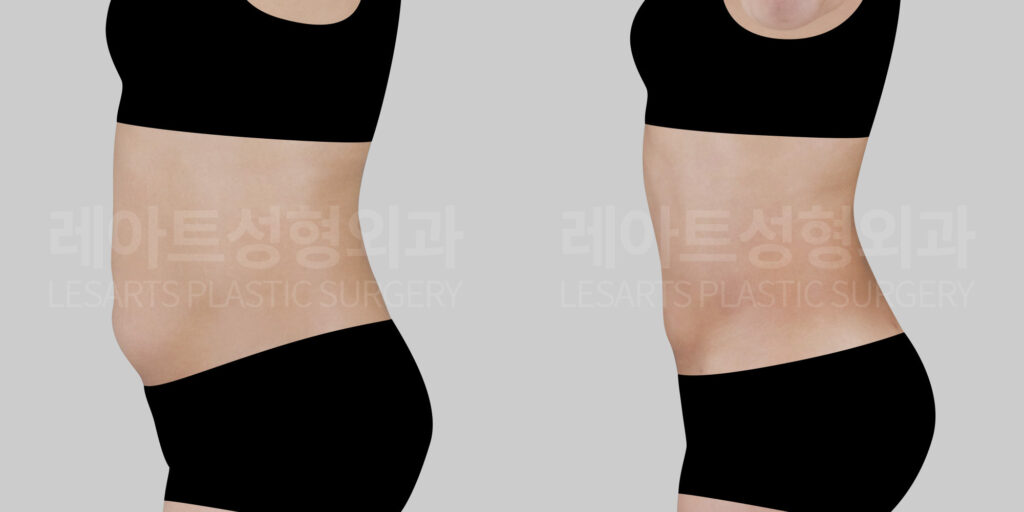
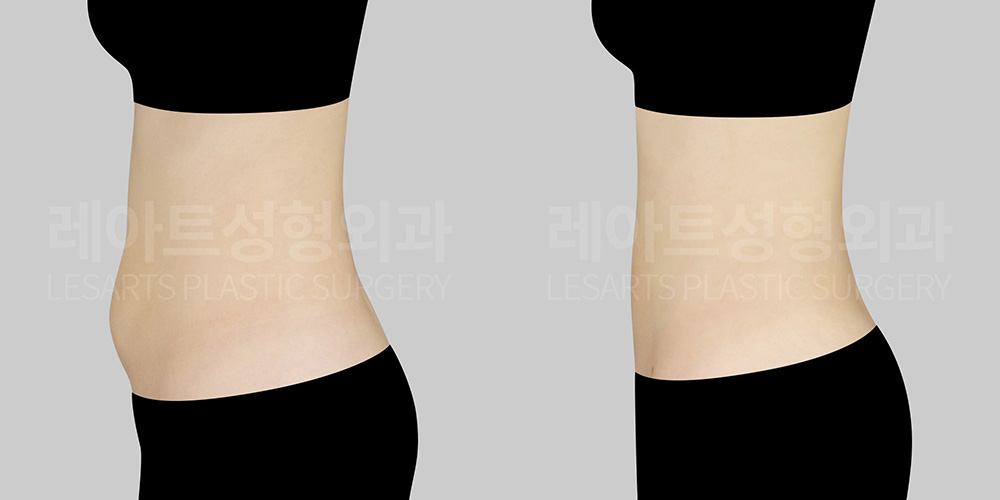
Side-view comparison before & after abdominal liposuction — Dr. Pyongrim Choi at Lesarts
Minimizing skin wrinkling
To minimize skin wrinkling
along the upper abdominal muscle lines,
a uniform cross-tunneling technique
was used during liposuction.
For the lower abdomen,
where reduced skin elasticity
after fat removal
could potentially lead
to skin wrinkling,
deep-layer fat reduction
combined with superficial tunneling
was performed
to encourage smooth
and even tissue adhesion.
After abdominal liposuction,
the patient consistently wore
compression garments
for approximately 3 to 6 months
to help promote
uniform tissue adhesion.
In addition,
radiofrequency treatments
performed within the first 3 months
helped reduce
swelling and fibrosis.
For patients over their 40s,
abdominal liposuction
is not simply a procedure
focused on removing
as much fat as possible.
Rather,
a customized surgical approach
that carefully evaluates
both tissue characteristics
and skin condition
is especially important.
Particularly in the lower abdomen,
if factors such as
increased fibrosis,
reduced skin elasticity,
and the adhesion process
are not considered together,
even small differences in technique
can lead to significant differences
in the final results.
Ultimately,
good outcomes are determined by
uniform thickness,
natural tissue adhesion,
and smooth contour continuity.