Thigh Liposuction-Why Thighs Feel Firm: It's Not Just MuscleHow to Target the Hidden Layer of Fat
Hello, this is Dr. Pyongrim Choi
from Lesarts Plastic Surgery.
“It feels like muscle,
not fat, so I don’t think it can get any smaller.”
This is one of the most common comments
I hear during Thigh Liposuction consultations.
Particularly when the thighs feel firm
to the touch,
or when a patient has exercised regularly
for many years,
many assume that their thighs
are simply “muscular.”
However,
when we perform a detailed examination,
it is surprisingly uncommon
for that firmness to be caused
by muscle alone.
The thighs are actually
a complex structure,
consisting of Muscle,
Subcutaneous Fat,
and often a layer of
Fibrotic Fat Tissue
existing together.
Today,
through a real patient case,
I would like to explain
the true reason
why some thighs feel so firm,
and the hidden fat layer
that can often be addressed through
Liposuction.
[Patient Case]
Female, 20s
Height: 162 cm
Weight: 56 kg
BMI: 21.4
Primary Concern:
To make her firm, bulky thighs
appear as slim as possible.
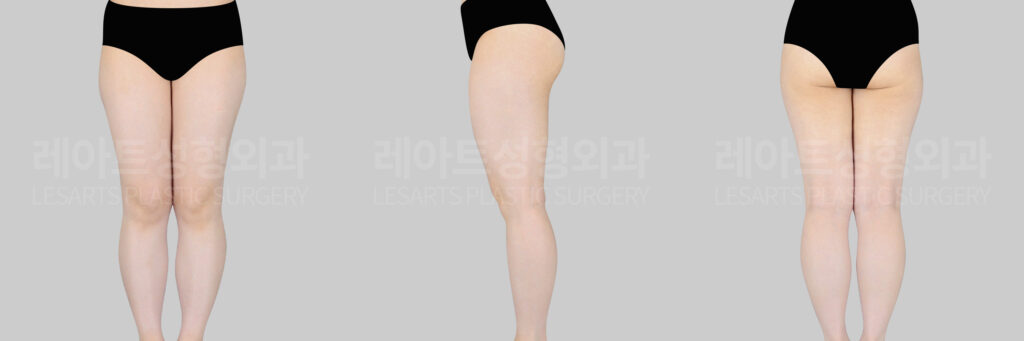
Thigh Liposuction Consultation and Body Analysis – Dr. Pyeonglim Choi | Lesarts Plastic Surgery
Although the patient
had an overall slim physique,
her primary concern was that
her thighs appeared unusually thick
and felt very firm.
She believed that
the appearance was caused entirely
by muscle,
and that there was little
that could be done to improve it.
However,
upon physical examination
and palpation,
we found a more complex structure
than expected.
This included:
-A thicker-than-anticipated layer of Subcutaneous Fat overlying the muscle
-Dense Fibrotic Fat Tissue concentrated along the outer and posterior thighs
-A relatively softer fat layer along the inner thighs
1. The True Source of Firmness Fibrotic Fat Tissue
This is a common misconception.
The firm feeling that many patients notice
is not always caused by muscle alone.
In many cases,
fibrous connective tissue develops
within the fat layer,
causing the fat to become
more rigid and fixed in place.
This type of Fibrotic Fat
is often resistant to change,
responds poorly to exercise,
and can make the thighs appear
wider and bulkier than they truly are.
2. Strategic Approach Based on Regional Fat Characteristics
For this patient,
a uniform reduction strategy
would not have produced
the most natural outcome.
Instead,
different areas required
different approaches.
1) Inner Thighs
The inner thighs contained
a relatively soft fat layer,
making this one of the areas
where contour changes
can appear most quickly
after Liposuction.
This region also plays
a critical role in creating
thigh separation.
2) Outer Thighs (Saddlebag Area)
The outer thighs demonstrated
both Fibrotic Fat Tissue
and well-developed muscle.
This region was the primary contributor
to the excessive thigh volume.
Therefore,
the goal was not aggressive removal,
but rather careful
Volume Reduction and Contouring.
3) Anterior Thighs
The front of the thighs contained
both firm muscle
and an overlying fat layer.
The objective was to remove
the excess Subcutaneous Fat
while preserving the natural
muscular contours,
allowing for a smoother
and more refined appearance.
3. Key Surgical Considerations
Successful Thigh Liposuction
is not determined solely by
the amount of fat removed.
What matters most is:
-Identifying the correct tissue layer to target
-Understanding how to release and treat Fibrotic Fat Tissue
-Removing fat while preserving
the natural muscular contour
These three factors
are essential for achieving
a natural and balanced result.
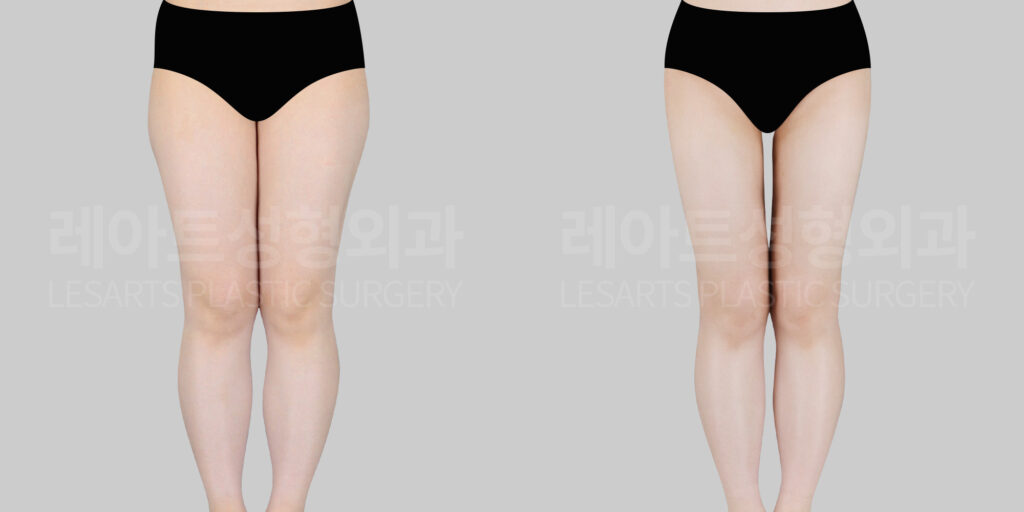
Before-and-After Comparison of Thigh Liposuction – Dr. Pyeonglim Choi | Lesarts Plastic Surgery
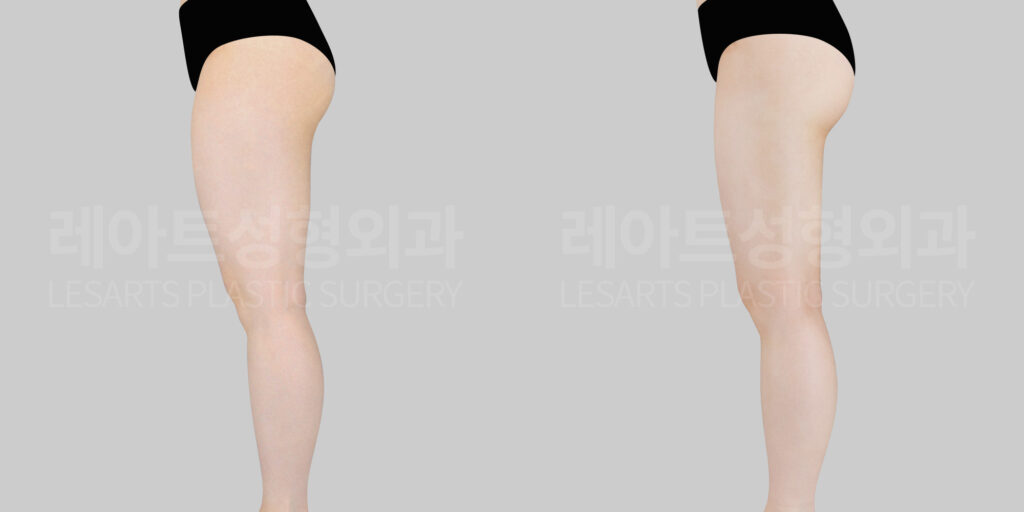
Changes in the Anterior Thighs After Thigh Liposuction – Dr. Pyongrim Choi | Lesarts Plastic Surgery
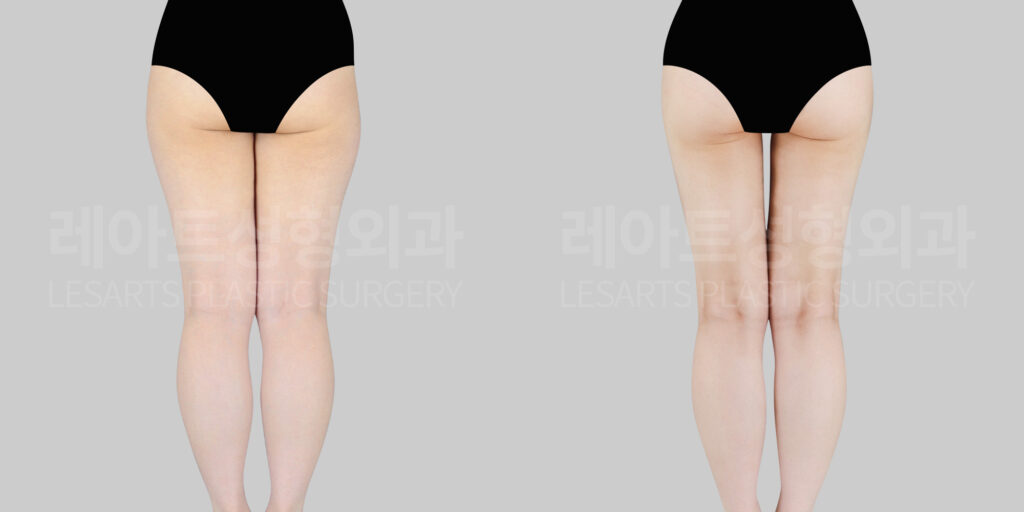
Results of Liposuction for Muscular-Looking Thighs – Lesarts Plastic Surgery | Dr. Pyeonglim Choi
Results and Changes Three Months After Thigh Liposuction
Over the three-month recovery period,
the prominence of the outer thighs
was reduced,
the inner thigh gap became
more visible,
and the posterior thigh contour
was noticeably refined.
As a result,
the legs appeared slimmer
and longer,
while the lower body
developed a lighter
and more balanced appearance.
It is true that
thighs with a strong muscular component
can be more challenging to treat
than thighs that consist primarily
of soft fat tissue.
However,
it is not accurate to conclude that
Liposuction offers no benefit
for so-called “muscular thighs.”
The key factor
is identifying whether
the firmness is being caused
by Fibrotic Fat Tissue
rather than muscle alone.
When this hidden fat layer
is properly identified,
and each area is approached
with an appropriate strategy,
meaningful and satisfying improvements
can often be achieved.
Many patients describe their thighs as,
“Thighs that never changed,
no matter how much I exercised.”
In reality,
the reason may not be muscle itself,
but rather a hidden layer of
Fibrotic Fat
that has remained resistant
to conventional weight loss efforts.