
[Hyperhidrosis]What are the causes, symptoms, and treatment options for stress-related sweating, hyperhidrosis?
Hello, this is Dr. Jihoon Moon
from Lesarts Plastic Surgery.
Some people experience constant dampness
in their hands, feet, or underarms,
causing significant daily stress.
In more severe cases,
it can interfere with daily activities,
making simple tasks uncomfortable.
Rather than leaving it untreated,
it is important to consider
the possibility of hyperhidrosis.
Palmar sweating, underarm sweating, plantar sweating, hyperhidrosis treatment – Dr. Jihoon Moon, Lesarts Plastic Surgery
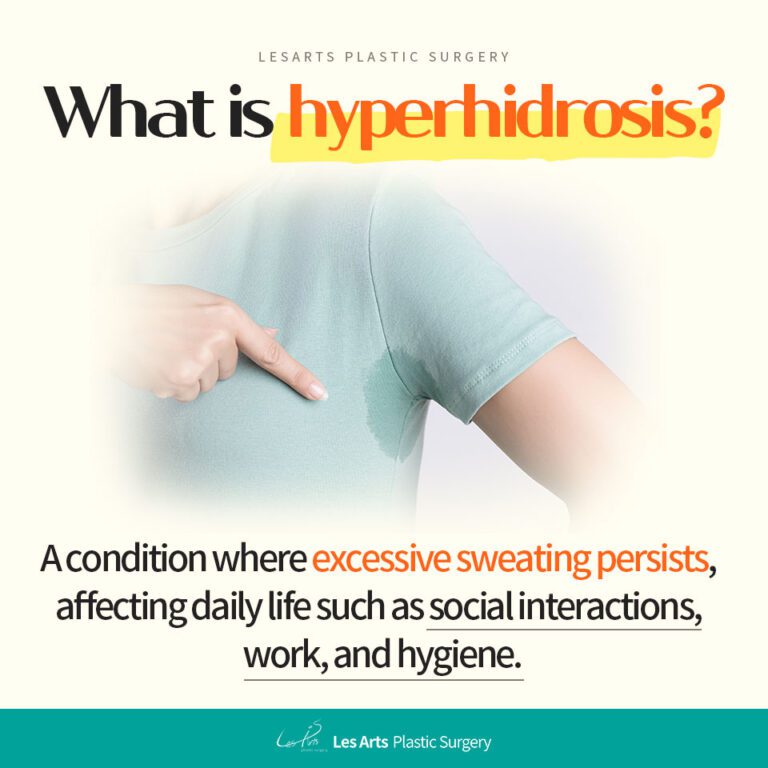
What is hyperhidrosis?
It is a condition where
excessive sweating occurs persistently
beyond what the body requires.
This can interfere with
social interactions, work, and hygiene,
affecting overall daily life.
Areas and symptoms of hyperhidrosis – Dr. Jihoon Moon, Lesarts Plastic Surgery
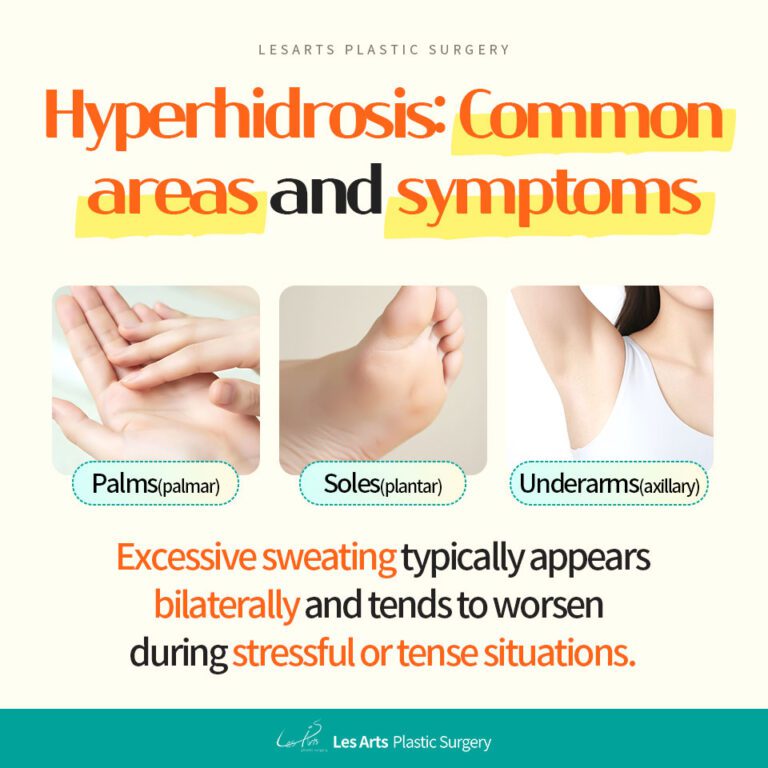
1. What are the main areas and typical symptoms?
Excessive sweating mainly occurs
in the palms, soles, and underarms,
and is usually bilateral in presentation.
Symptoms tend to worsen
in situations involving tension
or emotional stress.
In particular,
palmar hyperhidrosis often leads
to avoiding handshakes with others.
The hands may become slippery,
making it difficult to handle tools
or perform precise tasks.
Plantar hyperhidrosis can worsen foot odor
and may progress
to fungal infections.
Axillary hyperhidrosis may cause
visibly soaked clothing,
leading to social discomfort.
When combined with bromhidrosis,
it can cause unpleasant odor
and even discoloration of clothing.
Underarm sweating concerns in summer, causes and treatment of hyperhidrosis – Dr. Jihoon Moon, Lesarts Plastic Surgery
2. What causes hyperhidrosis?
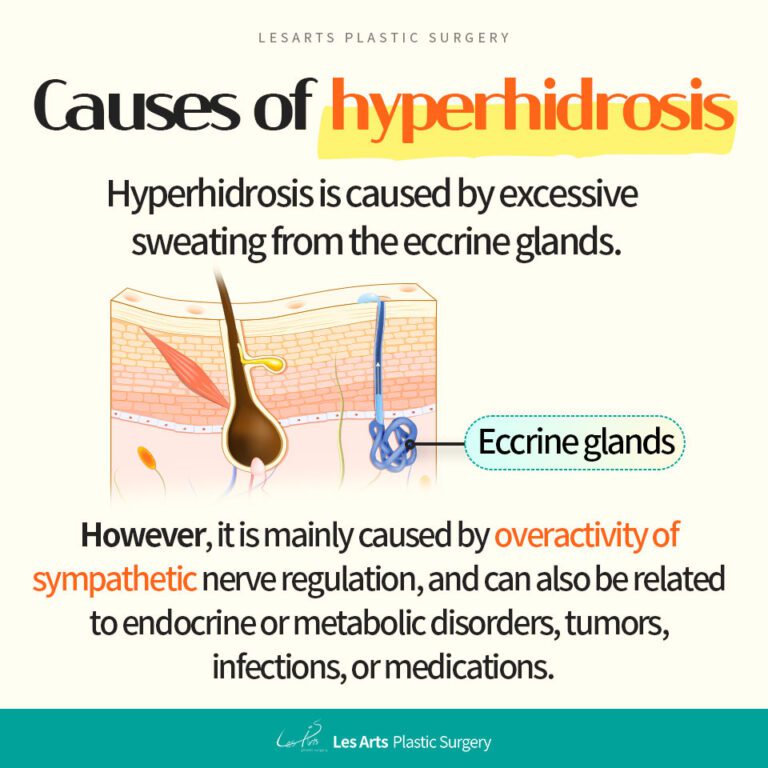
Sweat glands are largely divided
into two types: eccrine and apocrine glands.
Excessive secretion from
the eccrine sweat glands
is the main cause of hyperhidrosis.
However, the exact cause
is not simply a gland abnormality,
but rather related to regulation.
It is believed to result
from overactivation of the
sympathetic nervous system,
which becomes more active
during tension or stress situations
beyond normal temperature control.

Is hyperhidrosis hereditary? – Dr. Jihoon Moon, Lesarts Plastic Surgery
Quick note, is hyperhidrosis hereditary?
A single gene causing hyperhidrosis
has not been clearly identified,
but a family history is commonly observed.
In addition,
endocrine or metabolic disorders
may also be underlying causes.
These include conditions such as
hyperthyroidism, diabetes,
menopause, or pheochromocytoma.
Infections or tumors,
such as tuberculosis or lymphoma,
especially with night sweating,
as well as certain medications
like SSRI or SNRI antidepressants,
can also be contributing factors.
Therefore, proper evaluation
through medical consultation
is necessary for accurate diagnosis.
Diagnosis methods for hyperhidrosis – Dr. Jihoon Moon, Lesarts Plastic Surgery
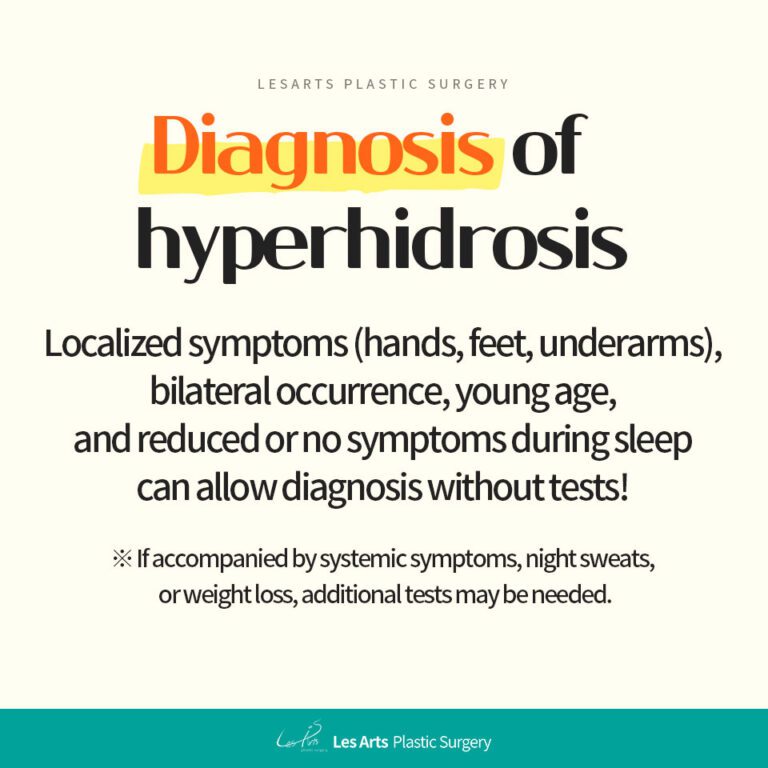
3. How is hyperhidrosis diagnosed?
When symptoms are localized
to areas such as hands, feet,
or underarms, and show bilateral patterns,
especially in younger patients,
and when sweating decreases
or disappears during sleep,
a diagnosis can often be made
through outpatient consultation
without additional testing.
However, if accompanied by
systemic symptoms, night sweating,
or unexplained weight loss,
further evaluation and testing
may be required
for accurate diagnosis.
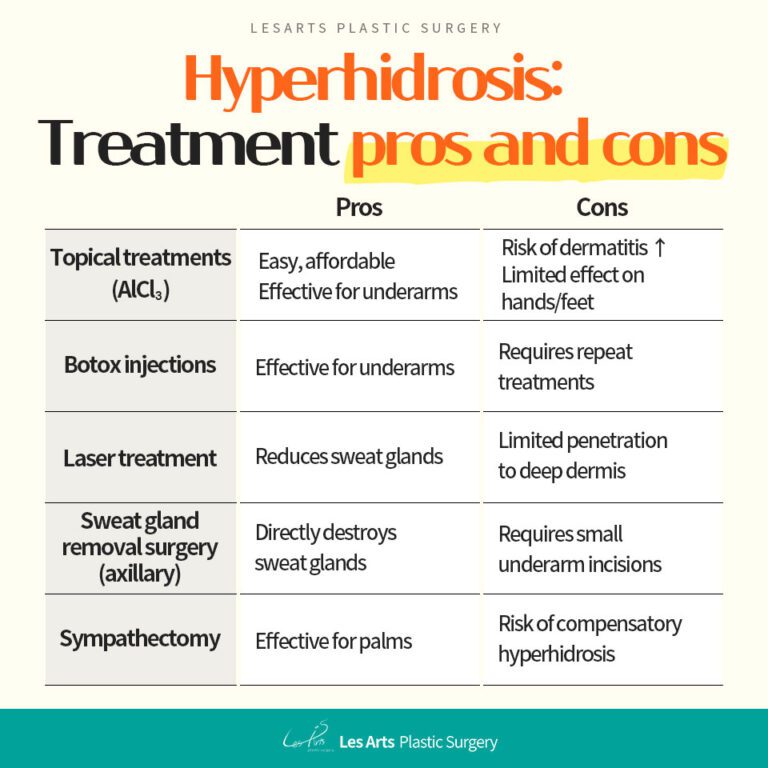
4. How is hyperhidrosis treated?
Topical treatments
Aluminum chloride (AlCl₃) solutions
are particularly effective
for axillary hyperhidrosis.
They are easy to use
and relatively inexpensive,
but may cause skin irritation.
There is also a risk
of contact dermatitis,
and effectiveness on hands and feet is limited.
Botulinum toxin (Botox)
This treatment is highly effective
for underarm hyperhidrosis,
with high patient satisfaction.
However, the duration is limited,
typically lasting several months,
requiring repeated treatments.
Energy-based local treatments (laser)
These include external applications
such as microwave, laser,
or radiofrequency devices.
They aim to reduce
eccrine sweat glands
in the underarm area.
However, there are limitations
in reaching deeper dermal layers
or subcutaneous tissues.
Surgical treatment
A. Endoscopic Thoracic Sympathectomy (ETS)
An endoscope is used
to access the thoracic sympathetic chain,
reducing nerve signals.
This is achieved through
cutting, clipping, or cauterization
of the sympathetic nerves.
It is particularly effective
for palmar hyperhidrosis,
showing significant symptom improvement.
However, compensatory sweating
may occur after surgery,
affecting other body areas.
B. Surgery to reduce sweat glands
(axillary hyperhidrosis)
This procedure targets
eccrine sweat glands
within the underarm skin layers.
If bromhidrosis is present,
apocrine glands may also
be removed as the cause.
Using laser or ultrasound energy,
the glands are physically destroyed
and then suctioned out.
As the number of sweat glands decreases,
overall sweating is reduced,
leading to noticeable improvement.
The procedure is performed
under sedation anesthesia,
with a small incision.
A probe is inserted
through the incision
near the underarm or inner arm.
Energy is delivered
to the lower dermis
and upper subcutaneous layer.
This process aims to destroy
as many causative
eccrine sweat glands as possible.
Residual debris and liquefied fat
are then removed
using liposuction techniques.
The procedure is completed
with skin closure,
taking approximately one hour.
Hyperhidrosis can cause
significant discomfort
in everyday life.
If symptoms are concerning,
it is recommended to seek consultation
and consider appropriate treatment.