Tummy tuck in Seoul: 3-month results for lower abdominal sagging and wrinkles after abdominal liposuction
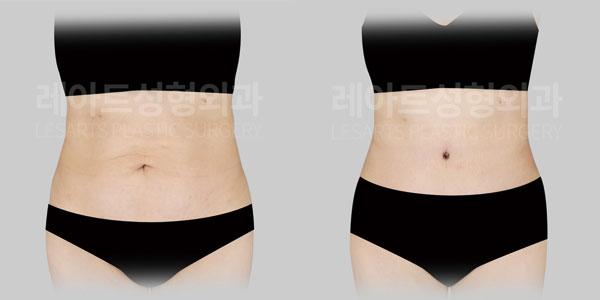
Patient Registration Info
| Age | Weight | Height | BMI |
|---|---|---|---|
|
40s |
57kg |
153cm |
24 |
Surgical site
Surgical site : Abdomen, M-Type, muscle repair, umbilicus correction| liposuction aspirate volume : 1,400cc
Many patients consider abdominoplasty
to address concerns such as
lower abdominal skin laxity
and wrinkling around the navel
that develop following pregnancy and childbirth.
In some cases,
patients have previously undergone
abdominal liposuction
in an attempt to improve
their altered abdominal contour,
only to become frustrated
by the limitations of the procedure
and seek a more definitive solution
at our clinic.
These patients often present with
fine abdominal wrinkles,
skin laxity surrounding the navel,
and an overall abdominal contour
that appears uneven and poorly defined.
Simply reducing abdominal fat volume
is often insufficient to correct
excess skin laxity
or the stretching and weakening
of the underlying fascial support structures.
For this reason,
addressing the underlying cause
of the deformity
is essential to achieving
a more meaningful and lasting improvement.
The patient featured in this post
presented with a similar concern.
Although she had previously undergone
abdominal liposuction
and had minimal residual fat deposits,
she remained dissatisfied with
persistent upper abdominal wrinkling
and lower abdominal skin laxity,
which continued to affect
the overall appearance of her abdomen.
As a result,
the patient ultimately decided
to undergo abdominoplasty surgery
to restore a smoother, firmer,
and more harmonious abdominal contour.
Let us take a closer look at
the findings, surgical planning,
and post-operative changes
through the following photographs.
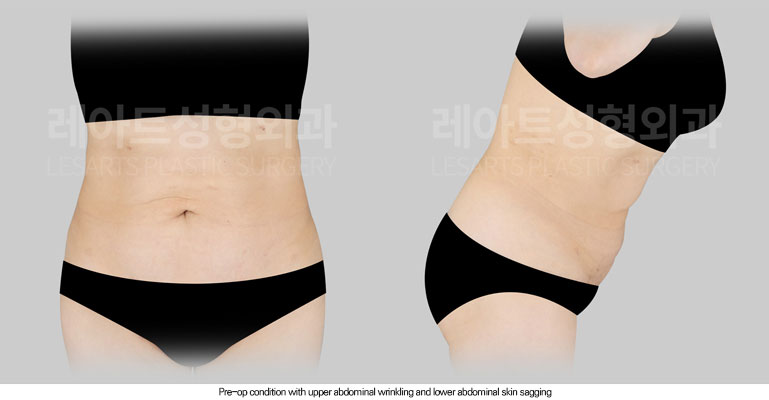
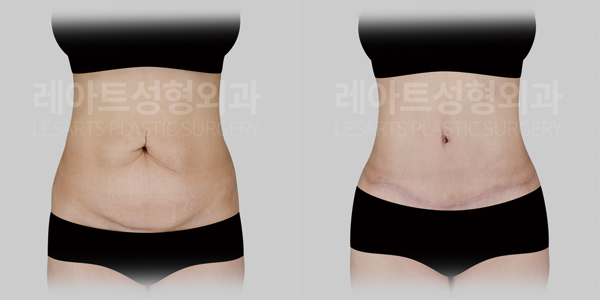
Pre-operative photographs obtained prior to abdominoplasty surgery
demonstrated a significant loss of skin elasticity
originating in the upper abdomen,
which resulted in the development of
fine wrinkling around the umbilical region.
In addition,
the shape of the navel itself
had become elongated and descended,
reflecting changes associated with
abdominal skin laxity.
As skin elasticity progressively declined,
redundant skin gradually accumulated
within the lower abdomen,
creating an irregular contour
and preventing the lower abdominal line
from appearing smooth and well-defined.
In this particular patient,
the abdominal deformity was not primarily related
to residual fat deposits,
but rather represented a problem
predominantly caused by
loss of skin elasticity.
Furthermore,
the patient demonstrated
rectus diastasis and
fascial laxity extending from the upper abdomen.
As a result,
the weakened abdominal wall
contributed more significantly
to the protruding abdominal contour
than the actual thickness of the subcutaneous fat layer,
indicating that abdominal wall insufficiency
was a major factor affecting
the overall abdominal shape.
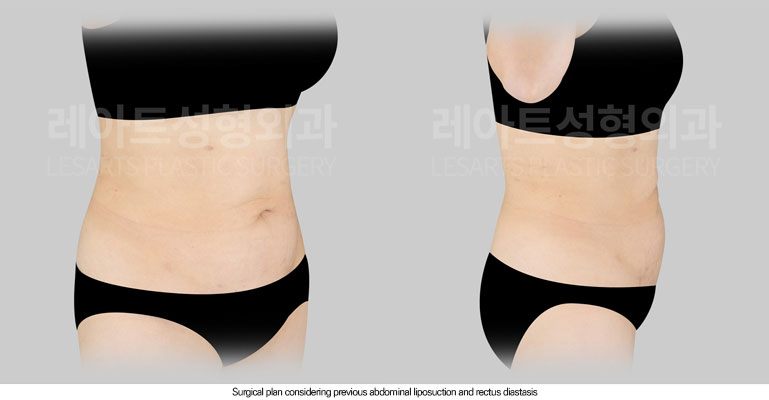
Accordingly,
an M-Type Abdominoplasty
was planned to address
the skin laxity originating
from the upper abdomen,
while simultaneously correcting
the rectus diastasis through
rectus muscle plication.
In addition,
a limited liposuction procedure
was incorporated to release and refine
areas of fibrosis and adhesions
that had persisted following
the patient’s previous abdominal liposuction,
with the goal of achieving
a smoother and more harmonious contour.
Because removal of the redundant skin
would inevitably alter the position
of the existing umbilicus,
an umbilicoplasty was also planned
to create a newly designed navel
that would be repositioned
in a more aesthetically balanced location.
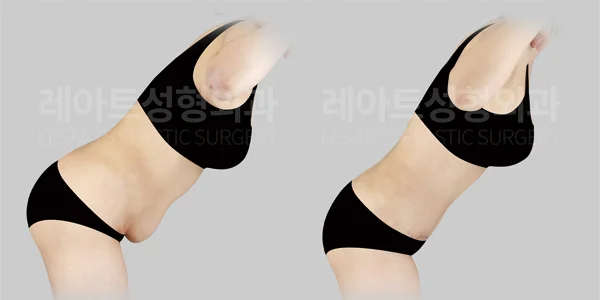
However,
it was explained that
completely eliminating
the natural skin folds that appear
while sitting or bending forward
would not be feasible.
The extent of correction in abdominoplasty
is primarily determined
based on the abdominal contour
and degree of skin redundancy
while standing in an upright position,
and this concept was discussed thoroughly
with the patient to establish
realistic surgical expectations.
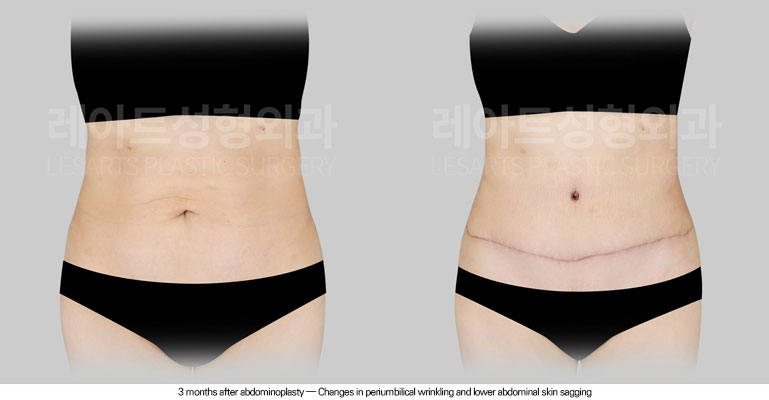
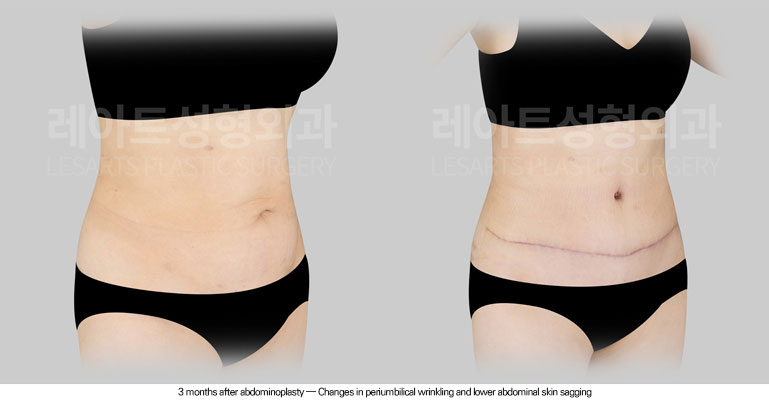
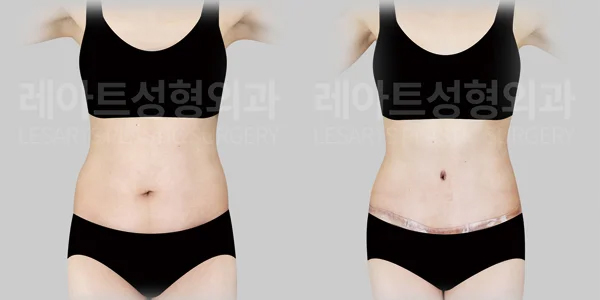
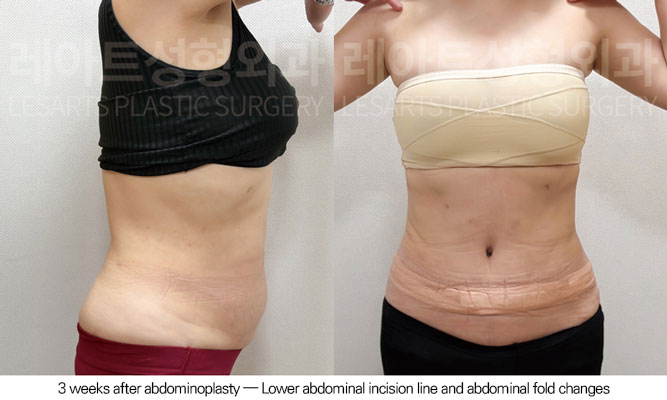
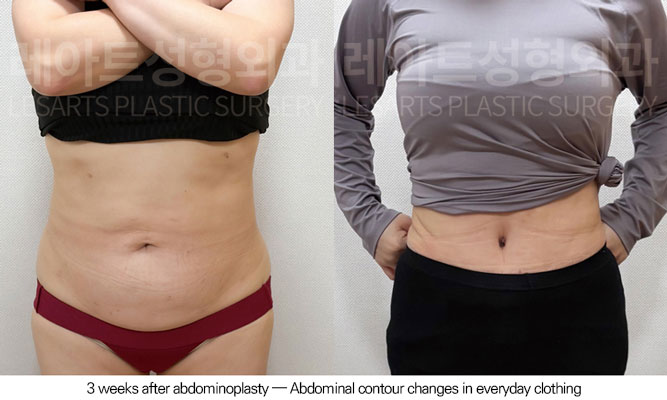
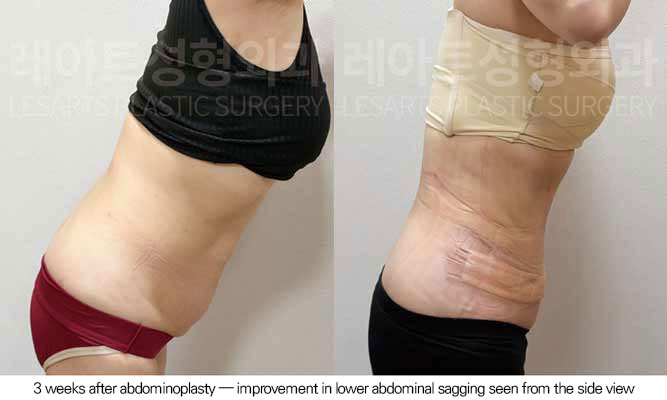
These photographs compare
the patient’s appearance
before abdominoplasty surgery
and at 3 months post-operatively.
The fine wrinkles that had developed
around the umbilical region,
along with the crinkled and irregular appearance
of the skin within the lower abdomen,
have been significantly improved.
In addition,
stretch marks located within the area
of skin excision have also been removed,
contributing to a smoother
and more refined abdominal contour.
Following abdominoplasty,
the anterior abdomen and waistline
demonstrate a noticeable restoration
of skin tightness and firmness,
creating a more youthful
and well-supported appearance.
Through rectus muscle plication,
support of the abdominal wall
has been re-established,
allowing the central abdominal contour
to appear firmer,
more stable,
and better defined.
Furthermore,
the umbilicus,
which had become distorted
as a result of upper abdominal skin laxity,
was redesigned and repositioned
through umbilicoplasty,
resulting in a newly contoured navel
that is proportionately aligned
with the patient’s waistline
and overall abdominal aesthetics.
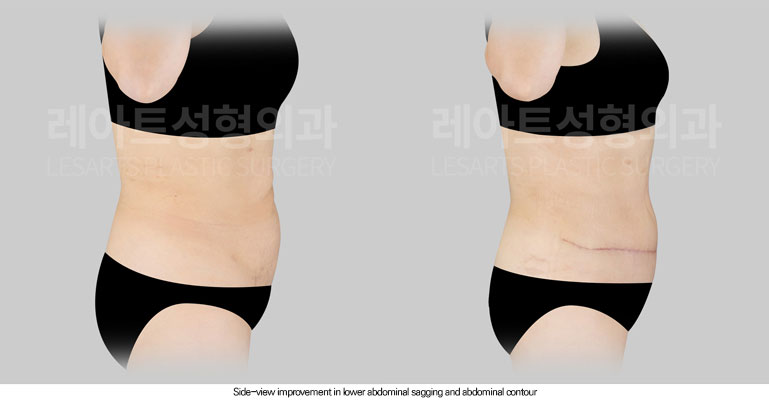
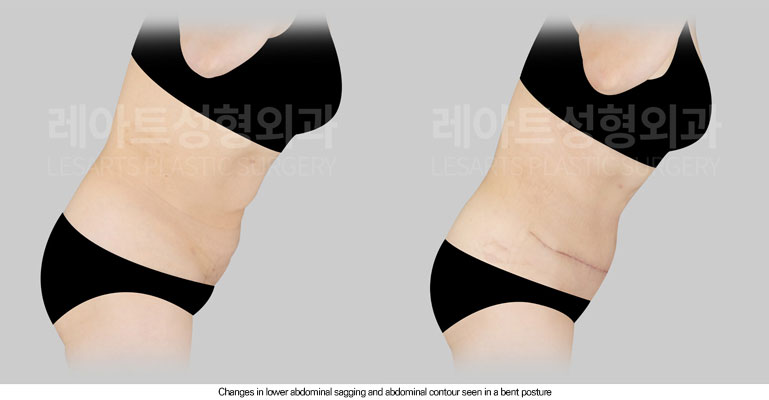
These photographs compare
the patient’s appearance
before abdominoplasty surgery
and at 3 months post-operatively.
The fine wrinkles that had developed
around the umbilical region,
along with the crinkled and irregular appearance
of the skin within the lower abdomen,
have been significantly improved.
In addition,
stretch marks located within the area
of skin excision have also been removed,
contributing to a smoother
and more refined abdominal contour.
Following abdominoplasty,
the anterior abdomen and waistline
demonstrate a noticeable restoration
of skin tightness and firmness,
creating a more youthful
and well-supported appearance.
Through rectus muscle plication,
support of the abdominal wall
has been re-established,
allowing the central abdominal contour
to appear firmer,
more stable,
and better defined.
Furthermore,
the umbilicus,
which had become distorted
as a result of upper abdominal skin laxity,
was redesigned and repositioned
through umbilicoplasty,
resulting in a newly contoured navel
that is proportionately aligned
with the patient’s waistline
and overall abdominal aesthetics.
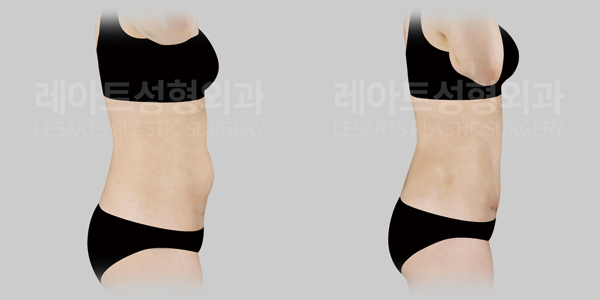
At 3 months after abdominoplasty surgery,
a clear improvement can be seen
when comparing the pre- and post-operative photographs.
The fine wrinkles that were present
around the umbilical area,
as well as the crinkled and uneven skin laxity
of the lower abdomen,
have been significantly improved.
In addition,
many of the stretch marks located
within the excised skin segment
have also been removed,
resulting in a smoother
and more refined abdominal appearance.
Following abdominoplasty,
the anterior abdominal contour
and waistline demonstrate
a noticeably firmer and tighter appearance,
reflecting the restoration of skin elasticity
and improved abdominal support.
Through rectus muscle plication,
the abdominal wall regained its structural support,
allowing the central abdominal contour
to become more stable,
defined,
and aesthetically balanced.
Furthermore,
the umbilicus,
which had become distorted and elongated
due to upper abdominal skin laxity,
was redesigned and repositioned
through umbilicoplasty.
As a result,
a new umbilical contour was created
and placed in a location that harmonizes
with the patient’s waistline,
contributing to a more natural,
proportionate,
and youthful abdominal appearance.
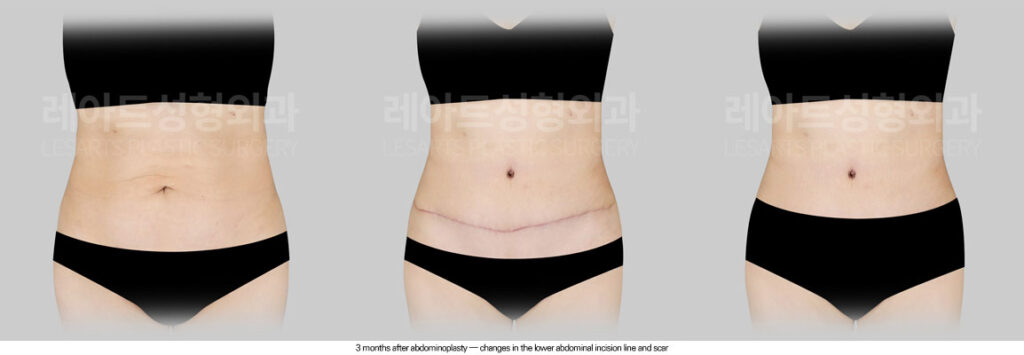
Because abdominoplasty is a procedure
that involves excision of excess skin,
a relatively long incision
along the lower abdomen
is unavoidable.
In addition,
the recovery process of both
the elevated tissues
and the surgical scar
becomes an important aspect
of post-operative management.
For this patient,
the 3-month post-operative follow-up
coincided with the initiation of
scar laser treatments
to further optimize scar maturation.
Although redness along
the incision line
was still clearly visible
at this stage of recovery,
it was explained that
this represents a normal phase
of scar healing,
and that the patient was recovering well
without any significant concerns.
The incision itself
was designed to be positioned
low along the lower abdomen,
allowing it to be naturally concealed
within the underwear line,
as can be appreciated
in the photographs above.
The patient reported being highly satisfied
with the improvement in
abdominal skin laxity and wrinkling,
which had previously proven difficult
to address through liposuction
or conventional weight loss efforts.
She also shared that
her recovery had progressed smoothly,
allowing her to return to daily activities
without experiencing significant discomfort.
As demonstrated in this case,
abdominal wrinkling, skin laxity,
and umbilical deformities
that develop following pregnancy
and childbirth often have limitations
when treated with dieting, stretching,
skin-tightening procedures,
or even liposuction alone.
For this reason,
it is important to accurately determine
whether the underlying cause of concern
is primarily related to
subcutaneous fat accumulation,
skin laxity,
or structural changes such as
rectus diastasis and weakening
of the abdominal wall support system.
A thorough consultation with
an experienced surgeon
should therefore be the first step
in the decision-making process.
Understanding the current condition
of the abdomen,
reviewing the most appropriate treatment options,
and discussing the expected recovery process
in sufficient detail
can help patients make
a more informed decision
and move forward with greater confidence.
#Abdominoplasty
#TummyTuck
#MTypeAbdominoplasty
#AbdominoplastyBeforeAfter
#RectusDiastasisRepair
#Umbilicoplasty
#PostPregnancyBodyContouring
#AbdominalSkinLaxity
#MommyMakeover
#LesartsPlasticSurgery
#BestAbdominoplastyClinicInKorea
#BestTummyTuckClinicInKorea