Gynecomastia surgery in Seoul: 2-week chest size changes for persistent adolescent gynecomastia
Patient Registration Info
| Age | Weight | Height | BMI |
|---|---|---|---|
|
20s |
86kg |
183cm |
26 |
Surgical site
Surgical area: Gynecomastia | Grade 2-A
Can gynecomastia that develops during adolescence naturally disappear by adulthood?
Chest changes that occur during puberty
may improve as the body develops.
However, true gynecomastia caused by
developed glandular tissue may persist
even after reaching adulthood.
If chest protrusion or a firm lump remains
despite exercise or weight loss,
an ultrasound examination can help distinguish
between fat and glandular tissue.
[Learn More About Lesarts Gynecomastia Surgery]
When treating patients with gynecomastia,
there is often a significant gap between
when they first notice the symptoms
and when they actually seek treatment.
In particular, when the chest begins to enlarge
during adolescence, many assume it is
a temporary part of puberty
and postpone medical evaluation.
Some also wait for years, expecting
the condition to improve naturally
through exercise or weight loss.
In fact, pubertal gynecomastia may decrease
as growth and hormonal changes stabilize.
In other cases, however, chest protrusion
may persist into adulthood or become
more noticeable with weight gain.
Therefore, even if surgery is not
being considered immediately, it is important
to accurately evaluate the amount and distribution
of fat and glandular tissue in the chest.
Today, we will introduce the case
of a patient who had experienced chest protrusion
and firm lumps on both sides since adolescence
and underwent male gynecomastia surgery
in his 20s.
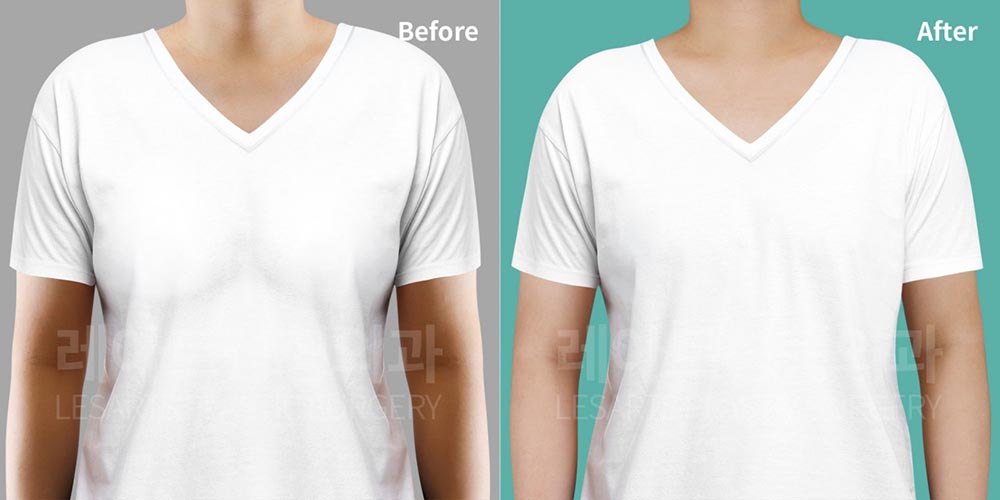
[2 Weeks After Male Gynecomastia Surgery,
Change in Chest Protrusion Under a T-Shirt]
Before surgery, the chest protruded forward
even under a thin short-sleeved T-shirt.
The rounded volume extending to the lower chest
also made the upper body appear heavier.
Two weeks after surgery, the chest protrusion
had decreased, allowing the T-shirt to fall
more naturally without catching on the chest.
Although this was still an early stage of recovery
when swelling and bruising could remain,
changes in the chest size and thickness
were already visible through clothing.
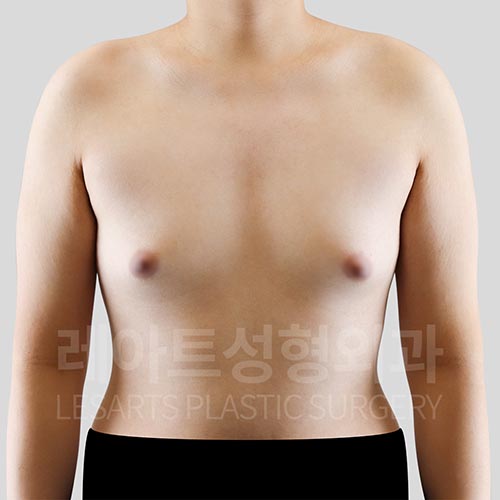
[Preoperative Condition Showing Chest Protrusion and Bilateral Lumps Present Since Adolescence]
[Patient Information and Gynecomastia Examination Results]
Age: 20s
Height: 183 cm
Weight: 86 kg
Gynecomastia Diagnosis: Simon Grade 2A, True Gynecomastia
Skin Elasticity: Moderate
In this case, chest changes that began
during adolescence did not resolve naturally
and persisted into the patient’s 20s.
Before surgery, the frontal view showed
an overall increase in the size of both breasts,
with noticeable protrusion in the center
of the chest.
In addition to the visible changes,
firm lumps could also be felt
in both breasts.
A high-resolution ultrasound examination revealed
excessively developed glandular tissue, confirming
true gynecomastia rather than pseudogynecomastia
caused primarily by excess body fat.
Even when chest protrusion appears similar,
the proportion of fat and glandular tissue
can vary from patient to patient.
Therefore, rather than judging by appearance alone,
the first step is to accurately identify
the current condition through a gynecomastia
examination and diagnosis.
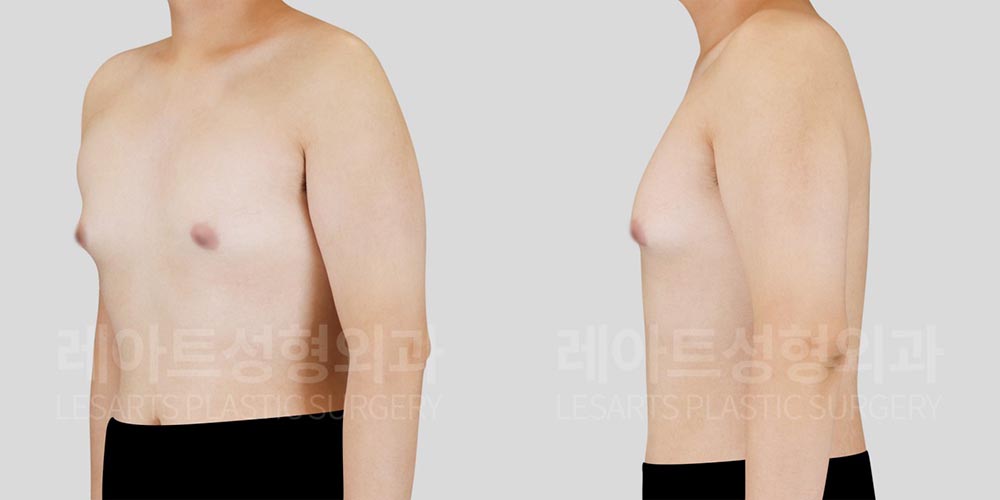
[Preoperative Condition Showing Chest Protrusion, Bilateral Lumps, and Increased Chest Thickness]
From the oblique and side views,
protrusion in the center of the chest
was visible along with thickness extending
from the lower to the outer chest.
The firm lumps in the central chest
were caused by developed glandular tissue,
while subcutaneous fat also contributed significantly
to the rounded lower and outer chest volume.
Therefore, rather than removing
the glandular tissue alone,
the following procedures were planned together.
– Removal of developed glandular tissue
– Liposuction of the entire chest
– Chest contour refinement through tissue repositioning
If only the glandular tissue is removed
while the surrounding fat remains,
the center of the chest may appear sunken
or uneven transitions may develop.
Conversely, if only liposuction is performed,
firm glandular tissue may remain,
leaving the chest protrusion and lumps
insufficiently corrected.
Therefore, the glandular tissue and fat
were appropriately removed, while the remaining
tissue was evenly repositioned to create
a natural transition from the center
to the outer chest.
If you are concerned about lower abdominal skin folding
over the underwear line, contour irregularities around
a previous C-section scar, or lower abdominal protrusion
caused by abdominal wall laxity, it is important to undergo
a thorough evaluation before deciding on a surgical technique.
Rather than choosing a procedure based solely
on another patient’s results, we recommend an individualized
assessment of skin laxity, rectus diastasis,
and umbilical position.
At Lesarts Plastic Surgery, a personalized consultation
can help determine the most appropriate abdominoplasty approach
for your specific condition.
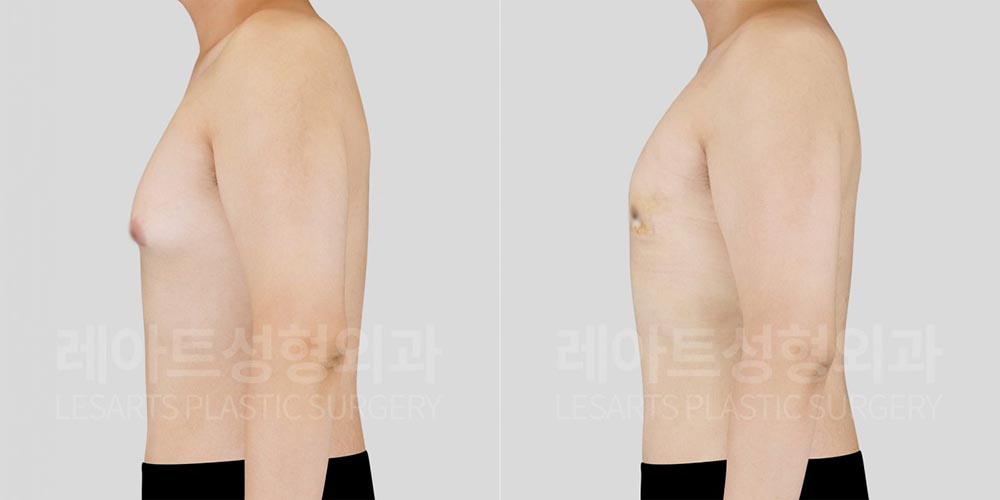
Gynecomastia Surgery Before and After: 2 Weeks
Two weeks after surgery is a period
when the overall recovery is evaluated
and sutures at the incision site are removed.
Although residual swelling and bruising may remain
and it is still too early to assess
the final results, changes in the prominent
chest protrusion and overall chest thickness
can already be observed.
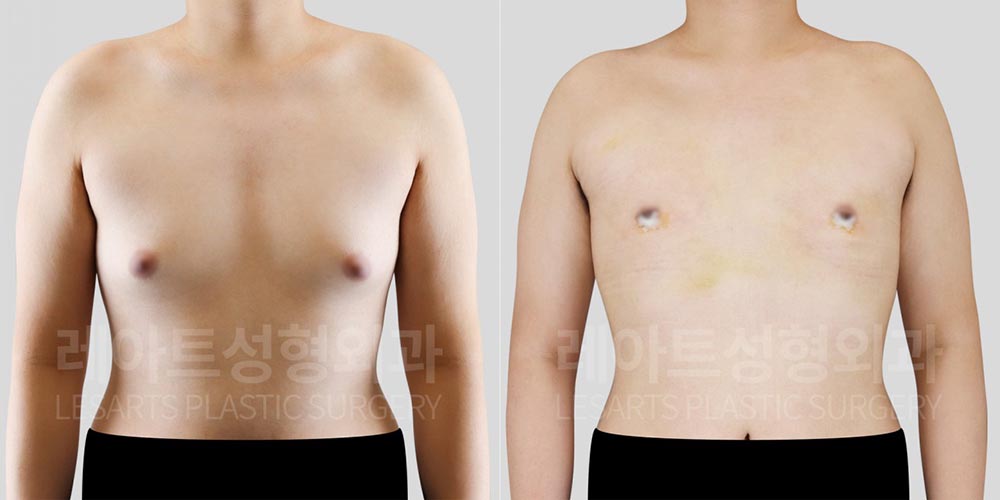
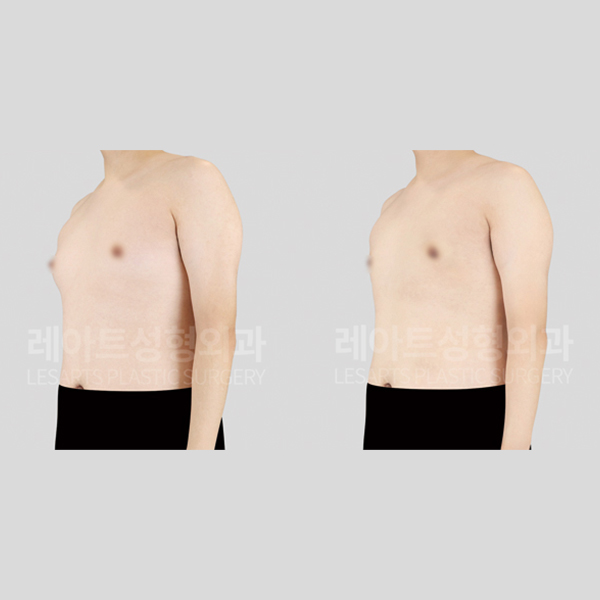
[2 Weeks After Male Gynecomastia Surgery, Change in Chest Protrusion from the Front]
Before surgery, the center of both sides
of the chest appeared prominent,
with a rounded contour extending from
the lower chest toward the underarm area.
Two weeks after surgery, the central protrusion
and overall chest volume had decreased,
creating a flatter chest contour
from the frontal view.
Although swelling and bruising were still present
at this early stage of recovery,
the healing process appeared stable,
with relatively balanced contours on both sides.
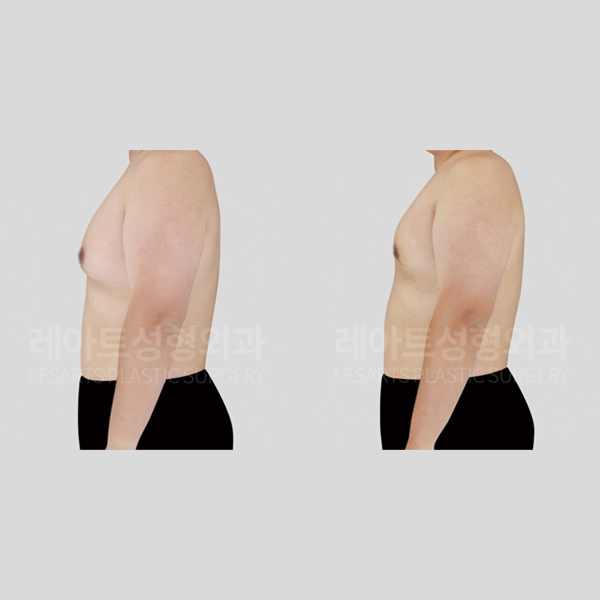
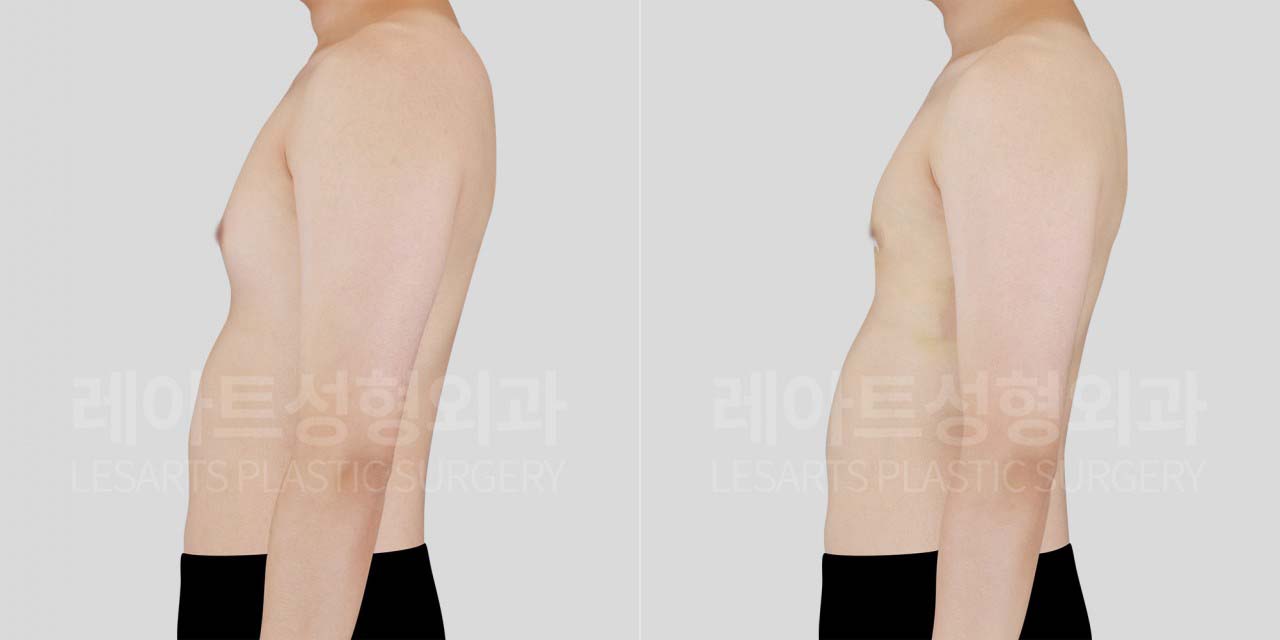
[2 Weeks After Male Gynecomastia Surgery, Changes in Chest Thickness and Lower Chest Contour from the Side]
From the side view, the reduction
in the forward-projecting chest thickness
is even more noticeable.
As the firm glandular tissue in the central chest
and surrounding fat were addressed together,
the degree of forward chest protrusion
was reduced.
The angled bulge along the lower chest
also became less prominent, creating
a straighter upper-body contour from
below the collarbone toward the abdomen.
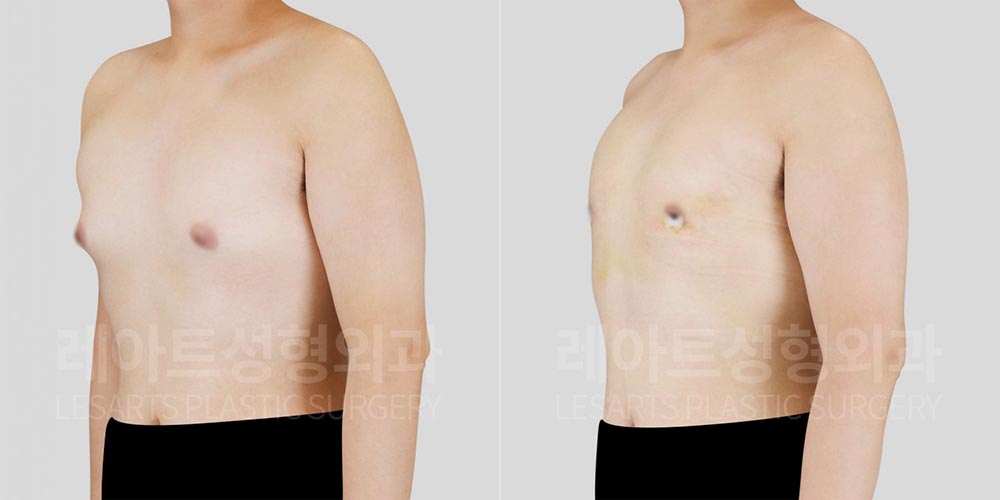
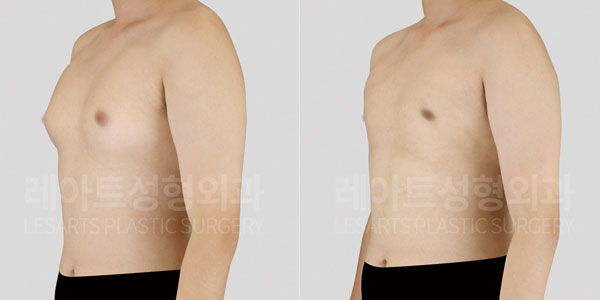
[2 Weeks After Male Gynecomastia Surgery, Change in Chest Protrusion from the Oblique View]
From the oblique view, reductions in both
the central chest protrusion and outer chest volume
can be observed.
Before surgery, the central chest projected forward,
with rounded volume extending
into the lower chest.
After surgery, the overall chest contour
was reduced and positioned closer
to the chest wall.
By combining glandular tissue removal, liposuction,
and tissue repositioning, the central and surrounding
chest areas were smoothly connected
without excessive indentation in any specific area.
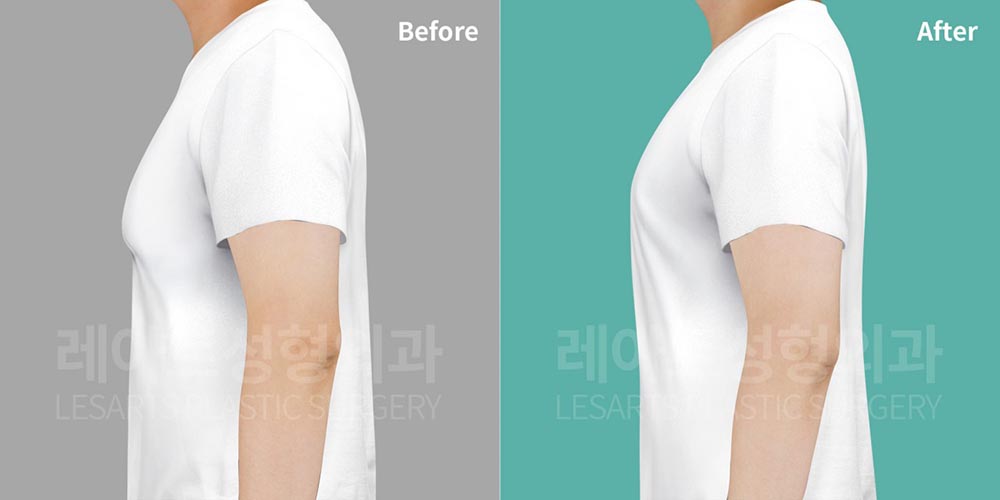
[2 Weeks After Gynecomastia Surgery, Change in Chest Protrusion from the Side View in a T-Shirt]
Before surgery, the chest protrusion was visible
even through a T-shirt, causing the fabric
to project forward around the chest.
Two weeks after surgery, the chest thickness
had decreased, allowing the T-shirt to fall
more naturally along the torso
without catching on the chest.
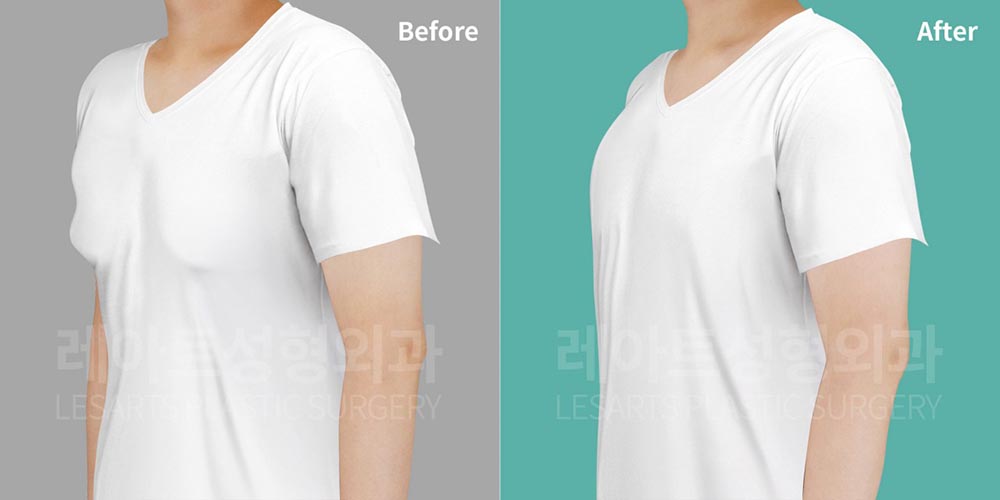
[2 Weeks After Gynecomastia Surgery, Change in Chest Contour in a Short-Sleeve T-Shirt]
From the oblique view, the chest volume
that had previously appeared prominent
was reduced, creating a lighter upper-body contour.
The patient had been self-conscious about
his chest showing through clothing since adolescence.
After surgery, he was pleased that his chest
looked more natural even in a thin
short-sleeve T-shirt.
Is It Okay to Simply Wait and See
with Pubertal Gynecomastia?
During puberty, hormonal changes can cause
temporary breast development, which may
naturally decrease as growth progresses.
Therefore, not every adolescent with
chest enlargement requires surgery.
However, an accurate evaluation is recommended
if any of the following persist for a long time:
– Chest size does not decrease after growth is complete
– A firm lump is felt in the center of the chest
– Chest protrusion remains despite exercise and weight loss
– One or both sides of the chest remain enlarged
– A prominent chest under thin clothing causes discomfort in daily life
Weight gain can also make the chest appear larger
due to increased fat accumulation.
However, if glandular tissue has also developed,
dieting alone may not eliminate the central
chest protrusion or firm lump.
2 Weeks After Gynecomastia Surgery Is Not the Final Result
At 2 weeks after surgery, early changes
in chest size and protrusion can be seen,
but recovery is not yet complete.
Residual swelling, bruising, and firmness
may still remain in the chest, and the skin
and internal tissues need time to settle.
During the early recovery period, wear the
compression garment as instructed by your surgeon.
Exercises that place strong pressure on the chest
and heavy upper-body workouts should be avoided.
Depending on your recovery, light activities
can be resumed first, while gym workouts
and strength training should be restarted gradually
after receiving clearance from your surgeon.
Swelling and firmness around the surgical area
gradually soften over several months.
Rather than judging the final chest contour
based only on 2-week photos, regular follow-up
is important throughout the recovery process.
If you notice a firm lump or pain,
do not automatically assume it is gynecomastia.
An ultrasound examination can help evaluate
the tissue and rule out other possible conditions.
Adolescent gynecomastia may naturally improve
in some cases, while in others it can persist
into adulthood.
Therefore, rather than assuming it is simply
a temporary change from puberty or weight gain,
it is important to accurately evaluate the condition
and understand the available treatment options.
#adolescentgynecomastia
#gynecomastiasurgery
#malebreastreduction
#gynecomastiabeforeandafter
#chestcontouring
Gynecomastia Surgery FAQ
Q1. Does adolescent gynecomastia naturally go away in adulthood?
Gynecomastia caused by temporary hormonal changes
during puberty may improve naturally with growth.
However, if developed glandular tissue persists
into adulthood without significant change,
an evaluation is recommended.
Q2. Can exercise and dieting get rid of gynecomastia?
Fat accumulated in the chest may decrease
with weight loss, but developed glandular tissue
cannot be removed through exercise alone.
If central chest protrusion or a firm lump remains
after weight loss, the presence of glandular tissue
should be evaluated.
Q3. Does a firm lump in the chest mean true gynecomastia?
Developed glandular tissue may feel like
a firm lump, but the cause cannot be determined
through palpation alone.
An ultrasound examination can help assess
glandular tissue development and rule out
other possible conditions.
Q4. Is removing glandular tissue alone enough for gynecomastia surgery?
It depends on the distribution of glandular tissue
and surrounding fat.
When both are developed, gland removal and
chest liposuction may be combined to create
a smoother and more natural chest contour.
Q5. Can I exercise 2 weeks after gynecomastia surgery?
At 2 weeks, the internal tissues are still healing,
so strenuous chest and upper-body exercises
should generally be avoided.
Exercise intensity can usually be increased gradually
after about one month, depending on recovery
and your surgeon’s evaluation.
▼ Visit Lesarts Plastic Surgery in Gangnam, Seoul, Korea ▼