
Gynecomastia surgery in Korea: 2-week results for enlarged chest and areolas in men in their 40s

Patient Registration Info
| Age | Weight | Height | BMI |
|---|---|---|---|
|
40s |
72kg |
175cm |
23.5 |
Surgical site
Surgical site : Gynecomastia | Grade 2-A
Could It Be Gynecomastia If Your Chest Gets Bigger After 40 Without Weight Gain?
After your 40s, changes in body fat distribution
and hormonal balance may affect the appearance
of your chest.
However, if your weight has remained relatively stable
while your chest and areolas have become larger,
it is important not to assume that the changes
are simply caused by increased body fat.
Instead, the development of glandular tissue,
current medications, and overall health conditions
should also be evaluated.
▶ Watch More Gynecomastia Surgery Cases and Changes in Clothing Fit
When the chest becomes larger than before
and the area around the areolas appears more prominent,
many people first try to reduce the volume
through weight loss or chest exercises.
Particularly after the age of 40, physical activity
and muscle mass may decrease, while body fat
can accumulate more easily.
These changes may also affect the appearance
of the chest.
However, not every change in chest size
can be attributed simply to weight gain.
If your weight has not changed significantly
but your chest continues to enlarge,
or your areolas appear wider and more protruded
than before, it may be necessary to check
whether glandular tissue has actually developed.
It is also important to examine whether
any existing medical conditions or medications
may be affecting your hormonal balance.
In this article, we will review the case
of a patient who began noticing enlargement
of both sides of his chest and areolar projection
after entering his 40s.
We will examine his diagnostic findings,
surgical plan, and the changes observed
2 weeks after gynecomastia surgery.
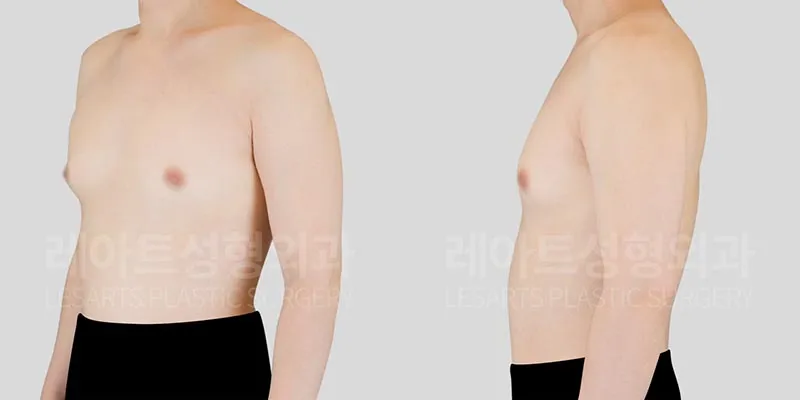
[Preoperative Chest Projection and Areolar Changes in a Man in His 40s with Gynecomastia]
After entering his 40s, the patient began noticing
gradual enlargement of both sides of his chest,
which eventually caused discomfort in everyday life.
Recently, his chest seemed to have become slightly larger,
and he was particularly concerned about his areolas,
which appeared wider and more protruded than before.
Although he tried losing weight and performing chest exercises,
there was little change in the overall size
or shape of his chest.
He eventually sought a surgical consultation
to determine whether the changes were caused
by excess body fat or actual gynecomastia.
[Patient Information and Gynecomastia Ultrasound Findings]
Age: 46 years
Height: 175 cm
Weight: 72 kg
BMI: 23.5
Gynecomastia Diagnosis: Mixed-type gynecomastia, Simon Grade 2A
Skin Condition: Mild skin laxity
The examination confirmed that the enlarged chest
and forward-projecting areolas were not caused
by excess fat alone.
Ultrasound imaging revealed enlarged glandular tissue
on both sides of the chest.
Firm tissue could also be felt beneath the skin
during the physical examination.
In addition, subcutaneous fat was distributed
from the lateral chest to the lower chest,
contributing to the overall enlargement.
The patient was also taking medication for hair loss,
which needed to be considered during the evaluation.
We explained that his medication might have contributed
to the development of his symptoms
and that continued observation of chest changes
would be necessary even after surgery.
[Why Liposuction and Tissue Rearrangement Were Performed Along with Glandular Tissue Removal]
The patient had mixed-type gynecomastia,
with both glandular tissue and fat contributing
to the enlarged appearance of his chest.
If only the enlarged glandular tissue were removed,
the remaining fat along the lateral and lower chest
could prevent the overall contour
from appearing smooth and balanced.
Therefore, we planned to remove the enlarged
glandular tissue responsible for the gynecomastia
and perform liposuction to reduce
the surrounding fat.
Tissue rearrangement was also included
to prevent sudden depressions or uneven transitions
between the central chest, where the glandular tissue
had been removed, and the surrounding areas.
The goal was to create a natural, continuous
chest contour without noticeable irregularities.
A small amount of fat grafting was also performed
to reduce the risk of the central chest
appearing excessively flat or hollow.
The primary goal of this surgery was not simply
to reduce chest volume.
It was to decrease the overall chest size
while maintaining a natural masculine chest contour.
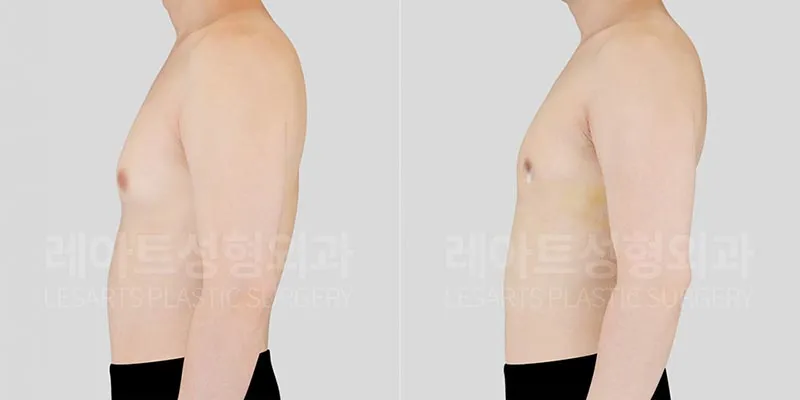
[Changes in Anterior Chest Projection 2 Weeks After Gynecomastia Surgery in a Man in His 40s]
Let’s compare the photos taken
2 weeks after gynecomastia surgery.
The most noticeable change is the reduced projection
of the central chest, particularly around the areolas.
Before surgery, the areolas projected forward,
and the surrounding tissue appeared enlarged,
giving the entire chest a rounded, protruding appearance.
At 2 weeks after surgery, the projection
around the areolas had decreased,
making the anterior chest appear naturally flatter.
The overall chest volume, which had previously
appeared enlarged and rounded, had also decreased.
Although this was still an early recovery stage
with some swelling and bruising remaining,
the reduction in anterior chest projection
was clearly visible compared to before surgery.

[Changes in Areolar Projection and Anterior Chest Contour from the Oblique View 2 Weeks After Male Gynecomastia Surgery]
From the oblique view, changes can be seen
not only around the areolas but also in the volume
extending toward the lower chest.
Before surgery, the anterior chest projected forward
around the areolas, with the volume extending
down toward the lower chest.
This created an overall rounded and soft chest contour.
At 2 weeks after surgery, the thickness
of the anterior chest and the volume
of the lower chest had decreased,
creating a flatter and smoother appearance.
Rather than simply making the chest flat,
the procedure focused on creating a natural transition
between the central chest and surrounding areas.
As a result, the overall chest contour
appeared closer to a natural masculine chest shape.

[Changes in Chest Projection Through a T-Shirt 2 Weeks After Gynecomastia Surgery in a Man in His 40s]
When gynecomastia symptoms suddenly develop
in a man’s 40s, he may become increasingly conscious
of his chest during everyday activities
that previously caused no discomfort.
Many patients report feeling self-conscious
when wearing fitted T-shirts that make
their chest projection more noticeable.
They may also feel uncomfortable in places
where the upper body is exposed,
such as saunas or gyms.
In this case, the patient also experienced
significant discomfort from the forward projection
of his chest when wearing everyday clothes.
At 2 weeks after surgery, swelling, bruising,
and tissue firmness were still present
as part of the early recovery process.
However, the previously prominent chest volume
had already decreased, making the changes
noticeable even through a thin T-shirt.
Before surgery, the fabric lifted forward
around the chest, emphasizing the projection
of the areolas and surrounding tissue.
After surgery, the T-shirt fell more naturally
along the contour of the torso,
making the chest projection appear
less noticeable than before.

[Changes in Chest Projection Through a T-Shirt 2 Weeks After Gynecomastia Surgery]
From the oblique view, the difference in chest volume
visible through the T-shirt can also be seen.
Before surgery, the anterior chest projected forward
in a rounded shape, making the chest stand out
separately from the rest of the upper body.
After surgery, the volume in the central and lower chest
had decreased, creating a more natural transition
between the chest and torso.
These changes improved not only the appearance
of the chest but also the discomfort the patient
had experienced when wearing everyday clothes.
Unlike patients who have experienced gynecomastia
since adolescence, this patient began noticing
enlargement of both sides of his chest
and increased areolar projection in his 40s.
He initially tried losing weight and performing
chest exercises, but there was little change
in his chest size.
Ultrasound examination confirmed the presence
of enlarged glandular tissue.
Fat was also distributed along the lateral
and lower chest, contributing to the overall volume.
Therefore, glandular tissue removal, liposuction,
and tissue rearrangement were performed together.
A small amount of fat grafting was also added
to the central chest where necessary.
At 2 weeks after surgery, the previously protruding
areolas appeared less prominent,
and the overall chest size had decreased.
Both the side and oblique views showed
a flatter chest contour than before surgery.
In particular, the anterior chest projection
that had previously been noticeable through thin T-shirts
had decreased, bringing noticeable improvements
to the patient’s everyday comfort.
After the age of 40, physical activity
and muscle mass may decrease,
making it easier for body fat to accumulate.
This is also a period when various factors,
including changes in health conditions
and medications, may affect chest appearance.
Therefore, if you notice new changes in chest size
or areolar projection that were not present before,
it is important not to assume that they are simply
caused by age-related weight gain.
Instead, an accurate examination should be performed
to determine whether glandular tissue has developed
and whether other possible causes need to be evaluated.
If your weight has remained relatively stable
but your chest continues to enlarge,
or if the projection around your areolas persists
despite exercise and weight loss,
it is important to have your current condition evaluated.
You can then discuss the treatment approach
most appropriate for your individual needs.
Gynecomastia FAQ for Men in Their 40s
Q1. Can gynecomastia suddenly develop in your 40s?
Yes. In addition to changes in body fat,
various factors should be evaluated,
including hormonal balance, health conditions,
and current medications.
Q2. Could it be gynecomastia if your chest gets bigger without weight gain?
If your chest and areolas become larger
despite no significant change in weight,
it may be necessary to check whether
glandular tissue has developed.
Rather than judging by appearance alone,
an examination is recommended
to identify the underlying cause.
Q3. Can areolar projection remain unchanged despite chest exercises?
If glandular tissue beneath the areolas
has become enlarged, exercise may change
the surrounding body fat or muscle.
However, the glandular tissue itself
may not decrease as much as desired.
Q4. Does taking hair loss medication always cause gynecomastia?
No. In this case, the patient was taking
hair loss medication, so a possible connection
between the medication and his symptoms
was also considered.
However, not everyone who takes
hair loss medication develops gynecomastia.
It is important to review the relationship
between your current medications and symptoms
with a medical professional.
Q5. Can changes in T-shirt fit be noticeable 2 weeks after gynecomastia surgery?
In this case, the patient still had swelling,
bruising, and tissue firmness at 2 weeks after surgery.
However, the volume of the anterior chest
had already decreased, making the changes
noticeable even when wearing a thin T-shirt.
▼ Visit Lesarts Plastic Surgery in Gangnam, Seoul, Korea ▼