
Thigh liposuction in Seoul: is high-volume fat removal safe for thighs with poor skin elasticity?
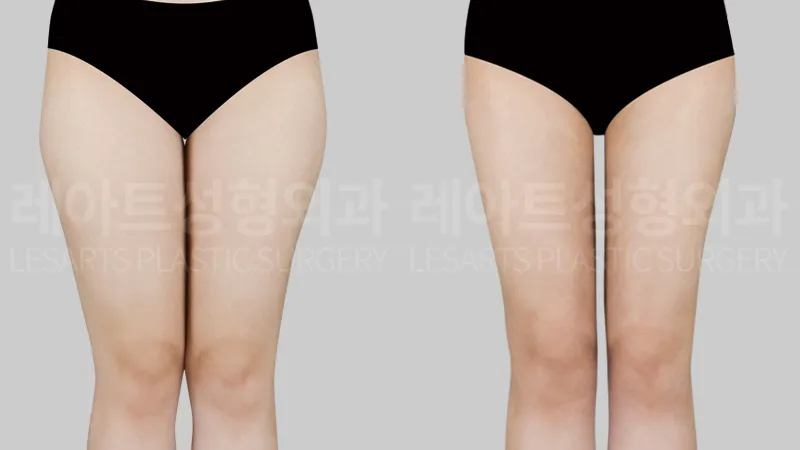
Patient Registration Info
| Age | Weight | Height | BMI |
|---|---|---|---|
|
20s |
55kg |
169cm |
19 |
Surgical site
Surgical site : Thigh|liposuction volume : 3,700 cc
Should You Remove as Much Fat as Possible During Thigh Liposuction?
Even if there is a sufficient amount of fat
that can be removed from the thighs,
removing as much as possible does not necessarily
lead to better results.
If skin elasticity is poor or certain skeletal
features are prominent, excessive fat removal
may cause sagging, wrinkles, or an unnatural leg contour.
Therefore, it is important to distinguish
between areas that require significant fat reduction
and areas where some volume should be preserved.
Some people look in the mirror and think,
“If only I could lose a little more fat
from my inner thighs and saddlebags,
my legs would look much slimmer.”
When considering thigh liposuction,
it is easy to assume that removing as much fat
as possible from these areas will naturally
create slimmer and longer-looking legs.
However, when planning thigh liposuction,
it is important to evaluate not only
the amount of fat that can be removed
but also the condition of the skin,
skeletal structure, and muscle shape.
In particular, if skin elasticity is poor,
removing excessive amounts of fat may reduce
the overall thickness of the thighs.
However, the remaining skin may sag or wrinkle,
potentially making the leg contour appear
less smooth and natural.
Therefore, for patients with these body characteristics,
it is important not to remove large amounts of fat
uniformly from every area.
Instead, the surgical plan should distinguish
between areas that require sufficient fat reduction
and areas where volume should be preserved
to maintain a natural leg contour.
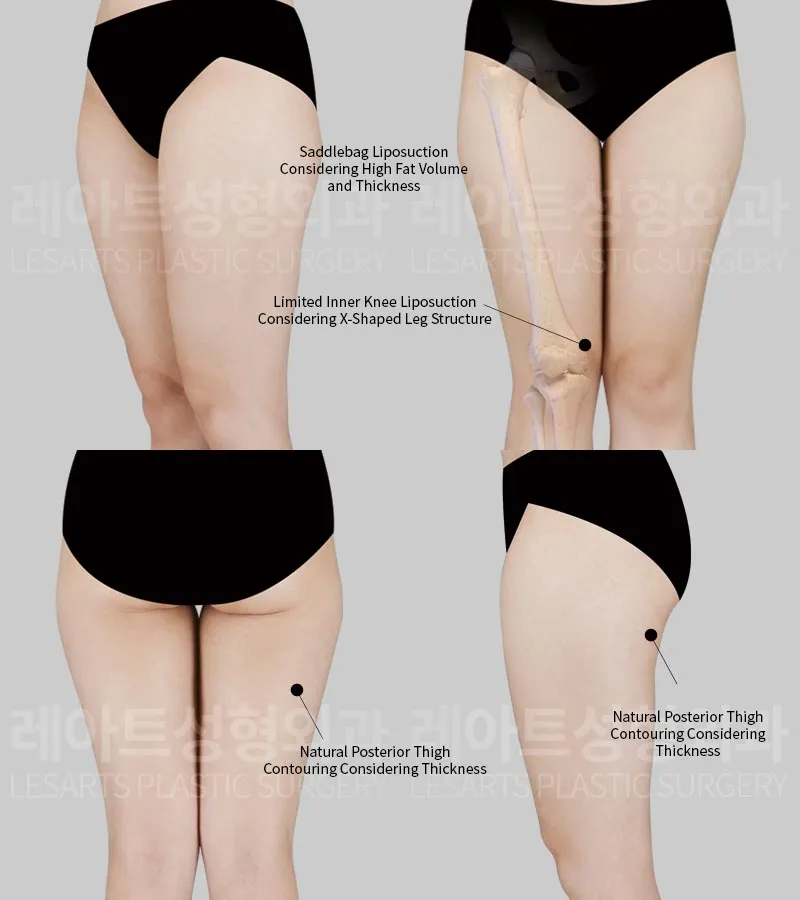
[Preoperative Inner Thigh and Saddlebag Contour Before Thigh Liposuction]
The patient’s main concerns were excess fat
along the inner thighs and outer thighs (saddlebags).
She wanted to reduce the overall thickness
of her thighs while achieving slimmer, straighter legs
with a smooth contour from top to bottom.
[Patient Information]
Age: 20s
Height: 169 cm
Weight: 55 kg
BMI: 19.3
Before surgery, the front-view photos showed
that excess fat along the inner thighs
caused both legs to touch without a visible gap.
The saddlebags along the outer thighs
were also noticeably prominent.
As a result, the upper thighs appeared
relatively wide, making the legs look
shorter and heavier than her actual body proportions.
[Planning Thigh Liposuction Based on Skin Elasticity and X-Shaped Leg Alignment]
Although the patient had sufficient fat
that could be removed from her thighs,
her skin elasticity was relatively poor
despite being in her 20s.
For this reason, removing as much fat
as possible from every area was not
considered an appropriate approach.
If the fat directly beneath the skin
were reduced excessively, the skin might
not contract sufficiently to accommodate
the loss of volume.
This could increase the possibility
of sagging or visible wrinkles.
Another important consideration
was her X-shaped leg alignment.
If too much fat were removed
from the inner thighs, the inward alignment
of her skeletal structure could become
more noticeable.
This might actually make it more difficult
to achieve the straight-leg appearance
the patient wanted.
Therefore, the inner thighs were planned
to be reduced enough to create a visible gap,
while avoiding excessive fat removal
along the inner thighs near the knees.
The depth of liposuction was adjusted
according to each area.
For the saddlebags, the goal was
to sufficiently reduce the outward-projecting volume.
The posterior thighs were also planned
to be refined without excessive hollowing,
taking into account the existing fat volume
and skin condition.
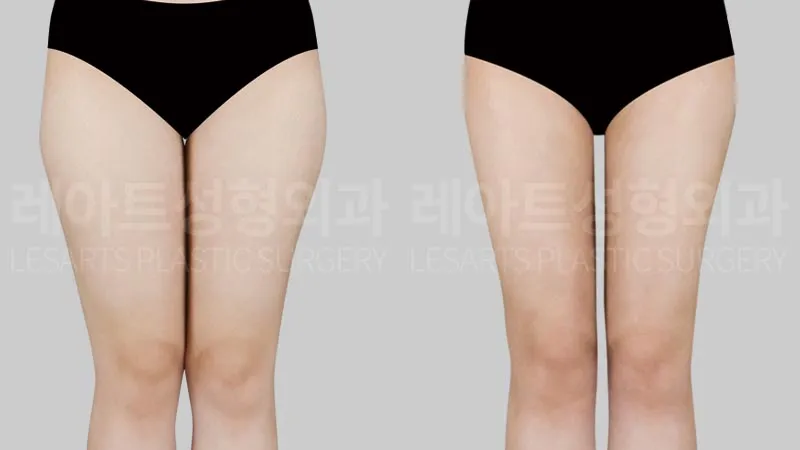
[Changes in Inner Thigh and Saddlebag Contours from the Front View 4 Months After Thigh Liposuction]
Let’s compare the photos taken
4 months after thigh liposuction.
The most noticeable change is the improvement
in the inner thighs, which previously touched.
Before surgery, the inner thighs were in broad contact,
starting from the upper thigh area.
At 4 months after surgery, the volume
in this area had decreased, creating
a natural gap between the thighs.
Rather than removing inner thigh fat
as deeply as possible, the amount of fat removal
was carefully adjusted according to each area.
As a result, the patient’s X-shaped leg alignment
did not become excessively noticeable,
allowing a smoother, straighter leg contour
from the upper thighs downward.
The saddlebags along the outer thighs
had also decreased, reducing the overall width
of the upper thighs.
As a result, the legs appeared to begin
at a higher point than before surgery.
Along with the reduction in overall thigh thickness,
this created the appearance of slimmer
and noticeably longer-looking legs.
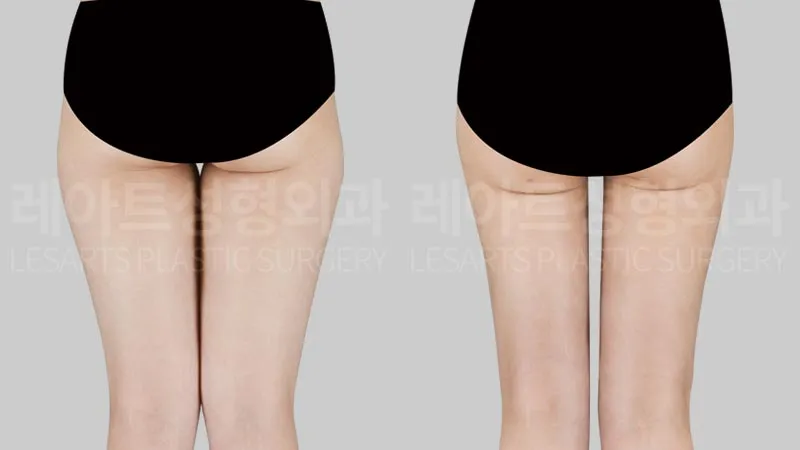
[Changes in the Posterior Thigh and Under-Buttock Contour from the Rear View 4 Months After Thigh Liposuction]
From the rear view, the reduced width
of the inner thighs is also noticeable,
creating a straighter and slimmer overall leg contour.
In this procedure, the goal was not simply
to remove as much fat as possible
from the posterior thighs.
When skin elasticity is poor, excessive fat removal
from the posterior thighs and beneath the buttocks
may leave behind loose skin or create
unnatural hollowing along the under-buttock contour.
Therefore, only the necessary amount of fat
was removed based on the existing thigh thickness,
while preserving a natural transition
from the buttocks to the thighs.
In the photos taken 4 months after surgery,
the area beneath the buttocks showed
no sudden hollowing or irregular skin folds.
Instead, the under-buttock contour
blended naturally with the reduced thigh circumference,
maintaining a smooth and balanced appearance.
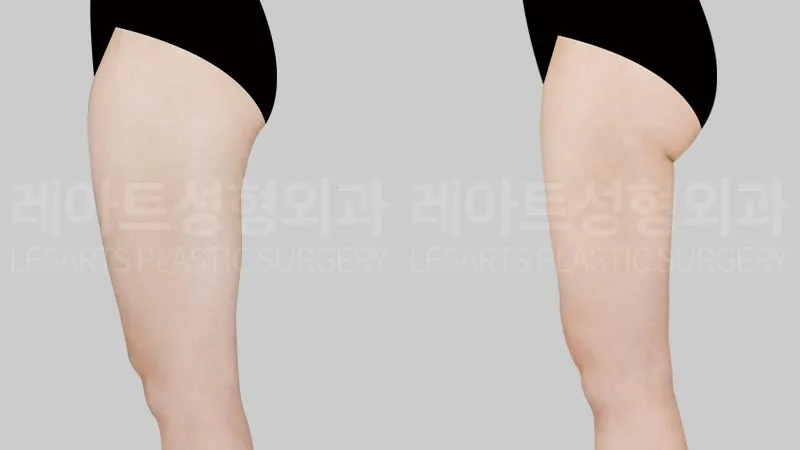
[Changes in the Outer Thigh Contour from the Saddlebags Downward 4 Months After Thigh Liposuction]
From the side view, the changes in the saddlebags,
which had been one of the patient’s main concerns,
are even more noticeable.
Before surgery, the area extending from
the upper thighs toward the buttocks
projected outward more prominently
than the rest of her body proportions.
At 4 months after surgery, the volume
in this area had decreased,
creating a slimmer overall thigh circumference.
The natural transition between the buttocks
and thighs, which had previously been obscured
by excess fat, also became more clearly visible.
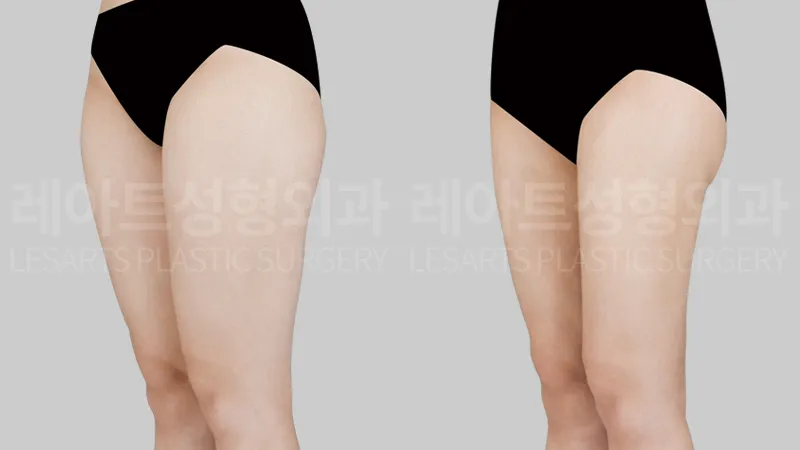
[Changes in Thigh Thickness from the Front Thigh to Above the Knee 4 Months After Thigh Liposuction]
From the oblique view, the reduction
in anterior thigh thickness is also noticeable.
If only the upper thigh volume is reduced
while the area above the knee remains unchanged,
an abrupt transition may develop
along the middle of the leg.
In this case, the patient’s X-shaped leg alignment
was carefully considered when planning fat removal.
While avoiding excessive fat reduction
along the inner knee area, the procedure
was adjusted to create a smooth transition
in thickness from the front thighs
to the area above the knees.
As a result, no specific areas appeared
unnaturally hollowed out.
Both the front and oblique views show
a slimmer, straighter leg contour
with a more natural and continuous appearance.
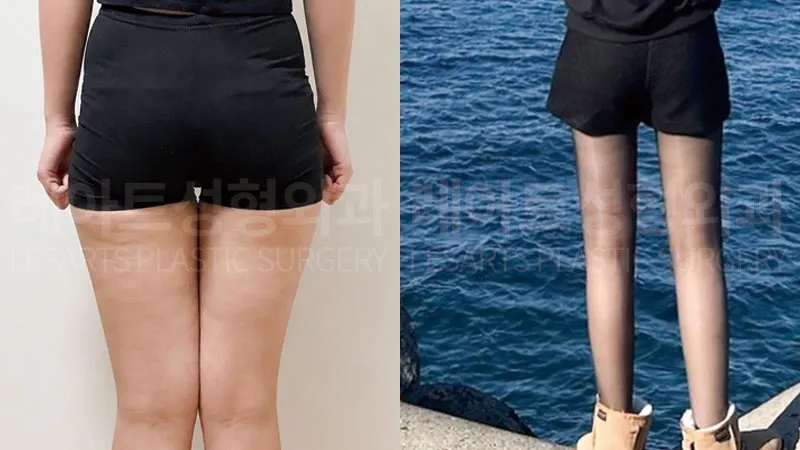
[Before-and-After Selfie Comparison: 2 Months After Thigh Liposuction]
Changes in the overall leg contour can also be seen
in the photos taken by the patient herself.
At 2 months after surgery, some of the initial swelling
had subsided, creating a visible gap between
the inner thighs that previously touched.
The thickness of the saddlebags
had also noticeably decreased.
Even in everyday standing positions,
the reduced width of the upper thighs
made the legs appear slimmer and longer
than before surgery.
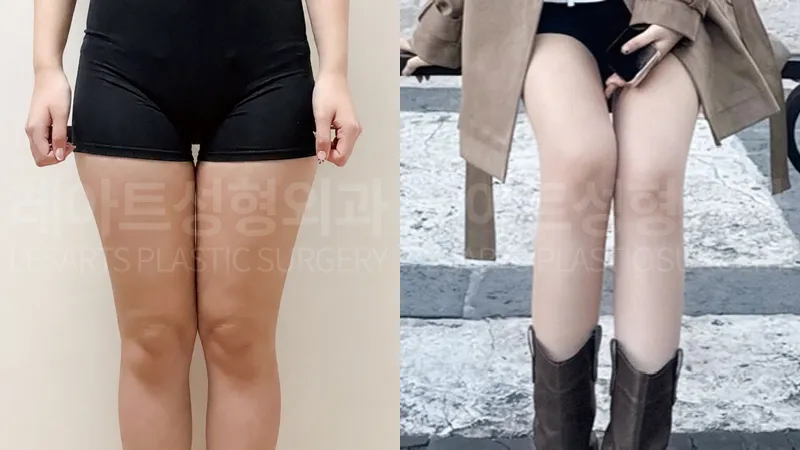
[Before-and-After Selfie Comparison: 4 Months After Thigh Liposuction]
At 4 months after surgery, the inner thighs
and saddlebags had settled into a more natural shape,
and the overall leg contour had become more stable.
The patient expressed satisfaction with the improvement
in the two areas that had concerned her most,
as well as the slimmer and longer appearance of her legs.
In particular, as her thigh thickness decreased,
she noticed changes in the fit of her usual
leggings and pants.
She shared that the slimmer appearance of her legs
became even more noticeable when wearing clothes.
When considering thigh liposuction,
patients who have a sufficient amount of fat
may naturally want to remove as much as possible.
However, although this patient had enough fat
for liposuction, her skin elasticity was relatively poor,
and she also had X-shaped leg alignment.
For this reason, determining how much fat
could be safely and naturally removed from each area
was more important than simply maximizing
the total amount of fat removal.
The inner thighs and saddlebags were sufficiently reduced
to create a slimmer upper thigh contour.
At the same time, fat removal around the inner knees
was carefully adjusted to prevent her skeletal alignment
from becoming excessively noticeable.
The posterior thighs were also treated
while preserving the necessary volume
to minimize skin sagging and unnatural hollowing
beneath the buttocks.
As a result, at 4 months after surgery,
a natural gap had formed between the inner thighs
without emphasizing her X-shaped leg alignment.
The reduced saddlebag volume also made
the upper thighs appear noticeably narrower.
These changes brought her closer to the slimmer,
longer-looking, straighter leg contour she had wanted.
When thigh thickness is a concern,
the goal should not simply be to perform
large-volume liposuction.
Instead, it is important to evaluate
the patient’s skin elasticity, skeletal structure,
and muscle shape to determine which areas
require sufficient fat reduction
and where some volume should be preserved.
If you have excess thigh fat but are concerned
about skin sagging, or if you want to reduce
your inner thighs and saddlebags while achieving
a straighter leg contour, it is important
to discuss both the possible improvements
and limitations based on your current body shape.
A surgical plan should then be developed
according to these individual characteristics.
Thigh Liposuction FAQ
Q1. Is it safe to remove as much fat as possible during thigh liposuction?
The amount of fat removed is not determined by fat volume alone.
If skin elasticity is poor, excessive fat removal may cause sagging or wrinkles.
Therefore, the amount of fat removed should be carefully adjusted for each area.
Q2. Can thigh liposuction be performed if skin elasticity is poor?
After evaluating the degree of skin sagging and the current skin condition, a surgical plan can be developed.
This involves identifying areas where fat can be sufficiently reduced and areas where some superficial fat volume should be preserved.
Q3. Can liposuction make X-shaped legs look straighter?
Liposuction can improve contours that appear more pronounced due to excess fat, but it cannot change the underlying skeletal structure.
In fact, removing too much fat may make X-shaped leg alignment more noticeable.
Therefore, the extent of fat removal should be carefully adjusted.
Q4. Can excessive saddlebag fat removal cause the buttocks to sag?
Removing excessive fat from the area where the buttocks meet the thighs may create an unnatural transition or make the area appear saggy.
It is important to reduce fat only where necessary, based on the patient’s existing fat distribution.
Q5. Can thigh contour changes be evaluated 4 months after liposuction?
In this case, the photos taken 4 months after surgery showed reduced volume in the inner thighs and saddlebags.
The overall leg contour had also become more stable, creating an appearance closer to the straight-leg shape the patient wanted.
▼ Visit Lesarts Plastic Surgery in Gangnam, Seoul, Korea ▼