Gynecomastia surgery in Korea: why delaying treatment may not be the best choice (2-week results)
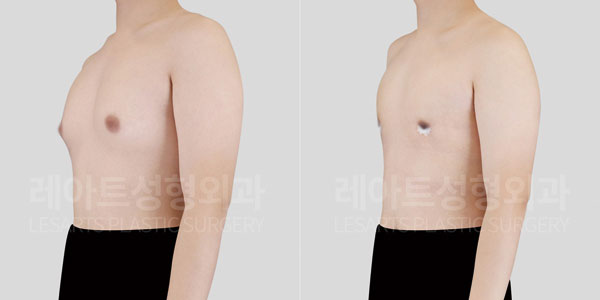
Patient Registration Info
| Age | Weight | Height | BMI |
|---|---|---|---|
|
20s |
71kg |
173cm |
24 |
Surgical site
Surgical area: Gynecomastia | Grade 2-A
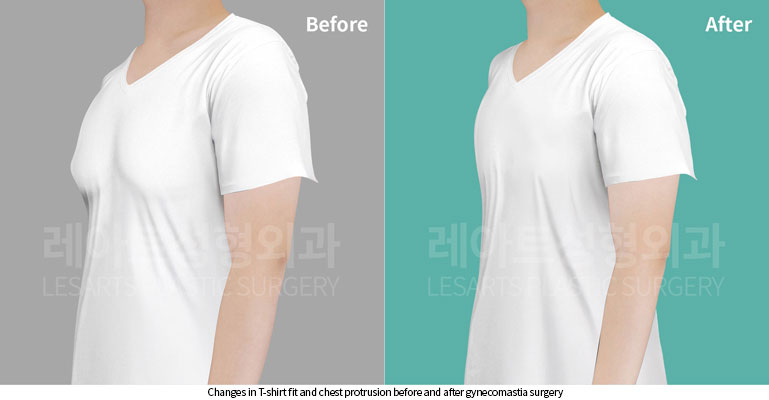
Gynecomastia refers to
a condition in which
the male chest enlarges
and protrudes forward,
creating a more feminine chest appearance.
In most cases,
once men notice
gynecomastia symptoms,
they begin trying various methods
such as exercise
— particularly chest workouts —
and dieting to improve the condition.
One reason many patients believe
these efforts may be effective
is because it is often difficult
to determine through visual observation alone
whether the enlarged chest is caused by
simple fat accumulation
or by changes in the glandular tissue
located beneath the areola.
As a result,
many hope that reducing body fat
and increasing muscle mass
will naturally improve
the appearance of the chest.
However,
if chest size and shape
remain unchanged despite
weight loss and increased muscle development,
there is a high possibility that
the condition is actually
true gynecomastia caused by
glandular tissue overgrowth.
In these situations,
patients seeking meaningful improvement
often require
an accurate diagnosis
followed by appropriate
surgical treatment.
Let’s take a closer look
at the effectiveness of
gynecomastia surgery
through an actual patient case.

[Gynecomastia Surgery Patient Information]
Age: Early 20s
Height: 173 cm
Weight: 71 kg
BMI: 24
Diagnosis: True Gynecomastia, Simon Grade 2A
This patient visited
Lesarts Plastic Surgery
after gynecomastia that first developed
during adolescence
became a long-standing condition.
Although he had
an average body type,
the increase in chest size
and visible protrusion
caused considerable discomfort
in daily life.
In addition to
the enlarged chest appearance,
the patient was also experiencing
breast tenderness,
which led him to seek
surgical treatment.
During the physical examination,
firm glandular tissue
was palpated beneath
both areolae,
and a raised, puffy appearance
around the areolar area
was also observed.
Ultrasound evaluation confirmed
that the palpable masses
were enlarged glandular tissue,
supporting the diagnosis of
true gynecomastia.
Based on these findings,
the surgical plan included
gland excision through
a periareolar incision,
combined with lateral chest liposuction
to create a more masculine
and natural chest contour.
The patient also demonstrated
good skin elasticity,
which suggested that
with proper post-operative care
and adherence to recovery guidelines,
a firm, natural-looking
chest shape could be achieved.
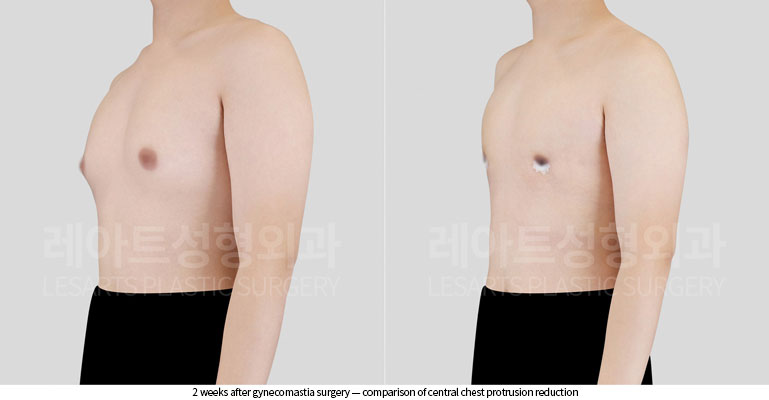
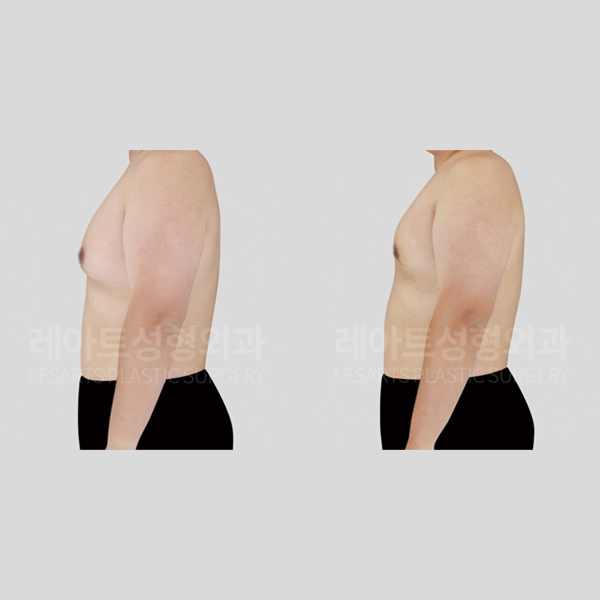
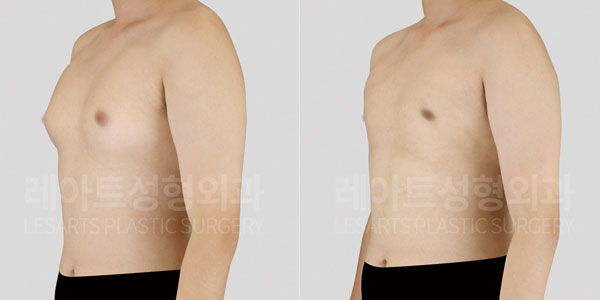
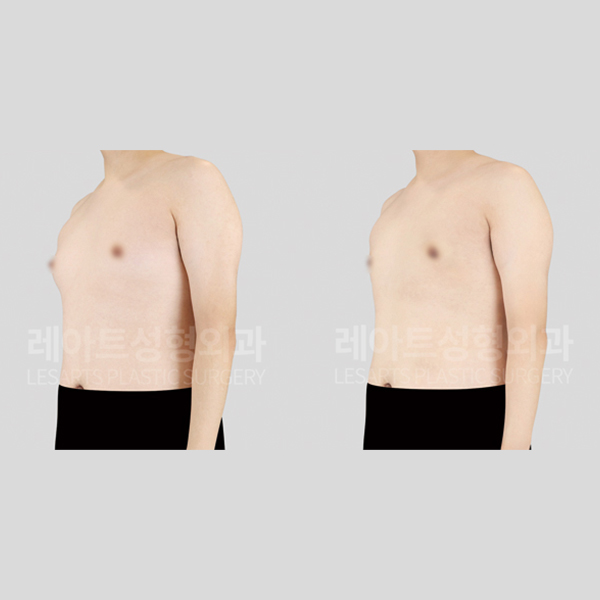
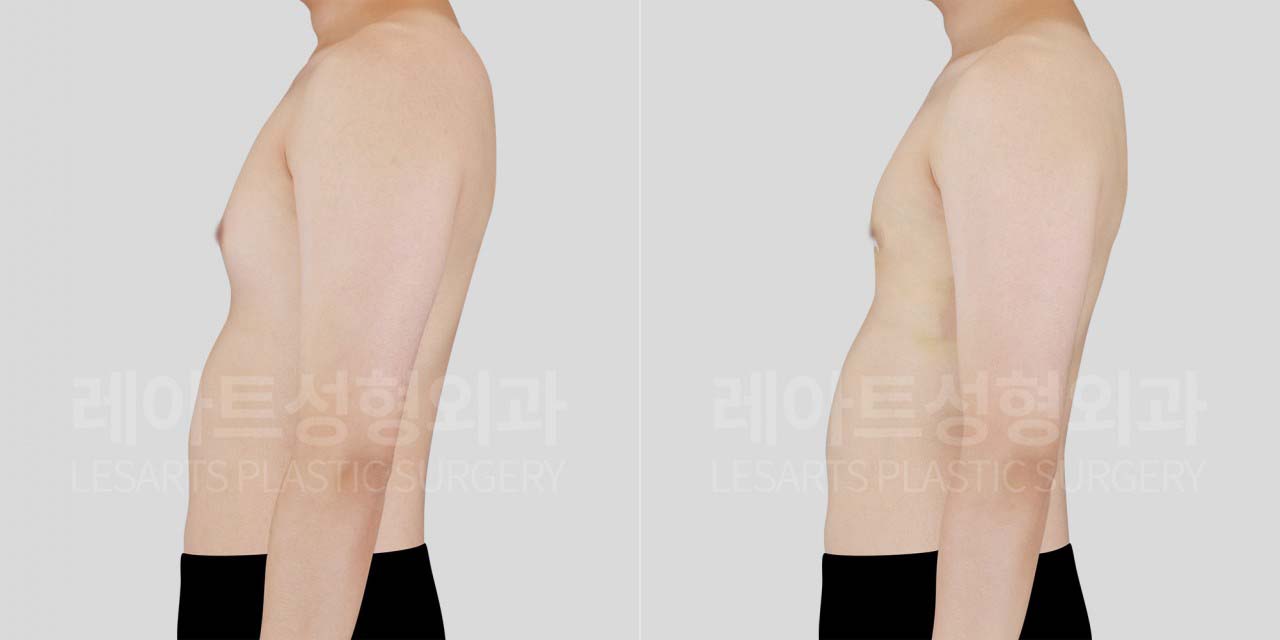
These photos were taken
2 weeks after gynecomastia surgery.
Even during the early stage
of recovery,
a noticeable reduction in
chest size
and significant improvement in
the overall chest contour
can already be observed.
In particular,
the previously swollen
areolar area
and the pointed chest protrusion
show clear improvement,
creating a smoother
and more natural appearance.
As a result,
the overall upper body silhouette
appears more refined and balanced,
even at this early stage
of the recovery process.
Although residual swelling
is still present at 2 weeks,
the correction of the underlying
glandular tissue overgrowth
has already produced
a visible change in
the chest shape and contour.
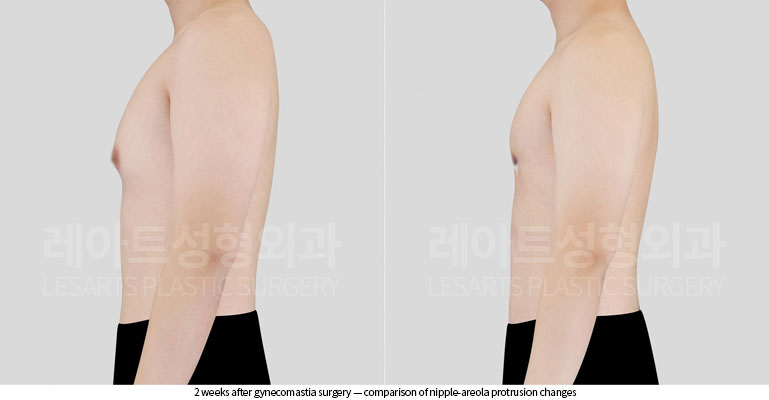
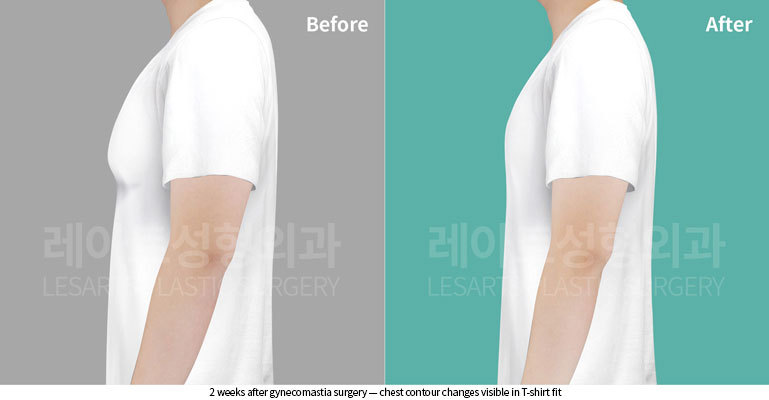
From the side view,
the previously noticeable
chest protrusion
has been effectively corrected,
creating a much flatter
and more natural chest contour.
The change is also clearly visible
when wearing a short-sleeved T-shirt,
where a smooth and natural fit
can now be observed.
Because this patient
was in his early 20s
and had excellent skin elasticity,
the recovery process remained stable,
without concerns regarding
significant skin wrinkling
or post-operative sagging.
For patients considering
gynecomastia surgery,
reducing the amount of time
the skin remains stretched
can be an important factor.
As we age,
skin elasticity naturally declines,
and all areas of the body
are affected by gravity.
Therefore,
if increased chest volume
is left untreated for many years,
the skin may gradually lose
its ability to contract effectively,
making recovery more difficult.
In some cases,
skin laxity, sagging,
and wrinkling may develop together,
which can ultimately reduce
overall satisfaction with treatment outcomes.
If you are currently struggling with
gynecomastia symptoms
as summer approaches,
it may be beneficial to seek
an accurate diagnosis and consultation
rather than continuing to delay treatment.
Establishing an appropriate treatment plan
at the right time
can help achieve both
functional improvement
and a more confident appearance.
#Gynecomastia
#GynecomastiaSurgery
#TrueGynecomastia
#SimonGrade2A
#TeenageGynecomastia
#MaleBreastReduction
#ChestContour
#ChestLiposuction
#GlandExcision
#GynecomastiaBeforeAfter
#TshirtFit
#LesartsPlasticSurgery
#BestGynecomastiaClinicInKorea