
Accessory Breast Tissue Medical Column: Why It’s More Than Just Armpit Fat and How Treatment Can Be Tailored by Type
How is accessory breast tissue different from ordinary armpit fat, and how is the appropriate treatment determined?
Accessory breast tissue contains glandular breast tissue rather than just excess fat.
Treatment is determined by the amount of glandular tissue and fat, skin elasticity, and the degree of sagging.
Written by Dr. Jihoon Moon, Lesarts Plastic Surgery
This medical column was written directly by the attending surgeon.
※ Unauthorized reproduction, editing, or redistribution is prohibited. ※
Many women feel self-conscious about fullness
around the armpits, especially when wearing sleeveless,
fitted, or lightweight clothing during the summer.
A common concern we hear is:
“I thought it was just extra fat,
so I tried dieting, but the fullness
around my armpits just wouldn’t go away.”
In some cases, this is not simply caused
by excess body fat.
It may be accessory breast tissue,
which develops when breast tissue
is present in the armpit area.
In our previous article, we discussed
the basic concept of accessory breast tissue,
how to identify it, and when surgical treatment
may be considered.
Today, we’ll take a closer look at
the three stages of accessory breast tissue,
based on its severity and condition.
We’ll also explain the surgical approach
for each stage, along with scarring
and the recovery process.
1. Accessory Breast Tissue Can Be Classified by Stage
Similar to how gynecomastia is assessed
according to its condition, accessory breast tissue
also requires an individualized approach.
The amount of glandular tissue and surrounding fat,
as well as the degree of skin laxity,
should all be considered when planning treatment.
Rather than applying the same surgical method
to every patient, it is important to accurately assess
the individual condition first.
Identifying the characteristics and severity
of the accessory breast tissue helps determine
the most appropriate surgical approach
for achieving a smoother body contour.
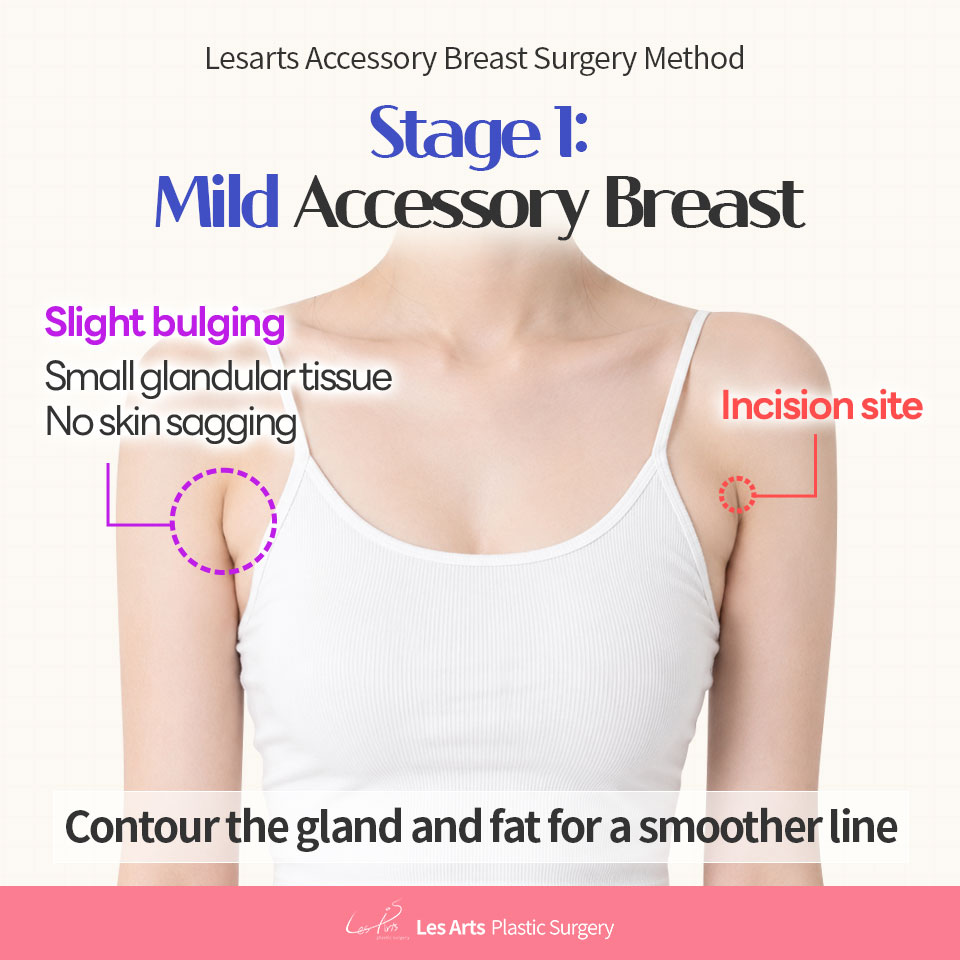
Accessory Breast Tissue Surgery by Stage (Stage 1) – Dr. Moon Ji Hoon, Lesarts
Stage 1 (Mild Stage): Early-Stage Accessory Breast Tissue
✔ Characteristics
There is only a slight bulge
or subtle fullness in the armpit area.
The glandular tissue is relatively small,
and skin elasticity remains good,
with no noticeable skin sagging.
✔ Customized Surgical Approach
① A small incision of approximately 5 mm
is made along the natural crease
inside the armpit.
② A fine cannula is inserted through
the small incision to carefully remove
excess fat around the accessory breast tissue.
③ The firm glandular tissue is then
carefully trimmed and excised.
④ Because skin elasticity is still good,
removing the appropriate amount of glandular tissue
and fat allows the skin to naturally contract,
creating a smoother, cleaner contour.

Accessory Breast Tissue Removal and Liposuction – Dr. Moon Ji Hoon, Lesarts Plastic Surgery
Stage 2 (Moderate Stage): Most Common Type
✔ Characteristics
The armpit area shows noticeable fullness,
and a firm lump of glandular tissue
can be clearly felt by touch.
Pain may also occur during menstruation,
pregnancy, childbirth, or breastfeeding.
Most accessory breast cases fall into this stage.
✔ Customized Surgical Approach
① Because both glandular tissue and surrounding fat
are developed at this stage, complete glandular tissue removal
is combined with liposuction.
② Removing only the fat may leave glandular tissue behind,
while removing only the glandular tissue may create
an uneven contour or visible indentation.
③ Through a small incision along the armpit crease,
the glandular tissue is removed while surrounding fat
is carefully sculpted layer by layer.
This helps create a smoother transition
between the armpit and chest contour.
④ Since skin elasticity is generally well preserved,
a flatter contour can usually be achieved
without additional skin excision.

Accessory Breast Tissue with Armpit Sagging – Dr. Moon Ji Hoon, Lesarts Plastic Surgery
Stage 3 (Severe Stage): Enlarged Accessory Breast Tissue with Skin Sagging
✔ Characteristics
At this stage, the accessory breast tissue
has become significantly enlarged.
Over time, the weight of the glandular tissue and fat
may stretch the skin downward,
resulting in noticeable skin sagging.
✔ Customized Surgical Approach
① The key to Stage 3 treatment is
complete removal of the glandular tissue
combined with appropriate skin excision.
If only the glandular tissue and fat are removed
while excess skin remains, the skin may appear
wrinkled or saggy after surgery.
② Liposuction incision: When liposuction is needed,
a small incision is made along a natural crease
at the front of the armpit.
Fat is then carefully removed
to refine the surrounding contour.
③ Elliptical incision and skin excision:
When skin removal is necessary,
the amount of excess skin is carefully assessed
along with the size of the glandular tissue.
An elliptical, leaf-shaped incision
of an appropriate length is then designed.
This allows the enlarged glandular tissue
to be removed while excess, sagging skin
is carefully excised and reshaped.
2. Scarring and J-P Drain Management After Stage 3 Surgery
Because Stage 3 surgery may also involve skin excision,
many patients are concerned about
whether a noticeable scar will remain.
However, carefully planning the location
and extent of the incision can help
minimize scar visibility.

Accessory Breast Tissue Removal and Lifting – Dr. Moon Ji Hoon, Lesarts
1. Incision Design Within the Anterior Axillary Line
① The incision is carefully designed
so that it does not extend beyond
the anterior axillary line.
② This helps keep the surgical scar
from being visible from the front
when standing upright after surgery.
2. Linear Scar Inside the Armpit
① The remaining scar is positioned
as a straight line within the natural hollow
of the armpit.
② When standing normally or keeping
the arms naturally lowered, the scar
is generally concealed within the armpit area.
This placement helps reduce
the visual prominence of the scar.
3. Why a J-P Drain May Be Needed
① Stage 3 surgery involves extensive removal
of glandular tissue and may also include
excision of excess skin.
② A J-P drain may therefore be kept
in place for several days after surgery
to remove accumulated blood or fluid.
This can help reduce the risk of hematoma
or seroma and allow the tissues
to adhere more smoothly during recovery.
③ The drain serves as an important measure
to support stable healing
of the surgical area.
3. Conclusion: An Accurate, Individualized Diagnosis Is the First Step
Accessory breast surgery is not simply
a procedure to remove excess armpit fat.
It involves removing glandular breast tissue
while also creating a natural contour based on
the amount of tissue and individual skin elasticity.
For the more common Stage 1 and Stage 2 cases,
treatment can often be performed through
a relatively small incision with a shorter recovery period.
Even in Stage 3 cases with significant skin sagging,
careful incision planning and precise closure
can help keep the scar less visible from the front
while creating a smoother contour.
If you are concerned about persistent fullness
or discomfort around the armpit area,
dieting alone may not address the underlying cause.
A detailed consultation and ultrasound examination
can help determine the stage of accessory breast tissue
and the most appropriate treatment approach.
FAQ
Q1. Can accessory breast tissue be reduced through diet and weight loss?
Accessory breast tissue may contain glandular tissue as well as fat, so a bulge or lump can remain even after weight loss.
A physical examination and ultrasound can help determine the tissue composition.
Q2. How is accessory breast tissue classified by stage?
It can be broadly classified into three stages based on the amount of glandular tissue and fat, skin elasticity, and the degree of sagging.
The appropriate surgical approach may differ depending on the stage.
Q3. How are stage 1 and stage 2 accessory breasts treated?
When there is little or no significant skin sagging, glandular tissue can be removed through a small incision along the natural armpit crease.
Liposuction may also be performed to create a smoother contour.
Q4. How is stage 3 accessory breast tissue with sagging skin treated?
When significant skin sagging is present, glandular tissue removal and liposuction may be combined with skin excision.
The incision is carefully positioned within the armpit area to minimize frontal scar visibility.
Q5. Will accessory breast surgery leave a noticeable scar?
Scar length and visibility depend on the size of the accessory breast tissue, the degree of skin sagging, and the extent of surgery.
When skin excision is necessary, the incision may be longer, so scar placement should be considered during surgical planning.
▼ Visit Lesarts Plastic Surgery in Gangnam, Seoul, Korea ▼