Accessory Breast Medical Column: “It’s Breast Tissue, Not Armpit Fat?” What Women Should Know Before Sleeveless Season
Is a Bulge Near the Armpit Always Just Fat?
No. If the bulge near the front of the armpit
does not improve with diet or exercise,
it may be an accessory breast rather than simple fat.
Accessory breast tissue contains ectopic breast tissue
and may respond to hormonal changes just like normal breast tissue,
causing swelling, tenderness, or a palpable lump
around menstruation, pregnancy, or after childbirth.
Because appearance alone cannot reliably distinguish
accessory breast tissue from localized fat,
an ultrasound examination is important for an accurate diagnosis.
If glandular breast tissue is confirmed,
surgical excision may be required for complete removal,
while areas composed only of fat may be treated differently.
[Learn More About Lesarts Liposuction]
Written by Dr. Jihoon Moon, Lesarts Plastic Surgery
This medical column was written directly by the attending surgeon.
※ Unauthorized reproduction, editing, or redistribution is prohibited. ※
1. The Hidden Cause of an Armpit Bulge During Sleeveless Season
As vacation season approaches
and women begin wearing sleeveless tops or swimsuits,
many notice the same concern in the mirror.
“I’ve lost weight through dieting,
so why won’t this bulge
at the front of my armpit go away?”
Because the area protrudes when wearing sleeveless clothing,
many women find themselves constantly trying
to cover the armpit bulge with their clothes.
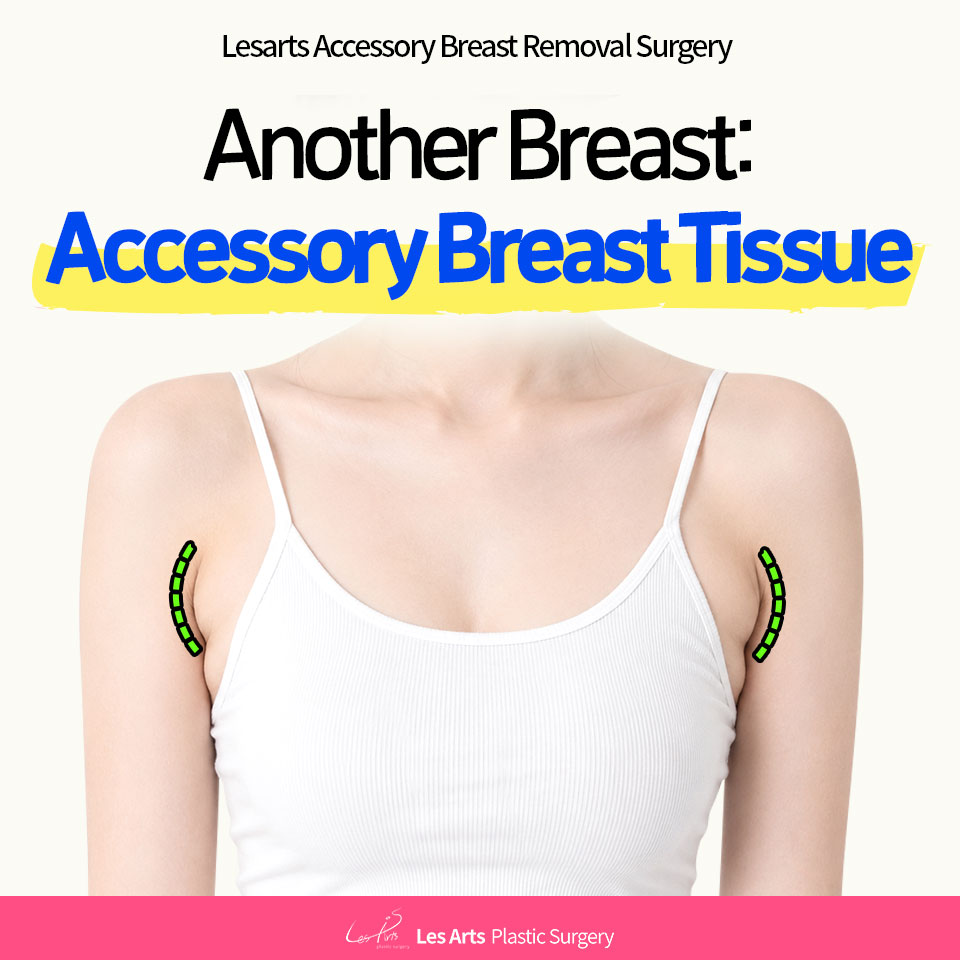
Accessory Breast Removal – Dr. Jihoon Moon, Lesarts Plastic Surgery
Many people assume that a bulge
at the front of the armpit
is simply excess fat or age-related fat.
They may try to reduce it
through exercise or dieting,
or eventually give up on treating the area.
However, if the bulge does not disappear
despite consistent exercise and weight loss,
it may not be simple fat.
It could be an accessory breast,
additional breast tissue located outside
the normal breast area.
Today, we will take a closer look
at the causes of accessory breasts,
how they are accurately diagnosed,
and the available treatment options.
2. Is Every Armpit Bulge an Accessory Breast? – Definition and Diagnosis
The answer is no.
A bulge at the front of the armpit
does not necessarily mean
that an accessory breast is present.
To understand an accessory breast,
also known as ectopic breast tissue,
we need to look at how the body develops
during the embryonic stage.
At approximately 4–6 weeks of embryonic development,
the mammary ridge, or milk line,
extends from the armpit to the groin.
Along this line,
multiple pairs of mammary buds develop.
Most of these normally regress,
leaving only one pair in the chest
to develop into the normal breasts.
However, if some mammary tissue
does not completely regress
and remains in areas such as the armpit or abdomen,
it may develop into ectopic breast tissue.
This is the underlying cause
of an accessory breast.
The most common location
for accessory breast tissue
is the front of the armpit.
Accurate Diagnosis of Accessory Breast Tissue: The Importance of Ultrasound
So how can simple armpit fat
be distinguished from an accessory breast?
It can be difficult to tell
based on appearance alone.
For an accurate diagnosis,
an ultrasound examination
is necessary.

Accessory Breast Ultrasound Examination – Dr. Jihoon Moon, Lesarts Plastic Surgery
An accessory breast can be medically diagnosed
only when ultrasound confirms the presence
of actual glandular breast tissue
within the subcutaneous fat layer.
If ultrasound shows no glandular tissue
and the area consists only of fat,
it is considered localized fat accumulation
rather than an accessory breast
and may be treated with liposuction.
In contrast, if a significant amount
of glandular breast tissue is present,
surgical excision of the glandular tissue
may be necessary for complete correction.
3. Signs of an Accessory Breast: Cyclical Pain and Changes After Menopause
An accessory breast is not simply
a cosmetic concern caused by
a visible armpit bulge.
The glandular tissue within an accessory breast
responds to female hormones
just like normal breast tissue.
For this reason,
it can cause a variety of symptoms
that change with hormonal fluctuations.

Armpit and Accessory Breast Pain and Lumps Before Menstruation and After Childbirth – Lesarts Plastic Surgery
[Common Symptoms of Accessory Breasts]
1. Swelling and sharp pain in the armpit around the menstrual cycle, especially before menstruation
2. Significant swelling and severe pain in the armpit during pregnancy or shortly after childbirth
3. A firm, lump-like mass that can be felt by hand
4. Persistent armpit bulging and lumps even after menopause
Recurring Pain with the Menstrual Cycle
One of the most common symptoms of accessory breasts
is their connection to the menstrual cycle.
Just as the breasts may become swollen and tender
due to hormonal changes before menstruation,
accessory breast tissue in the armpit may also swell
or become painful.
These symptoms often improve once menstruation ends,
then recur with the next cycle.
Severe Discomfort Shortly After Childbirth
Women who have experienced pregnancy and childbirth
may also experience significant discomfort
from accessory breast tissue.
Shortly after childbirth, when milk production begins,
increased female hormones and prolactin
can cause accessory breast tissue to swell rapidly.
During this period, the armpit may become significantly enlarged,
and milk may even appear through a small accessory nipple
or an opening in the armpit skin.
The area may also feel warm
and become severely painful.
As hormone levels stabilize after childbirth,
the swelling usually decreases.
However, enlarged glandular tissue and stretched skin
may not completely return to their previous condition,
and some sagging may remain.
Accessory Breasts After Menopause
Some patients ask,
“Will accessory breast tissue disappear on its own after menopause?”
After menopause, reduced hormonal stimulation
may improve swelling and pain.
However, previously developed fibrotic glandular tissue
and the surrounding fat remain.
As a result, the armpit bulge may still be visible,
and a lump may continue to be felt even after menopause.

Accessory Breast Treatment (Surgery) – Dr. Moon Jihoon, Lesarts Plastic Surgery
4. A Definitive Solution for Accessory Breasts: Surgical Treatment and Recovery
Glandular tissue within an accessory breast
cannot be eliminated through medication,
diet, or massage.
The fundamental treatment is
surgical removal of the tissue.
Accessory breast surgery does not simply involve
removing glandular tissue or fat alone.
To achieve a smooth and natural contour,
both glandular tissue removal and liposuction
may need to be performed together.
Accessory breast removal usually takes
about one hour, and patients can typically
return home the same day.
The incision is placed within a natural skin crease
at the front of the armpit and is generally
8 mm or less in length.
Sutures are usually removed
about 10–14 days after surgery.
Once the sutures are removed, patients can generally
resume showering, light exercise, and gym activities
according to their recovery progress.
Accessory breasts are not something to be embarrassed about.
They are a natural physical condition caused by breast tissue
that remains from fetal development,
and they can be medically treated.
✔ Those who feel stressed about
a noticeable bulge in the armpit when wearing clothes
✔ Those who experience recurring armpit swelling
or aching around their menstrual cycle
✔ Those who notice increased sagging
or a firm lump in the armpit after childbirth
If you are experiencing any of these concerns,
rather than relying solely on dieting,
we recommend visiting a medical professional
for an accurate diagnosis and appropriate treatment.
With an accurate diagnosis through ultrasound
and appropriate surgical treatment,
you can regain your confidence
and enjoy everyday life more comfortably.
FAQ
Q1. Is every bulge in the armpit area an accessory breast?
No. An armpit bulge may simply be caused by
localized fat accumulation.
An ultrasound examination is needed to determine
whether actual breast gland tissue is present.
Q2. Can accessory breast tissue disappear with diet or exercise?
Glandular tissue within an accessory breast
is difficult to eliminate through weight loss or exercise alone.
Ultrasound can assess the distribution of glandular tissue and fat
to determine the appropriate treatment.
Q3. Can armpit pain before menstruation or after childbirth be a symptom of accessory breast tissue?
Yes. Accessory breast tissue can respond
to hormonal changes just like normal breast tissue.
Swelling, tenderness, or a lump may develop
before menstruation or after childbirth.
Q4. Does accessory breast tissue disappear naturally after menopause?
Swelling or discomfort may decrease after menopause
as hormonal stimulation declines.
However, existing glandular tissue and surrounding fat may remain,
leaving a persistent armpit bulge or lump.
Q5. How is accessory breast tissue treated?
If glandular tissue is confirmed by ultrasound,
surgical excision and contouring of the surrounding fat may be considered.
The specific surgical approach depends on
the amount and distribution of glandular tissue and fat.
▼ Visit Lesarts Plastic Surgery in Gangnam, Seoul, Korea ▼