
Gynecomastia Medical Column: Can You Keep Taking Hair Loss Medication After Surgery?
Can I continue taking hair loss medication after gynecomastia surgery?
Hair loss medications such as finasteride and dutasteride
may affect hormonal balance and potentially stimulate
breast glandular tissue.
After gynecomastia surgery, the medication should not
be stopped or changed abruptly. Dosage, frequency,
or medication type should be adjusted in consultation
with the treating physicians.
Written by Dr. Jihoon Moon, Lesarts Plastic Surgery
This medical column was written directly by the attending surgeon.
※ Unauthorized reproduction, editing, or redistribution is prohibited. ※
These days, many men in their 20s and 30s
take hair loss medication as routinely
as vitamins or supplements.
Hair loss management has become
a common part of everyday self-care.
However, during gynecomastia consultations,
patients are often surprised when I explain
that their hair loss medication may be related
to breast enlargement.
For many, it is the first time they have heard
that hair loss medication can affect
the appearance of the chest.
After gynecomastia surgery, one of the most
common questions I receive is:
“Doctor, can I start taking my hair loss
medication again right after surgery?”
Today, we will look at why certain hair loss
medications may contribute to gynecomastia
and how dosage, medication type, and dosing
frequency may be adjusted after surgery.
1. Why Can Hair Loss Medication Cause Gynecomastia?
Common hair loss medications can generally
be divided into two categories:
medications that affect hormone pathways
and medications that improve blood flow
to the scalp.

Possibility of Gynecomastia After Taking Hair Loss Medication – Lesarts Plastic Surgery
① Hormonal Hair Loss Medications
(Finasteride and Dutasteride)
One of the main causes of male pattern hair loss
is the conversion of male hormones into DHT
(dihydrotestosterone), a hormone that can affect
hair follicles through the action of 5α-reductase.
Finasteride and dutasteride work by inhibiting
this enzyme, helping reduce DHT production
and protect the hair follicles.
However, this process may alter the balance
between androgen and estrogen activity
in the body.
When androgen activity is reduced,
the relative effect of estrogen may increase,
potentially stimulating glandular breast tissue
and contributing to gynecomastia.
② Scalp Vasodilators
(Topical or Oral Minoxidil)
Minoxidil helps improve blood flow to the scalp
and supports the delivery of nutrients
to the hair follicles.
Because it does not directly affect
the hormonal system, it is not associated
with the development or recurrence
of gynecomastia.
However, when used alone, its preventive effect
on hair loss may be more limited than that
of hormonal hair loss medications.
For this reason, it is often used as an adjunct
to medications such as finasteride
or dutasteride.
2. Finasteride vs. Dutasteride: What’s the Difference?
Finasteride and dutasteride are two commonly used
hormonal hair loss medications, but they differ
in how strongly they may affect hormonal pathways
and glandular breast tissue.
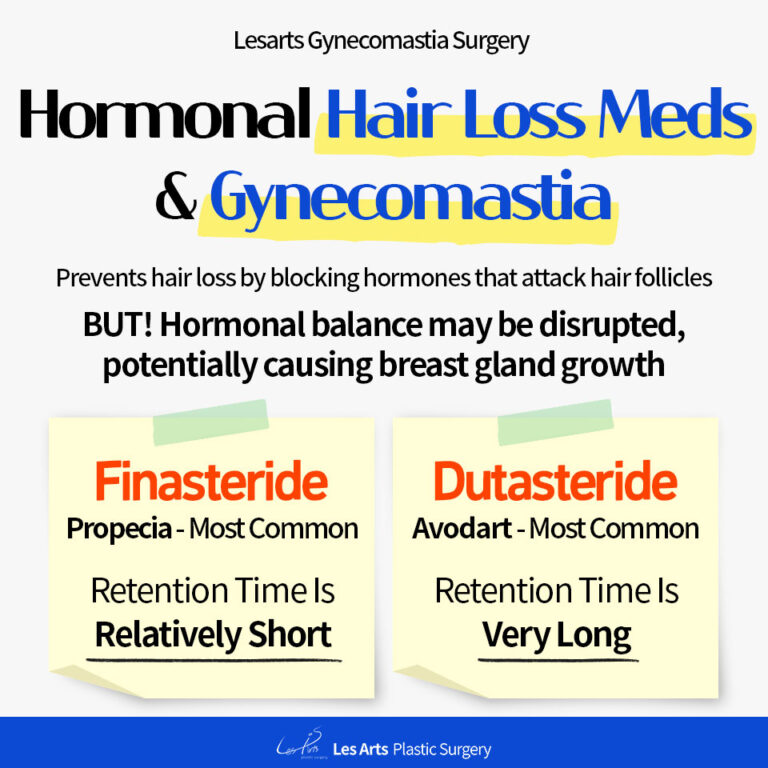
Finasteride, Dutasteride, and Gynecomastia – Dr. Moon Ji-hoon
① Finasteride
(Common brand name: Propecia)
Finasteride primarily blocks one type
of enzyme involved in hair loss:
type II 5α-reductase.
Its hormonal effect is relatively milder,
and it remains in the body
for a comparatively shorter period.
② Dutasteride
(Common brand name: Avodart)
Dutasteride blocks both type I
and type II 5α-reductase.
It has a stronger inhibitory effect
and remains in the body
for a much longer period.
Some patients switch from finasteride
to dutasteride for stronger hair loss prevention.
However, because dutasteride remains
in the body longer and has a stronger
hormonal effect, it may have a greater potential
to stimulate glandular breast tissue.
3. What the Literature Says vs. What We See in Clinical Practice
According to medical literature
and medication information, gynecomastia
associated with hair loss medication
is reported to occur in approximately 1–2% of cases.
The reported rate of glandular breast tissue
regrowth after gynecomastia surgery while continuing
the same medication is also relatively low.
However, what we observe in clinical practice
can sometimes feel different.
We frequently see men who have developed
gynecomastia after taking hair loss medication
for several years.
Even when the glandular tissue responsible
for gynecomastia has been carefully removed,
continuing the same medication at a high dose
every day may potentially stimulate
glandular tissue again over the long term.
Therefore, the possibility of recurrent symptoms
or breast discomfort cannot be completely excluded.
For this reason, after gynecomastia surgery,
a carefully planned dosage adjustment may be considered
to help maintain the chest contour
while continuing hair loss management.
4. Hair Loss Medication Adjustment After Gynecomastia Surgery
① For Patients Taking Finasteride Daily
(Propecia-type medications)
If you previously took one tablet every day,
the dosing frequency may be gradually reduced
to minimize breast stimulation while maintaining
the hair loss prevention effect.
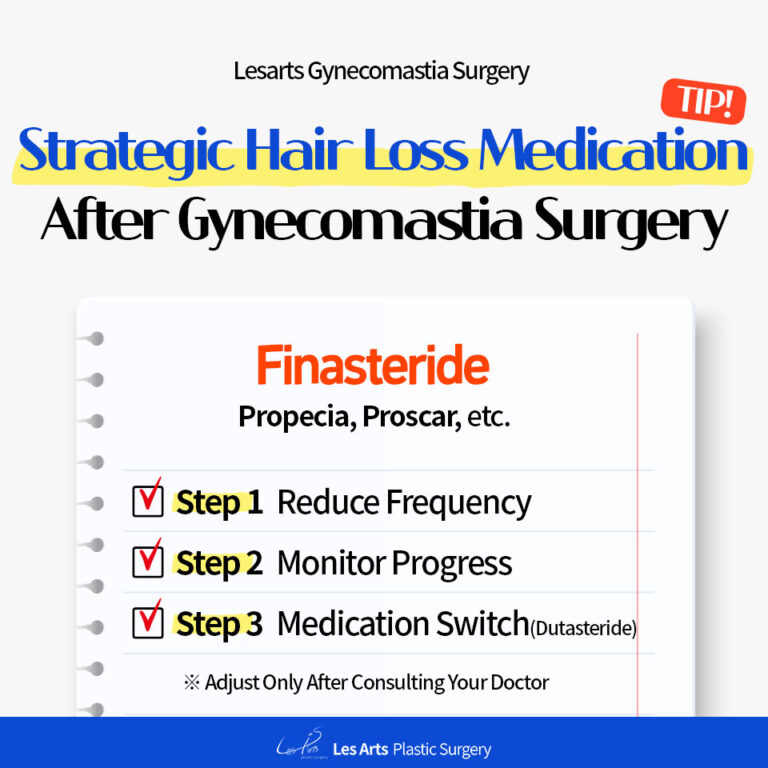
Hair Loss Medication After Gynecomastia Surgery – Finasteride (Propecia, Proscar)
✔ Step 1 – Reduce dosing frequency
Daily dosing may be reduced
to 3–4 times per week
or approximately every other day.
For example:
Monday · Wednesday · Friday
or Monday · Wednesday · Friday · Sunday
✔ Step 2 – Monitor your condition
If there is no breast discomfort
and hair remains stable after approximately
3–6 months, the adjusted schedule
may be maintained.
✔ Step 3 – If switching to a stronger medication
If hair loss progresses and you switch
from finasteride to dutasteride,
daily dosing may not be necessary.
Because dutasteride remains in the body
for a long time, it may be started
and maintained at approximately
2–3 times per week.
② For Patients Taking Dutasteride Daily
(Avodart-type medications)
Because dutasteride has a strong effect
and remains in the body for a long time,
adjusting the dosing frequency
may be particularly important.
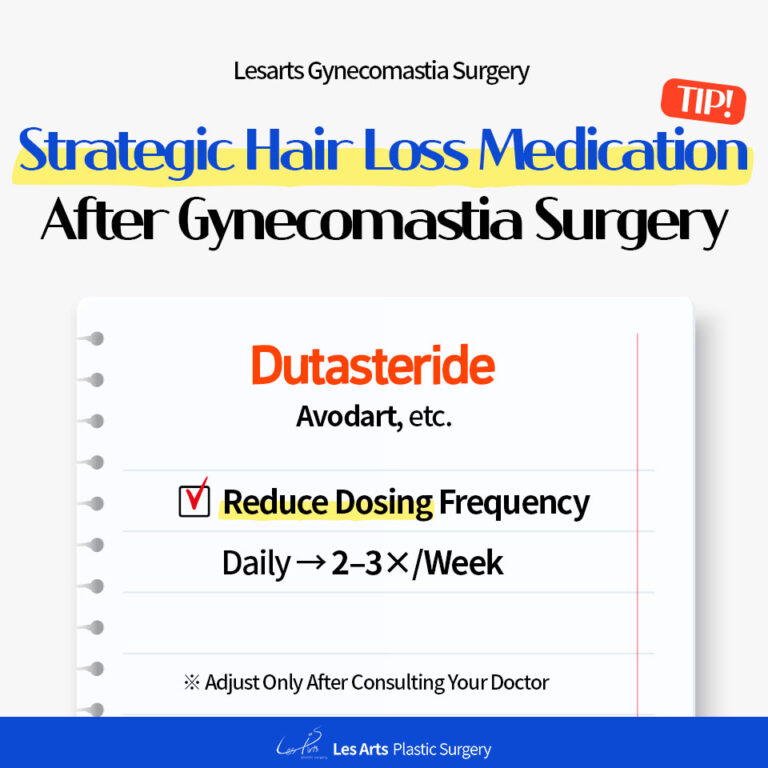
How to Take Dutasteride After Gynecomastia Surgery – Avodart
✔ Reduced dosing schedule
Instead of taking one tablet every day,
the frequency may be reduced
to approximately 2–3 times per week.
This approach may help maintain
the hair loss prevention effect
while reducing hormonal stimulation
of the breast tissue.
5. The Most Important Rule: Do Not Stop Suddenly
Even if hair loss medication may be related
to gynecomastia, you should not abruptly
stop taking it on your own.

Hair Loss Medication Side Effects and Gynecomastia – Lesarts Plastic Surgery, Dr. Moon Ji-hoon
Suddenly discontinuing medication,
particularly finasteride, may be followed
by noticeable hair shedding as the medication’s
suppressive effect wears off.
Adjusting the dose or switching medications
after gynecomastia surgery should take into account
the patient’s preoperative chest condition,
including whether glandular or fatty tissue
was predominant, as well as the degree
of hair loss progression.
Therefore, do not stop, reduce, or switch
your medication on your own.
Consult both the surgeon who performed
your gynecomastia surgery and the physician
prescribing your hair loss medication
to establish an appropriate and safe
treatment plan.
FAQ
Q1. Can hair loss medication cause gynecomastia?
Yes. Hormonal hair loss medications such as
finasteride and dutasteride may alter hormone balance
and potentially stimulate glandular breast tissue,
contributing to gynecomastia.
Q2. What is the difference between finasteride and dutasteride?
Finasteride mainly inhibits type II 5α-reductase,
while dutasteride inhibits both type I and type II.
Dutasteride also remains in the body longer
and has a stronger hormonal effect.
Q3. Can I continue taking hair loss medication after gynecomastia surgery?
Medication may be continued after surgery,
but the dosage or dosing frequency may need adjustment
depending on the medication, chest condition,
and degree of hair loss.
Q4. How may hair loss medication be adjusted after gynecomastia surgery?
According to the approach described in this article,
finasteride may be reduced to 3–4 times per week,
while dutasteride may be reduced to 2–3 times per week.
Any adjustment should be made with your physician.
Q5. Can I suddenly stop hair loss medication after gynecomastia surgery?
No. The article advises against abruptly stopping
or changing hair loss medication on your own.
Discuss any dosage reduction or medication change
with both your gynecomastia surgeon and prescribing physician.
▼ Visit Lesarts Plastic Surgery in Gangnam, Seoul, Korea ▼