
Gynecomastia Medical Column: When Is It Safe to Fly After Gynecomastia Surgery?
When is it safe to fly after gynecomastia surgery?
The recommended timing depends on the flight duration and your recovery status.
Short flights may be possible after 2–3 days, while long-haul flights are generally recommended
after 1–2 weeks, following your surgeon’s assessment.
Written by Dr. Jihoon Moon, Lesarts Plastic Surgery
This medical column was written directly by the attending surgeon.
※ Unauthorized reproduction, editing, or redistribution is prohibited. ※
Among patients planning gynecomastia surgery
or those who have already undergone the procedure,
one of the most common concerns is air travel.
This is especially common among patients
planning an overseas trip or visiting Korea for surgery.
“When can I fly after gynecomastia surgery?”
“Could cabin pressure cause pain or affect the surgical area?”
In general, there is no need to be overly concerned about flying
as long as your recovery has been checked by your medical team
and you follow the recommended timing and precautions.
However, air travel involves more than just changes in cabin pressure.
Long periods of sitting, carrying heavy luggage,
and frequent arm movements at the airport
can also place stress on the body after surgery.
For a safer journey, it is important to consider
the length of the flight and how much time has passed since surgery,
as well as precautions at the airport and during the flight.

1. Cabin Pressure and Pain: Will My Chest Hurt During a Flight?
As an airplane climbs to a high altitude,
cabin pressure is maintained at a lower level than at ground level,
typically around 75–80%.
Some patients worry that small amounts of air
or empty spaces (dead space) inside the chest may expand,
causing severe pain or damage to the surgical area.
However, gynecomastia surgery does not involve
a closed air-filled space like the lungs or internal organs.
The surgical area is carefully closed
so that no significant amount of air remains
within the tissue or subcutaneous layer.
herefore, changes in cabin pressure alone
are very unlikely to cause physical damage
or severe pain in the surgical area.
You may, however, notice slightly increased swelling
or a mild feeling of tightness in the chest during the flight.
This can be a temporary response to the cabin environment
and usually does not indicate a problem.
2. Flight Safety Guidelines by Flight Duration
The recommended timing for flying after gynecomastia surgery
may vary depending on the length of the flight
and how many days have passed since surgery.

① Short-Haul Flights (Within 1–2 Hours)
Examples: Japan, China, domestic flights
✔ Recommended timing: From 2–3 days after gynecomastia surgery
✔ Key point: The short flight duration generally places minimal strain on the body.
✔ Precaution: Wear your compression garment properly throughout the flight
to help ensure a more comfortable journey.
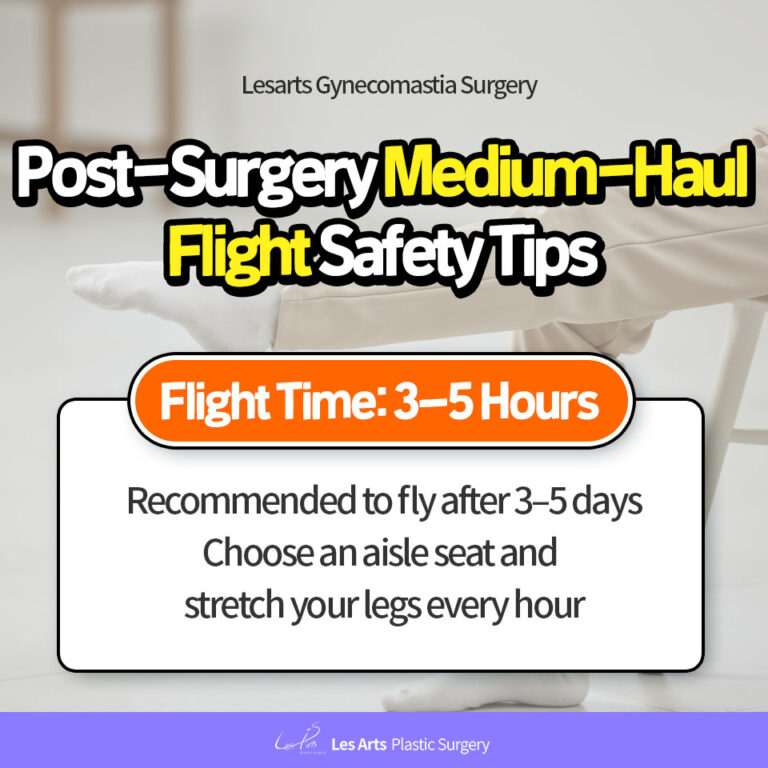
② Medium-Haul Flights (3–5 Hours)
Examples: Southeast Asia, Guam, Saipan
✔ Recommended timing: 3–5 days after gynecomastia surgery
✔ Key point: You will be seated for a longer period,
so circulation and swelling should be considered.
✔ Precaution: Choose an aisle seat if possible
and gently flex and extend your ankles once every hour
to help reduce swelling.
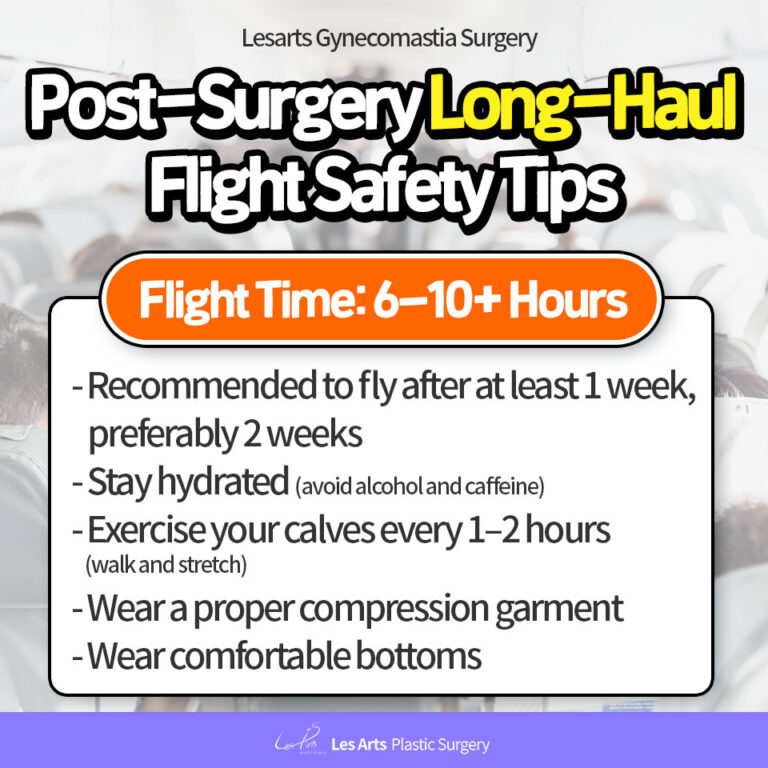
③ Medium- to Long-Haul Flights (6–10+ Hours)
Examples: the Americas, Europe, Oceania
✔ Recommended timing: Flying is generally possible from 7 days after gynecomastia surgery,
once the initial incision and bleeding risks have stabilized.
However, waiting at least 14 days is recommended.
✔ DVT prevention: The main concern during a long-haul flight is not the surgical area itself,
but deep vein thrombosis (DVT), sometimes called “economy class syndrome,”
which can occur when blood flow in the legs slows during prolonged sitting.
After surgery, the body’s blood-clotting mechanisms are temporarily activated,
so remaining in the same position for long periods may increase the risk of blood clots.
✔ Long-Haul Flight Safety Tips
▷ The cabin is very dry, so drink water frequently instead of alcohol
(avoiding alcohol for 4 weeks after surgery is recommended) or caffeinated beverages.
▷ Every 1–2 hours, take a short walk along the aisle
or repeatedly raise and lower your heels while seated.
*Contracting the calf muscles helps prevent blood from pooling in the legs
and supports venous return to the heart.
▷ Wear your chest compression garment properly,
but avoid tight pants that excessively compress the thighs or lower body.
3. Practical Risks to Watch for at the Airport
Many patients focus mainly on what may happen during the flight.
However, the surgical area is often more likely to be strained
while moving through the airport or handling heavy luggage.
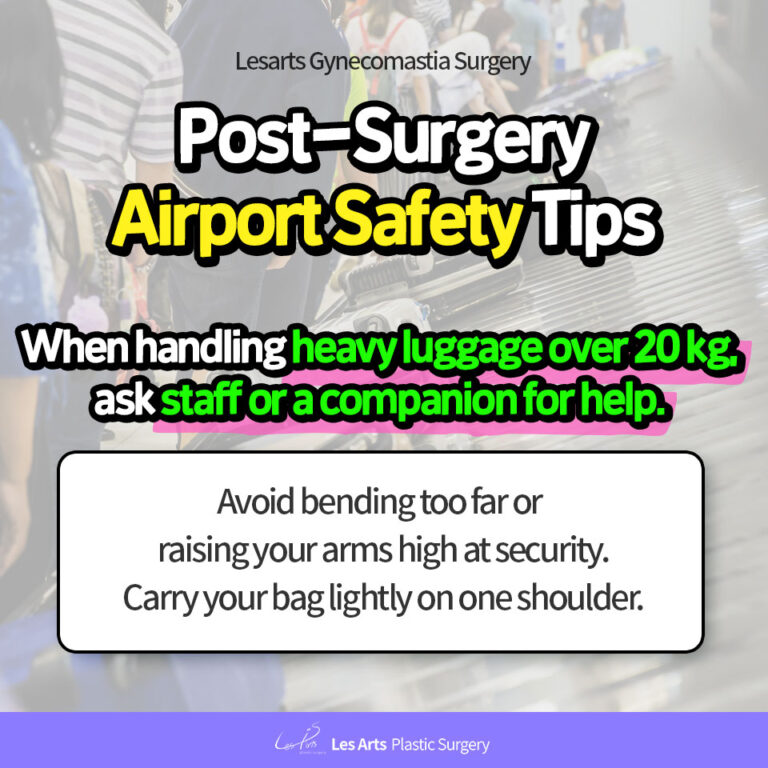
① Be Careful with Heavy Luggage Over 20 kg
For the first 1–2 weeks after gynecomastia surgery,
avoid movements that put significant strain on the pectoral muscles.
Lifting a heavy suitcase onto a check-in counter
or into an overhead compartment may stress small blood vessels in the chest,
potentially causing temporary bleeding (hematoma) or pain.
✔ What to do: Do not lift heavy luggage yourself.
Ask a travel companion, airport staff, or flight attendant for assistance.
② Security Checkpoints and Carry-On Items
When placing your belongings into trays at security,
avoid bending your upper body too far forward or raising your arms too high.
If carrying a backpack, wear it lightly over one shoulder
to minimize friction or pressure against the chest compression garment.
③ Compression Garments and In-Flight Comfort
Compression garments play an important role in supporting the surgical area
and shaping the chest contour, so they should generally be worn during the flight.
For longer flights, wear comfortable and loose-fitting outer clothing
to reduce discomfort while traveling.
4. Pre-Flight Safety Checklist
Before boarding your departure or return flight,
check these three important points to help ensure a safer journey.
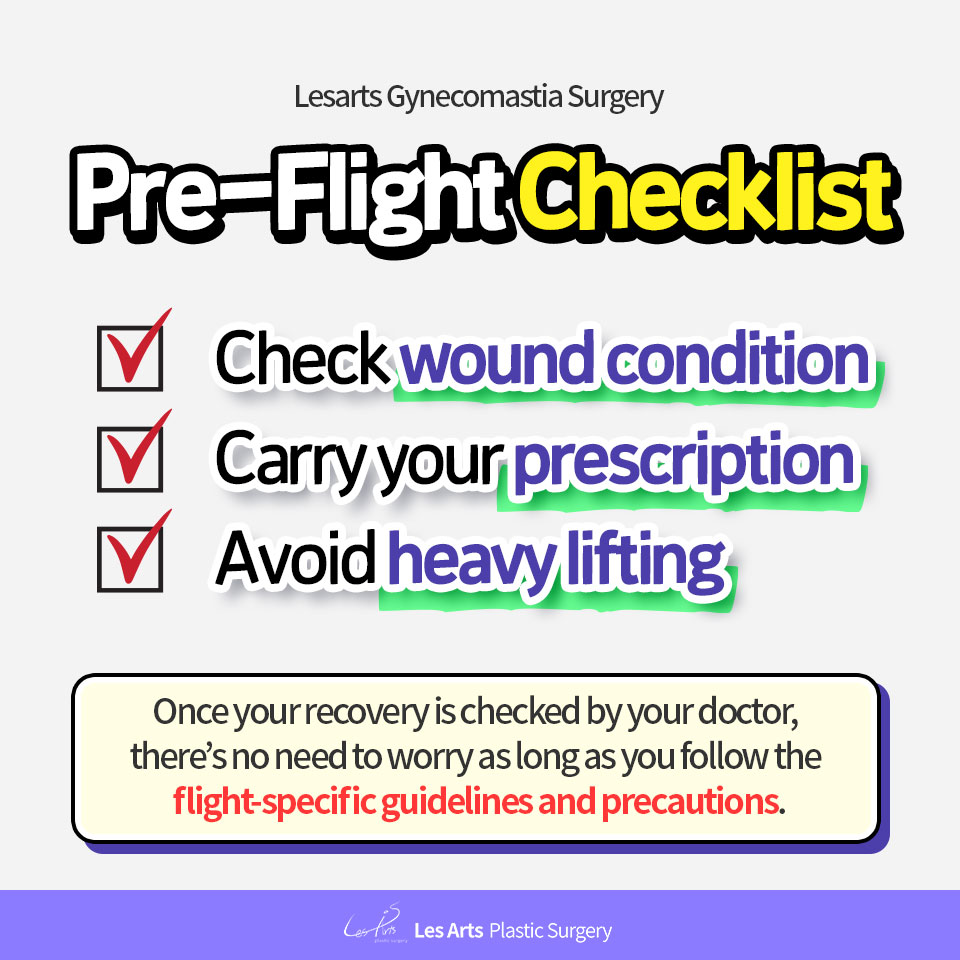
① Check Bleeding and Wound Condition
Has there been any sudden increase in swelling
or bruising around the surgical area?
② Carry Your Prescribed Medications
Keep medications prescribed by your clinic,
such as antibiotics and anti-inflammatory pain relievers,
in your carry-on bag in case of pain or discomfort during the flight.
③ Avoid Heavy Lifting
Remember the key rule:
Do not lift heavy luggage yourself.
5. Conclusion
Recovery after gynecomastia surgery is a gradual process
as the body heals and the surgical area settles.
Before flying, have your recovery status checked by your medical team
and follow the recommended guidelines based on flight duration.
As long as you also take proper precautions when handling luggage,
you can travel or return home more safely and comfortably.
FAQ
Q1. Can cabin pressure damage the surgical area after gynecomastia surgery?
Cabin pressure changes are unlikely to physically damage the surgical area.
However, temporary swelling, tightness, or mild discomfort may occur during the flight.
Q2. When can I take a short flight after gynecomastia surgery?
For flights of about 1–2 hours, travel may be possible from around 2–3 days after surgery.
The surgical site should be stable, and the compression garment should be worn as instructed.
Q3. When can I take a long-haul flight after gynecomastia surgery?
For flights lasting 6–10 hours or longer, flying after at least 7 days may be possible depending on recovery,
while waiting about 14 days is recommended when possible.
Your individual condition should be checked by your surgeon before departure.
Q4. How can I reduce the risk of DVT during a long flight?
Stay hydrated, move your ankles and calves regularly, and walk around the cabin every 1–2 hours when possible.
Avoid clothing that excessively compresses the thighs or lower body.
Q5. What should I avoid at the airport after gynecomastia surgery?
Avoid lifting heavy luggage, raising your arms excessively, or making movements that strongly engage the chest muscles.
Ask a companion, airport staff, or cabin crew for assistance with heavy bags.
▼ Visit Lesarts Plastic Surgery in Gangnam, Seoul, Korea ▼