
Abdominal Liposuction – “Stubborn Belly Fat That Won’t Go Away with Exercise? It’s Not That There’s No Solution—You May Have Been Taking the Wrong Approach”
Can abdominal liposuction improve belly fat that does not respond well to diet and exercise?
Yes. Abdominal liposuction can directly remove localized subcutaneous fat that remains despite diet and exercise.
However, it does not remove visceral fat, so patients
with high visceral fat levels may still need weight management to achieve a flatter abdominal contour.
Written by Dr. Yongseung Seo, Lesarts Plastic Surgery
This article was written directly by the attending surgeon.
※ Unauthorized reproduction, editing, or redistribution is prohibited. ※
Many people find that when they gain weight,
their abdomen is the first area to become noticeably larger,
and even after losing weight, belly fat can be particularly difficult to reduce.
Many patients visit our clinic with concerns such as:
“My weight is a concern, but my abdomen seems disproportionately larger.”
“Whether it’s my upper or lower abdomen,
I still can’t achieve a defined body line even when wearing clothes.”
Even after trying various diets,
the stubborn abdominal fat they want to lose may remain.
Meanwhile, areas where volume is often desirable—such as the face, breasts, or buttocks—
may become slimmer first, sometimes leading patients to give up on dieting altogether.
Accumulated abdominal fat can make the silhouette in the mirror
feel more noticeable than the number on the scale.
The patient presented today had a relatively high amount of body fat overall,
but her main concerns were a particularly protruding abdomen
and a waist circumference that remained difficult to reduce.
She visited Lesarts Plastic Surgery
to address these concerns.
[Patient Information]
Age: Early 20s
Height: 165 cm
Weight: 72.6 kg
BMI: 26.7 kg/m²
Body Fat Percentage: 41.5%
Visceral Fat Level: 15
※ Liposuction results may vary between individuals,
even among patients with similar body measurements and characteristics.
[Consultation and Diagnosis]

Diagnosis Before Abdominal Liposuction
[Consultation and Diagnosis]
“I want to reduce the overall size of my thighs.
Especially, I want a straighter inner thigh line.”
The patient’s main goals were to reduce overall thigh volume
and create a smooth, straight contour along the inner thighs.
She was also concerned about scarring
and wanted to minimize the number and size of incisions.
On visual examination, there was a significant amount of fat
not only along the inner thighs but also around the knees.
The inner thighs remained in contact from the upper thighs down to the knees,
creating a heavy and congested appearance without a visible thigh gap.
“I want to reduce my overall waist circumference because my abdomen protrudes so much.”
The patient’s main concern was her noticeably protruding abdomen,
which was visible whether she was standing or sitting.
She wanted to reduce the overall circumference of her torso,
as the abdominal volume was difficult to conceal even with clothing.
On visual examination, there was also some fat accumulation
around the flanks and love handles.
However, her natural waistline was relatively well defined,
indicating favorable body proportions with the potential
for a more pronounced S-line after surgery.
We explained that with appropriate postoperative management
after abdominal liposuction, she could achieve
a more defined and attractive waist contour.
However, as the patient had noticed,
the anterior abdomen protruded significantly forward.
This created an imbalance with the surrounding areas
and made the overall torso appear larger and heavier.
[Ultrasound Examination Results]
Upper abdomen: 44 mm
Lower abdomen: 46 mm
Flanks: 19/17 mm
Love handles: 18/18 mm
The ultrasound examination confirmed
a very thick layer of subcutaneous fat throughout the abdomen.
In particular, the fat layer in the anterior abdomen
was more than twice as thick as in the surrounding areas.
With a fat layer this thick, a substantial amount of fat could be removed,
so a significant reduction in circumference was expected.
However, because a large volume would be removed,
one important consideration was how well the skin would contract
and adapt to the reduced volume.
We therefore thoroughly explained
the possibility of postoperative skin laxity.
Fortunately, the patient was still young
and had well-maintained skin elasticity.
For this reason, even with sufficient fat removal,
the risk of significant skin sagging was expected to be relatively low.
However, her visceral fat level was 15,
which was considerably high.
We clearly explained that abdominal liposuction alone
would not be enough to achieve the desired anterior abdominal contour
without accompanying diet and weight management after surgery.
The patient also reported occasional abdominal pain and diarrhea
when taking antibiotics.
These were considered common gastrointestinal symptoms
and were not expected to interfere with the planned surgery.
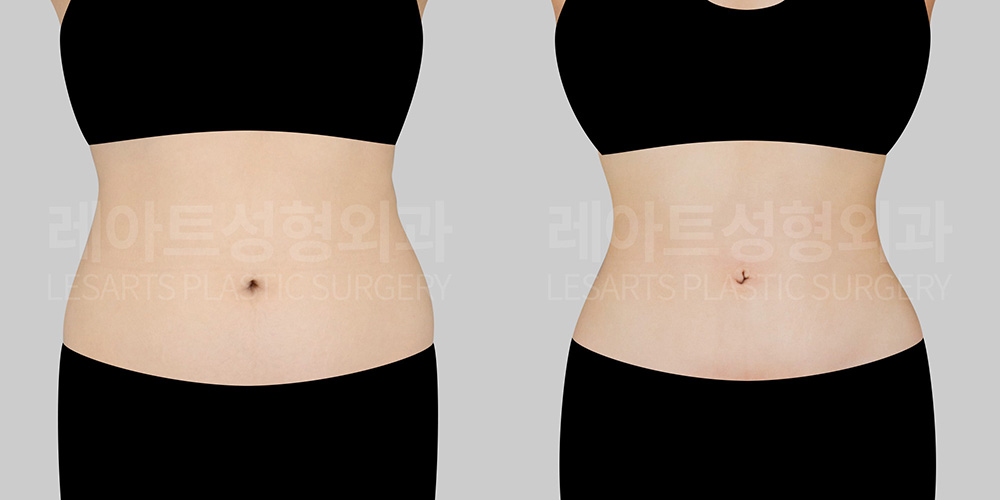
[Abdominal Liposuction Before and After]
(Photos taken 3 months after surgery
under the same lighting and environmental conditions.)

Before surgery, the entire anterior abdomen
from the upper to the lower abdomen
had a uniformly rounded and protruding appearance.
From the side view, the contour extending
from below the breasts to the pubic area
also projected gradually forward throughout the abdomen.
After surgery, this area showed the most significant change.
The volume around the navel was noticeably reduced,
and the side profile from below the breasts to the pubic area
became much flatter, creating an overall smoother and flatter abdominal contour.
This result reflects not only the effect of surgery,
but also the patient’s dedicated efforts to reduce
her previously high level of visceral fat through postoperative management.
We therefore encouraged and acknowledged
the effort she had put into managing her visceral fat after abdominal liposuction.

Before surgery, the flank-to-hip contour
was already relatively well defined
considering the patient’s weight and overall amount of body fat.
After abdominal liposuction, this natural contour was preserved
while becoming smoother and more refined,
making the curve of the waist more noticeable.
Combined with the flatter anterior abdomen,
this resulted in a more balanced and ideal waist-to-hip proportion.

Before surgery, the love handles created
a slight fold below the bra line and above the buttocks
when viewed from the back.
After surgery, the volume in this area was noticeably reduced,
creating a much smoother transition from the back to the waist.
There was also less excess tissue pressing over
the edges of underwear or pants.
Because a large amount of fat was removed in this case,
one of the main concerns before surgery was the possibility of skin sagging.
However, at 3 months after surgery,
the skin had adapted well to the reduced volume,
with no noticeable wrinkling or significant laxity.
she was able to recover with a natural, smooth contour
without the significant sagging that had initially been a concern,
despite the large amount of fat removed.
Lesarts Abdominal Liposuction
See More Before-and-After Case Analyses
▼▼▼
Like this patient, many people visit our clinic
with concerns about their body contour
even when their weight has not changed significantly.
This is often not because they feel no need to lose weight.
Rather, repeated unsuccessful dieting attempts may leave them discouraged from trying again,
or their body may have already adapted despite their ongoing efforts
to manage their diet and lifestyle.
Liposuction is not a weight-loss procedure,
but it can provide practical benefits for patients
who have difficulty achieving their desired results through dieting alone.
When losing weight through diet and exercise,
the size of fat cells decreases,
while the number of fat cells generally remains unchanged.
Liposuction physically removes fat cells from the treated area,
making that area less likely to regain the same degree of volume
even if the patient gains weight again.
In addition, seeing a noticeable change in an area
that previously showed little improvement despite consistent effort
can provide motivation to continue weight management.
For some patients, this visible improvement can become
an opportunity to restart a diet that had previously stalled.
However, liposuction should not be considered
simply as a substitute for diet and exercise.
The greater the amount of fat to be removed,
the more noticeable the contour improvement may be,
but the risk of skin laxity can also increase.
For this reason, it is important to accurately evaluate skin elasticity
and develop a surgical plan that also considers postoperative care.
If you are concerned about an abdominal contour
that has not improved despite your efforts,
contact Lesarts Plastic Surgery for a personalized consultation.
We will work with you to find
the most appropriate approach for your concerns.
FAQ
Q1. Why can abdominal fat remain even after diet and exercise?
Diet and exercise reduce the size of fat cells, but some areas may remain disproportionately full.
When localized subcutaneous fat is concentrated in the abdomen, liposuction can help reduce this volume and improve body contour.
Q2. Can abdominal liposuction reduce visceral fat?
No. Liposuction removes subcutaneous fat located beneath the skin, not visceral fat surrounding the internal organs.
Patients with high visceral fat levels may need diet and exercise in addition to liposuction.
Q3. Can abdominal liposuction make the waistline more defined?
Yes. By reducing excess fat from the abdomen, flanks, and love handles while considering the patient’s natural body proportions,
liposuction can create a smoother and more defined waistline.
Q4. Is skin sagging possible after large-volume abdominal liposuction?
Yes. Removing a large amount of fat can increase the risk of loose or sagging skin.
The degree of sagging depends on factors such as age, skin elasticity, the amount of fat removed, and individual tissue characteristics.
Q5. Is abdominal liposuction a weight-loss procedure?
No. Abdominal liposuction is primarily a body-contouring procedure rather than a weight-loss treatment.
However, visible changes in stubborn areas may help motivate some patients to continue diet and exercise after surgery.
▼ Visit Lesarts Plastic Surgery in Gangnam, Seoul, Korea ▼