
Abdominoplasty – Sagging Belly After Childbirth: What If Abdominal Exercise Doesn’t Help? 7-Month Results After Full Abdominoplasty
Can abdominoplasty improve sagging abdominal skin and muscle separation after childbirth?
Yes. When loose abdominal skin and rectus diastasis remain despite weight loss and exercise,
abdominoplasty can remove excess skin and repair the separated abdominal muscles.
This can help create a flatter, firmer, and more balanced abdominal contour.
[ Learn More About Abdominoplasty at Lesarts Plastic Surgery ]
Written by Dr.Kukhan Lee, Lesarts Plastic Surgery
This article was written directly by the attending surgeon.
※Unauthorized reproduction, editing, or redistribution is prohibited.※
When the body undergoes significant weight gain and loss,
loose skin may remain even after reaching the desired weight.
This is especially common among women who experience
substantial weight gain during pregnancy followed by weight loss after childbirth.
Skin that has been stretched and lost its elasticity
may be difficult to restore through diet and exercise alone,
leaving a long-term concern even after weight loss.
In this case, we will look at a patient who experienced
significant weight gain during pregnancy
and later regained a relatively balanced body shape
through consistent weight management and exercise.
Despite these efforts, loose skin in the lower abdomen
and a protruding abdominal contour remained,
leading her to consider abdominoplasty.
The patient was a woman in her 30s,
164 cm tall and weighing 54 kg.
She had given birth to two children through vaginal delivery
and had no other significant history of surgery or procedures.
During pregnancy, she experienced substantial weight gain,
reaching 98 kg at full term.
After childbirth, she lost weight and continued
to manage her diet and exercise consistently.
At the time of her consultation,
she maintained a relatively balanced physique
with a BMI of approximately 22 kg/m².
Despite this, her primary concern remained the lower abdomen.
In particular, the protruding lower abdomen
and loose skin hanging over the underwear line
had not improved through exercise or weight management alone,
which led her to visit our clinic.

Postpartum Weight Loss but Sagging Abdominal Skin Remains – Dr. Kukhan Lee, Lesarts Plastic Surgery
During the physical examination,
skin laxity was observed not only in the lower abdomen
but throughout the entire abdominal area.
In particular, the lower abdominal skin showed noticeable sagging and folding
above the underwear line.
Because of these skin folds,
the lower abdomen could appear more protruding than it actually was,
even when wearing clothes.
Skin laxity was also present in the upper abdomen above the navel.
The navel had developed an inverted V-shaped appearance,
which was another indication of significant skin laxity
in the upper abdomen.
Multiple stretch marks caused by pregnancy and weight gain
were also visible across both the upper and lower abdomen.
These findings indicated that the abdomen had expanded significantly during pregnancy,
stretching the skin beyond the limits of its natural elasticity.

Rectus Diastasis Caused by Pregnancy and Childbirth
These changes suggested that rectus diastasis
was likely present as well.
Physical examination confirmed separation of the rectus abdominis muscles,
with a noticeable gap in both the upper and lower abdomen.
Despite these findings,
the patient’s overall body contour was relatively well balanced.
There was also only a small amount of subcutaneous abdominal fat.
However, we determined that limited liposuction would be beneficial
to reduce contour irregularities around the incision
and create a smoother, more natural abdominal contour after surgery.
Although the patient’s primary concern was loose skin in the lower abdomen,
the physical examination also revealed significant skin laxity in the upper abdomen.
For this reason, rather than correcting only the lower abdomen,
an M-type full abdominoplasty was considered more appropriate
to address both the upper and lower abdominal areas.
We therefore planned abdominal liposuction
combined with an M-type full abdominoplasty.
At the same time, the separated rectus abdominis muscles would be repaired,
and the altered shape of the navel would also be corrected.
[7 Months After Abdominoplasty]
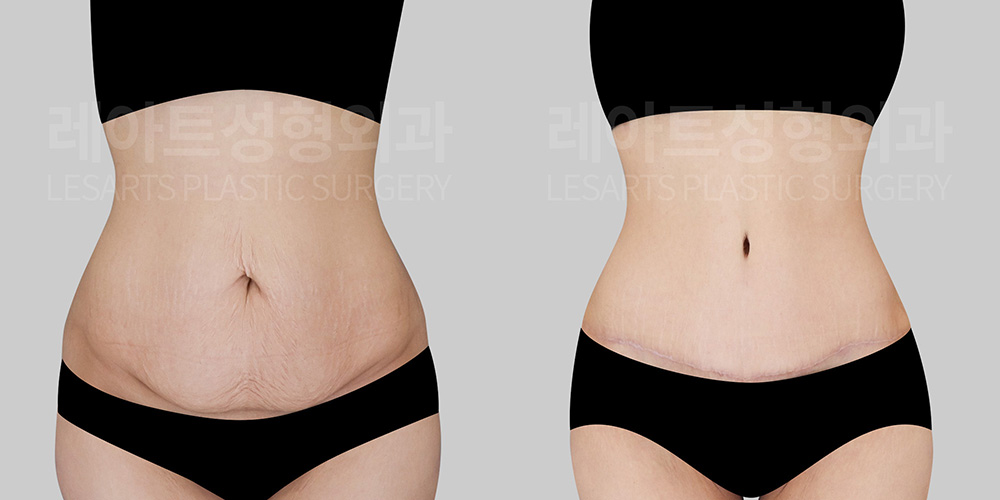
Postpartum Lower Abdominal Fold – Lesarts Abdominoplasty
At 7 months after surgery,
the most noticeable improvement can be seen
in the sagging skin of the lower abdomen.
The loose skin that previously folded over the underwear line
has been corrected, creating a smoother lower abdominal contour
without the previous skin fold.
Since this was the patient’s primary reason for choosing surgery,
she was highly satisfied with the improvement.
The navel was also reshaped
according to the patient’s preference.
She wanted a vertically elongated navel,
so the shape was corrected accordingly,
and she was satisfied with its current appearance.
Before surgery, upper abdominal skin laxity
made the navel appear relatively low.
By correcting the loose skin throughout the abdomen,
the navel was restored to a more natural-looking position.
As a result, the overall proportions of the abdomen
also appear more balanced than before surgery.

Abdominoplasty Before and After at 7 Months – Dr. Kukhan Lee, Lesarts Plastic Surgery
With the M-type full abdominoplasty,
skin laxity in the upper abdomen was also corrected.
From the front, side, and oblique views,
the overall abdominal contour appears firmer and more refined
compared with before surgery.

Abdominoplasty and Rectus Muscle Repair Before and After – Lesarts Plastic Surgery

Correction of Abdominal Protrusion Caused by Rectus Diastasis – Dr. Kukhan Lee, Lesarts Plastic Surgery
Repairing the rectus diastasis was another important part of the procedure.
Before surgery, the entire abdomen had a rounded contour
that protruded forward.
After repairing the separated rectus abdominis muscles,
the abdomen developed a firmer, more stable contour.
[Scar Healing at 7 Months]
At 7 months after surgery,
the scar is still progressing through the maturation process.
Abdominoplasty scars generally become softer and lighter in color
as they continue to mature over time.
Therefore, it is still too early to evaluate
the final appearance of the scar based on its current condition alone.

Abdominoplasty Scar Location – Lesarts Plastic Surgery
With consistent scar care,
the scar can be expected to gradually fade
and become less noticeable over time.
Although the patient is currently able to carry out daily activities
without significant discomfort, recovery from abdominoplasty
is not necessarily complete at 7 months.
I generally explain to patients that the 7-month point
is still around the middle stage of the overall recovery process.
Just as the scar continues to mature over time,
sensation in the surgical area also gradually returns,
while firmness around the treated tissues
typically becomes softer with continued healing.
At 7 months, patients may occasionally experience
a sensation of abdominal tightness or firmness,
as well as reduced sensation in certain areas.
These symptoms may continue to improve gradually over time,
so it is important to allow sufficient time for recovery
rather than expecting the healing process to be complete too quickly.
[If You Are Considering Abdominoplasty]
Abdominoplasty is not simply a procedure that tightens loose skin.
Unlike other approaches, it can address not only skin laxity caused by weight changes,
pregnancy, and childbirth, but also structural changes in the abdominal wall, such as rectus diastasis.
As with any surgery, abdominoplasty has both advantages and considerations.
One of the most important factors to consider when deciding on abdominoplasty is the scar.
During consultations, I always begin by assessing whether surgery is truly necessary.
If the abdomen can be sufficiently improved through exercise or weight management alone,
I do not recommend surgery unnecessarily.
However, if loose skin and rectus diastasis remain despite sufficient weight loss and
consistent management, abdominoplasty may provide a more fundamental solution.
For patients who are appropriate candidates for abdominoplasty,
I make sure to explain not only the potential benefits of surgery, but also the scar that will remain.
There is something I often tell my patients:
“It is a surgery that improves what is visible, while leaving a scar in a less visible area.”
Ultimately, abdominoplasty is a procedure that improves the visible appearance of the abdomen
while accepting a scar in a less visible area.
For this reason, before deciding on surgery,it is important to fully understand both the improvements
that can be achieved and the trade-offs involved.
However, if the current condition of the abdomen has been a long-standing concern,
and the benefits expected from surgery are considered more meaningful than the scar,
abdominoplasty can be a highly satisfying procedure.
If you have been concerned for a long time about loose abdominal skin,
a protruding abdominal contour, or rectus diastasis after childbirth,
the first step is to determine which treatment approach is most appropriate for your individual condition.
FAQ
Q1. Why can sagging abdominal skin remain after pregnancy and weight loss?
During pregnancy, the abdominal skin can stretch beyond its normal elasticity.
Even after significant weight loss and exercise, stretched skin may not fully contract
and can remain loose or folded,particularly in the lower abdomen.
Q2. Can exercise correct rectus diastasis after childbirth?
Exercise may help strengthen the abdominal muscles, but significant rectus diastasis may remain after pregnancy.
When muscle separation is accompanied by loose skin and abdominal protrusion, surgical repair may be considered.
Q3. Why is a full abdominoplasty recommended when both the upper and lower abdomen are sagging?
A full abdominoplasty can address excess skin across both the upper and lower abdomen.
It can also be combined with rectus diastasis repair and umbilical correction when these concerns are present.
Q4. Is recovery complete 7 months after abdominoplasty?
Not necessarily. At 7 months, patients may still experience occasional firmness, tightness, or reduced sensation.
These changes can continue to improve gradually as the tissues and scar mature.
Q5. Will abdominoplasty leave a scar?
Yes. Abdominoplasty requires an incision and therefore leaves a permanent scar.
The scar generally softens and fades as it matures, but patients should carefully consider this trade-off
when deciding whether surgery is appropriate.
▼ Visit Lesarts Plastic Surgery in Gangnam, Seoul, Korea ▼