Abdominoplasty in Seoul: results for vertical C-section scar removal and lower abdominal sagging correction
Patient Registration Info
| Age | Weight | Height | BMI |
|---|---|---|---|
|
40s |
48kg |
154cm |
20 |
Surgical site
Surgical site : Abdomen, M-Type, muscle repair, umbilicus correction| liposuction aspirate volume : 1,000cc
The patient discussed in this post
underwent abdominoplasty surgery
to improve a prominent
vertical Cesarean section scar
located below the umbilicus,
as well as the irregular
and uneven contour of
the lower abdomen that
had developed around the scar.
Following her previous
Cesarean section delivery,
the patient was left with
a relatively wide midline scar
extending along the lower abdomen,
which had remained a significant
source of concern.
She hoped not only
to remove the existing scar,
but also to correct
the protruding and irregular
appearance of the lower abdomen,
ultimately achieving a smoother,
firmer, and more aesthetically
pleasing abdominal contour through
abdominoplasty surgery.
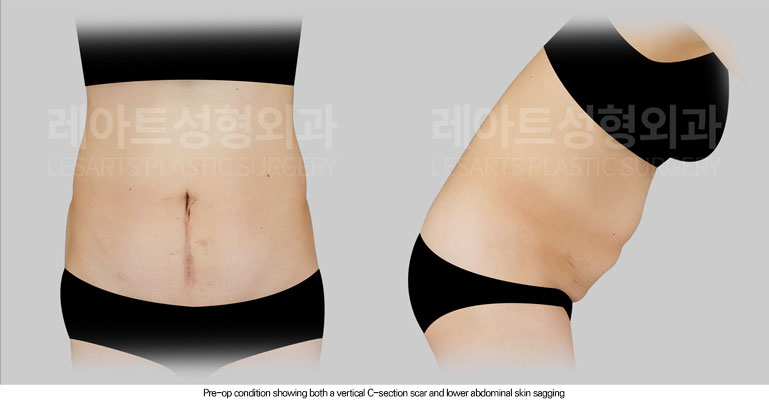
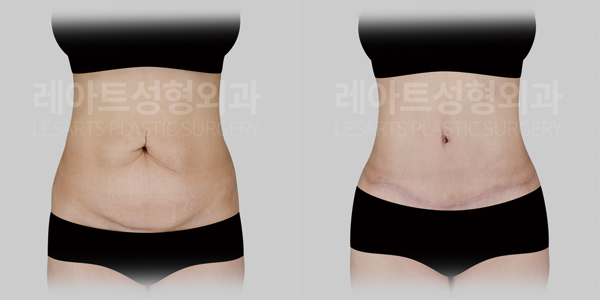
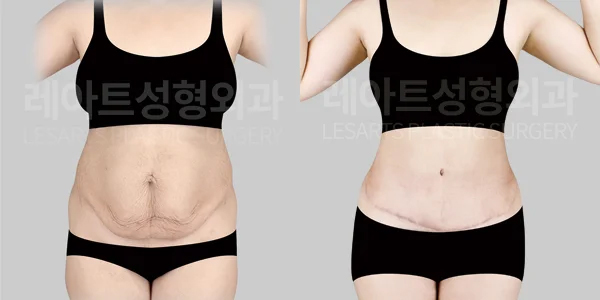
Before undergoing abdominoplasty surgery,
the patient demonstrated
a broad vertical Cesarean section scar
located along the midline
of the lower abdomen.
In addition,
the contour of the lower abdomen
appeared noticeably protruded,
with fullness extending outward
around the scar region.
Most importantly,
in addition to skin laxity,
adhesions involving the tissues
surrounding the scar had developed,
creating an irregular contour
that appeared to pull inward
and descend toward the midline.
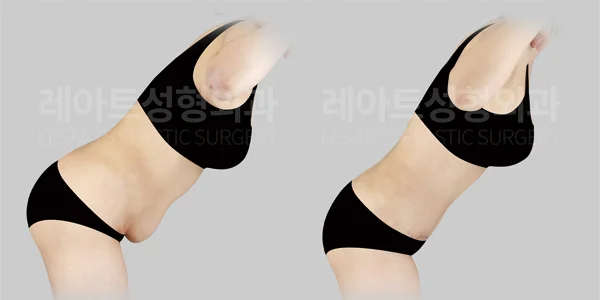
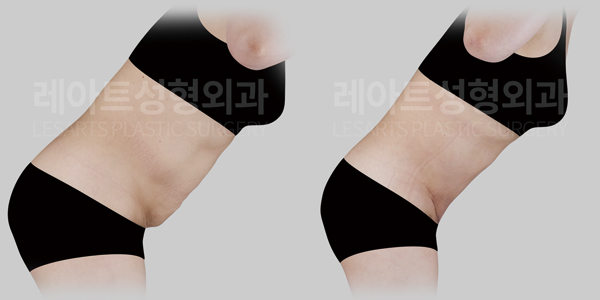
When bending forward,
both the abdominal wall
and overlying skin shifted downward
under the influence of gravity,
making the loss of overall
abdominal support and elasticity
even more apparent.
These findings suggested that
the patient’s concerns were not
simply related to excess skin,
but rather represented a combination of
scar adhesion, skin redundancy,
and weakening of the
abdominal wall support structures,
all of which contributed to
an uneven and poorly defined
abdominal contour.
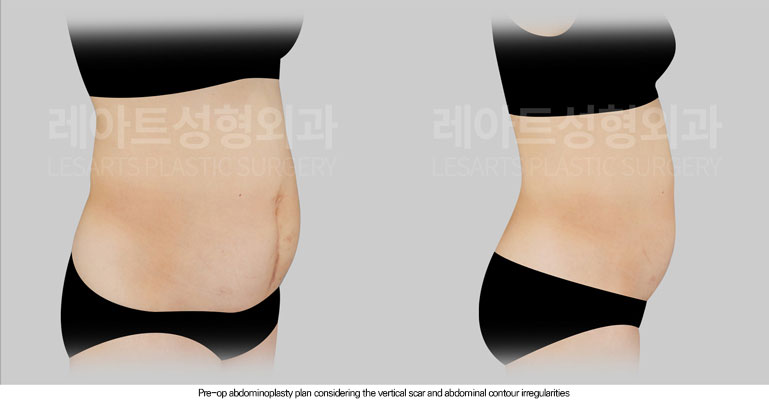
As previously discussed,
the patient’s primary concerns were
the vertical Cesarean section scar
located below the umbilicus and
the surrounding lower abdominal contour,
which appeared protruded and irregular
around the scar.
For this reason,
she initially believed that
scar revision surgery alone
would be sufficient to address
her concerns.
However, after a comprehensive evaluation,
it became apparent that
performing scar revision alone
would carry a considerable risk of
recurrent scar widening due to
persistent tension from the overlying tissues.
Accordingly,
we recommended an approach aimed at
correcting the entire anterior abdomen
through lower abdominal skin excision,
rather than focusing solely on
scar reconstruction.
In particular,
it was explained that
simultaneous contouring of
the upper abdominal fat layer
and downward advancement of the skin flap
would be necessary to achieve
a smooth transition between
the upper and lower abdomen,
thereby avoiding postoperative step-offs
or contour irregularities.
In addition,
evaluation revealed the presence of
rectus diastasis extending from
the upper abdomen, which was also
contributing to the protruding appearance
of the abdomen.
For this reason,
it was determined that
rectus muscle plication
would need to be performed concurrently
to restore abdominal wall support
and effectively improve
the overall abdominal contour.
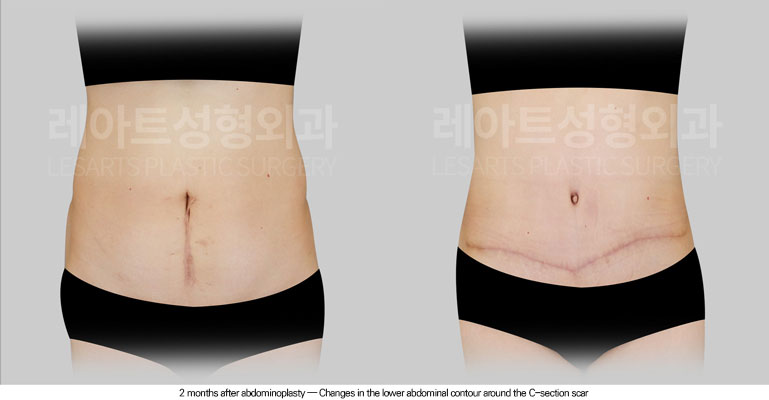
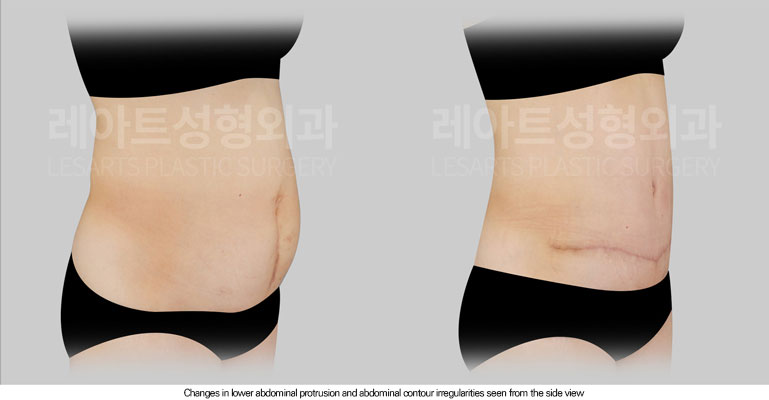
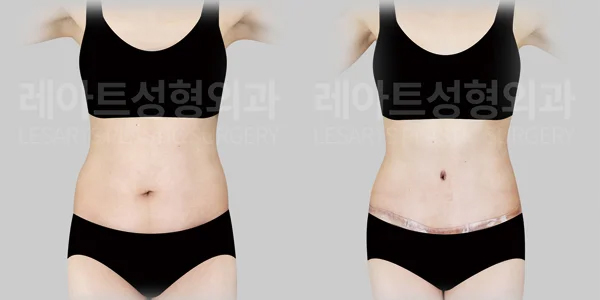
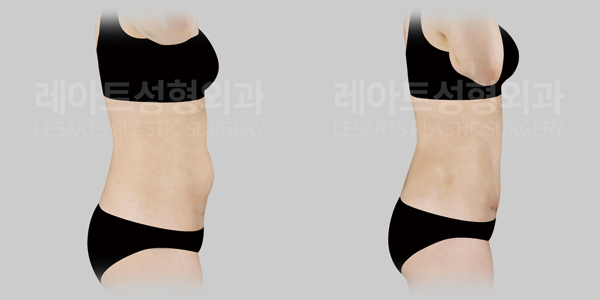
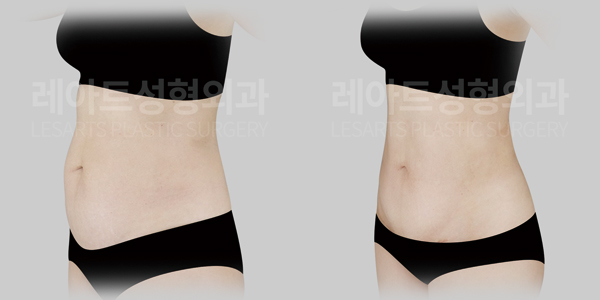
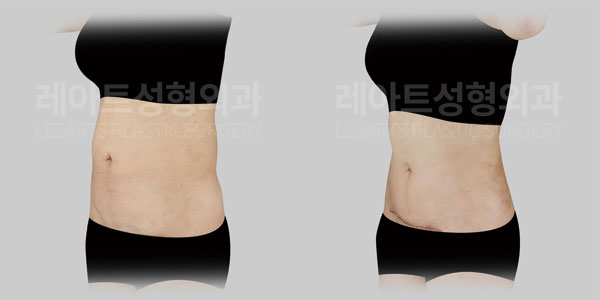
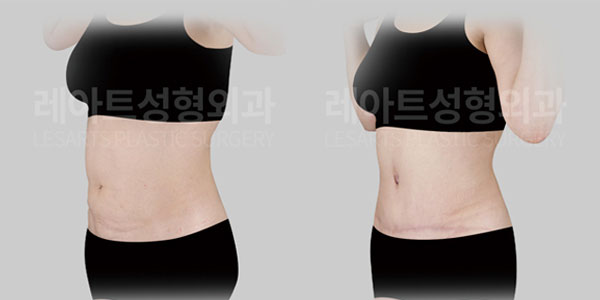
The following photographs demonstrate
the patient’s appearance
at 2 months after abdominoplasty surgery.
Compared with the pre-operative appearance,
the previously protruding contour
of the anterior abdomen, extending
from the upper abdomen downward,
has become noticeably flatter
and more harmonious.
In addition,
the irregular bulging and contour deformity
that had been present within
the lower abdomen have been
effectively corrected, resulting in
a smoother and more refined
abdominal silhouette overall.
Even at 2 months post-operatively,
when mild residual swelling and
tissue firmness may still persist,
the abdomen already demonstrates
a firmer, more stable appearance,
suggesting that further improvement
can be expected as healing
continues over the coming months.
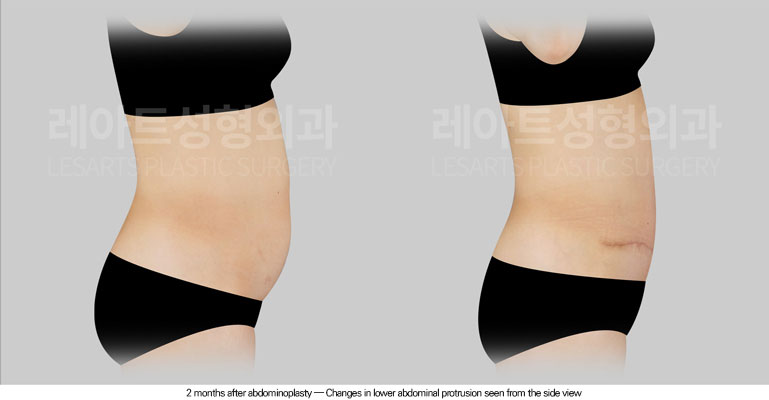
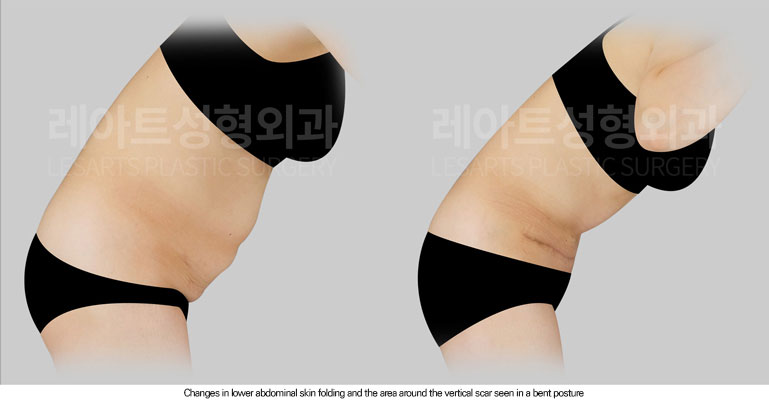
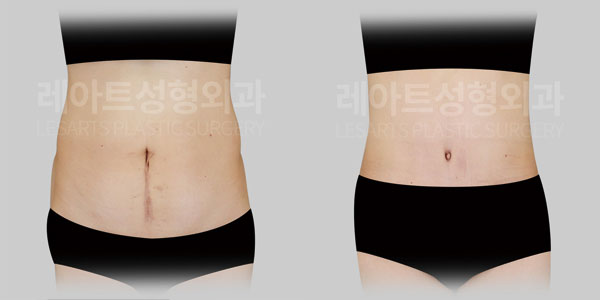
The previous vertical Cesarean section scar
was completely removed through
lower abdominal skin excision
performed during abdominoplasty surgery.
In addition,
the adhesions surrounding
the previous scar were carefully released,
allowing the previously irregular
and uneven abdominal contour
to be restored to
a much smoother appearance.
The redundant abdominal skin,
which had previously descended heavily
over the waistband of underwear
and created a bulky lower abdominal contour,
has also been effectively eliminated.
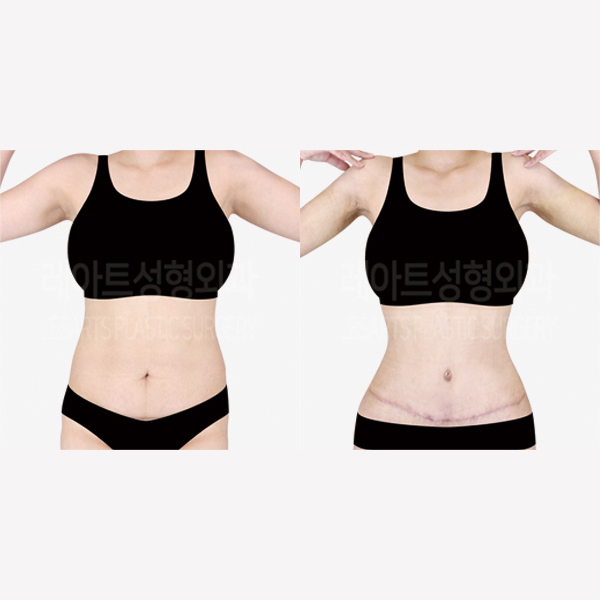
As a result,
the lower abdomen now demonstrates
a firmer, flatter, and more refined appearance,
with a smoother transition between
the upper and lower abdomen
and a significantly improved
overall abdominal silhouette.
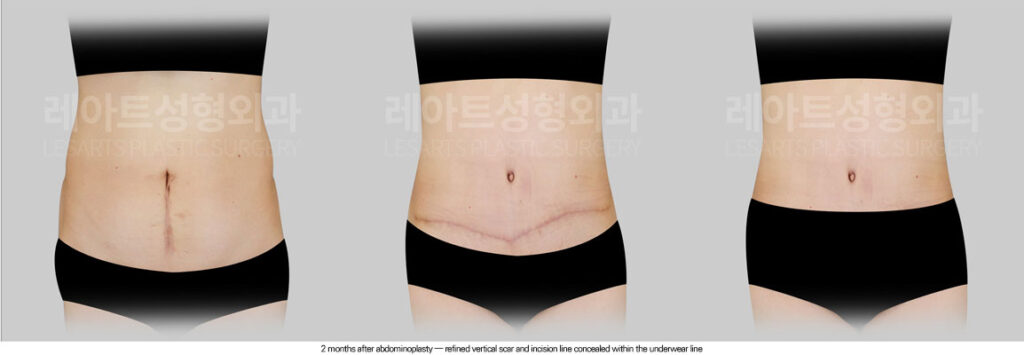
The patient initially visited
Lesarts Plastic Surgery
primarily to address concerns regarding
the vertical Cesarean section scar
and the protruding contour
that had developed around it.
The existing scar was not only
positioned high enough to remain visible
above the underwear line,
but had also widened and become
noticeably red due to
keloid scar formation, making it
a persistent source of stress.
Through abdominoplasty surgery,
the redundant abdominal skin
was removed, allowing the previous
Cesarean section scar to be
completely excised at the same time.
In addition,
the new abdominoplasty incision
was strategically positioned
along the lower abdomen
to ensure that it could be
naturally concealed beneath underwear,
thereby improving both the contour
and aesthetic appearance of the abdomen.
Despite being only 2 months post-operatively,
the patient expressed a very high level
of satisfaction with the outcome.
She explained that
the disappearance of the previously
conspicuous Cesarean section scar,
together with the improvement in
the irregular bulging and protrusion
surrounding the scar, had significantly
increased her confidence when
wearing clothing and participating in
daily activities.
As demonstrated in this case,
successful abdominoplasty surgery
requires individualized planning that
carefully reflects each patient’s
unique anatomical characteristics,
specific concerns, and aesthetic goals.
For individuals struggling with
postpartum abdominal contour deformities
or persistent Cesarean section scars,
obtaining an accurate diagnosis and
understanding the surgical options
most appropriate for their condition
can be an important first step toward
achieving a smoother, firmer,
and more balanced abdominal contour.
Find a customized abdominoplasty case similar to yours
☞ Lesarts Plastic Surgery – Abdominoplasty Case
#Abdominoplasty
#TummyTuck
#PostpartumBodyContour
#CesareanScarRevision
#RectusDiastasisRepair
#AbdominalWallReconstruction
#ScarAdhesionRelease
#LowerAbdominalSkinExcision
#AbdominoplastyRecovery
#AbdominoplastyBeforeAfter
#LesartsPlasticSurgery
#BestAbdominoplastyClinicGangnam