
Abdominoplasty in Gangnam: improving lower abdominal sagging and abdominal wall laxity after weight loss
Patient Registration Info
| Age | Weight | Height | BMI |
|---|---|---|---|
|
40s |
57kg |
167cm |
20 |
Surgical site
Surgical site : Abdomen, Thighs, Hip Dips, M-Type, Rectus Muscle Repair, Umbilicoplasty| liposuction aspirate volume : 1,400cc
Fat Grafting: Hip Dips (Right: 90 cc / Left: 120 cc)
Can a Tummy Tuck Help If Lower Abdominal Sagging and Protrusion Remain After Weight Loss?
After significant weight loss or childbirth,
stretched skin and separated abdominal muscles
may remain even after excess fat has decreased.
If both loose abdominal skin and abdominal wall laxity
are present, a tummy tuck combined with rectus muscle repair
may be considered to improve the overall abdominal contour.
When someone who has carried excess weight
for a long period loses a significant amount of weight,
overall body volume decreases, but previously stretched skin
may not fully contract along with it.
Even after reaching a target weight,
remaining loose skin around the lower abdomen
can become a new concern.
The same can occur after pregnancy and childbirth.
After the abdomen has significantly expanded and then reduced,
insufficient skin elasticity may cause excess skin
to sag or fold downward, making the lower abdomen
appear heavier.
If laxity of the abdominal muscles and fascia
is also present, the abdomen may continue
to protrude forward even after weight loss.
A tummy tuck removes excess stretched skin
while also allowing the abdominal wall to be repaired,
helping address structural abdominal concerns
that may be difficult to improve through
exercise or weight loss alone.
The patient featured in this case had a history
of Cesarean delivery as well as significant
weight loss in the past.
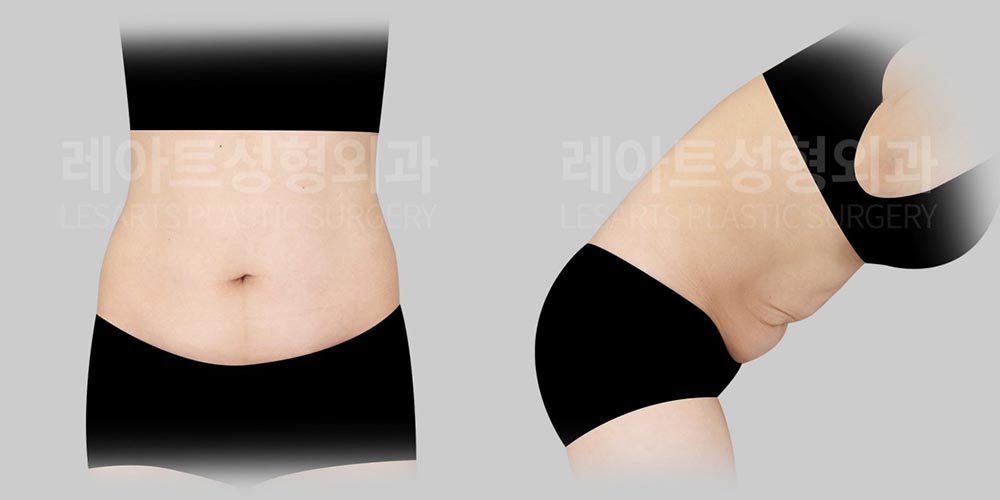
[Preoperative Assessment of Periumbilical Skin and Abdominal Wall Protrusion Before Tummy Tuck]
The patient had previously undergone
abdominal liposuction at another clinic.
However, liposuction alone did not sufficiently improve
the loose skin or the protruding lower abdomen,
so she visited Lesarts Plastic Surgery.
Before surgery, reduced skin elasticity was visible
from the upper abdomen downward.
The loose skin extending below the belly button
formed folds over the lower abdomen, making the area
appear thicker and heavier.
[Preoperative Surgical Plan Considering Lower Abdominal Protrusion and Abdominal Wall Laxity]
The protruding lower abdomen was not caused
by skin and fat alone.
The patient had rectus diastasis, which caused
the abdominal wall to shift forward.
As a result, the front abdomen appeared
rounded and lacked firmness, creating
an overall thicker abdominal contour.
Therefore, removing loose skin alone would not
have been sufficient to achieve the desired change.
The surgical plan needed to address both
the excess skin and abdominal wall laxity.
[Why an M-Type Tummy Tuck and Rectus Muscle Repair Were Planned Together]
The patient had reduced skin elasticity
extending from the upper abdomen, with a significant amount
of loose skin remaining below the belly button.
For this reason, rather than limiting correction
to the lower abdomen, an M-type tummy tuck
was considered more appropriate to tighten
both the upper and lower abdomen.
During surgery, the separated rectus muscles
were brought toward the midline to repair
the abdominal wall and create a firmer
front abdominal contour.
As the stretched skin from the upper abdomen
was sufficiently pulled downward and removed,
the existing belly button would naturally be removed
with the excess skin.
Therefore, reconstruction of the belly button
at a new position was also required.
Subcutaneous fat distributed throughout the abdomen
was also addressed with abdominal liposuction
to improve not only skin sagging but also
the overall waist and abdominal contour.
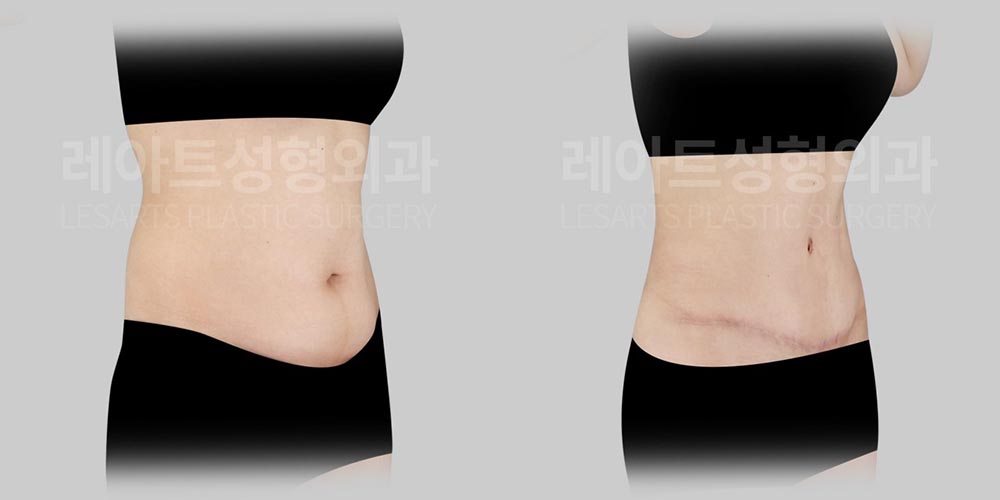
Changes in Abdominal Protrusion and Waist-to-Hip Contour from an Oblique View 1 Year and 4 Months After Tummy Tuck]
This comparison shows the patient before surgery
and 1 year and 4 months after the tummy tuck.
Before surgery, loose skin extended below the belly button,
making the lower abdomen appear heavy and sagging.
After surgery, the excess skin was tightened upward,
reducing the lower abdominal folds and creating
a firmer, smoother lower abdominal contour.
The abdominal wall that had protruded forward
due to rectus diastasis was also repaired,
improving the previously rounded and thick
appearance of the front abdomen.
The belly button, which had shifted downward
along with the loose abdominal skin, was reconstructed
in a vertical shape at a position that better suited
the waistline.
With abdominal liposuction performed at the same time,
the waistline also appears more naturally defined
than before surgery.
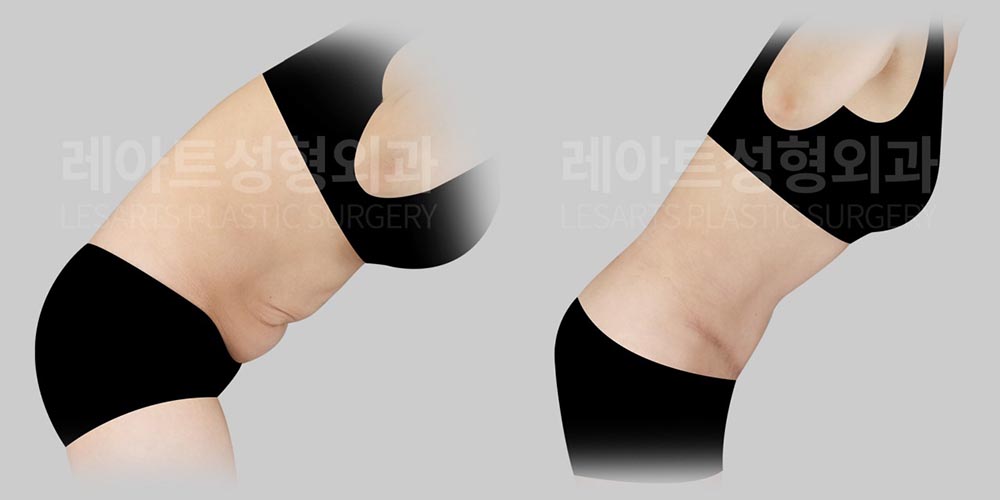
[Changes in Abdominal Skin Sagging and Folding When Bending Forward 1 Year and 4 Months After Tummy Tuck]
Abdominal skin laxity can become even more noticeable
when bending forward than when standing upright.
Before surgery, when the patient bent forward,
the loose lower abdominal skin folded downward,
creating multiple layers of skin folds.
After surgery, the amount of excess skin
in the lower abdomen was reduced.
Even when bending forward, the skin no longer
folds as heavily as before, and the abdomen
maintains a firmer, smoother appearance.
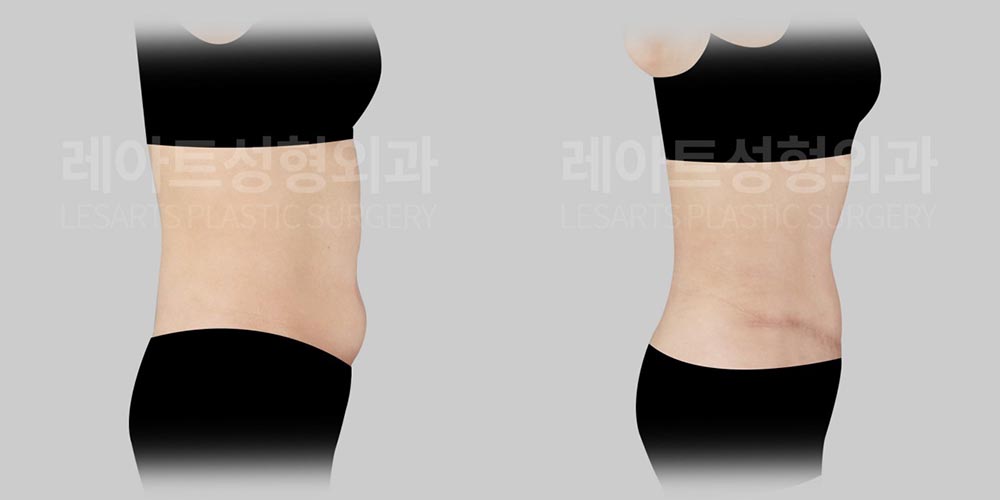
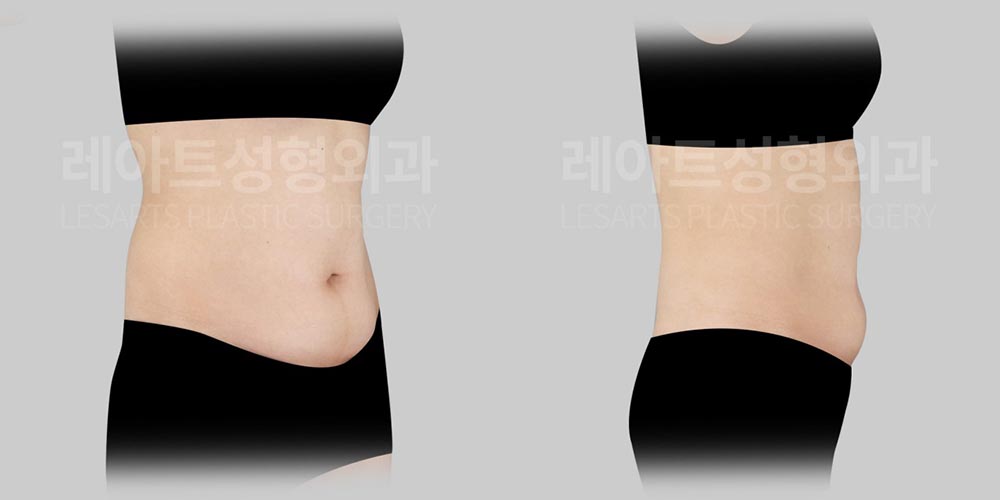
[Changes in Lower Abdominal Protrusion and Front Abdominal Contour from the Side 1 Year and 4 Months After Tummy Tuck]
From the side view, the change in the thickness
of the front abdomen after rectus muscle repair
can be seen more clearly.
Before surgery, the stretched abdominal wall
and loose skin projected forward together,
making the front abdomen appear uneven and heavy.
After surgery, the protruding abdominal wall
was tightened inward and the excess skin was removed,
creating a smoother contour from the upper
to the lower abdomen.
Even when bending forward, deep folds
and downward sagging of the abdominal skin
are noticeably reduced compared with before surgery.
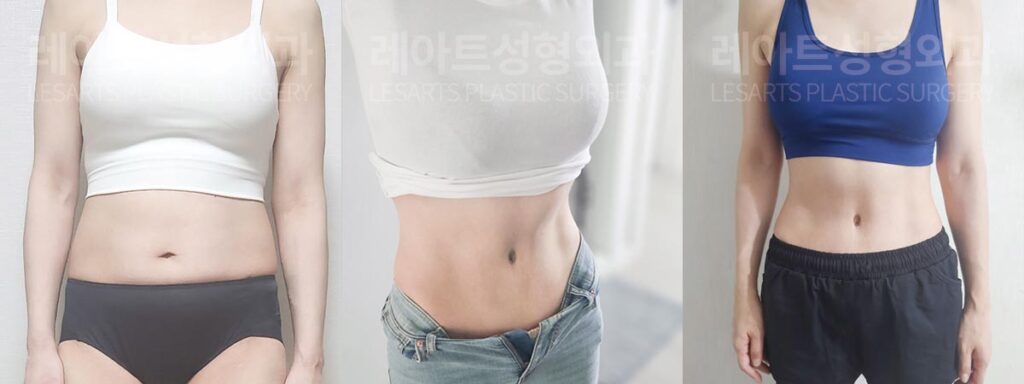
[Selfie Comparison Before, 2 Months After, and 3 Months After Tummy Tuck]
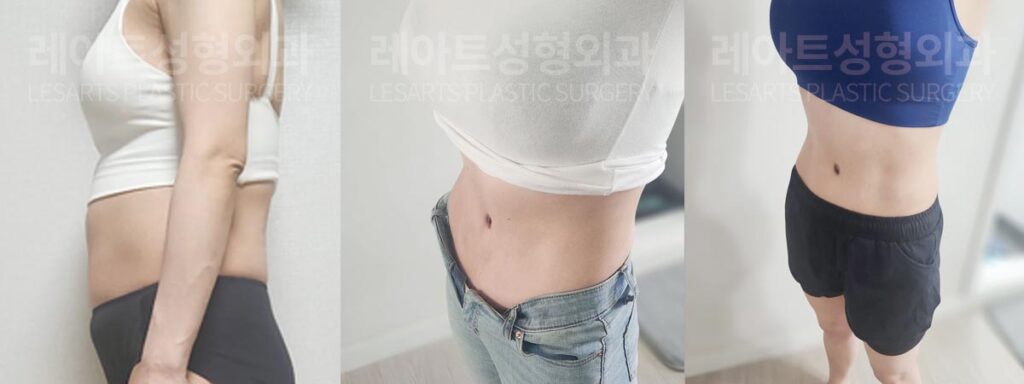
[Selfie Comparison Before, 2 Months After, and 3 Months After Tummy Tuck]
These photos were taken and provided by the patient
before surgery and at 2 and 3 months after surgery.
Before surgery, the loose lower abdominal skin
sagged enough to extend over the waistline
of her clothing.
After surgery, the excess skin was removed,
creating a firmer front abdominal contour
and a more clearly defined waistline.
Even during the early stages of recovery,
the lower abdominal folds were reduced,
giving the abdomen a lighter appearance.
This patient had loose abdominal skin
and lower abdominal protrusion after a Cesarean delivery
and significant weight loss.
She had previously undergone abdominal liposuction,
but the loose skin and rectus diastasis remained.
Therefore, an M-type tummy tuck, rectus muscle repair,
and abdominal liposuction were performed together.
At 1 year and 4 months after surgery,
the skin that had previously sagged below the belly button
was tightened, reducing both lower abdominal folds
and protrusion.
The abdominal wall that had projected forward
also appeared firmer and flatter.
Even when bending forward, the skin no longer
formed multiple heavy folds or sagged downward
as it had before surgery.
The reconstructed belly button and waistline
also settled into a natural-looking position.
In the selfies provided by the patient,
the abdomen appears noticeably more refined,
allowing her to wear cropped tops or clothing
that reveals the waistline without needing
to conceal the lower abdomen.
If loose abdominal skin and abdominal wall laxity
remain despite continued exercise and dieting
after childbirth or significant weight changes,
the condition of the skin, fat, and rectus muscles
should be evaluated together.
It is important to determine whether the concern
is caused primarily by excess fat or whether
correction of stretched skin and the abdominal wall
may also be necessary before planning
the appropriate surgical approach.
Tummy Tuck FAQ
Q1. Will loose lower abdominal skin naturally tighten after weight loss?
If skin elasticity is sufficient, the skin may
tighten to some extent after weight loss.
However, skin that has been stretched for a long time
or significantly expanded may remain loose
and folded even after weight loss.
Q2. Can abdominal liposuction improve loose skin?
Abdominal liposuction is a procedure
that reduces subcutaneous fat.
If loose skin or rectus diastasis is the main concern,
liposuction alone may not be sufficient
to achieve the desired change.
Q3. Why is rectus muscle repair performed during a tummy tuck?
When the rectus muscles separate, the abdominal wall
may protrude forward, causing the abdomen
to remain prominent even after weight loss.
In these cases, the separated rectus muscles
can be brought together to repair
the abdominal wall.
Q4. Is a new belly button created during an M-type tummy tuck?
When the upper abdominal skin is sufficiently
moved downward, the existing belly button is removed
and reconstructed at a new position.
The appropriate surgical method may vary depending
on the extent of abdominal skin laxity.
Q5. How are tummy tuck scars managed after surgery?
The scar healing process varies from person to person.
In this case, regular follow-up examinations
and laser treatments were continued, and at 1 year
and 4 months after surgery, the scar gradually
became lighter starting from both ends.
▼ Visit Lesarts Plastic Surgery in Gangnam, Seoul, Korea ▼