
Arm liposuction in Korea: is it suitable for keloid-prone skin? Scar and arm contour changes at 7.5 months
Patient Registration Info
| Age | Weight | Height | BMI |
|---|---|---|---|
|
20s |
49kg |
168m |
17 |
Surgical site
Surgical site : Arms, Accessory Breasts, Axillae, Scapular|liposuction volume : 1,100 cc
Can Keloid-Prone Skin Leave More Noticeable Scars After Arm Liposuction?
Having a history of keloid-type scarring
does not necessarily mean that liposuction incision sites
will heal in the same way.
However, because there may be a greater risk
of noticeable scarring, it is important to keep
the incision sites stable and closely monitor
the healing process.
When considering liposuction, many patients
are just as concerned about postoperative scars
as they are about changes in body contour.
This concern may be even greater for patients
who have previously developed keloid reactions
after ear piercings or injuries
and required additional treatment.
In these cases, even liposuction performed
through small incisions may not be
an easy decision.
To manage liposuction scars, it is important
to prevent the incision sites from becoming
unnecessarily widened during surgery.
After surgery, the thickness, color,
and overall healing condition of the scars
should also be monitored regularly.
If necessary, additional scar treatments
can be continued according to
the condition of the healing incision.
Watch the Video on Scar Care After Liposuction
In this article, we will look at
an arm liposuction case involving a patient
with keloid-prone skin and examine how
the arm contour and incision scars healed
7.5 months after surgery.
[Preoperative Body Analysis and Surgical Plan for Arm Liposuction]
The patient was 169 cm tall, weighed 49.6 kg,
and had a BMI of 17.4, placing her close
to a naturally slim body type.
Her weight had remained relatively stable,
but residual fat along the back of the upper arms
made her upper body appear wider and heavier
than her actual frame.
Because she was already quite slim,
she did not want to lose additional weight.
Instead, she wanted to reduce the areas
that made her arms appear thicker
and create a naturally straight arm contour.
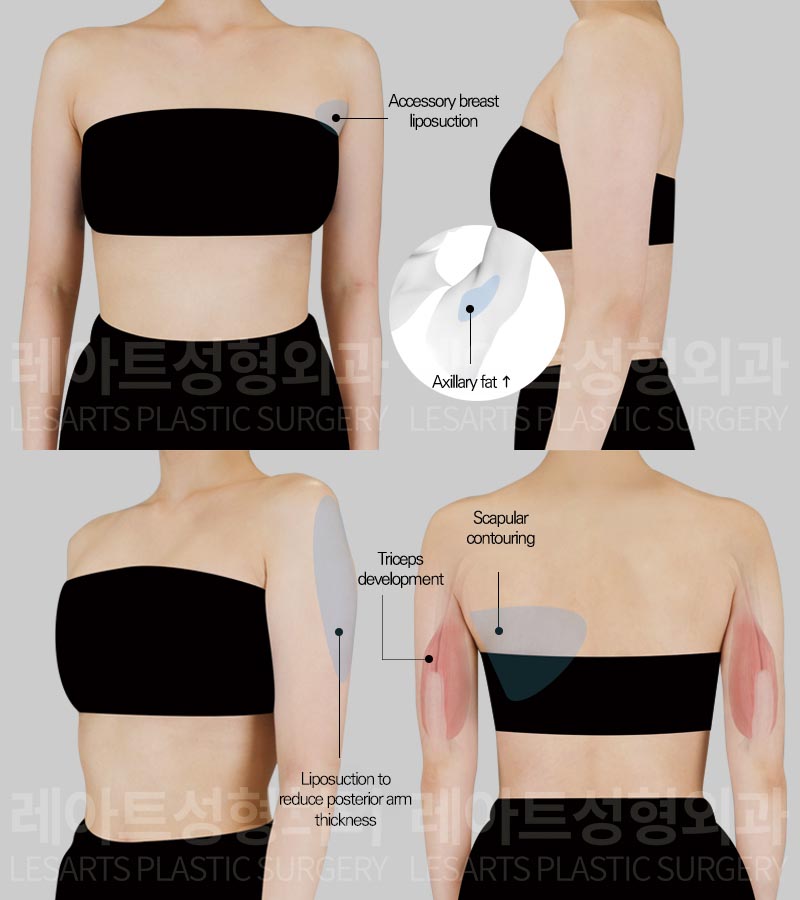
[Why the Accessory Breast, Armpit, and Scapular Areas Were Considered Together]
If only the back of the upper arms were reduced,
remaining fat where the arms meet the torso
could interrupt the overall contour.
For this reason, the accessory breast, armpit,
and scapular areas were evaluated together
with the posterior upper arms.
The accessory breast and armpit areas affect
the width where the arms begin, while fat around
the scapula influences how smoothly the arms
and back connect from the rear view.
Even in a slim patient, localized fat
in these areas can make the arms stand out
or make the upper body appear wider
than the actual frame.
The surgical range was therefore planned
to reduce overall arm thickness while creating
a natural transition into the surrounding areas.
[Planning a Straight Arm Contour Without Overemphasizing the Triceps]
One area that required particular attention
during surgical planning was the triceps.
Because the patient had moderately developed arm muscles,
removing as much fat as possible could have made
the muscular boundaries appear overly prominent.
This could create a more athletic, muscular appearance
rather than the smooth, straight arm contour
the patient wanted.
The plan was therefore to reduce the fat
contributing to arm thickness while preserving
an appropriate fat layer around the triceps.
This was intended to prevent excessive muscle definition
and create a smooth, straight line
from the shoulder to the elbow.
Fat removal around the accessory breast area
was also carefully adjusted, as excessive removal
could contribute to skin folding or wrinkling.
There was not a large amount of fat
around the scapular area, so rather than significantly
reducing its thickness, the goal was to refine it
enough to create a smoother back contour.
The patient’s keloid-prone skin was also considered
during surgical planning.
Before proceeding with surgery, we explained
the possibility of more noticeable incision scars
and the postoperative scar care that might be required.
[Changes in Arm Thickness and Upper Body Width from the Front 7.5 Months After Arm Liposuction]
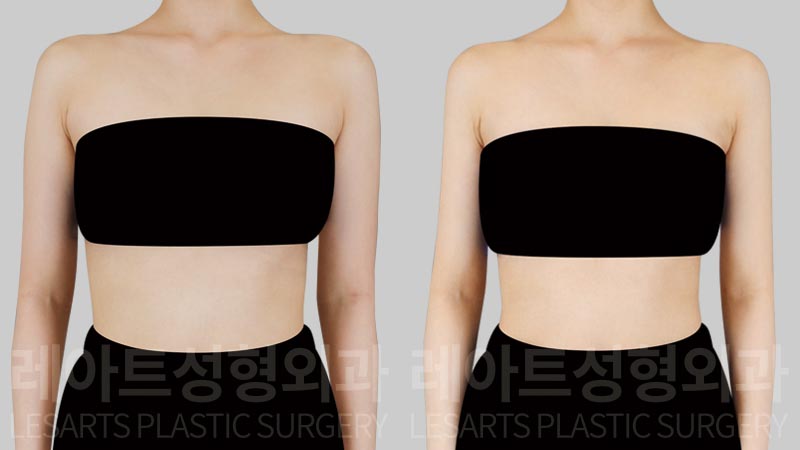
These before-and-after photos were taken
7.5 months after arm liposuction.
Before surgery, fullness along the back and outer arms
made the arms appear wider on both sides of the torso.
After surgery, the fat that contributed
to the outer arm contour was reduced,
creating a straighter line from below
the shoulders to the elbows.
As the overall width of the arms decreased,
the torso also appeared narrower and lighter,
creating upper body proportions that better matched
the patient’s height and weight.
[Changes in the Back of the Arms and Scapular Contour 7.5 Months After Arm Liposuction]
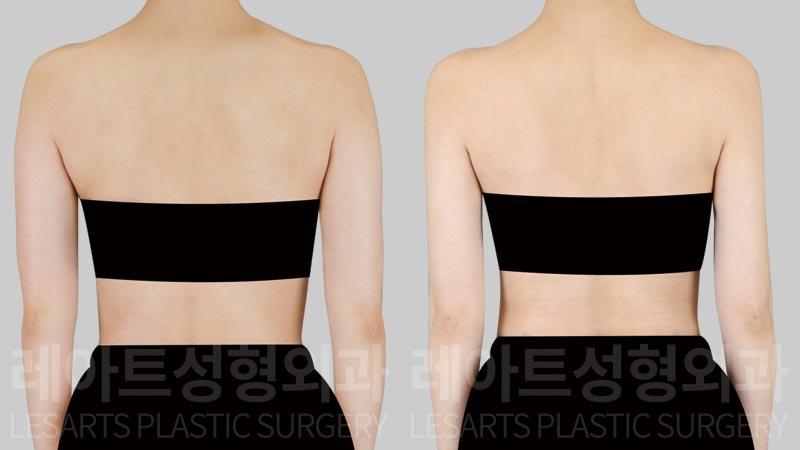
From the back, the reduction in posterior arm thickness
and refinement around the scapular area
can be seen together.
As the remaining fat along the back of the arms
was reduced, the contour from the shoulders
to the elbows became lighter and smoother.
The scapular area was gently refined
rather than aggressively reduced, helping prevent
an abrupt transition between the arms and back.
By treating the accessory breast, armpit,
and scapular areas together with the arms,
the result was not limited to slimmer-looking arms.
Instead, the entire upper body developed
a smoother and more naturally connected contour.
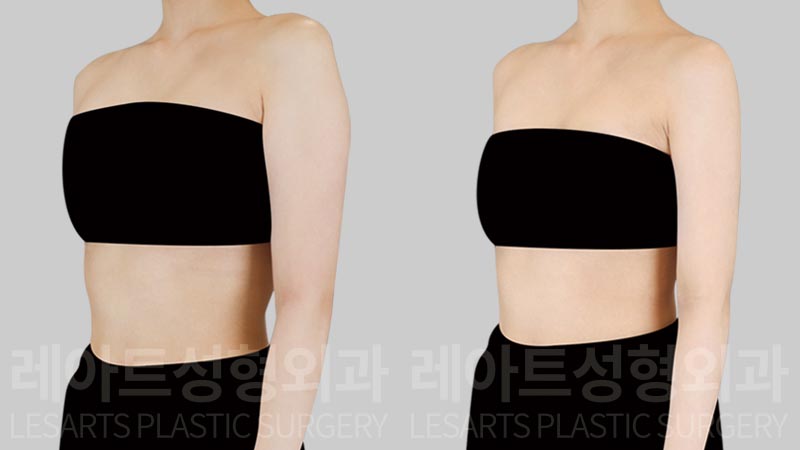
[Changes in the Back of the Arms and Armpit Contour from an Oblique View 7.5 Months After Arm Liposuction]
From the oblique view, the reduction in thickness
from the back of the arms toward the armpits
can be seen more clearly.
Before surgery, fullness where the arms met the torso
made the starting point of the arms appear
less defined and wider.
After surgery, the armpit and accessory breast areas
were refined together, creating a clearer and more natural
separation between the arms and torso.
The thickness along the back of the arms
was also reduced, giving the overall arm contour
a lighter and smoother appearance.
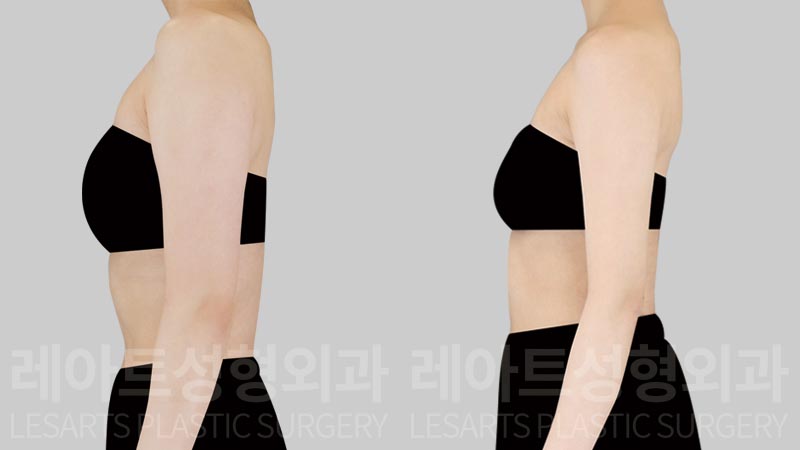
[Changes in Arm Thickness and Straight Arm Contour from the Side 7.5 Months After Arm Liposuction]
From the side view, the reduction in thickness
along the back of the arms and below the armpits
makes the front-to-back width of the arms
appear noticeably slimmer.
The fullness that previously projected backward
when the arms were resting naturally was reduced,
decreasing the overall arm circumference and creating
a longer, straighter line from top to bottom.
The triceps contours do not appear overly prominent,
resulting in the smooth, straight arm shape
the patient wanted.
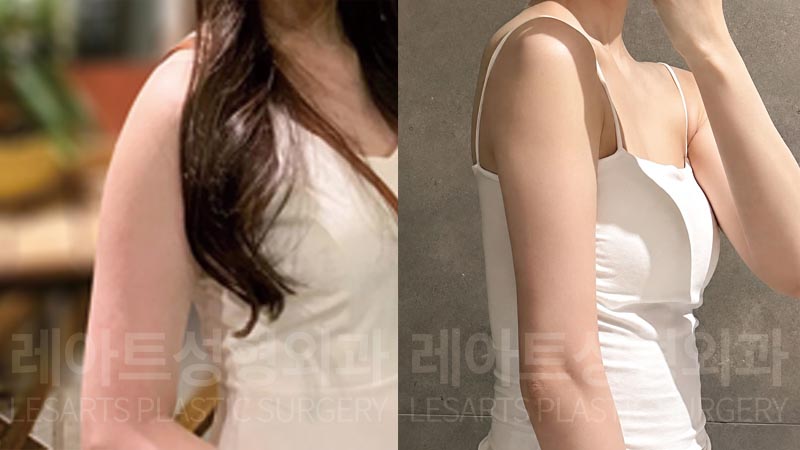
[Selfie Comparison Before and 7.5 Months After Arm Liposuction]
These photos were taken by the patient
before surgery and 7.5 months after surgery.
Despite having a slim body type, the patient felt
self-conscious about the fullness at the back of her arms,
especially when taking photos or wearing sleeveless clothing.
After surgery, the thickness of the posterior upper arms
was reduced and the overall arm contour
became naturally slimmer and smoother.
The patient was also pleased that not only the arms,
but also the accessory breast and armpit areas
were refined together, giving the upper body
a slimmer and more delicate appearance
when wearing sleeveless clothing.
[Healing of the Liposuction Incision Scars]
Because of her keloid-prone skin, the patient
had been particularly concerned about
the liposuction incision scars before surgery.
However, at 7.5 months after surgery,
the incision sites had healed stably without
becoming noticeably raised or inflamed.
Having experienced keloid-type scarring in the past
does not necessarily mean that every liposuction incision
will heal in the same way.
However, depending on individual skin characteristics,
there may be a greater possibility of noticeable scarring.
For this reason, thorough consultation before surgery
and continued monitoring of the incision sites
during recovery are important.
Scar care should also be adjusted according
to how each incision heals.
This patient had an overall slim body type,
but localized fat along the back of the arms,
accessory breast, armpit, and scapular areas
made the upper body appear wider and heavier.
Because her triceps were moderately developed,
the goal was not to remove fat excessively.
Instead, an appropriate amount of volume
was preserved around the muscles to create
a smooth, straight contour from the shoulders
to the elbows.
At 7.5 months after surgery, the thickness
of the posterior upper arms was reduced,
and the overall width of the upper body
also appeared noticeably lighter.
The patient expressed high satisfaction
with the improvement in the arm contour
that had previously bothered her when taking photos
or wearing sleeveless clothing.
The incision scars, which had been
a major concern before surgery, also healed stably
without becoming thick, raised, or inflamed.
Keloid-prone skin does not necessarily mean
that arm liposuction cannot be performed.
However, the possibility of noticeable scarring
and the healing process should be carefully considered.
In addition to evaluating fat and muscle distribution
in the arms, it is important to assess skin characteristics
and any previous scar reactions before surgery
and to discuss both the procedure and postoperative
scar management with the medical team.
Keloid-Prone Skin and Arm Liposuction FAQ
Q1. Can I have arm liposuction if I have keloid-prone skin?
A history of keloid scarring does not necessarily mean
that arm liposuction cannot be performed.
However, because there may be a higher risk
of noticeable scarring, the current skin condition
and previous scar reactions should be carefully evaluated
before surgery.
Q2. Can liposuction incision scars develop into keloids?
Depending on individual skin characteristics,
incision scars may heal thicker or wider than expected.
However, it cannot be assumed that every liposuction scar
will heal in the same way as previous keloid scars.
Q3. Can arm liposuction be effective for a slim body type?
Even with a low overall body weight, localized fat
may remain along the back of the arms, accessory breast,
or armpit areas.
Reducing fat in these areas can help refine
the contour of the arms and upper body.
Q4. If I have developed arm muscles, is it better to remove more fat?
Excessive fat removal may make the borders
of the triceps appear more prominent.
If a smooth, straight arm contour is desired,
an appropriate fat layer should be preserved
based on the underlying muscle structure.
Q5. How long should arm liposuction scars be managed?
The time required for scars to stabilize
varies from person to person.
The color, thickness, and degree of scar elevation
should be monitored throughout recovery,
with additional scar care provided as needed.
▼ Visit Lesarts Plastic Surgery in Gangnam, Seoul, Korea ▼