
Gynecomastia surgery in Seoul: is an areolar incision alone enough? Before and after results
Patient Registration Info
| Age | Weight | Height | BMI |
|---|---|---|---|
|
30s |
79kg |
172cm |
26 |
Surgical site
Surgical site : Gynecomastia | Grade 2-A
Can Gynecomastia Surgery Be Performed Through an Areolar Incision Alone?
Depending on the location of the glandular tissue
and fat distribution, gynecomastia surgery may sometimes
be performed through an areolar incision alone.
However, the required surgical range differs for each patient,
so the incision site should be determined after
an ultrasound examination and physical evaluation.
When considering gynecomastia surgery,
the incision location is often just as important
to patients as breast size and postoperative changes.
Patients who are particularly concerned about visible
surgical scars may wonder whether the procedure
can be performed through an areolar incision alone.
An areolar incision provides direct access
to the glandular tissue located in the center of the chest
and also allows the remaining tissue to be evenly refined
after gland removal.
Because the incision is placed along the border
between the areola and surrounding skin,
the resulting scar may blend more naturally
with the surrounding color as it heals.
However, not every gynecomastia procedure
is performed using the same incision method.
Depending on the extent of glandular tissue development,
fat distribution, and any additional procedures performed,
an axillary incision may also be required.
In this case, the patient did not want
an incision in the armpit area.
After examination, we determined that the necessary
treatment area could be accessed through the areola,
so the surgery was planned using
an areolar incision alone.
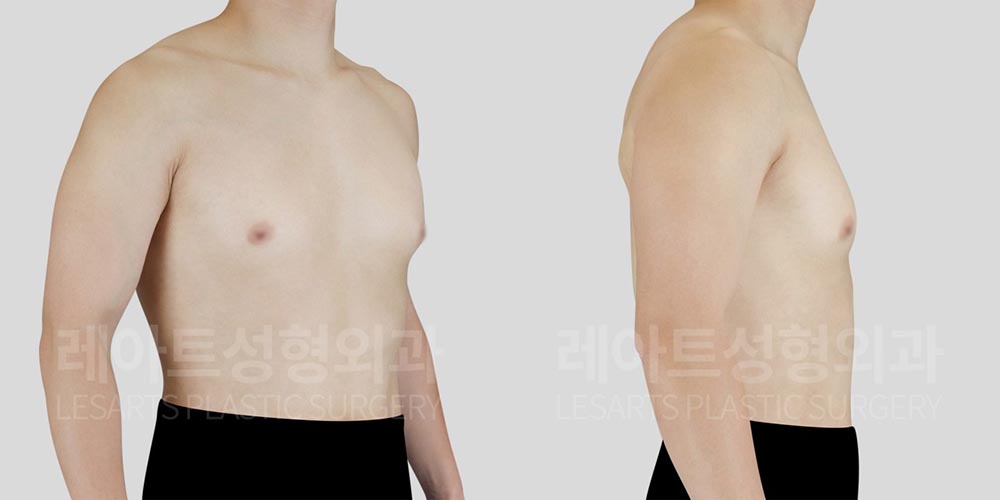
This patient had noticed prominent chest projection
since his teenage years.
Although he continued exercising regularly,
there was no noticeable change in overall chest size
or the protrusion at the center of the chest.
As exercise alone was unlikely to sufficiently improve
his current chest contour, he decided
to undergo gynecomastia surgery.
[Patient Information and Examination Results]
Age: 30s
Height / Weight: 172 cm / 78.9 kg
BMI: 26.7
Gynecomastia Diagnosis: Simon Grade 2A, true gynecomastia
Skin Elasticity: Moderate
Before surgery, the central area of both breasts
projected forward, giving the entire chest
a rounded and enlarged appearance.
The external appearance corresponded to Simon Grade 2A,
while ultrasound and physical examination confirmed
developed glandular tissue in both breasts.
Fat was also distributed along the lower
and outer chest, making it necessary to combine
glandular tissue removal with chest liposuction.
[Gynecomastia Surgery Without an Axillary Incision]
The patient did not want an additional surgical scar
in the armpit area.
Based on the examination, we determined that
the glandular tissue and surrounding fat could be
adequately addressed through an areolar incision.
The procedure was therefore performed
using an areolar incision alone.
The developed glandular tissue was removed,
while fat along the lower and outer chest
was also reduced to decrease the overall
thickness of the chest.
If only the area where the glandular tissue
was removed becomes too deeply depressed,
the center of the chest may appear sunken
or develop a visible transition from surrounding areas.
To help prevent this, the remaining tissue
was evenly redistributed to create a natural contour
from the upper chest through the center of the chest
and down toward the upper abdomen.
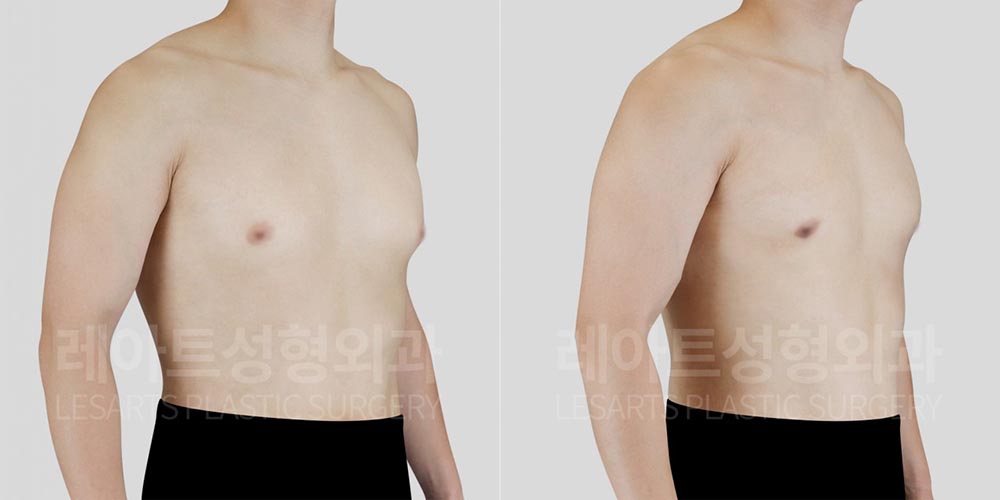
[Changes in Chest Protrusion and Chest Contour 2 Months After Gynecomastia Surgery]
This photo shows the patient
2 months after gynecomastia surgery.
Before surgery, the rounded fullness extending
from the center to the lower chest made
the entire chest appear larger and heavier.
After surgery, the prominent central chest area
became flatter, while the overall chest size
was naturally reduced.
The glandular tissue and surrounding fat
were removed through an areolar incision alone,
and tissue rearrangement was also performed
to help prevent a sunken appearance
in the center of the chest.
At 2 months after surgery, some residual swelling
and firmness may still remain as part
of the recovery process.
However, the reduction in chest protrusion
and overall chest size can already
be clearly observed at this stage.
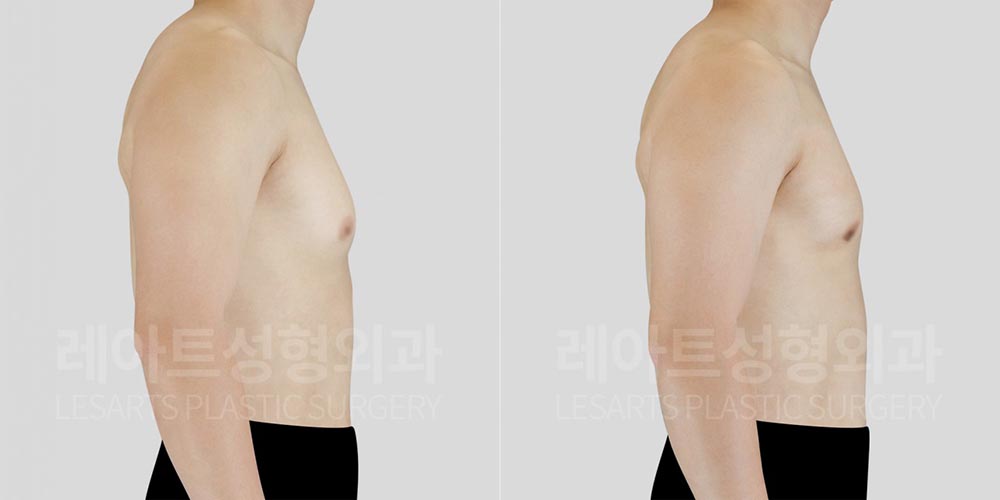
[Changes in Chest Thickness and Lower Chest Angle from the Side 2 Months After Gynecomastia Surgery]
From the side view, the difference in chest thickness
before and after surgery is even more noticeable.
Before surgery, the center of the chest projected
the furthest forward, with rounded fullness extending
down toward the lower chest and creating a heavier appearance.
After surgery, the projection at the center of the chest
was reduced, allowing the upper chest to naturally become
the most prominent point of the chest contour.
The angle from the lower chest to the upper abdomen
also became more gradual, creating a smoother
and more balanced overall upper body line.
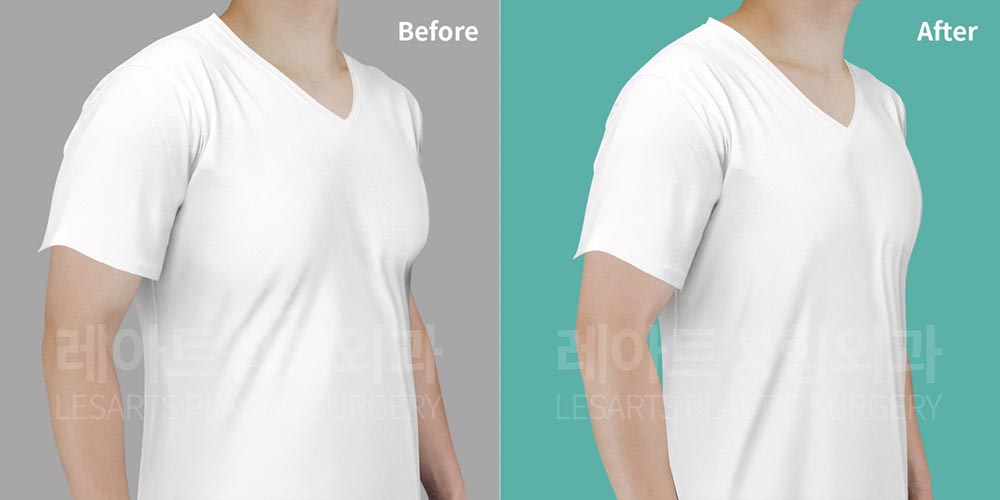
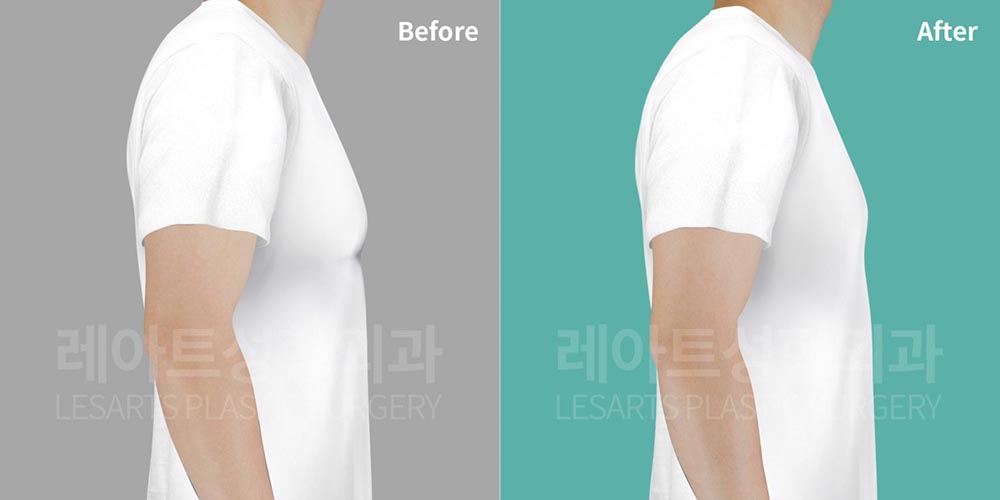
[Side-View Changes in a T-Shirt 2 Months After Gynecomastia Surgery with an Areolar Incision]
Before surgery, when wearing a thin T-shirt,
the chest projected forward, causing the fabric
to lift away around the chest area.
At 2 months after surgery, the thickness
of the chest was reduced, allowing the T-shirt
to fall more naturally along the torso.
[Three-Quarter View in a T-Shirt 2 Months After Gynecomastia Surgery with an Areolar Incision]
From the three-quarter view, the rounded fullness
in the center of the chest has decreased,
making the front chest appear noticeably flatter.
Although some residual swelling may still remain,
the contour from the chest down to the upper abdomen
already appears smoother and more natural.
The patient was also satisfied that the central chest projection
that had bothered him whenever he wore clothing
was noticeably reduced.
He was particularly pleased that no separate incision
was made in the armpit area, while the incision
along the border of the areola was naturally concealed.
This patient had experienced gynecomastia
since his teenage years and had continued exercising regularly,
but saw little change in the central chest projection
or overall chest size.
After ultrasound and physical examination confirmed
the distribution of glandular tissue and fat,
the surgical plan was made using only an areolar incision
while also considering the patient’s preference
for the incision location.
At 2 months after surgery, the previously prominent
front chest appeared flatter, while chest thickness
and the angle of the lower chest also decreased
when viewed from the side.
Most importantly, the patient was satisfied
that thin T-shirts no longer lifted away from the chest
as they had before surgery and instead fell
more naturally along the torso.
Although reducing chest size is one of the main goals
of gynecomastia surgery, the incision location
and visibility of surgical scars can also be important concerns
for many patients.
Whether gynecomastia surgery can be performed
through an areolar incision alone depends on the size
and location of the glandular tissue
and the distribution of surrounding fat.
If you prefer gynecomastia surgery without an axillary incision,
a detailed examination is necessary to determine
the possible surgical range and expected changes in advance.
Male Gynecomastia Surgery FAQ
Q1. Can gynecomastia surgery be performed through an areolar incision alone?
Depending on the location of the glandular tissue and fat,
as well as the required surgical range, the procedure
may be performed through an areolar incision alone.
The appropriate approach is determined after
an ultrasound examination and physical evaluation.
Q2. Can glandular tissue be sufficiently removed through an areolar incision?
An areolar incision provides direct access
to the glandular tissue in the center of the chest,
making it suitable for gland removal.
However, if the glandular tissue and fat are widely distributed,
a different surgical approach may be necessary.
Q3. Is the scar from an areolar incision noticeable?
Because the incision is placed along the border
between the areola and surrounding skin,
the scar may blend relatively naturally with the surrounding color.
The degree of scar healing varies
from person to person.
Q4. Can fat also be removed through an areolar incision?
Depending on the location and distribution of fat,
surrounding fat may also be addressed
through the areolar incision.
If liposuction over a wider area is required,
an additional approach may be considered.
Q5. Is 2 months after surgery the final result?
At 2 months after surgery, changes in chest projection
and overall size can already be observed.
However, residual swelling and tissue firmness may remain,
and the chest contour and incision area
will continue to settle over time.
▼ Visit Lesarts Plastic Surgery in Gangnam, Seoul, Korea ▼