Tummy tuck in Seoul: 3-month results for postpartum abdominal wrinkles and lower belly sagging
Patient Registration Info
| Age | Weight | Height | BMI |
|---|---|---|---|
|
30s |
58kg |
164cm |
22 |
Surgical site
Surgical site : Abdomen, M-Type, muscle repair, umbilicus correction| liposuction aspirate volume : 2,200cc
The patient featured in this post
underwent abdominoplasty surgery
to improve abdominal skin laxity,
wrinkling around the navel,
and folding of the lower abdomen
that developed following
a previous Cesarean section delivery.
The patient had been experiencing
significant stress due to
the sagging abdominal skin
extending from the upper abdomen
down to the lower abdomen,
as well as the tendency for the abdomen
to protrude noticeably after meals.
In particular,
the patient hoped to achieve
a smoother and more refined
abdominal contour,
especially when wearing
thin or form-fitting clothing.
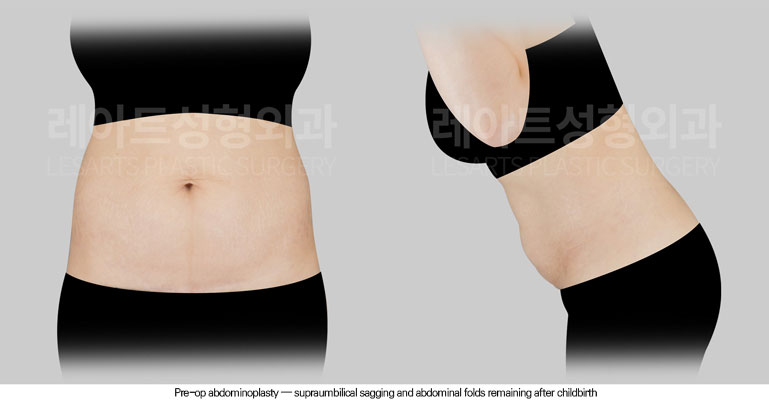
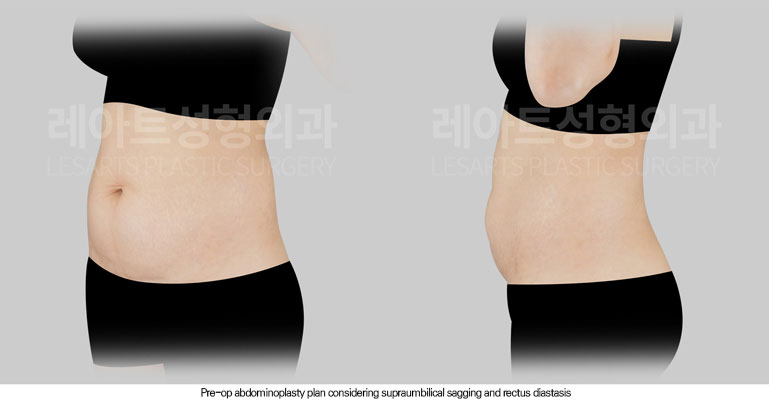
During the pre-operative consultation for abdominoplasty,
the patient’s abdomen demonstrated
significant skin laxity extending from above the navel
to the lower abdomen,
along with the presence of rectus diastasis.
When the rectus muscles separate,
the abdominal wall loses its ability
to provide firm support.
As the patient had experienced,
this weakened support allows the abdominal contents
to protrude more prominently after meals,
causing the anterior abdominal contour
to bulge outward.
In addition,
when bending forward,
the abdomen assumed a noticeably
overhanging and folded appearance,
which had become a major source
of stress in daily life.
On physical examination,
the lower abdominal skin
was visibly stretched downward
and folded over itself.
Fine wrinkles surrounding the umbilical area,
stretch marks,
and an overall irregular, uneven contour
throughout the abdomen
were also observed.
Accordingly,
an M-Type Abdominoplasty
was planned to address
the skin laxity extending from
the upper abdomen to the lower abdomen,
while simultaneously correcting
the rectus diastasis
that originated in the upper abdomen.
However,
it was explained that
whether the existing Cesarean section scar
could be completely removed
would ultimately depend on
the actual amount of skin
that could be safely advanced
during surgery.
The patient was also informed that
the abdominoplasty incision
would be designed to remain
as concealed as possible
within the underwear line.
Nevertheless,
depending on individual tissue characteristics
and the degree of skin advancement achieved,
there remained a possibility that
two separate scar lines
could ultimately be present.
This aspect was discussed thoroughly
during the consultation process
to ensure realistic expectations.
With regard to abdominal liposuction,
the objective was not to remove
the maximum amount of fat possible.
Instead,
the procedure was planned within a range
that could provide a synergistic effect
when combined with abdominoplasty,
focusing primarily on improving
the overall abdominal contour
and creating a smoother,
more harmonious body line.
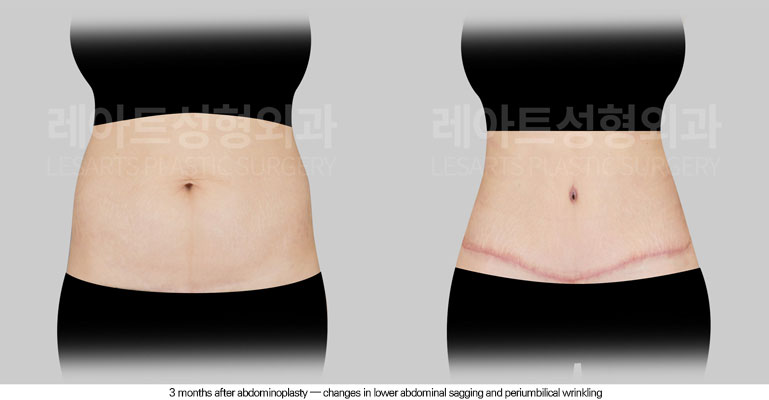
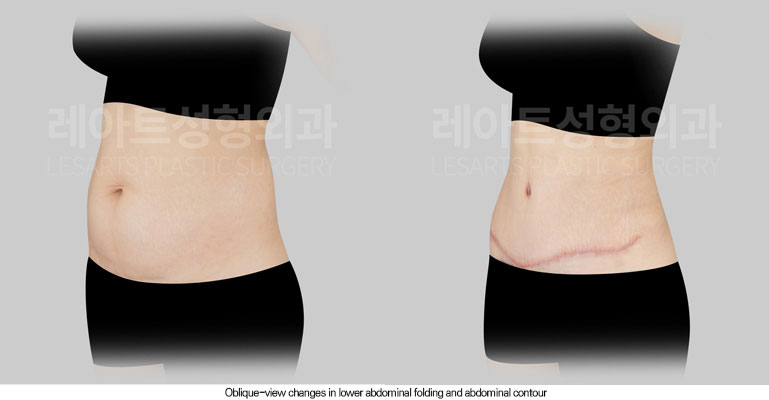
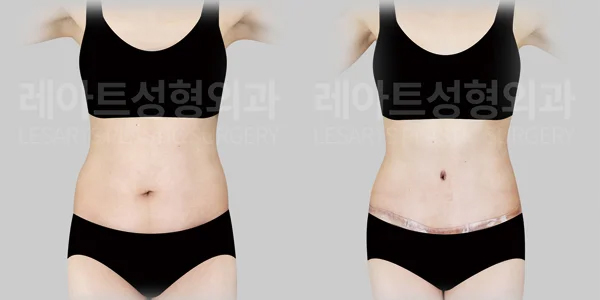
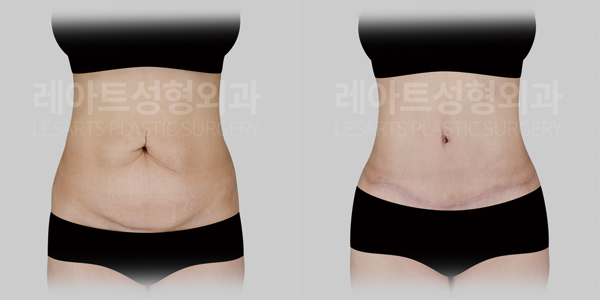
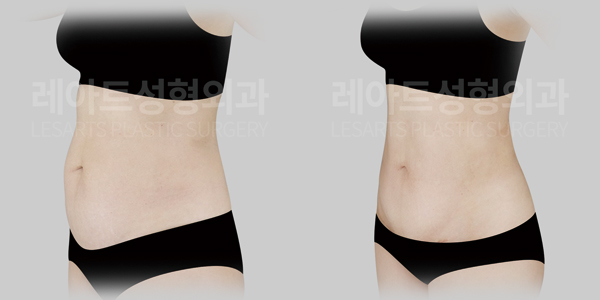
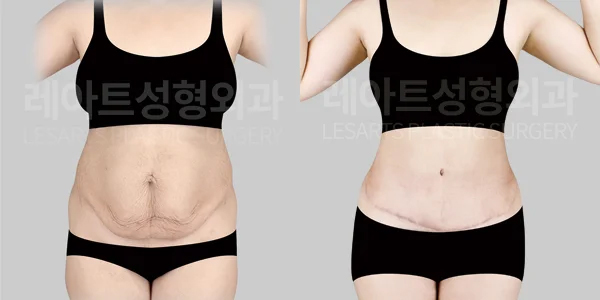
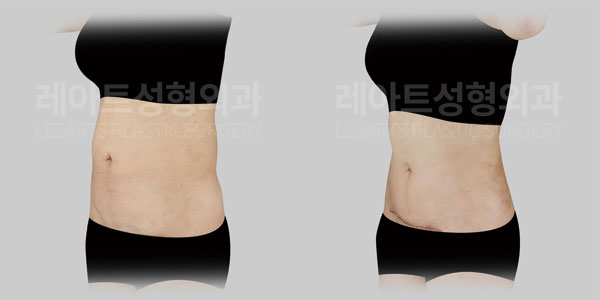
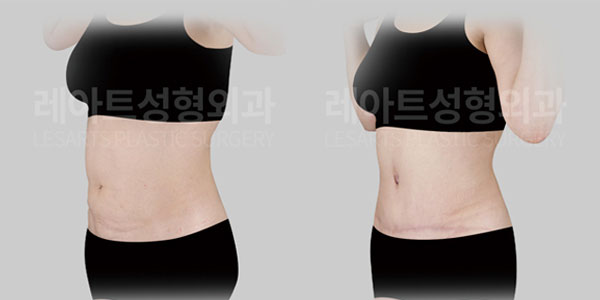
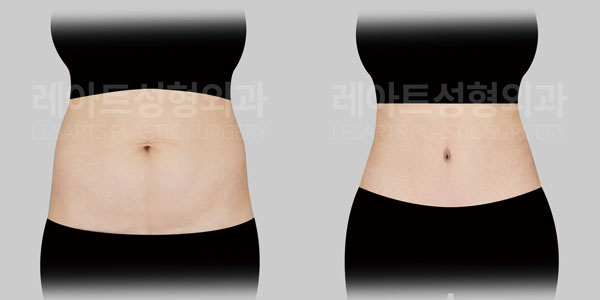
These photographs compare
the patient’s appearance
before abdominoplasty surgery
and 3 months after the procedure.
Before surgery,
skin laxity and fine wrinkling
were evident from the periumbilical area
to the lower abdomen.
Excess skin had descended
and accumulated in the lower abdomen,
preventing the abdominal contour
from appearing smooth and well-defined.
In particular,
the lower abdomen projected forward
with an irregular and uneven appearance,
while laxity around the navel
and widening of the central abdominal line
created a weakened and unsupported contour.
In contrast,
the post-operative photographs demonstrate
that the excess skin previously sagging
and folding over the lower abdomen
has been effectively removed,
resulting in a smooth and continuous transition
from the upper abdomen
to the lower abdomen.
In addition,
repair of the abdominal wall
has restored support to the midline,
transforming the previously weakened
anterior abdominal contour
into a firmer and more defined shape.
The accompanying umbilicoplasty
also created a newly positioned navel
that is proportionate to the waistline,
providing a more balanced
and aesthetically pleasing appearance.
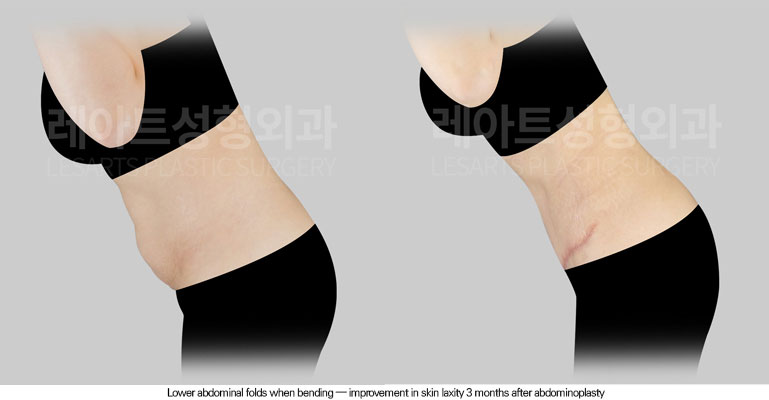
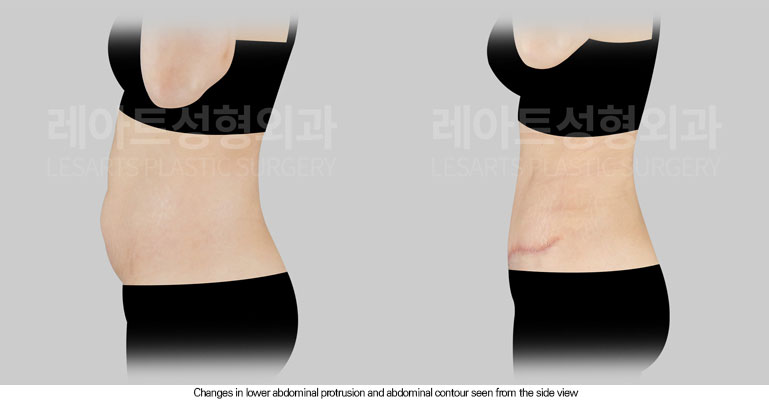
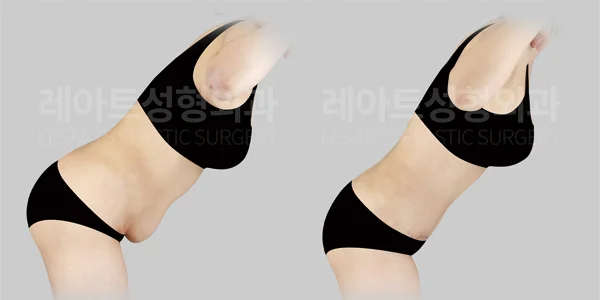
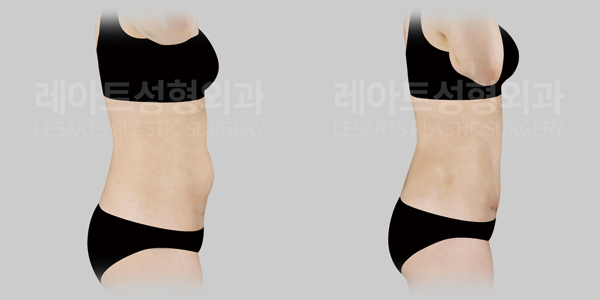
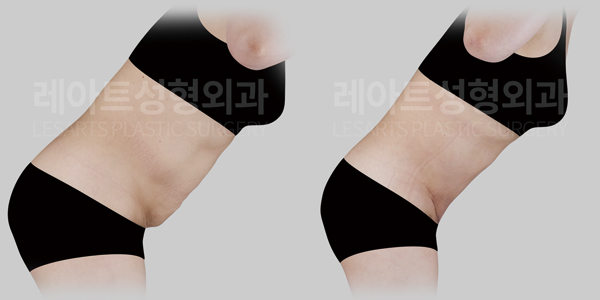
From the side profile,
the improvement in the previously protruding abdomen
and the excess lower abdominal skin
that folded noticeably when bending forward
can be appreciated more clearly.
Following pregnancy and childbirth,
the patient developed skin laxity and wrinkling
extending from the periumbilical area
down to the Cesarean section scar,
while the loss of skin elasticity,
rectus muscle separation,
and fascial laxity failed to recover adequately.
As a result,
the patient was left with
an overall abdominal contour
that appeared irregular and lacked definition,
which had become a major source of concern
in daily life.
Through abdominoplasty
combined with rectus muscle repair,
these issues were effectively corrected,
restoring a firmer and more stable abdominal contour.
Most importantly,
the forward protrusion of the abdomen
and the skin folding that occurred
during movement and bending
were significantly improved.
The patient shared that
these changes substantially reduced
the stress and discomfort
previously experienced in everyday activities,
allowing her to feel more comfortable
and confident with both movement
and clothing choices.
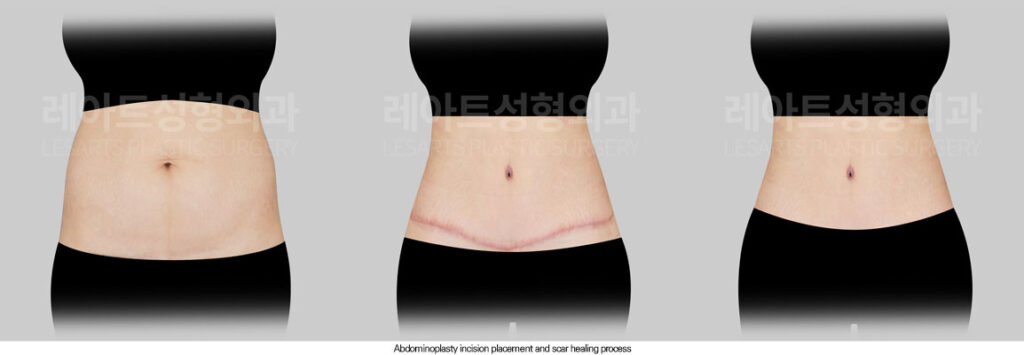
During the pre-operative consultation for abdominoplasty,
the patient had been informed that
the possibility of completely removing
the existing Cesarean section scar
would depend on the amount of skin
that could be safely advanced
during surgery.
Fortunately,
the previous C-section scar
was successfully excised,
leaving only a single
abdominoplasty incision scar.
The incision was also positioned
as low as possible along
the lower abdomen,
allowing it to be naturally concealed
within the underwear line.
At 3 months post-operatively,
the scar was healing
along a normal and favorable course,
without any notable concerns.
It was explained that
the current redness of the scar
would gradually continue to fade,
and that consistent laser scar treatments
combined with diligent home care,
including moisturization,
silicone scar sheets,
and topical scar ointments,
would further optimize the final result
and contribute to a more refined scar appearance over time.
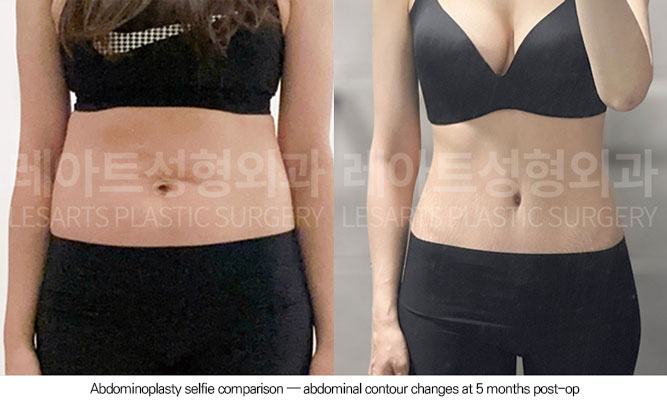
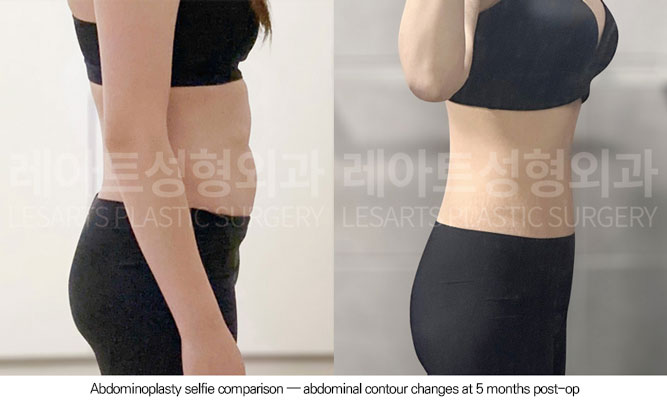
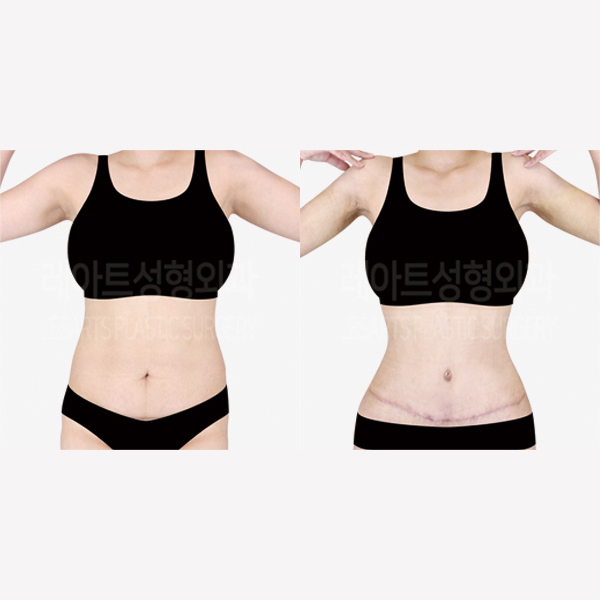
The selfies provided by the patient,
taken before surgery and again
at 5 months after abdominoplasty,
demonstrate just how significantly
the discomfort experienced in daily life
has been alleviated.
The previously irregular anterior abdominal contour,
wrinkling around the navel,
and even the functional weakness of the abdomen
caused by rectus diastasis
have all been improved simultaneously.
Many women who have undergone
pregnancy and childbirth,
like this patient,
struggle with concerns related to
abdominal skin laxity
and changes in abdominal shape
that become more pronounced
when bending forward or during movement.
Unfortunately,
these concerns often represent
an area in which dieting,
skin-tightening treatments,
or even liposuction alone
have clear limitations.
For this reason,
a thorough consultation with an experienced surgeon
to accurately evaluate
the current condition of the abdomen,
discuss available treatment options,
and understand the expected recovery process
is extremely important.
By making an informed decision
based on a comprehensive assessment,
patients may not only achieve
the abdominal contour
they have struggled with for years,
but also regain the confidence
to wear clothing comfortably
and enjoy daily life with greater satisfaction.
#Abdominoplasty
#TummyTuck
#AbdominoplastyBeforeAfter
#MTypeAbdominoplasty
#RectusDiastasisRepair
#Umbilicoplasty
#PostpartumBodyContouring
#CSectionScarRevision
#AbdominalWallRepair
#BodyContouring
#LesartsPlasticSurgery
#BestAbdominoplastyClinicInKorea