[Gynecomastia] Benefits and considerations of areolar incision in gynecomastia surgery
Hello, this is Dr. Kukhan Lee,
a board-certified plastic surgeon.
When planning
gynecomastia surgery,
many patients have questions.
One of the most common
concerns is
the incision location.
Gynecomastia is not simply
fat accumulation,
but often involves
true gynecomastia,
accompanied by
glandular tissue proliferation.
Because of this,
liposuction alone
is often insufficient.
In most cases,
glandular tissue removal
must be performed together.
Incision sites for gynecomastia surgery – Dr. Kukhan Lee, Lesarts Plastic Surgery
In this process,
in addition to small incisions
for liposuction,
an additional incision
is required
for glandular removal.
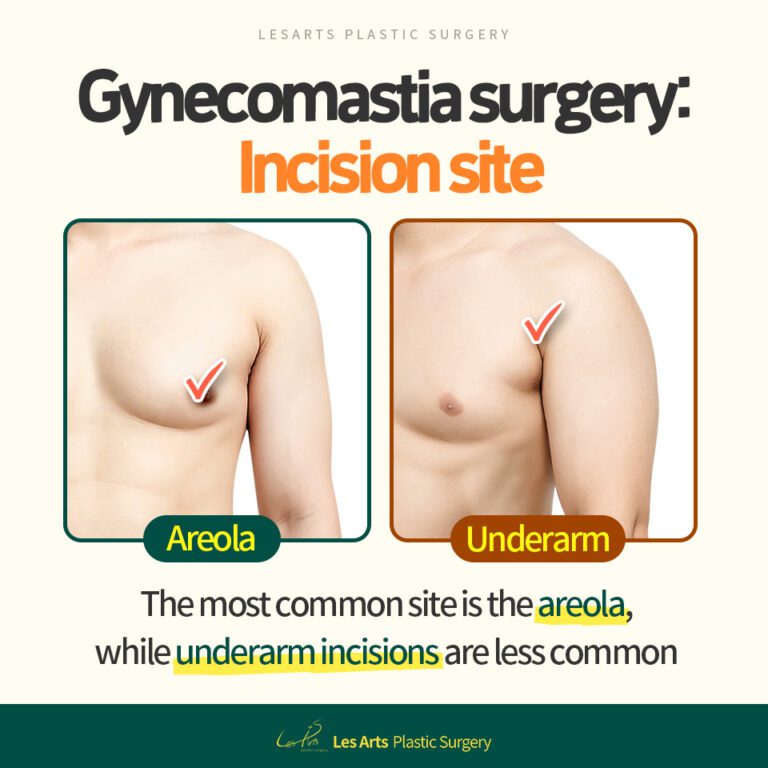
In gynecomastia surgery,
the most commonly used
approach is
the periareolar incision,
made around
the areola.
In some cases,
an axillary incision
may also be selected.
Advantages of periareolar incision in gynecomastia surgery – Lesarts Plastic Surgery
[Advantage ①]
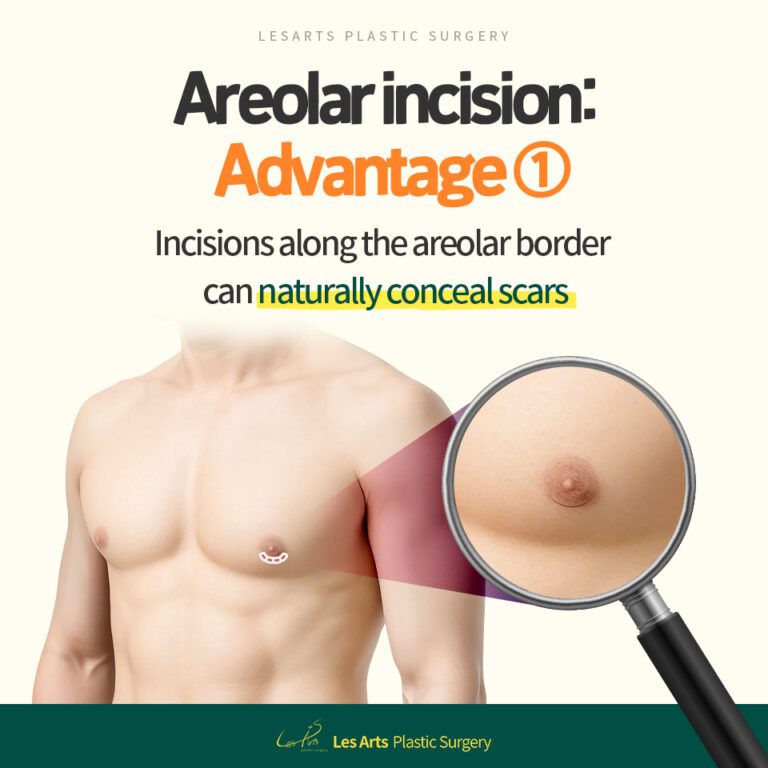
The greatest advantage
of a periareolar incision
is scar concealment.
It allows the scar
to be hidden
more naturally.
One of the key factors
when determining incision sites
is scar visibility.
The goal is
to minimize how noticeable
the scar appears.
The areola has
a distinct boundary
in both color and texture.
By placing the incision
along this natural border,
the scar blends in.
This creates
a more discreet
and natural result.
In the early stage,
the incision may appear red,
or mild pigmentation may occur.
However, due to
the color and texture
of the areola,
the scar tends
to be less noticeable
over time.
This is often referred to
as a camouflage effect
in plastic surgery.
Selection criteria for incision sites in gynecomastia surgery – Lesarts Plastic Surgery
[Advantage ②]
Another key advantage
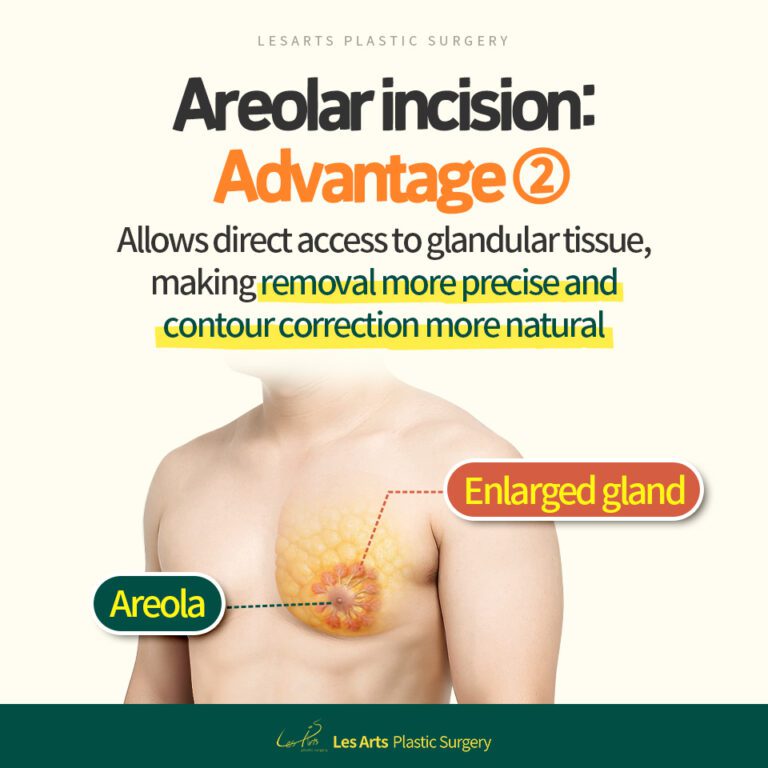
is direct access
to glandular tissue.
The main cause
of gynecomastia,
glandular overgrowth,
is often concentrated
beneath
the areola.
Using a periareolar incision,
the surgeon can
directly access this area.
This allows
more precise removal
of excessive glandular tissue.
It also helps
achieve a more natural
chest contour.
For these reasons,
the periareolar approach
remains widely used
as the most common
surgical technique
for gynecomastia worldwide.
Precautions for gynecomastia surgery – Lesarts Plastic Surgery
[Considerations for periareolar incision]
Although the periareolar approach
has many advantages,
incision length is critical.
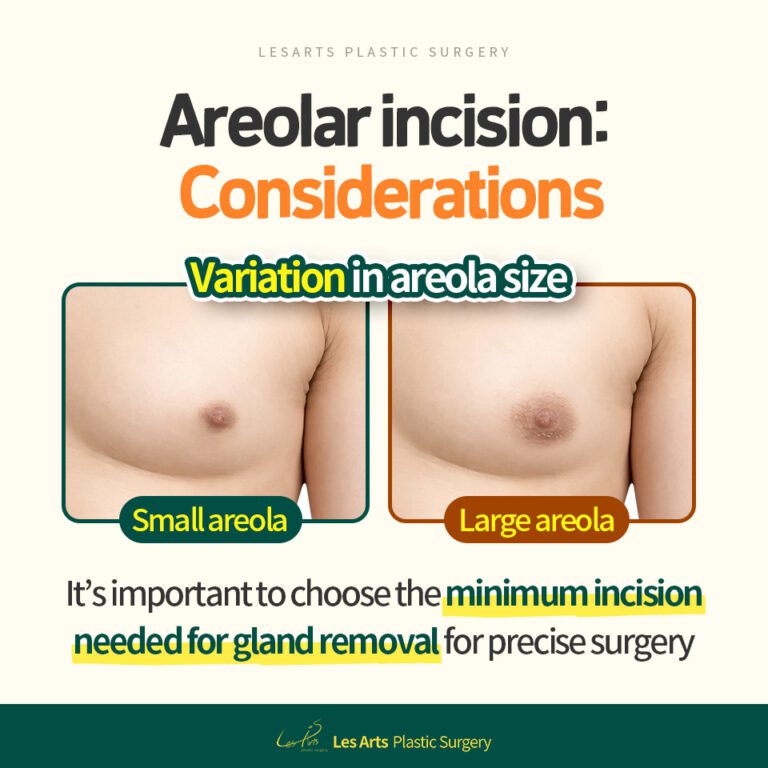
The size of the areola
varies between individuals,
so careful planning is required.
If the incision
is too long
in a small areola,
the scar may become
more noticeable
than expected.
In the past,
larger incisions
covering nearly half
of the areola
were sometimes used,
but this approach had limitations.
It increased the risk
of visible scarring
and areolar distortion.
Recently, the trend
is to minimize
the incision length.
Only the necessary extent
for glandular removal
is selected.
Quick check,
possible complications
of periareolar incision.
Since it is still
a surgical procedure,
some risks exist.
Common concerns include
visible scarring
and color mismatch
along the areolar
border or edge.
However, these risks
can be reduced
with proper planning.
By selecting
appropriate incision length
and positioning,
and balancing
glandular removal
with liposuction,
most complications
can be significantly
minimized.
Additionally,
postoperative scar treatment
can further improve results.
Incision location for gynecomastia surgery – Dr. Kukhan Lee, Lesarts Plastic Surgery
The incision approach
in female breast surgery
differs from that in men.
This is because
the surgical goals
and anatomical structures differ.
Therefore,
the same incision method
cannot be applied.
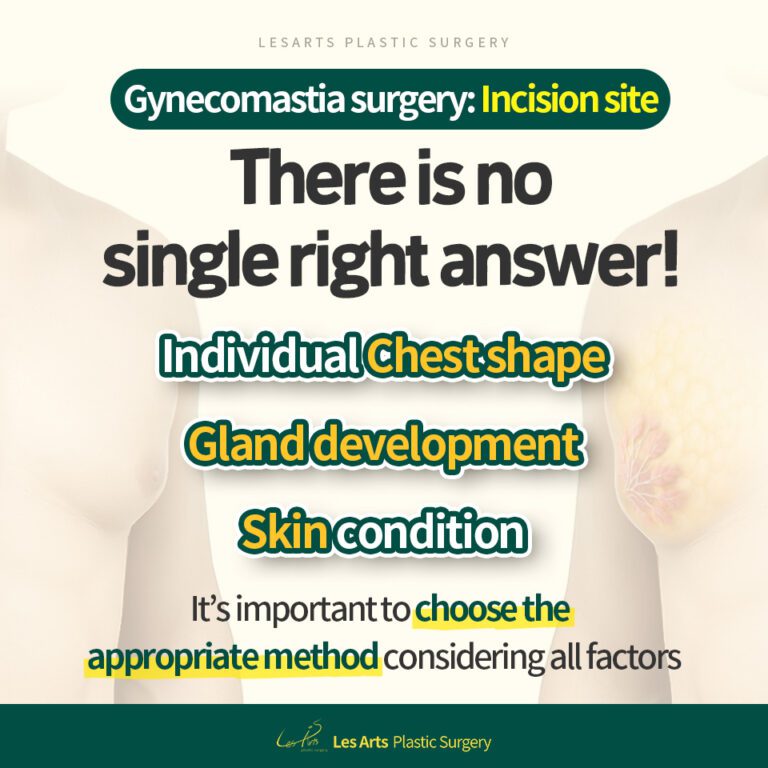
Rather than determining
a universally better method,
individual factors matter.
These include
chest shape,
glandular development,
and overall
skin condition.
A comprehensive evaluation
is essential
for proper selection.
If you need
more detailed information
about surgical methods
or scar outcomes,
consultation can provide
real case references.