
Tummy tuck in Seoul for a woman in her 60s: C-section scar and lower abdominal sagging at 3.5 months
Patient Registration Info
| Age | Weight | Height | BMI |
|---|---|---|---|
|
60s |
56kg |
154m |
24 |
Surgical site
Surgical site : Abdomen, M-Type, Rectus Muscle Repair, Umbilicoplasty|liposuction volume : 2,300 cc
Can Patients in Their 60s Undergo Abdominoplasty?
Age alone does not determine
whether abdominoplasty can be performed.
It is important to carefully evaluate not only
the abdominal skin and abdominal wall,
but also the patient’s current health condition
and any medications they are taking before planning
an appropriate surgical approach.
Changes in body shape after childbirth may remain
for many years while patients focus on childcare
and their daily responsibilities.
Especially in their 50s and 60s, as their children grow older
and they have more time for themselves, many women begin
to reconsider concerns about their bodies
that they had previously put aside.
Some patients visit the clinic later in life
to address loose abdominal skin after childbirth
or skin folds around a previous C-section scar.
The appropriate Abdominoplasty technique depends
on the location and extent of the skin laxity.
Because abdominoplasty can involve a relatively long surgery,
it is important to assess more than just
the visible condition of the abdomen.
The patient’s overall health and preoperative condition
should also be carefully evaluated.
The patient discussed in this case is a woman in her 60s
who visited our clinic to improve widespread abdominal skin laxity
and a vertical scar remaining after two C-section deliveries.

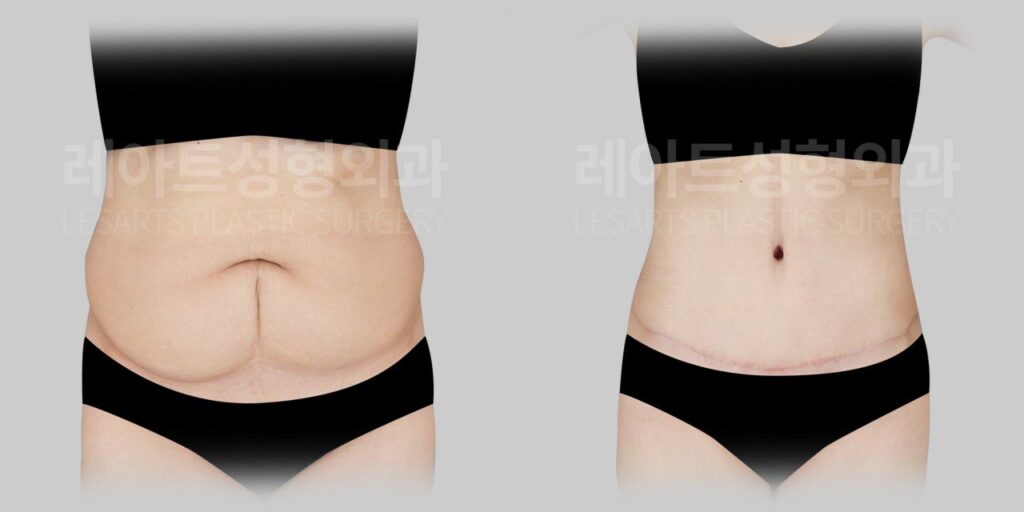
[Abdominal Skin Laxity and C-Section Scar Before Abdominoplasty]
Before surgery, the patient showed decreased skin elasticity
throughout the abdomen, starting from the upper abdomen.
The stretched skin sagged toward the lower abdomen,
creating deep folds that remained clearly visible
even when standing upright.
The rectus muscles and fascia had also become stretched
from the upper abdomen downward, making the entire
front abdomen appear heavy and protruding.
As the surrounding skin sagged downward, the navel appeared
horizontally stretched and deeply recessed.
A vertical scar from a previous C-section was also visible
along the center of the abdomen.
When the patient bent forward, the loose skin shifted further downward,
creating multiple prominent folds across the abdomen.
Abdominal skin laxity is different from a condition
caused simply by excess fat accumulation.
Once the skin has lost elasticity and become significantly stretched,
weight loss or fat removal alone may not allow it
to tighten sufficiently.
[Surgical Plan Based on Thigh and Pelvic Proportions]
To create the lower body contour the patient wanted,
we recommended combining Thigh Liposuction, love handle liposuction,
and hip dip fat grafting.
For the thighs, the plan focused on reducing overall thickness
by targeting the inner thighs and saddlebags.
The love handle area was also treated to create a smoother transition
from the waist to the pelvis.
Healthy fat collected during liposuction was then purified
and grafted into the hollow hip dip areas
to enhance the outer pelvic contour.

[Preoperative Surgical Plan Considering Abdominal Skin Laxity and C-Section Scar]
After evaluating the patient’s overall abdominal condition,
it was determined that the skin laxity extending from the upper abdomen
needed to be addressed rather than treating only the lower abdomen.
Therefore, an M-type full Abdominoplasty was planned
to sufficiently tighten and remove the stretched skin,
while also repairing the weakened rectus muscles
and abdominal wall.
The navel had become horizontally stretched
due to the surrounding skin laxity, so umbilicoplasty was planned
to create a new navel that better matched
the changed abdominal proportions.
Remaining abdominal fat was also addressed
to improve not only skin laxity, but also the thickness
of the front abdomen and the waistline.
The vertical C-section scar in the center of the abdomen
would be removed together with the excess skin
during the abdominoplasty.
However, the patient was also informed before surgery
that a new horizontal abdominoplasty incision
would remain in a relatively low position
on the lower abdomen.
Abdominoplasty is not simply a procedure
that removes loose, sagging skin.
It is important to evaluate the extent of skin laxity,
abdominal wall weakness, fat distribution, and navel position
together when reshaping the overall abdominal contour.
[3.5 Months After Abdominoplasty: Changes in Abdominal Skin Laxity and Vertical Scar]
Let’s compare the changes seen
3.5 months after Abdominoplasty.
Before surgery, the loose skin below the navel
folded over the lower abdomen, creating a deep crease
and an uneven abdominal contour.
After surgery, the excess lower abdominal skin
was removed, eliminating the overlapping fold.
The skin that previously hung over the underwear line
was also addressed, leaving the front abdomen
flatter and lighter in appearance.
The original horizontally stretched navel
was recreated to better match the new waistline,
and the long vertical C-section scar in the center
of the abdomen was also removed together
with the excess sagging skin.

[3.5 Months After Abdominoplasty: Changes in Abdominal Projection and Lower Abdominal Contour from an Oblique View]
In this case, abdominal liposuction was performed
together with Abdominoplasty.
Tightening the skin alone could leave some thickness
in the abdomen and flanks, so liposuction was also performed
in selected areas based on the patient’s fat distribution.
After surgery, the abdominal thickness decreased,
allowing the waistline to appear more naturally defined.
The contour from the upper to the lower abdomen
also became lighter and smoother, while reduced flank volume
helped create a more balanced overall silhouette.

[3.5 Months After Abdominoplasty: Changes in Lower Abdominal Projection and Abdominal Thickness from the Side]
Before surgery, the side view showed that loose skin
and abdominal wall laxity caused the lower abdomen
to protrude forward and appear heavy.
After repairing the rectus muscles and abdominal wall
and removing the excess skin, the lower abdominal projection
was reduced, creating a flatter abdominal contour.
The line from the upper abdomen through the navel
to the lower abdomen also appears smoother
and firmer than before.

[3.5 Months After Abdominoplasty: Changes in Lower Abdominal Skin Folds When Bending Forward]
Before surgery, bending forward caused the stretched skin
to shift downward and form multiple folds
across the lower abdomen.
After surgery, the loose skin was removed
and the abdominal wall was also tightened,
noticeably reducing the folds that appeared with movement.
As the abdominal skin now sits closer to the body,
the lower abdominal contour remains smoother
even when bending forward.

[3.5 Months After Abdominoplasty: Incision Within the Underwear Line and Lower Abdominal Changes]
The vertical C-section scar that remained
in the center of the lower abdomen was removed
together with the excess sagging skin.
Instead, a horizontal Abdominoplasty incision
now remains in a low position across the lower abdomen.
The incision is currently positioned
so that it can be naturally concealed by underwear.
At 3.5 months after surgery,
scar laser treatment has also begun.
Since the scar color and firmness have not yet fully stabilized,
regular follow-up and continued scar care based on
the healing process remain important.

[Selfie Comparison Before And 2 Weeks After Abdominoplasty in a Patient in Her 60s]

[Selfie Comparison Before and 3 Months After Abdominoplasty in a Patient in Her 60s]

[Selfie Comparison Before, 2 Weeks, and 3 Months After Abdominoplasty in a Patient in Her 60s]
Changes in the abdominal contour can also be seen
in the selfies taken by the patient
at 2 weeks and 3 months after surgery.
As the heavy, sagging skin was removed,
lower abdominal projection and skin folds decreased,
giving the entire abdomen a lighter appearance.
The lower abdomen also became less prominent under clothing,
allowing the patient to wear a wider variety
of clothes more comfortably than before.
The patient was particularly satisfied that her abdomen
appeared less prominent and that a long-standing
concern about her body shape had improved.
Even many years after childbirth, some patients may still experience
discomfort from lower abdominal skin laxity
or folds around a previous C-section scar.
However, Abdominoplasty in patients in their 60s
should not be decided based solely
on the desired cosmetic changes.
Before surgery, the patient’s current health condition,
medications, and overall physical condition
should be carefully evaluated.
Regular follow-up and appropriate postoperative care
are also important throughout the recovery process.
Planning the appropriate surgical extent for each patient
and following the medical team’s postoperative instructions
can help support a stable recovery and outcome.
#Abdominoplasty
#AbdominoplastyIn60s
#CSectionScar
#AbdominalSkinLaxity
#AbdominalLiposuction
#TummyTuckResults
#LesartsPlasticSurgery
60s Abdominoplasty FAQ
Q1. Can patients in their 60s undergo abdominoplasty?
Age alone does not determine whether Abdominoplasty can be performed.
The patient’s current health condition, medications,
and preoperative test results should be evaluated
to determine whether surgery is appropriate
and what surgical extent is suitable.
Q2. Can a vertical C-section scar be removed during abdominoplasty?
If the existing scar is located within the area of skin
that will be removed, it may be removed
together with the excess sagging skin.
Whether this is possible depends on the location of the scar
and the extent of abdominal skin laxity.
Q3. Where is the scar located after abdominoplasty?
A horizontal incision generally remains
across the lower abdomen.
The exact position and length may vary depending on
the amount of skin that needs to be removed
and the patient’s existing abdominal shape.
Q4. Can abdominoplasty and liposuction be performed together?
Depending on the amount of abdominal fat
and the condition of the skin, liposuction may be performed
together with Abdominoplasty.
The combination may be considered when both skin laxity
and abdominal thickness need to be addressed.
Q5. Are the results final 3 months after surgery?
At 3 months, most of the major swelling has decreased,
making changes in the abdominal contour easier to see.
However, the scar and internal tissues are still healing,
and the scar color and firmness may continue
to gradually improve over time.
▼ Visit Lesarts Plastic Surgery in Gangnam, Seoul, Korea ▼