
Thigh liposuction in Korea: can inner thigh and saddlebag liposuction with hip dip fat transfer improve lower body proportions?

Patient Registration Info
| Age | Weight | Height | BMI |
|---|---|---|---|
|
30s |
46kg |
155m |
19 |
Surgical site
Surgical site : Thighs, Hip Dips|liposuction volume : 3,100 cc|Fat Grafting: Hip Dips (Right: 220 cc / Left: 220 cc)
Can Thinner Thighs Alone Create the Lower Body Proportions You Want?
Reducing fat from the inner thighs and saddlebags
can make the legs look slimmer and less heavy.
However, if the hip dip area is hollow, the transition
between the pelvis and thighs may still appear angular.
When needed, Thigh Liposuction and hip dip fat grafting
can be planned together to add volume where it is lacking
while reducing areas that protrude.
▶ Learn More About Lesarts Liposuction
▶ Learn More About Lesarts Fat Grafting
Recently, many patients considering Thigh Liposuction
focus not only on reducing thigh circumference,
but also on improving the overall proportions and contour
from the pelvis down to the legs.
This is because slimmer thighs alone may not always create
the lower body contour they are looking for.
In particular, when the outer thigh saddlebags are prominent
while the hip dip area curves inward, the pelvis may appear narrower
and the visual weight of the lower body may be concentrated in the thighs.
This body shape can make the thighs appear shorter and heavier,
regardless of the actual length of the legs.
In these cases, Thigh Liposuction can be used
to reduce the inner thigh and saddlebag areas,
while fat grafting can add volume to the hip dips
to improve the balance between the pelvis and thighs.
In this post, we will review the surgical plan and changes
of a patient who underwent Thigh Liposuction
for the inner thighs and saddlebags,
combined with hip dip fat grafting.
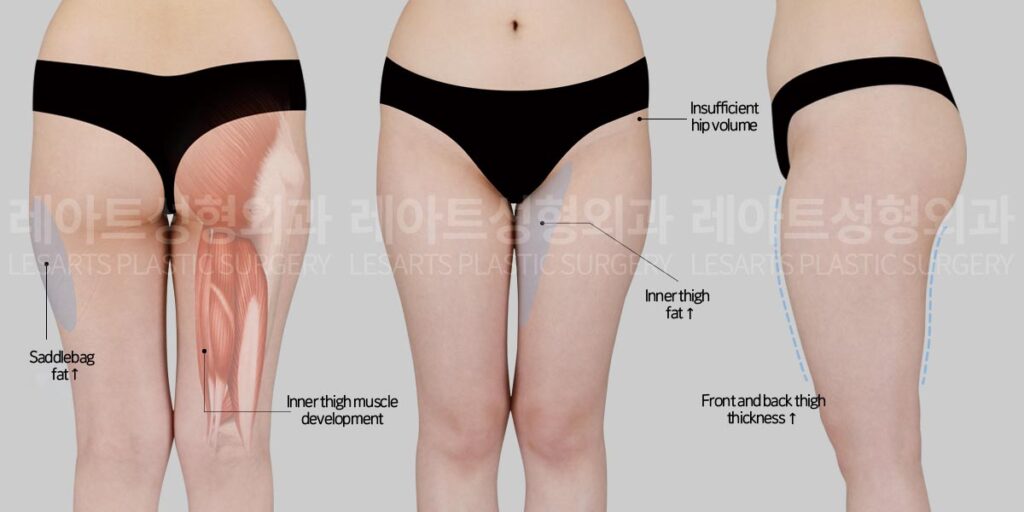
[Body Shape and Surgical Plan Before Thigh Liposuction and Hip Dip Fat Grafting]
[Patient Information]
Height: 155 cm
Weight: 46 kg
BMI: 19.2
The patient usually maintained a weight of around 43–44 kg
but visited us after recently gaining a small amount of weight.
Although her overall body weight was not high,
the inner thigh fat and outer thigh saddlebags remained
even with dieting, which continued to affect her lower body contour.
The patient wanted to create a more noticeable gap between the inner thighs
while adding volume to the hollow hip dip areas
for a rounder, smoother pelvic contour.
Before surgery, volume along the inner thighs caused
the legs to sit close together, while the prominent saddlebags
made the lower body appear wider.
In contrast, the hip dip areas curved inward,
creating an uneven transition from the pelvis to the thighs.
In this body type, reducing only the outer thigh volume
could make the hip dips appear even more noticeable.
Therefore, the surgical plan needed to address both
the prominent areas and the areas lacking volume.
Results from patients with different body types
can also be found on the page below.
[Surgical Plan Based on Thigh and Pelvic Proportions]
To create the lower body contour the patient wanted,
we recommended combining Thigh Liposuction, love handle liposuction,
and hip dip fat grafting.
For the thighs, the plan focused on reducing overall thickness
by targeting the inner thighs and saddlebags.
The love handle area was also treated to create a smoother transition
from the waist to the pelvis.
Healthy fat collected during liposuction was then purified
and grafted into the hollow hip dip areas
to enhance the outer pelvic contour.
[Why Hip Line Liposuction Was Not Recommended]
The patient wanted to reduce the vertical length of the buttocks
to create a slightly shorter and rounder hip contour.
However, excessive liposuction of the lower buttock area
can weaken skin support and may make
buttock sagging more noticeable.
Considering the patient’s current fat volume and skin elasticity,
the risk of sagging or contour irregularities could outweigh
the potential benefits of liposuction in this area.
For this reason, hip line liposuction was not recommended.
Liposuction is not simply about removing as much fat as possible
from every area the patient wants to reduce.
It is important to determine which areas should be reduced
and where fat should be preserved, while considering
the overall contour and skin condition after surgery.
[Preoperative Discussion of Left-Right Body Asymmetry]
The patient had differences in the shape and development
of the thigh muscles on each side.
Even when similar amounts of fat are removed,
differences in the underlying bone structure and muscles
cannot be completely corrected through surgery.
We explained in advance that perfect symmetry
between the two sides may not be achievable after surgery.
The amount of fat removed from each area
and the volume grafted to each hip dip were adjusted
to create the most natural balance from different angles.
[Changes 2 Months After Thigh Liposuction and Hip Dip Fat Grafting]
Let’s compare the changes in the pelvis and thigh contours
using photos taken before surgery and about 2 months afterward.
At 2 months, most of the major swelling has subsided,
making it possible to see the early contour changes.
However, some residual swelling and firmness may still remain,
while the fat-grafted areas are still undergoing
engraftment and stabilization.
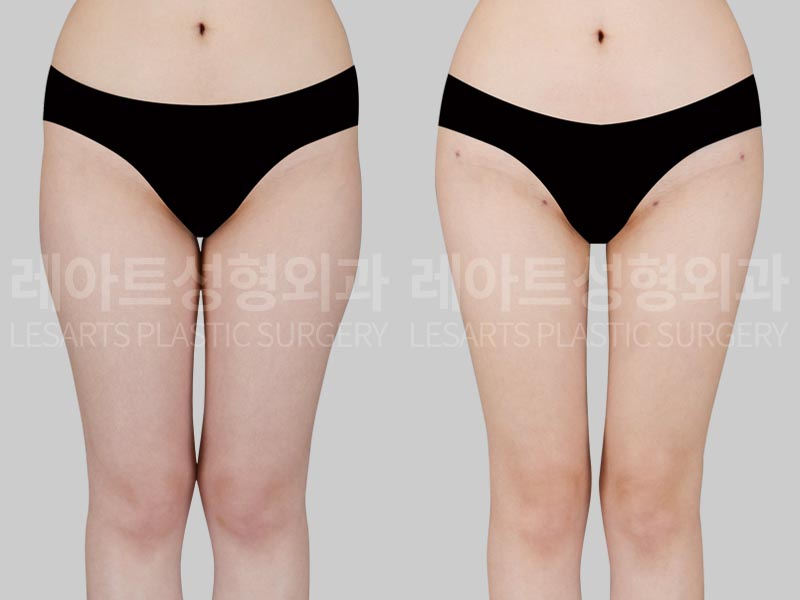
[Changes in the Pelvic and Thigh Contours 2 Months After Thigh Liposuction and Hip Dip Fat Grafting]
Before surgery, the inner thighs were close together,
while the prominent outer thigh saddlebags made the lower body
appear heavier around the thighs.
At 2 months after surgery, the inner thigh volume had decreased,
creating the natural thigh gap the patient wanted.
The inner leg line from the knees to the upper thighs
also appeared straighter, making the inner legs
look longer and more defined.
At the same time, the saddlebags were reduced
and volume was added to the hollow hip dip areas,
creating a smoother transition from the pelvis to the outer thighs.
Although the photos were taken in the same position and lighting,
the improved balance between the waist, pelvis, and thighs
made the legs appear longer and lighter overall.
[Changes in the Saddlebags and Lower Buttock Line 2 Months After Thigh Liposuction and Hip Dip Fat Grafting]
Before surgery, the hip dip areas were hollow
and the saddlebags projected outward, making the buttocks
appear wider and more angular from the back.
After surgery, the saddlebag volume was reduced
and the hip dips were filled, creating a rounder
and smoother outer buttock contour.
Although no procedure was performed to physically lift the buttocks,
correcting both the hollow areas beside the pelvis
and the outer thigh prominence made the buttocks
appear slightly higher and rounder.
Before surgery, the legs appeared to begin
from the lower edge of the buttocks.
After surgery, the transition from the pelvis to the thighs
became more defined, making the legs appear
to start higher than before.
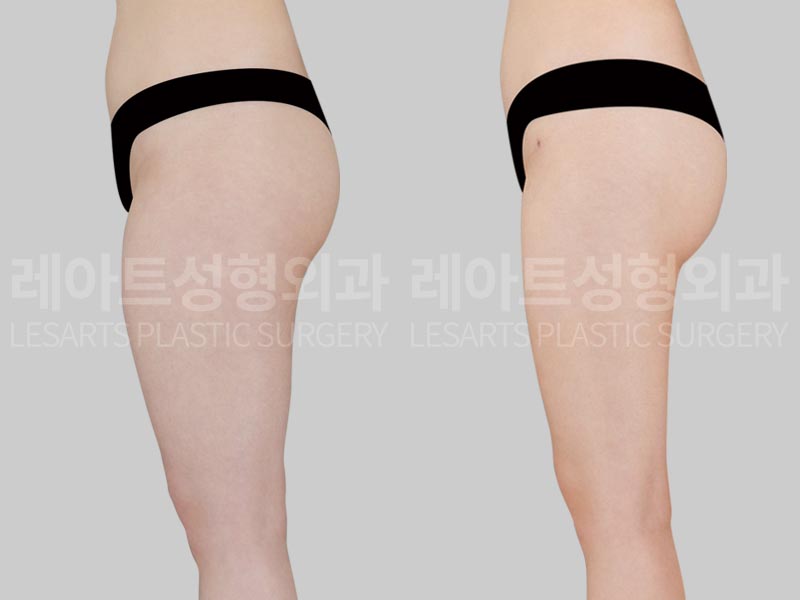
[Changes in Thigh Thickness and Pelvic Contour from the Side 2 Months After Thigh Liposuction and Hip Dip Fat Grafting]
From the side, the reduced front-to-back thigh thickness
makes the lower body appear lighter overall.
The previously rounded prominence of the front thighs has decreased,
creating a straighter line from the pelvis toward the knees.
For the back of the thighs, a necessary layer of fat was preserved
to avoid excessive removal that could make the muscle contours more visible.
This helped maintain a relatively smooth transition
from the lower buttocks to the thighs.
With added volume to the hip dip areas,
the pelvic contour also appears smoother
and more naturally connected from the side.
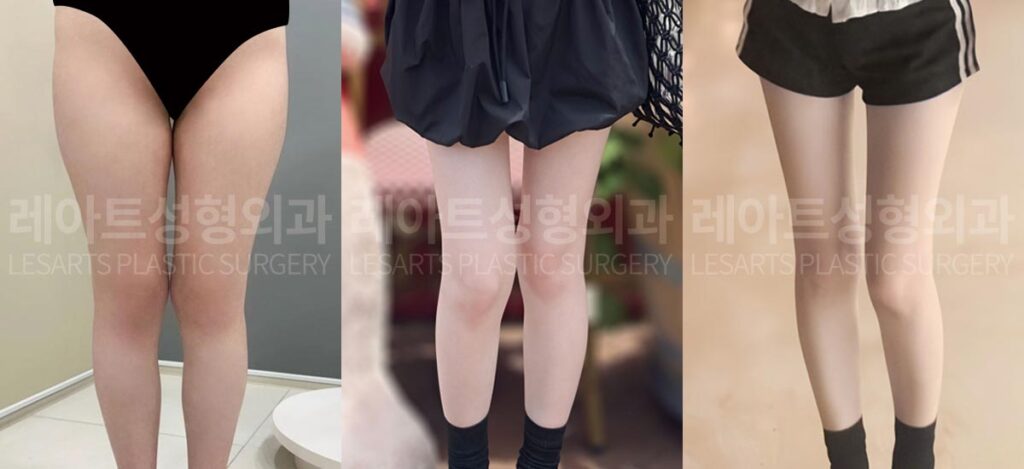
[Selfie Comparison Before Surgery and at 3 and 6 Months After Thigh Liposuction and Hip Dip Fat Grafting]
The patient’s own photos taken before surgery
and at 3 and 6 months afterward also show changes
in the inner thighs and pelvic contour.
Before surgery, the inner thigh volume caused the legs
to sit close together, but as recovery progressed,
a natural thigh gap was maintained.
The hollow areas along the outer pelvis were also smoothly filled,
creating a more seamless line from the waist
through the hip dips to the outer thighs.
The patient was most satisfied not simply with the reduction
in thigh circumference, but with the improved balance
between the pelvis and legs, which made the legs
appear longer and straighter overall.
[Is More Fat Always Better for Hip Dip Fat Grafting?]
Hip dip fat grafting is not a procedure
designed simply to make the pelvis wider.
If too much fat is grafted without considering
the patient’s bone structure, waist width, buttock size,
and the position of the saddlebags, the hip area may protrude excessively
or make the lower body appear wider and heavier.
Not all of the grafted fat will remain permanently.
During recovery, some of the fat may be absorbed,
while the remaining fat gradually stabilizes.
Rather than concentrating an excessive amount in one area,
it is important to assess the location and extent of the hip dips
and distribute an appropriate volume to create
a natural transition with the surrounding tissues.
The degree of fat survival may vary depending on
the condition of the grafted fat, blood circulation, individual recovery,
postoperative compression, and changes in body weight.
[Why Thigh Liposuction and Hip Dip Fat Grafting Are Performed Together]
Reducing areas where fat tends to accumulate,
such as the inner thighs and saddlebags, while adding volume
to areas that lack fullness, such as the hip dips,
can help improve overall lower body proportions.
Combining the two procedures may be considered
for body types with the following features:
– Inner thigh fat that causes the legs to touch extensively
– Prominent saddlebags that make the legs appear shorter
– Noticeable hollowness in the hip dip areas
– Thighs that appear wider than the pelvis
– An angular transition from the waist to the pelvis and thighs
However, hip dip fat grafting is not necessary
for every patient undergoing Thigh Liposuction.
If the pelvis already has sufficient volume,
or if reducing the saddlebags alone creates a natural contour,
additional fat grafting may not be necessary.
The surgical plan should be determined by identifying
which areas lack volume and which areas protrude,
while considering the overall proportions
that will be created after surgery.
Lower Body Contouring Requires Considering Both What to Reduce and What to Preserve
When localized fat and insufficient hip dip volume
affect overall lower body proportions, patients may find themselves
constantly choosing clothes that hide those areas.
In these cases, simply losing more weight
or removing as much thigh fat as possible
may not create the desired result.
It is important to assess where fat is distributed,
how the width of the pelvis transitions into the thighs,
as well as skin elasticity and muscle structure.
Reducing excess volume with liposuction while adding fat
to areas that lack fullness can help improve not only thigh circumference,
but also the overall proportions from the pelvis to the legs.
However, natural skeletal and muscular asymmetry may remain after surgery,
and the amount of fat that survives in the hip dip area
can vary from person to person.
For this reason, the surgical plan should distinguish
which areas need to be reduced and where fat should be preserved,
based on the patient’s current body shape and desired lower body contour.
#BestThighLiposuction
#ThighLiposuction
#ThighLiposuctionKorea
#ThighLiposuctionSeoul
#ThighLiposuctionGangnam
#SaddlebagLiposuction
#LesartsPlasticSurgery
Thigh Liposuction & Hip Dip Fat Grafting FAQ
Q1. Can thigh liposuction alone improve hip dips?
Reducing the saddlebags may make the hip dips
appear less noticeable by comparison.
However, if there is insufficient volume in the hip dip area,
liposuction alone cannot directly fill the hollow area,
so fat grafting may also be considered.
Q2. Will hip dip fat grafting make the pelvis much wider?
This depends on the amount and area of fat grafting.
Rather than excessively widening the pelvis,
the goal is to create a natural transition between
the hollow areas and the surrounding contours.
The grafting volume is adjusted
according to the patient’s body shape.
Q3. Does all of the fat grafted to the hip dips survive?
Some of the grafted fat is absorbed during recovery,
while fat that establishes a stable blood supply remains.
The exact fat survival rate varies depending on
the individual, surgical technique, and recovery process.
Q4. Can thigh liposuction create a noticeable inner thigh gap?
The degree of change depends on the amount of inner thigh fat,
as well as the patient’s muscle and skeletal structure.
If sufficient fat is present, reducing the inner thigh volume
can create more space between the thighs.
However, if muscle and bone structure are major factors,
creating a wide thigh gap may be difficult.
Q5. Are the results final 2 months after surgery?
At 2 months, most of the major swelling has subsided,
making the contour changes easier to see.
However, residual swelling and firmness may remain in the thighs,
and the grafted fat is still stabilizing.
Changes can continue for several months,
so regular follow-up is recommended.
▼ Visit Lesarts Plastic Surgery in Gangnam, Seoul, Korea ▼