Mini abdominoplasty in Seoul: improving lower abdominal skin folds and wrinkles after childbirth, weight loss, and liposuction

Patient Registration Info
| Age | Weight | Height | BMI |
|---|---|---|---|
|
30s |
61kg |
164cm |
23 |
Surgical site
Surgical site : Abdomen, S-type, rectus plication| liposuction aspirate volume : –
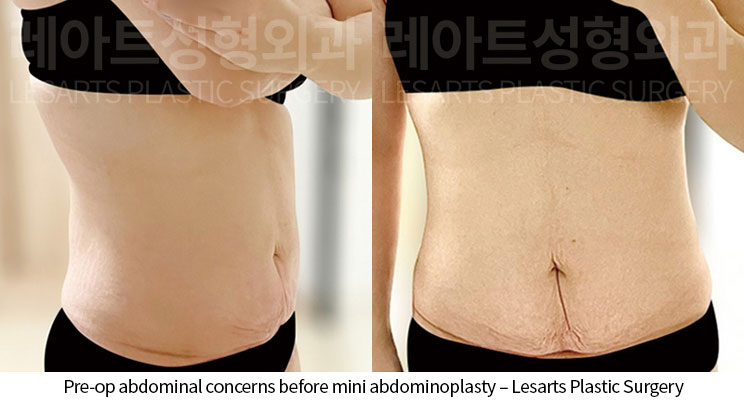
The patient presented in this case
had undergone numerous efforts over the years
to improve her abdominal contour, including
a previous Cesarean section, significant
weight fluctuations, prolonged dieting,
and even liposuction.
Despite these efforts,
the lower abdominal skin laxity,
deep wrinkling, and the contour irregularity
centered around the Cesarean section scar
remained essentially unchanged.
In addition,
rectus diastasis had weakened the abdominal wall,
allowing the abdomen to protrude forward
and creating a heavier, less defined
abdominal appearance.
Although the patient did not have
a significant amount of abdominal fat,
she was particularly concerned that
the lower abdominal skin folded
whenever she sat down or bent forward,
creating a deep vertical crease below the umbilicus
and making the lower abdomen appear
more irregular and aged.
The patient’s primary goal was to achieve
a smoother and more continuous
lower abdominal contour through
Mini Abdominoplasty, while also improving
the sagging skin and prominent skin folds
of the lower abdomen in a natural,
well-balanced manner.

During the preoperative consultation,
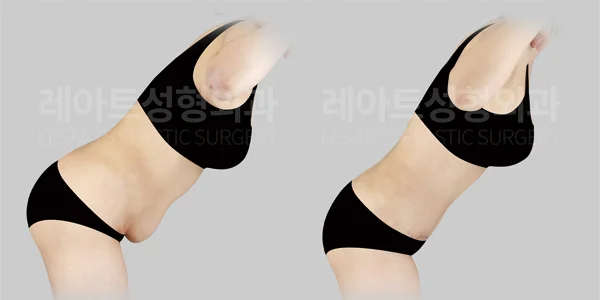
the patient demonstrated a long vertical crease
extending below the umbilicus.
The lower abdominal skin had descended
downward, creating a pronounced step-off deformity
centered around the previous Cesarean section scar,
while skin folding became increasingly
prominent with movement and changes in posture.
Most importantly,
the patient exhibited severe rectus diastasis
within the lower abdomen.
Because the abdominal wall was no longer
adequately supported, the weakened abdominal contents
protruded forward, causing the abdomen to appear
widened and separated when viewed from the front.
Although the patient had maintained
consistent weight control and had previously
undergone liposuction, leaving relatively
little residual abdominal fat,
the abdomen continued to appear heavy
because the underlying problem was not
excess fat, but rather structural deterioration
involving skin laxity, loss of soft-tissue elasticity,
and abdominal wall weakness.
As a result, the lower abdomen exhibited
a loose, unsupported appearance, with
the sagging skin creating a persistent sense
of heaviness despite the patient’s
otherwise lean body contour.

The surgical plan consisted of an S-Type Mini Abdominoplasty,
focused on excising the sagging lower abdominal skin
located below the umbilicus while simultaneously
repairing the lower rectus diastasis.
From an anatomical standpoint,
the patient was considered a suitable candidate for
all three procedures: M-Type Full Abdominoplasty,
S-Type Floating Mini Abdominoplasty, and
S-Type Mini Abdominoplasty.
After a detailed discussion regarding
the advantages and limitations of each option,
the patient ultimately elected to undergo
an S-Type Mini Abdominoplasty.
However, it was also explained in advance that,
to adequately correct the severe contour step-off,
the final lower abdominal scar would need
to be extended beyond a standard mini incision.
In addition, the patient was informed that
because the procedure was intentionally limited
to the lower abdomen, wrinkling and skin laxity above the umbilicus
would not be fully corrected through
an S-Type Mini Abdominoplasty alone.
After fully understanding these limitations,
the patient chose to prioritize a shorter incision
while accepting a more limited correction
of the upper abdominal contour.


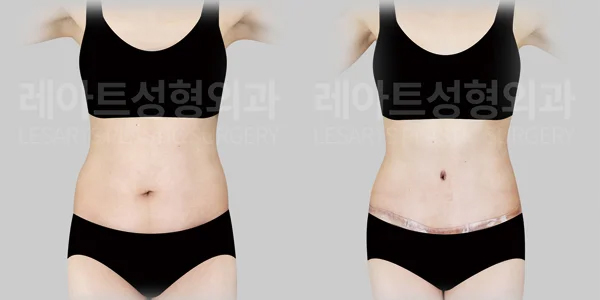
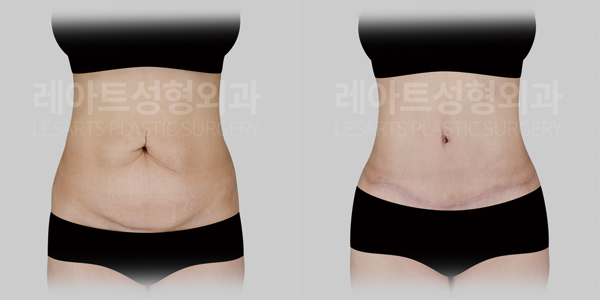
The following comparison demonstrates
the patient’s appearance before S-Type Mini Abdominoplasty
and 1 year and 3 months after surgery,
following consistent postoperative scar management.
Compared with the preoperative appearance,
the pronounced lower abdominal skin laxity,
step-off deformity, and deep vertical crease below the umbilicus
have been effectively corrected, creating
a much smoother and more harmonious
anterior abdominal contour.
Although the patient had
very little abdominal fat,
the abdomen had previously appeared
heavy and unsupported because of
skin redundancy and rectus diastasis,
which created a persistent sensation of
lower abdominal fullness despite
an otherwise slender body habitus.
Following Mini Abdominoplasty,
repair of the abdominal wall together with
excision of the redundant lower abdominal skin
resulted in a noticeably firmer, flatter, and more toned silhouette,
giving the patient a slimmer and more youthful appearance.
The patient also reported
a high level of satisfaction,
particularly because the deep vertical wrinkle
below the umbilicus and the folding of the lower abdominal skin—
which had been her greatest concerns—
had been naturally corrected through surgery.

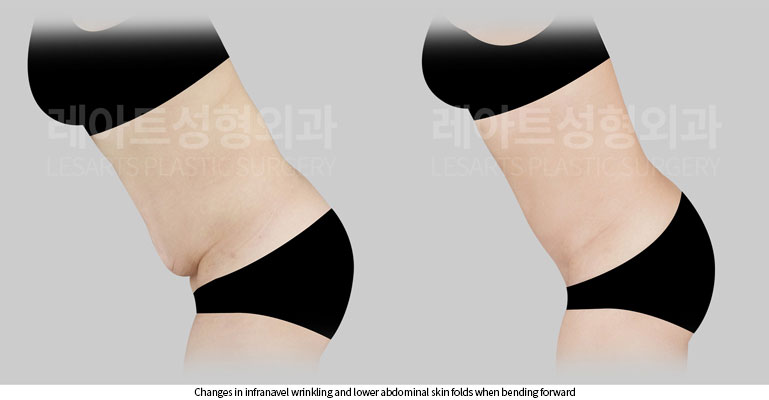
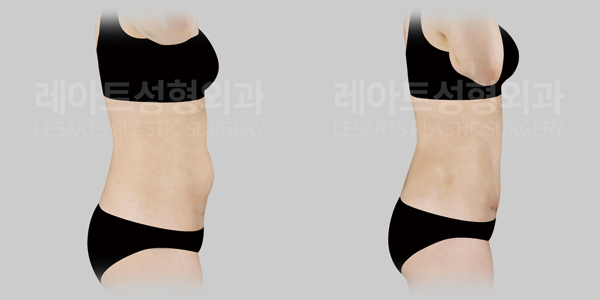
From the lateral view,
the previously protruding lower abdomen,
the pronounced contour step-off,
and the skin that had folded noticeably
with movement have all been
effectively corrected following surgery.
In addition,
rectus diastasis repair restored support to
the abdominal wall, eliminating the
forward protrusion that had previously
resulted from weakened abdominal musculature.
The original Cesarean section scar,
which had served as the reference point
for the contour irregularity and skin step-off,
was completely removed during surgery.
At 1 year and 3 months postoperatively,
only the Mini Abdominoplasty incision remains,
and it has matured into a faint, well-healed scar,
demonstrating favorable scar remodeling
through consistent postoperative care.
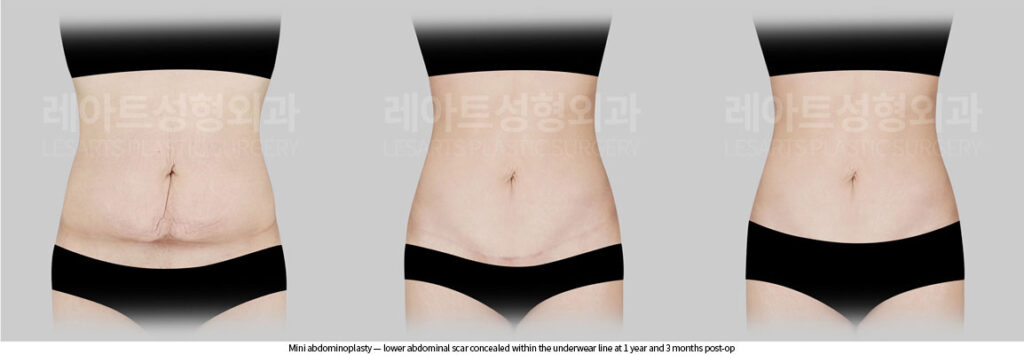
At 1 year and 3 months after
Mini Abdominoplasty, the skin that had
previously folded beneath the umbilicus
has been effectively corrected, allowing
the lower abdominal contour to appear
smoother, firmer, and more continuous.
In this patient,
scar maturation progressed very favorably.
Because regular postoperative visits
were expected to become less frequent,
the patient was advised to maintain
consistent scar moisturization at home
to support continued scar remodeling.
Although the incision became
somewhat longer than is typically expected
for a Mini Abdominoplasty in order to
adequately correct the severe contour step-off,
the scar was strategically positioned
low within the underwear line, where it remains
well concealed during daily activities.
In addition,
the lateral portions of the scar
demonstrated particularly rapid fading,
and the patient reported that
the scar itself had become
a relatively minor concern over time.
While the patient’s primary concerns—
including the lower abdominal skin fold,
contour irregularity, and sagging—were
successfully addressed, this case also illustrates
one of the inherent limitations of
Mini Abdominoplasty.
Because the patient elected to undergo
an S-Type Mini Abdominoplasty,
improvement of wrinkling above the umbilicus
was not achievable, making this the only
remaining limitation of the procedure.
As demonstrated in this case,
even patients with minimal abdominal fat
may continue to experience abdominal contour deformities
caused by skin laxity and loss of muscular support
following pregnancy and weight management.
In these situations,
focusing exclusively on further fat reduction
may actually make the remaining skin laxity
and wrinkling appear even more pronounced.
If you feel you have reached the limits
of improvement through dieting and exercise alone,
a comprehensive consultation with an experienced surgeon
can help determine the most appropriate treatment strategy
for restoring a smoother, firmer, and more balanced
abdominal contour.
#MiniAbdominoplasty
#STypeMiniAbdominoplasty
#Abdominoplasty
#TummyTuck
#RectusDiastasisRepair
#PostPregnancyBodyContour
#CesareanScarRevision
#AbdominalSkinLaxity
#LowerAbdominalSagging
#AbdominoplastyBeforeAfter
#LesartsPlasticSurgery
#BestMiniAbdominoplastyClinicGangnam