Mini abdominoplasty in Seoul: 3-month comparison for lower abdominal sagging improvement
Patient Registration Info
| Age | Weight | Height | BMI |
|---|---|---|---|
|
30s |
48kg |
161cm |
19 |
Surgical site
Surgical site : Abdomen, hip area, S-Type, muscle repair| liposuction aspirate volume : –
The patient presented in this post
underwent abdominoplasty surgery
to improve skin laxity and
folding of the lower abdomen
that developed following
a previous Cesarean section delivery.
Although the patient had successfully
maintained a stable body weight
through diet and lifestyle management
after childbirth, concerns regarding
the abdominal contour persisted.
As the skin of the lower abdomen
gradually lost elasticity,
wrinkling developed and the area
began to appear increasingly prominent
and protruded outward.
Despite having only a small amount
of residual abdominal fat,
the lower abdominal contour
did not appear smooth
even while standing upright.
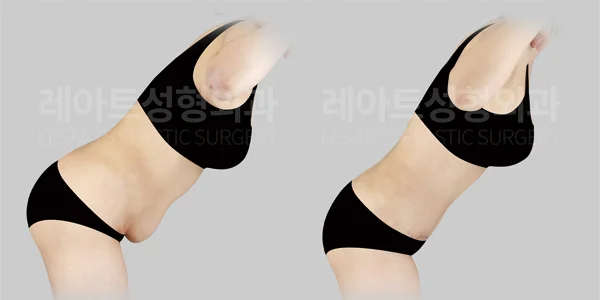
In addition, when bending forward
or during body movement,
the excess skin folds became
more pronounced and noticeable,
which caused considerable distress
in daily life.
For these reasons,
the patient hoped to achieve
a smoother and firmer abdominal contour
through abdominoplasty surgery,
with the goal of correcting
the skin laxity and restoring
a more natural abdominal silhouette.

During the pre-operative consultation
for abdominoplasty surgery,
the patient was found to have
a relatively low-positioned Cesarean section scar.
Above the scar,
the lower abdominal skin
had descended downward,
creating an appearance of
redundant and sagging tissue.
In addition,
rectus diastasis was identified,
indicating that the problem
extended beyond simple skin laxity.
Weakening of the abdominal wall support
had reduced the ability
of the lower abdomen
to maintain a firm contour,
resulting in a widened and
poorly supported appearance.
When bending forward,
the excess lower abdominal skin
became more pronounced,
stretching and folding downward
along the direction of gravity.
These changes were especially noticeable
around the previous C-section scar,
where the contour irregularity
and skin folding appeared
to be further accentuated.

Accordingly,
an S-Type Mini Abdominoplasty
was planned to remove
the redundant skin concentrated
below the umbilicus, while simultaneously
correcting the rectus diastasis.
The existing Cesarean section scar
was incorporated into the surgical design,
allowing it to be excised together
with the excess lower abdominal skin
during the skin resection process.
Because the amount of redundant skin
requiring excision was relatively extensive,
it was explained that, despite being
an S-Type Mini Abdominoplasty,
the incision length could become
somewhat longer than expected.
This aspect of the procedure
was discussed thoroughly
with the patient to establish
realistic expectations regarding
the surgical scar and recovery.
However, this patient had
a relatively small amount
of abdominal fat, making
fat reduction a lesser priority.
Instead, the surgical plan
focused primarily on removing
the lax skin and restoring support
through correction of the
rectus muscles and
relaxed abdominal fascia.
For this reason,
abdominal liposuction
was not performed in conjunction
with the abdominoplasty procedure.


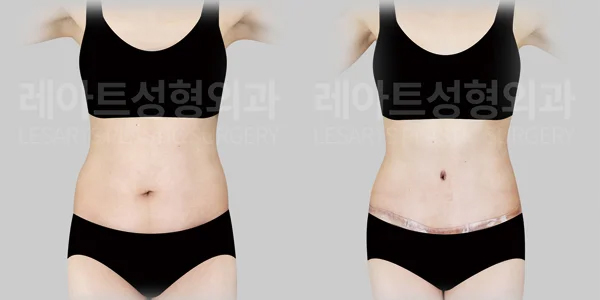
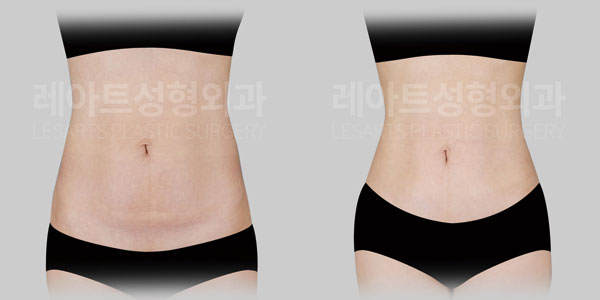
These photographs compare
the patient’s appearance before
Mini Abdominoplasty and
at 3 months post-operatively.
Before surgery,
the skin extending from
below the umbilicus to
the lower abdomen appeared
lax, protruding, and unsupported.
Skin overlap around
the previous Cesarean section scar
was particularly noticeable,
preventing the lower abdominal contour
from appearing smooth and well-defined.
Because the patient had
an overall slender physique,
the sagging lower abdominal skin
and protruding abdominal wall
became even more conspicuous.
Following Mini Abdominoplasty,
the excess skin that had descended
into the lower abdomen
was effectively removed,
creating a firmer and more refined contour.
In addition,
rectus muscle plication restored
support to the abdominal wall,
allowing the previously weakened
and widened central abdominal line
to appear more stable and structured.
Most importantly,
the lower abdominal skin folds
and protrusion that represented
the patient’s greatest concerns
have been noticeably improved,
resulting in a smoother, flatter,
and more harmonious abdominal silhouette.


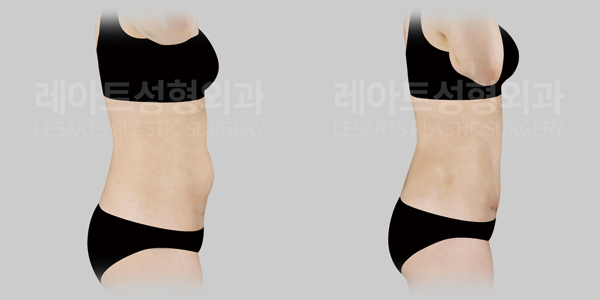
From the side profile,
the improvement in the previously
protruding lower abdomen
can be appreciated more clearly.
The wrinkled and folded appearance
of the lower abdominal skin
that became especially noticeable
when bending forward
has also been significantly improved.
The skin extending from
below the umbilicus to
the previous Cesarean section scar
had descended downward,
creating an uneven and bulging
lower abdominal contour.
Following Mini Abdominoplasty,
this disproportionate protrusion
has been effectively corrected,
resulting in a smoother, firmer,
and more youthful anterior abdominal line.
The restoration of abdominal support
through rectus muscle plication
also contributed to a more stable contour,
allowing the lower abdomen
to maintain a flatter appearance
during both standing and movement.

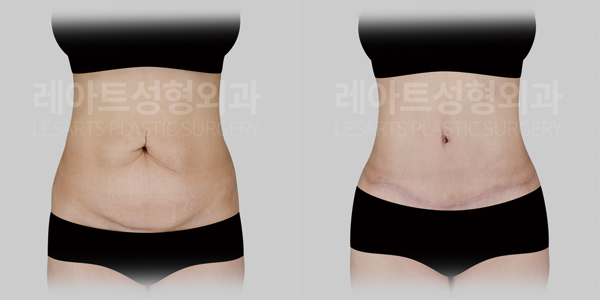
At 3 months after abdominoplasty,
patients commonly continue to experience
residual swelling and areas
of tissue firmness during healing.
Despite being in this stage
of recovery, the patient already
demonstrates a naturally narrowed waistline
and a firmer, lifted abdominal contour.
During the abdominoplasty procedure,
the previous Cesarean section scar
was successfully removed,
leaving only the new
abdominoplasty incision scar.
As discussed during consultation,
the vertical extent of skin excision
was relatively extensive,
which resulted in
a somewhat longer incision.
However, this approach allowed
adequate correction of the deformity,
helping to avoid issues such as
undercorrection or dog-ear deformities,
while achieving a highly satisfactory result.
The incision was strategically positioned
along the lower abdomen,
allowing it to be naturally concealed
within the underwear line.
At approximately 3 months post-operatively,
patients typically begin
scar laser treatments
to further optimize scar maturation.
By carefully following
the recommended scar management plan
and attending scheduled follow-up visits,
the scar is expected to gradually fade
and continue to improve over time,
resulting in an even more refined
and stable appearance.
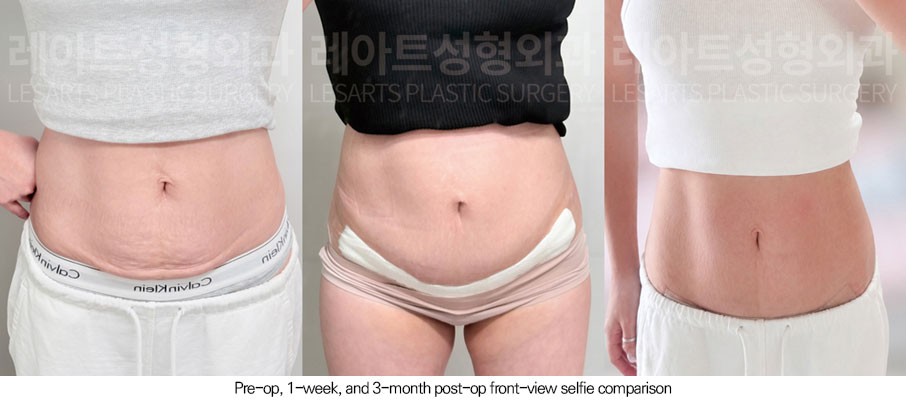

The patient’s selfies and personal review
also demonstrate a high level
of satisfaction with both
the recovery process and results
experienced in daily life.
Perhaps the most noticeable change
is the improvement in
the wrinkled, sagging appearance
of the lower abdomen, along with
the restoration of firmness
despite changes in posture.
The patient shared that
she was highly satisfied not only
with the correction of
her primary concerns, but also
with the improvement in
her waistline achieved through
the lifting effect of surgery.
Even when body weight is maintained
through consistent lifestyle management,
problems related to skin laxity
and weakened musculature may,
in some cases, require
surgical correction to achieve
meaningful improvement.
With thorough consultation,
meticulous surgical planning,
and attentive post-operative care,
patients may find an opportunity
to finally overcome the stress
they have experienced
for many years and regain
greater confidence in their bodies.
#MiniAbdominoplasty
#MiniTummyTuck
#MiniAbdominoplastyBeforeAfter
#RectusDiastasisRepair
#RectusMusclePlication
#PostpartumBodyContouring
#CSectionScarRevision
#LowerAbdominalSkinLaxity
#AbdominoplastyRecovery
#MommyMakeover
#LesartsPlasticSurgery
#BestMiniAbdominoplastyClinicInKorea