Gynecomastia surgery in Gangnam: 2-week results for chest protrusion since adolescence
Patient Registration Info
| Age | Weight | Height | BMI |
|---|---|---|---|
|
20s |
81kg |
171cm |
28 |
Surgical site
Surgical area: Gynecomastia | Grade 2-A
Will Gynecomastia That Develops During Adolescence Go Away on Its Own?
Temporary breast enlargement can occur during adolescence due to hormonal changes.
However, if chest projection or firm glandular tissue remains
into adulthood, a medical evaluation is recommended.
If weight loss and upper-body exercise have not improved the appearance,
it is important to determine whether enlarged glandular tissue,
rather than excess fat alone, is present.
[Learn More About Lesarts Gynecomastia Surgery]
Adolescent gynecomastia
is more common than many people realize.
During school vacations,
many teenagers visit the clinic
with their parents
for evaluation or consultation
about gynecomastia surgery.
However, many postpone seeking treatment
because they expect the condition
to resolve naturally over time,
or believe that losing weight
and exercising consistently
will reduce the size of the chest.
For teenagers and their parents
who visit us with concerns about gynecomastia,
we recommend undergoing
a thorough examination and accurate diagnosis,
even if surgery is not being considered immediately.
This is because the appropriate treatment
depends on whether the enlarged chest
is caused by temporary hormonal changes,
excess body fat,
or true gynecomastia with enlarged glandular tissue.
The patient featured in this case
underwent surgery in his twenties,
but first became concerned
about chest projection
during his teenage years.
He had experienced long-term stress
about the size and shape of his chest,
and after recent weight gain
the fullness became even more noticeable.
He visited Lesarts Plastic Surgery
for a comprehensive gynecomastia evaluation
and surgical consultation.

[2 Weeks After Gynecomastia Surgery: Improvement in Chest Projection Visible Through Clothing]
The patient had consistently performed
upper-body workouts
in an effort to reduce the size of his chest.
However, despite regular exercise,
there was little improvement
in the overall chest volume
or the central chest projection.
This led him to suspect
that the condition was more than
excess body fat alone,
and that he might have true gynecomastia.
During the examination,
both sides of the chest
showed generalized enlargement,
with noticeable central projection
and fullness extending
into the lower chest.
Ultrasound examination confirmed
widely distributed glandular tissue
in both breasts,
and the condition was classified as
Simon Grade IIA.
In addition, fat accumulation
was present from the lower armpit
to the lower chest.
Because of this, removing only
the glandular tissue
would not have been sufficient
to create a smooth, natural chest contour.
Therefore, the surgical plan included
removal of the enlarged glandular tissue,
contouring of the surrounding fat layer,
and tissue repositioning
to help prevent postoperative depression
or visible contour irregularities.
▶ View More Gynecomastia Surgery Cases
In the before-and-after photos below,
we will examine the changes
in the oblique view, side profile,
and the appearance of the chest
when wearing a T-shirt just 2 weeks after gynecomastia surgery.

[Chest Projection Since the Teenage Years: Preoperative Findings After Weight Gain Made Gynecomastia More Noticeable]
Patient Information & Examination Findings
– Age: 20s
– Height / Weight: 171 cm / 80.6 kg
– Diagnosis: Simon Grade IIA, Mixed Gynecomastia
– Skin Elasticity: Moderate
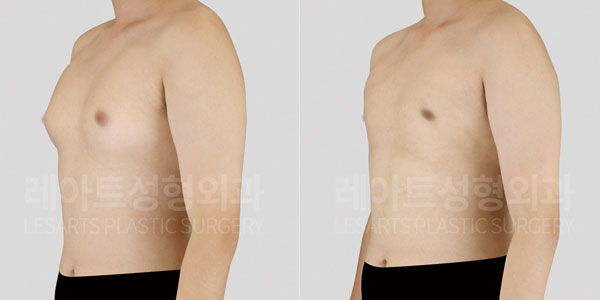
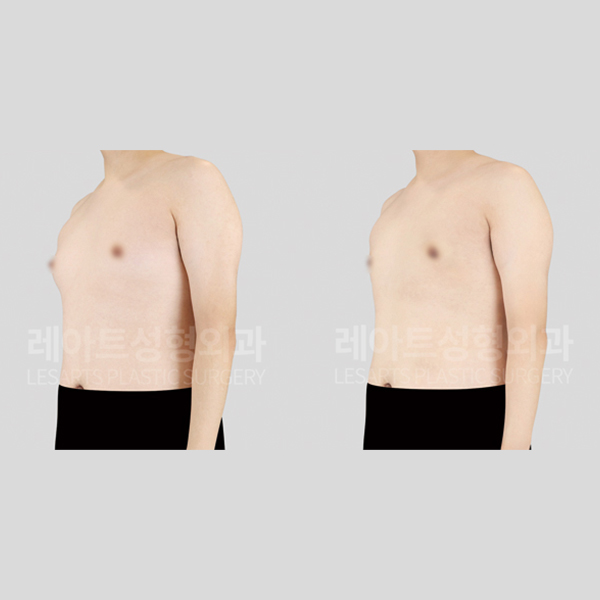
On the oblique preoperative view,
the central portion of the chest
showed noticeable forward projection,
while fullness in the lower chest
blended into the upper abdomen,
giving the upper body a heavier contour.
Although recent weight gain
had increased the thickness of the fat layer,
ultrasound examination confirmed
the presence of enlarged glandular tissue.
As a result, weight loss alone
would not have been sufficient
to reduce the central chest projection.

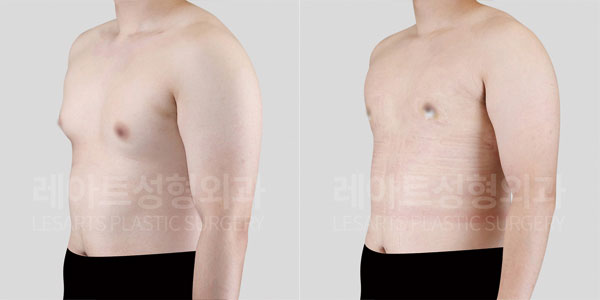
[2 Weeks After Gynecomastia Surgery: Improvement in Chest Projection on the Oblique View]
This photo was taken
2 weeks after gynecomastia surgery.
Because this is still
the early postoperative period,
some swelling and tissue firmness,
commonly referred to as BioBond,
are still present.
Even so, the prominent projection
of the central chest seen before surgery
has already decreased,
creating a smoother transition
from the rib cage to the chest.
The heavy fullness
in the lower chest
has also been reduced,
allowing a more natural transition
between the chest and upper abdomen.
At 2 weeks after surgery,
it is still too early
to evaluate the final result.
As the remaining swelling
and tissue firmness gradually resolve,
the chest contour will continue
to soften and become more refined.

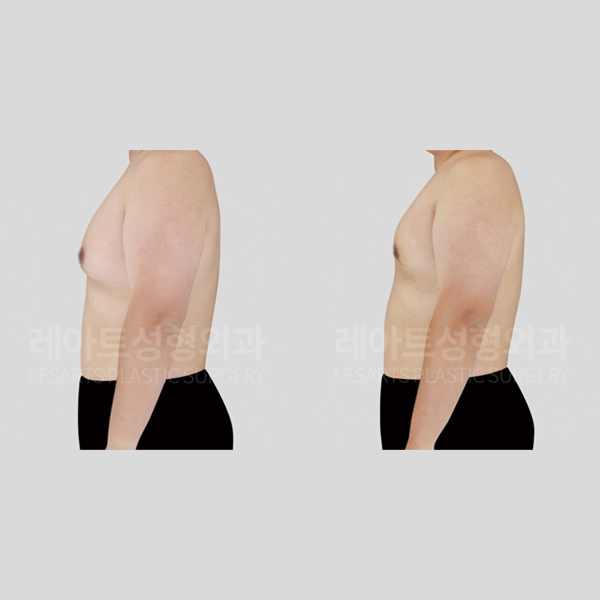
[Reduced Chest Projection: Side-View Changes 2 Weeks After Gynecomastia Surgery]
From the side view,
the forward projection of the chest
has already been reduced,
creating a smoother contour
across the front of the upper body.
Before surgery,
the lower chest was prominent enough
to create a visible shadow beneath it.
After surgery,
the heaviness of the lower chest decreased,
allowing the rib cage
and upper abdomen
to transition more naturally.
Because both the enlarged glandular tissue
and the surrounding fat
were addressed together,
the central chest does not appear
abruptly flat or separated
from the surrounding tissues.
Instead, the entire chest contour
has become smoother
and more evenly balanced.

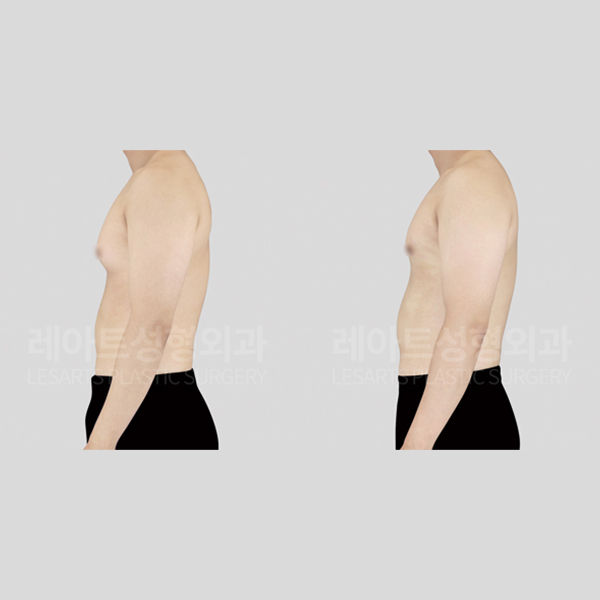
[2 Weeks After Gynecomastia Surgery: Chest Projection and T-Shirt Fit from the Side View]
Even while wearing a T-shirt,
the chest previously projected outward,
making the contour of the chest
clearly visible through clothing.
Just 2 weeks after surgery,
the thickness of the anterior chest
has already decreased,
allowing the shirt to drape
more naturally along the upper body
without catching on the chest.
The patient shared that,
since his teenage years,
he often hunched his shoulders
or chose loose-fitting clothes
to make his chest less noticeable.
After surgery,
he said he feels much more comfortable
choosing and wearing clothing.
He also mentioned that
if he had realized earlier
that the problem was caused
by enlarged glandular tissue
rather than excess body fat alone,
he could have addressed
his long-standing concerns much sooner.
True gynecomastia caused by
enlarged glandular tissue
cannot be effectively treated
through exercise or weight loss alone.
On the other hand,
if the enlarged chest
is primarily due to fat accumulation,
its size may change
with fluctuations in body weight.
For this reason,
it is important not to rely solely
on the external appearance.
An ultrasound examination
can accurately evaluate
the proportion of glandular tissue
and fat, helping determine
the most appropriate treatment plan.
If chest projection has persisted
since adolescence,
or if there has been no improvement
despite weight loss and exercise
after reaching adulthood,
it is advisable to undergo
a proper evaluation
rather than continuing to delay treatment.
#adolescentgynecomastia
#malebreastenlargement
#truegynecomastia
#lesartsplasticsurgery
Gynecomastia Surgery FAQ
Q1. Does gynecomastia that develops during adolescence always require surgery?
No. Not all cases of adolescent gynecomastia require surgery.
Some improve naturally during puberty, so treatment should be determined
after evaluating how long the condition has persisted
and whether enlarged glandular tissue is present.
Q2. Can exercise get rid of gynecomastia?
If excess fat is the primary cause, weight loss may reduce chest size to some extent.
However, true gynecomastia caused by enlarged glandular tissue
cannot be eliminated through exercise alone, so significant improvement is unlikely.
Q3. How is gynecomastia evaluated?
The examination includes an assessment of chest size, skin elasticity,
and the extent of chest projection.
An ultrasound examination is then performed
to evaluate the thickness and distribution of glandular tissue.
The treatment plan may vary depending on the proportion of fat
and glandular tissue.
Q4. Are the final results visible 2 weeks after gynecomastia surgery?
No. At 2 weeks after surgery, swelling and tissue firmness
are still part of the normal healing process.
As recovery progresses, the swelling gradually subsides,
the tissues soften, and the chest contour continues to improve.
Q5. Does gynecomastia surgery remove only glandular tissue?
It depends on the severity of glandular enlargement
and the amount of surrounding fat.
For mixed gynecomastia, treatment may include glandular tissue excision,
chest liposuction, and tissue repositioning
to achieve a smoother, more natural chest contour.
▼ Visit Lesarts Plastic Surgery in Gangnam, Seoul, Korea ▼