
Gynecomastia surgery in Seoul: chest protrusion in a man in his 40s, from ultrasound diagnosis to 2-week results

Patient Registration Info
| Age | Weight | Height | BMI |
|---|---|---|---|
|
40s |
81.9kg |
173cm |
27.4 |
Surgical site
Surgical site : Chest|Gynecomastia Surgery for Mixed-Type Gynecomastia (Simon Grade 2A), Glandular Tissue Removal with Liposuction of the Lower and Outer Chest
Could Chest Protrusion That Starts in Your 40s Be Gynecomastia?
Gynecomastia is not a condition that only affects young men.
Even after the age of 40, glandular tissue can develop,
making the area around the areolas look puffy
or causing the chest to project forward.
To tell whether it is simple weight gain or gynecomastia,
the current distribution of glandular tissue and fat needs to be checked
before gynecomastia surgery is considered.

[Changes in Chest Protrusion Through a T-Shirt 2 Weeks After Gynecomastia Surgery in a Man in His 40s]
In gynecomastia consultations,
we meet men of many different ages,
from their teens to their 50s.
In other words, concerns about chest protrusion
are not limited to young men
who pay close attention to their appearance.
True gynecomastia needs to be evaluated differently
from a change in body shape where fat
simply builds up on the chest with weight gain.
It is important to identify why the glandular tissue has developed,
diagnose the current state of the glandular tissue and fat inside the chest,
and then consider the appropriate treatment and recovery process together.
This patient is a man in his 40s who had noticed
both sides of his chest projecting forward since his 30s.
Let’s look at the chest condition found on ultrasound,
the surgical plan, and the changes seen
at the relatively early stage of 2 weeks after surgery.
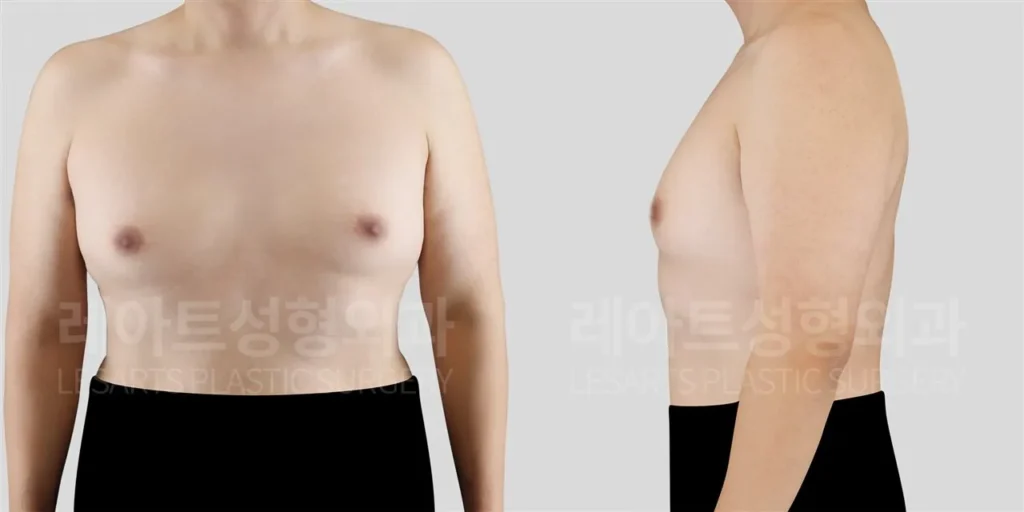
[Patient Information and Gynecomastia Ultrasound Findings]
Age: 48
Height: 173 cm
Weight: 81.9 kg
BMI: 27.4
Diagnosis: Mixed-type gynecomastia, Simon Grade IIa
Skin elasticity: Moderate
The patient had noticed both sides of his chest
projecting forward since his 30s.
Ultrasound examination revealed glandular tissue
that had developed widely behind both areolas.
On physical examination, firm tissue could also be felt beneath the areolas,
and from the outside, the area around the areolas looked puffy
with the center of the front chest projecting forward.
In addition, subcutaneous fat was distributed
over the lower and outer parts of the chest.
Because the surrounding fat added to the central protrusion caused by glandular tissue,
making the whole chest look larger,
he was diagnosed with mixed-type gynecomastia.
[Gynecomastia Surgery Plan Based on Both Glandular Tissue and Surrounding Fat]
In this patient, both glandular tissue and fat
were contributing to the chest protrusion.
The surgery was therefore planned to remove the glandular tissue causing the gynecomastia
while also liposuctioning the fat distributed
over the lower and outer chest.
The key to this surgery was not just removing the glandular tissue
but also addressing the surrounding fat
to reduce the overall chest size and refine its shape.

[Changes in Projection Around the Areolas 2 Weeks After Gynecomastia Surgery in a Man in His 40s]
This is how the chest looked at the relatively early stage of 2 weeks after surgery.
Although swelling is still present at this point,
the volume in the center of the chest, which had projected forward around the areolas before surgery,
can be seen to have decreased.
The volume that had continued roundly into the lower and outer chest
has also decreased,
and the overall size of the chest is smaller than before.

[Changes in Front Chest Volume from the Oblique View 2 Weeks After Gynecomastia Surgery]
The difference before and after surgery can also be seen from the oblique view.
Before surgery, the front of the chest projected roundly around the areolas,
making the chest feel quite thick.
At 2 weeks, along with the central protrusion,
the volume that extended toward the lower and outer chest has decreased,
and the chest as a whole looks lighter.
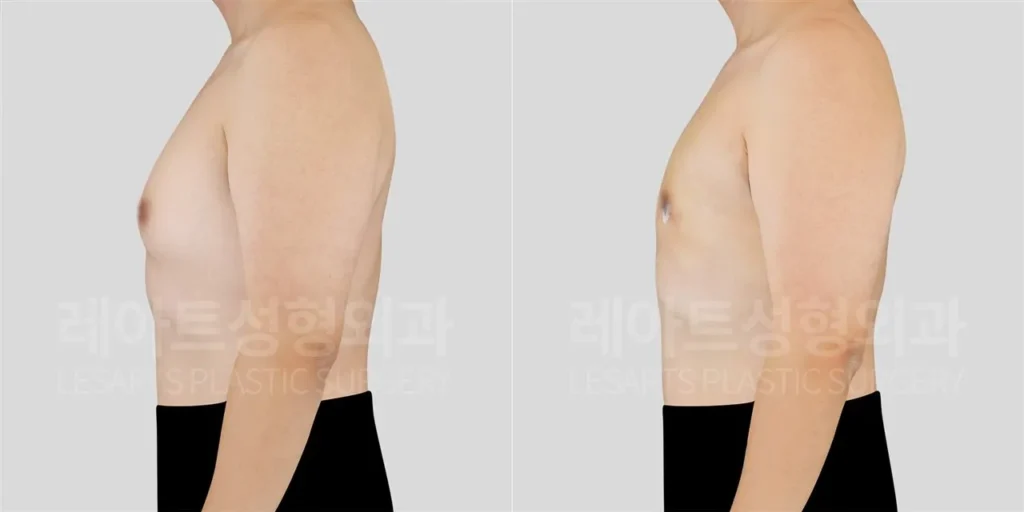
[Changes in Chest Thickness from the Side 2 Weeks After Male Gynecomastia Surgery]
The change in front-to-back chest thickness is even clearer from the side.
In particular, the curve and shadow that appeared under the chest before surgery have decreased,
and the chest now has a flatter, more refined shape than before.
The patient was also satisfied with this change.

[Changes in Chest Protrusion Through a T-Shirt After Gynecomastia Surgery in a Man in His 40s]

[Changes in Chest Protrusion Through a T-Shirt After Gynecomastia Surgery in a Man in His 40s]
Gynecomastia can cause significant discomfort not only when the shirt is off
but also when wearing everyday clothes.
This patient also felt uncomfortable because of his chest protrusion,
not only in the clothes he wore to work
but also during hobbies and leisure activities such as golf and the sauna.
In the photos of him wearing a T-shirt after surgery,
the volume of the chest that had stood out has decreased,
and the protrusion visible over his clothes is less than before.
The patient said he was most satisfied that the stress
he had felt from gynecomastia in his daily life had decreased.
[2 Weeks After Surgery: Still an Early Stage of Recovery]
Since only 2 weeks have passed since surgery, swelling remains in the chest
and the internal tissue is still in the process of settling.
This is therefore not the time to judge the current appearance as the final result.
As recovery progresses, the remaining swelling and tissue firmness will gradually decrease,
and we plan to continue checking his progress and recovery.
Some men are concerned about gynecomastia even after their 40s
because their chest has become larger than before
or the area around the areolas has started to project forward.
This patient had also noticed symptoms since his 30s,
and the examination revealed both wide glandular tissue behind the areolas
and fat in the lower and outer chest.
Glandular tissue removal and liposuction of the surrounding area were therefore performed together,
and 2 weeks after gynecomastia surgery, reduced protrusion around the areolas
and reduced overall chest volume could be seen.
However, even at the same age or with a similar body type, gynecomastia can differ
depending on its cause, how much the glandular tissue has developed, and how the fat is distributed.
It is important to first confirm your current condition through examination and diagnosis:
whether the chest protrusion is simply due to weight gain,
or whether glandular tissue has actually developed as well.
Related Gynecomastia Surgery Cases
▶ Gynecomastia surgery in Korea: 2-week results for enlarged chest and areolas in men in their 40s
▶ Gynecomastia surgery in Korea: 3-month results for Simon Grade 2B with chest sagging
Gynecomastia Surgery FAQ for Men in Their 40s
Q1. Can gynecomastia develop in your 40s?
Gynecomastia does not appear only at a specific age. As in this case, some men notice chest protrusion from their 30s and have an examination and surgery in their 40s.
Q2. How can you tell gynecomastia apart from a chest that has grown due to weight gain?
It is difficult to tell them apart accurately from appearance alone. Ultrasound and physical examination are used to check whether glandular tissue has developed behind the areolas and where and how much fat is distributed.
Q3. How is surgery performed when both glandular tissue and fat are present?
In mixed-type gynecomastia with both glandular tissue and surrounding fat, as in this patient, the glandular tissue can be removed while liposuction of the lower and outer chest is performed to refine the overall chest size and shape.
Q4. Has the chest shape fully settled 2 weeks after gynecomastia surgery?
Not yet. At 2 weeks, swelling remains in the surgical area and the tissue is still settling, so the reduction of swelling and tissue firmness needs to be followed up afterward.
Q5. Can the change be seen when wearing a T-shirt after gynecomastia surgery?
In this case, the chest volume that had projected forward over a T-shirt before surgery had decreased at 2 weeks. However, the degree of change may vary depending on the surgical range and the speed of recovery.
▼ Visit Lesarts Plastic Surgery in Gangnam, Seoul, Korea ▼