Gynecomastia surgery in Korea: does surgery remove male breast lumps? 2-week results

Patient Registration Info
| Age | Weight | Height | BMI |
|---|---|---|---|
|
30s |
90kg |
178cm |
28 |
Surgical site
Surgical area: Gynecomastia | Grade 2-A
Can exercise or weight loss cure gynecomastia?
Not always. If enlarged male breasts are caused by
hypertrophied glandular tissue rather than fat,
exercise and dieting alone are unlikely to resolve the condition.
An ultrasound examination can distinguish true gynecomastia
from fat accumulation and help determine whether surgery is the most appropriate treatment.

Many men who are concerned about gynecomastia
initially hope to improve their condition through
exercise or weight loss, rather than
considering surgical treatment.
This is because enlarged male breasts
are often assumed to be caused simply by
excess body fat or insufficient chest muscle development.
However, if the chest enlargement is accompanied by
a palpable lump, or symptoms such as
pain or tenderness, it is important to undergo
a proper evaluation and receive an accurate diagnosis.
In many cases, the lump represents
hypertrophied glandular tissue, and may be associated with
additional symptoms such as tenderness or
intermittent aching discomfort.
The patient presented in this case
had recognized the signs of gynecomastia
for many years and had also noticed
a palpable lump beneath the chest.
Despite repeated efforts with weight loss
and chest-focused strength training,
he experienced little improvement.
As a result, he visited Lesarts Plastic Surgery
to undergo a comprehensive evaluation
and receive appropriate treatment for his condition.
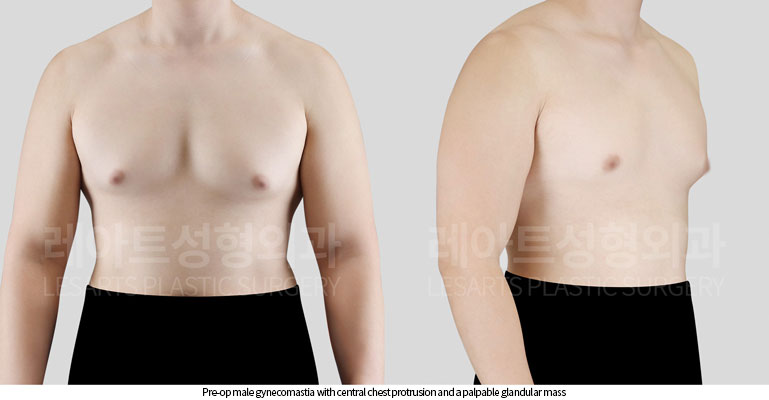
[Patient Information and Diagnostic Findings]
Age: Early 30s
Height / Weight: 178 cm / 90 kg
Diagnosis: Mixed Gynecomastia, Simon Grade 2A
Glandular Tissue Thickness: 17 mm (right), 18 mm (left)
Skin Elasticity: Moderate
On visual examination,
the patient demonstrated bilateral breast enlargement
with noticeable anterior chest projection.
Although the breasts did not exhibit
significant skin ptosis, the increased chest volume
created shadowing along the inframammary fold,
making the gynecomastia appear even more prominent.
Based on the physical appearance,
the condition was classified as Simon Grade 2A.
Ultrasound examination confirmed
diffuse hypertrophy of the glandular tissue,
and palpation revealed a firm glandular mass
rather than soft fatty tissue.
In addition, subcutaneous fat extending from
the lateral chest toward the rib cage contributed
to increased chest volume, further accentuating
the projection of the chest and surrounding contour irregularities.
Accordingly, the surgical plan included
gland excision, chest liposuction, and
tissue repositioning to smooth the thoracic contour,
eliminate the underlying cause of gynecomastia,
and create a flatter, more natural, and masculine chest appearance.
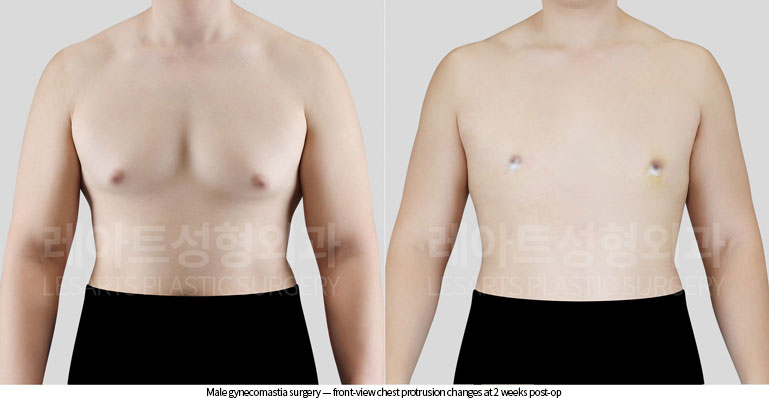
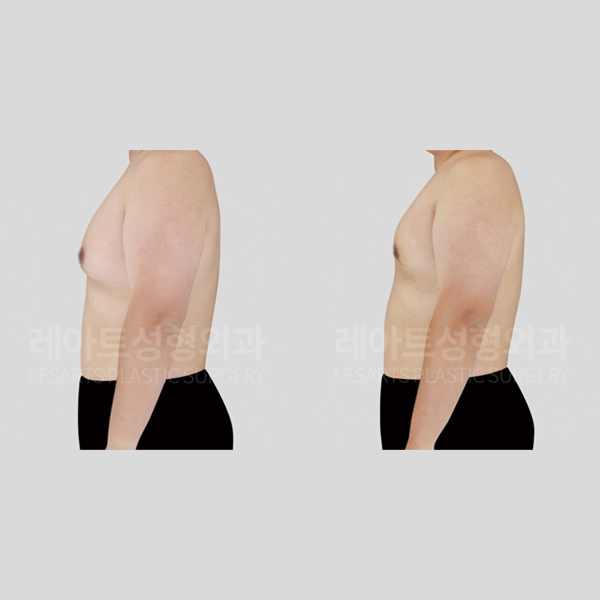
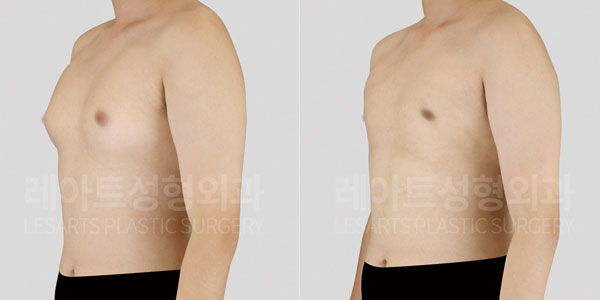
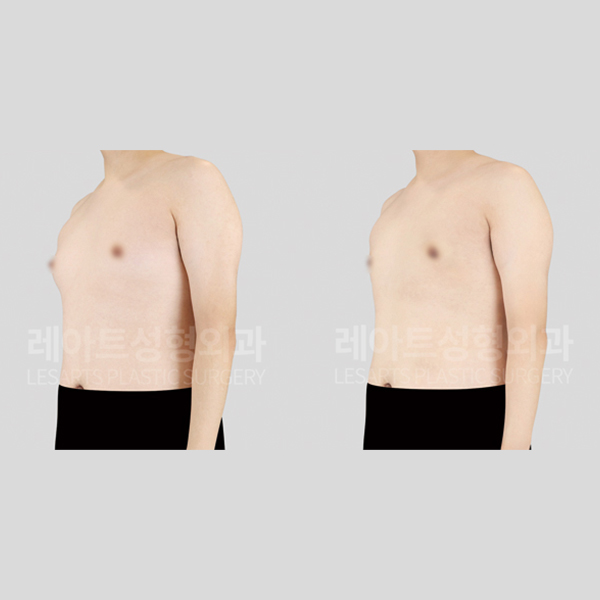
The following photographs were obtained
2 weeks after gynecomastia surgery,
demonstrating the patient’s early postoperative progress.
Although the patient was still in the early recovery phase,
when postoperative swelling and BioBond-related tissue firmness
(commonly experienced during healing) were most pronounced,
a noticeable reduction in chest volume was already evident.
The excessive anterior chest projection that had previously
made the chest appear prominent had also improved,
creating a flatter and smoother contour across the front of the upper body.
Before surgery,
both the medial chest and the area
directly beneath the nipple–areolar complex
demonstrated distinct shadowing,
and the chest prominence was clearly visible
even from the frontal view.
Following gynecomastia surgery,
the excess volume has been effectively reduced,
allowing the chest to settle into a smoother,
more natural contour with a noticeably
better-defined and more masculine appearance.
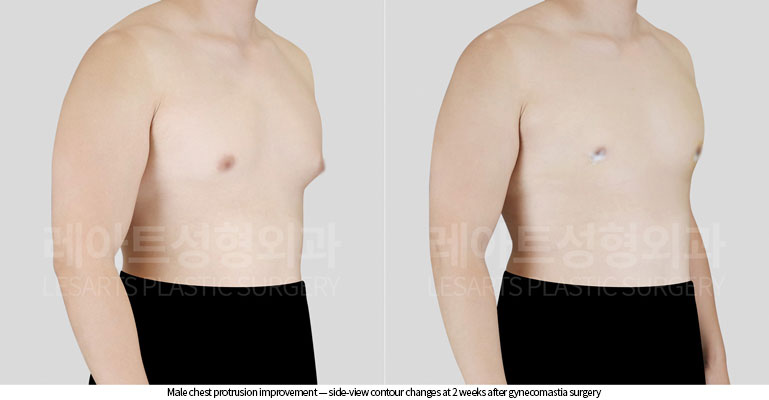
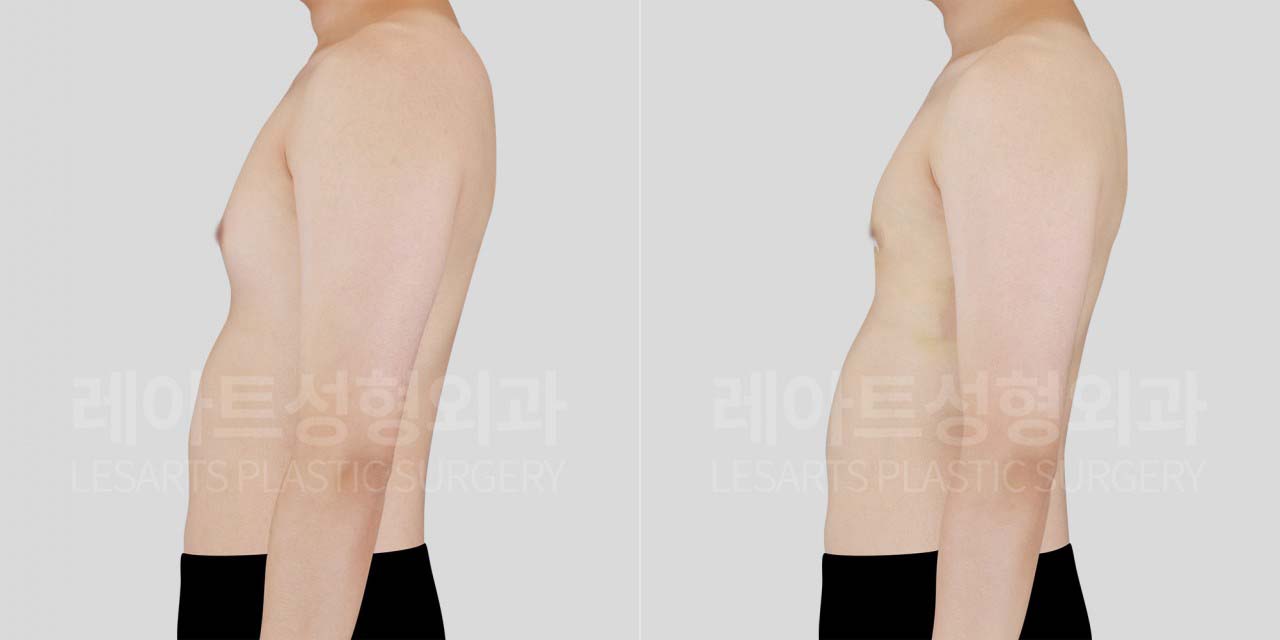
The lateral view also demonstrates
a clear improvement following gynecomastia surgery.
The previously pronounced, pointed anterior chest projection
has been effectively reduced, creating a much smoother transition
from the thoracic contour to the upper abdomen and revealing
a flatter, more naturally masculine chest profile.
In addition, chest liposuction was performed
along the lower and lateral chest, refining these areas together
with the gland excision.
As a result, the contour irregularities and shadowing
that had extended beneath and along the sides of the chest
have been eliminated, producing a cleaner, more continuous,
and well-defined masculine thoracic contour.

As demonstrated in this case,
gynecomastia often does not improve significantly
through exercise or weight loss alone,
leaving many patients frustrated despite their continued efforts.
For many men, the stress extends beyond
the physical appearance of the chest.
Repeatedly trying to conceal the chest beneath clothing
or feeling self-conscious about body posture
can gradually become a significant burden
in everyday life.
Even at 2 weeks after gynecomastia surgery,
the patient reported that one of the greatest benefits
was being able to wear clothes more comfortably
without constantly worrying about his chest contour
or the way he stood and moved.
He was also pleased that the firm glandular lump
that had concerned him for years
had been completely removed through surgery,
allowing him to stop thinking about his chest altogether.
Because he followed the postoperative instructions carefully,
his recovery has progressed smoothly and
his early healing has remained stable.
The patient was advised to continue wearing
the compression garment throughout the remaining recovery period
and to gradually return to normal daily activities
while avoiding excessive physical strain, allowing the chest
to continue settling into a more natural, masculine contour.
If anterior chest projection and a palpable lump
persist despite consistent dieting and exercise,
the underlying cause may not simply be excess body fat.
At Lesarts Plastic Surgery,
we evaluate the chest contour, the degree of
glandular tissue development, and the distribution of
surrounding fat before recommending a personalized
treatment plan for each patient.
If you have been struggling with persistent male breast enlargement,
a comprehensive consultation and ultrasound examination
can provide an accurate diagnosis and help determine
the most appropriate treatment for your condition.
#GynecomastiaSurgery
#GynecomastiaBeforeAfter
#MaleBreastReduction
#GynecomastiaKorea
#ChestContouring
#LesartsPlasticSurgery
#BestGynecomastiaClinicSeoul
FAQ
Q1. Can gynecomastia be cured with exercise or weight loss?
A. If the enlarged chest is caused by true glandular tissue, exercise and weight loss alone usually cannot eliminate it.
A proper examination is needed to determine the underlying cause.
Q2. Does a lump under the nipple always mean gynecomastia?
A. Not always. However, a firm lump beneath the nipple is commonly associated with glandular enlargement.
An ultrasound examination is recommended for an accurate diagnosis.
Q3. Why are gland excision and liposuction performed together?
A. Gland excision removes the enlarged glandular tissue, while liposuction refines the surrounding fat
and chest contour to create a smoother, more masculine appearance.
Q4. Are results visible 2 weeks after gynecomastia surgery?
A. Yes. Although swelling and BioBond-related firmness are still present at 2 weeks,
most patients already notice reduced chest projection and a flatter chest contour.
Q5. Will gynecomastia surgery improve confidence in daily life?
A. Many patients report feeling more comfortable wearing fitted clothing and no longer feeling the need to hide their chest,
improving confidence in everyday activities.
▼ Visit Lesarts Plastic Surgery in Gangnam, Seoul, Korea ▼