Fat transfer in Korea: can facial fat transfer restore volume after weight loss?
Patient Registration Info
| Age | Weight | Height | BMI |
|---|---|---|---|
|
20s |
55kg |
161cm |
21 |
Surgical site
Surgical site : Face (Forehead, Temples, Anterior Cheeks, Nasolabial Folds)| liposuction volume : –
Fat Transfer: Face (Forehead, Temples, Anterior Cheeks, Nasolabial Folds) – 51 cc
Repeated dieting for weight loss
is often pursued to achieve
a more attractive body contour.
However, rather than creating
the desired physique, some individuals
notice unexpected changes in
their facial appearance as
facial volume gradually diminishes.
In particular, when fat loss occurs
in areas that play an important role
in conveying a youthful and positive image,
patients may begin to appear
more hollow, fatigued, or older
than their actual age.
As facial fat volume decreases,
the soft tissues and skin that
were previously supported by
underlying adipose tissue may lose
structural support, resulting in
skin laxity and age-related changes
becoming more apparent over time.
In these situations,
strategically restoring volume to
deficient areas through facial fat grafting
can help improve facial harmony
and recreate a healthier, brighter,
and more youthful appearance.
Through the following facial fat grafting case,
we will take a closer look at
how restoring lost facial volume
can enhance contour balance,
soften facial features, and contribute
to a naturally rejuvenated image.
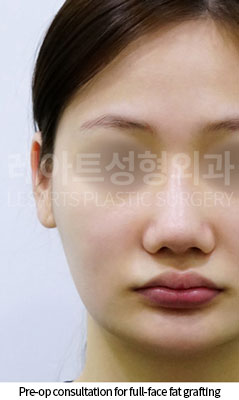
When evaluating the patient’s
overall facial contour,
volume deficiency was observed
within the forehead, anterior cheeks,
and nasolabial fold regions.
Most notably,
the central portion of the forehead
demonstrated mild depression,
preventing a smooth and natural transition
from the hairline to the upper face.
The anterior cheeks and
nasolabial areas also lacked
sufficient projection, contributing to
a relatively flat facial contour and
an appearance that seemed somewhat
fatigued and less vibrant.
To improve these concerns while
maintaining overall facial harmony,
we determined that simply augmenting
a single deficient area would not
produce the most balanced result.
Accordingly, a full-face fat grafting procedure
was planned with the goal of
creating a seamless transition extending
from the forehead to the chin,
restoring subtle volume where needed,
and enhancing facial contours in a way
that appears soft, natural,
and aesthetically harmonious.
This approach allows the face
to regain a healthier, more youthful,
and refreshed appearance without
creating excessive fullness in
any individual region.
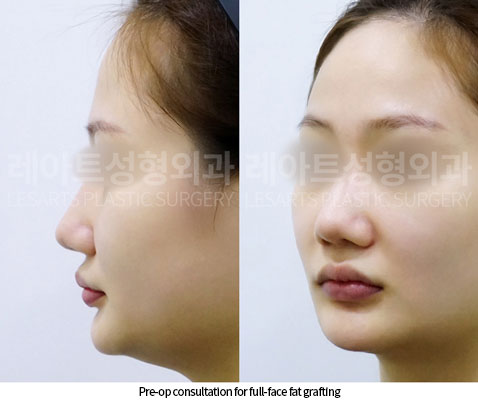
The patient also hoped to restore
volume to each deficient area
in a subtle and natural manner.
For this reason,
rather than pursuing a procedure
that would dramatically alter
the overall facial contour,
the surgical plan focused on
softening the facial lines
and enhancing the patient’s image
through harmonious volume restoration.
Forehead:
Volume was added primarily to
the central forehead region,
allowing for a smoother transition
from the hairline. This helped elevate
previously shadowed areas and created
a natural highlighting effect.
Temples:
Volume deficiency within the temples
had accentuated the prominence of
the cheekbones. Fat grafting was used
to soften these depressions and create
a smoother and more continuous
facial contour.
Anterior Cheeks and Nasolabial Folds:
Selective volume restoration was performed
to improve midfacial fullness, helping
reduce the tired and aged appearance
associated with volume loss in these regions.
A full-face fat grafting approach
was chosen, with the initial procedure
designed to establish the overall
facial contour and restore balance.
After fat engraftment stabilized,
a secondary touch-up procedure could
be considered if additional refinement
or subtle contour correction became necessary.
Let us now review the patient’s
before-and-after full-face fat grafting photographs
to appreciate the changes in
facial contour, volume distribution,
and overall improvement in facial harmony
and rejuvenation.
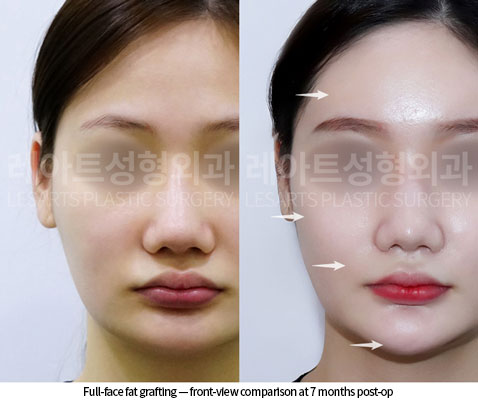
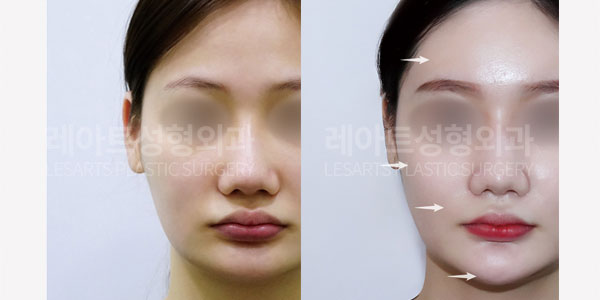
Prior to full-face fat grafting,
shadowing within the forehead
was noticeable even from the frontal view.
Volume deficiency involving
the temples and anterior cheeks
accentuated the prominence of
the cheekbones, causing the face
to appear broader while disrupting
the smooth transition of
the facial contour.
In addition,
the lack of volume extending from
the alar base toward the oral commissures
contributed to a more tired
and aged appearance, indicating that
restoration of these regions
would likely provide meaningful
facial rejuvenation.
When patients hear the term
full-face fat grafting,
many worry that the outcome
may result in an excessively full
or overcorrected appearance beginning
from the forehead.
However, as demonstrated in this case,
strategic enhancement of selected areas
can create subtle contour changes
that improve facial harmony
without producing an unnatural appearance.
Most notably,
restoration of projection within
the central forehead created
a gentle highlight effect, similar to
the appearance achieved with
soft cosmetic illumination,
adding natural three-dimensionality
to the upper face.
At the same time,
improved volume within the midface
helped re-establish facial balance,
while smoother transitions between
facial subunits prevented visual attention
from dispersing laterally.
As a result,
although the actual facial dimensions
remained unchanged, the patient obtained
the impression of a smaller, softer,
and more refined facial contour,
with an overall appearance that seemed
brighter, healthier, and more youthful.
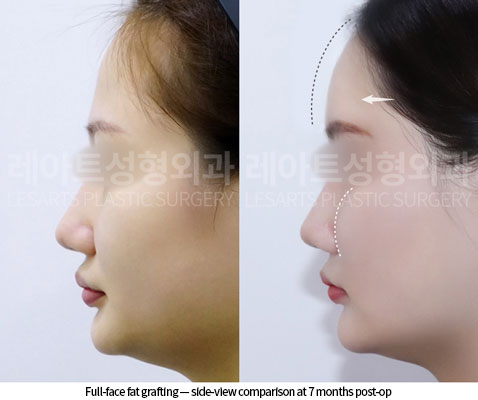
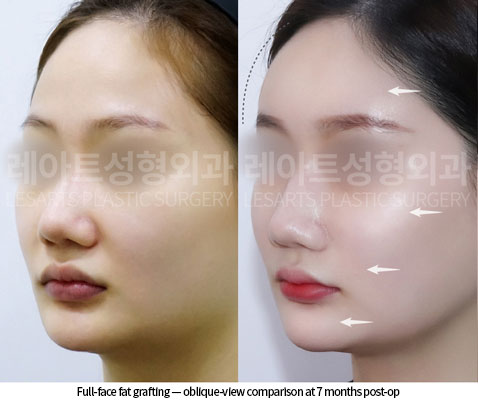
From the lateral view,
it becomes apparent that
the previously tired and hollow appearance
has been effectively improved.
Areas that had appeared flat,
shadowed, and lacking in projection
due to volume deficiency have been
subtly restored, allowing a smoother
and more three-dimensional transition
between the forehead, anterior cheeks,
and nasolabial regions.
In particular,
the depression that had extended
beneath the cheekbones has been softened,
eliminating the subtle irregularities
that previously disrupted the continuity
of the facial contour.
Notably,
no bony procedures were performed,
nor were any changes made to
the patient’s inherent facial features.
Nevertheless, the restoration of
strategically deficient areas alone
was sufficient to create
a naturally softer, younger,
and more delicate appearance.
The patient also expressed
a high level of satisfaction,
noting that the overall image
appeared fresher and more youthful
while maintaining her own identity
and natural facial characteristics.
It is important to understand that
facial fat grafting is not simply
a procedure designed to add volume
or camouflage wrinkles.
Rather, successful treatment requires
careful consideration of the proportions
extending from the forehead to the chin,
as well as meticulous restoration of
volume-deficient regions from various angles
without producing excessive fullness.
By improving the continuity of
facial contours and optimizing facial proportions,
full-face fat grafting can serve as
an effective method for enhancing
overall facial harmony and creating
a brighter, more youthful,
and naturally rejuvenated appearance.
#FacialFatGrafting
#FullFaceFatGrafting
#ForeheadFatGrafting
#TempleFatGrafting
#MidfaceRejuvenation
#FacialVolumeRestoration
#MicroFatGrafting
#FacialContourCorrection
#FacialRejuvenation
#FatGraftingBeforeAfter
#LesartsPlasticSurgery
#BestFacialFatGraftingClinicGangnam