
Liposuction Revision | Why Liposuction Is the Start, Not the End of Body Contouring – Thigh Revision Case
Can thigh liposuction revision improve asymmetry or uneven contours after a previous liposuction procedure?
Yes. If the remaining fat, tissue condition, and cause of asymmetry are carefully evaluated,
thigh liposuction revision can help improve uneven contours and visible asymmetry.
However, rather than simply removing more fat, the procedure should be carefully designed to
balance symmetry correction and overall thigh reduction.
[ Learn More About Liposcution Revision at Lesarts Plastic Surgery ]
Written by Dr. Yongseung Seo, Lesarts Plastic Surgery
This article was written directly by the attending surgeon.
※ Unauthorized reproduction, editing, or redistribution is prohibited. ※
Hello, this is Dr. Yongseung Seo
from Lesarts Plastic Surgery.
Among patients who have previously undergone liposuction,
it is fairly common to consider revision surgery due to visible asymmetry, uneven contours,
or changes in body shape caused by weight gain over time.
Areas that have already undergone liposuction may develop firm or hardened tissue,
and the remaining fat layer may be unevenly distributed.
Without proper post-procedure management, maintaining a smooth contour can be difficult.
If weight is regained, the remaining fat cells can enlarge,
making the body contour appear even more irregular than before.
“Can revision surgery still make a difference
if I’ve already had liposuction once?”
“I wasn’t completely satisfied the first time.
Can revision surgery really improve it?”
“Does revision surgery carry a greater risk
of complications or scarring?”
These concerns often make patients who have already undergone surgery
much more cautious when considering another procedure.
Revision surgery requires more precise planning
and experience than the initial procedure.
The patient featured in today’s case had similar concerns.
She had undergone thigh liposuction at another clinic two years earlier,
but later visited Lesarts Plastic Surgery due to renewed fat accumulation
and noticeable asymmetry along the inner thighs.
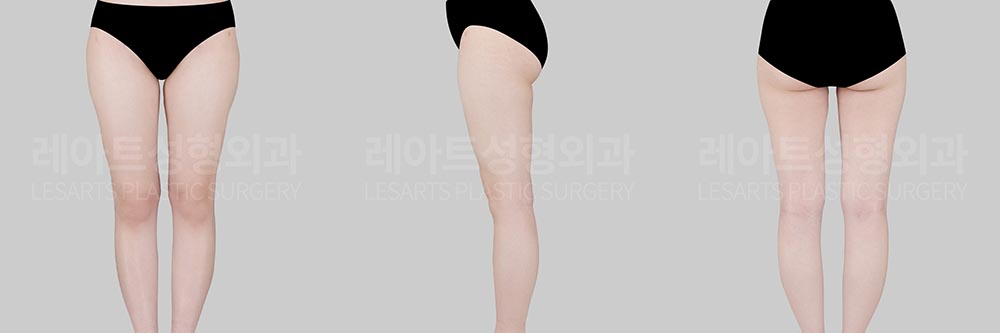
Thigh Liposuction Revision Consultation – Lesarts Plastic Surgery
[Patient Information]
Age: Early 20s
Height: 158 cm
Weight: 49.9 kg
BMI: 20.0 kg/m²
Body Fat Percentage: 31.5%
Even with similar body measurements, surgical results may vary from person to person.
[Thigh Liposuction Revision Consultation and Diagnosis]
The patient had undergone thigh liposuction at another clinic two years earlier.
Since then, she had gained approximately 4 kg compared to her weight at the time of the previous surgery,
making her feel that excess fat had accumulated around her thighs again.
Her main concern was the visible asymmetry between the left and right thighs.
The outer thigh, particularly the saddlebag area, also protruded,
making the thighs appear wider and thicker
and creating an uneven overall contour.
Ultrasound examination showed:
Outer thigh: 21/25 mm
Inner thigh: 8/11 mm
Front thigh: 10/6 mm
Back thigh: 7/11 mm
Knee: 9/9 mm
Although some fat remained in areas other than the saddlebag region,
the overall amount of residual fat was not particularly high.
In the inner thighs, despite the noticeable visual asymmetry,
the actual difference in fat volume between the two sides was relatively small.
In cases like this, it is important to determine which goal should take priority:
improving left-right symmetry
or maximizing overall fat removal and thigh circumference reduction.
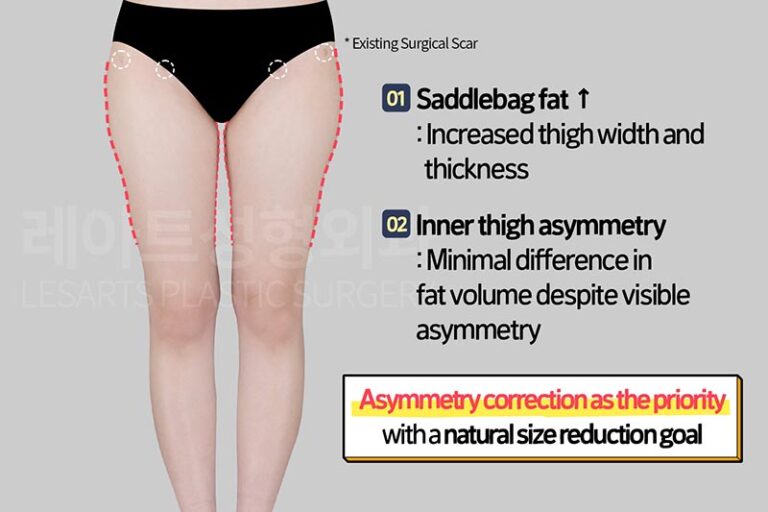
When the difference in fat volume between the two sides is relatively small,
trying to correct only the asymmetry too aggressively may reduce the degree of circumference reduction the patient originally wanted.
On the other hand, if maximizing fat removal is prioritized,
minor asymmetry may not be completely corrected.
For this reason, we discussed both goals carefully with the patient
and determined which should take priority.
[Surgical Design for Thigh Liposuction Revision]
Since the patient had already undergone liposuction once,
the goal of this revision was not simply to remove more fat.
The surgical plan began by analyzing
why the concerns had not been fully resolved after the first procedure.
✔ Inner Thighs
One of the patient’s main concerns was inner thigh asymmetry.
Although the asymmetry was clearly visible,
the actual difference in fat volume between the two sides was relatively small,
and there was not a large amount of fat remaining overall.
Therefore, we determined that aggressively removing as much fat as possible
could provide some additional size reduction,
but the remaining asymmetry might still be more noticeable to the patient.
For this reason, our priority was to adjust the amount of fat removed from each side
to make the asymmetry less visually noticeable.
✔ Muscle Contour Lines
Excessive fat removal around the muscles
can make the underlying muscle contours appear overly prominent
and create an unnatural appearance.
We therefore carefully determined how much fat should remain
to preserve a smooth and natural thigh contour.
✔ Limitations
With revision liposuction, results may vary depending on the condition of the tissues
after the previous procedure.
We also explained in advance that there may be limitations
to achieving perfect symmetry between both thighs.
[Before and After Thigh Liposuction Revision]
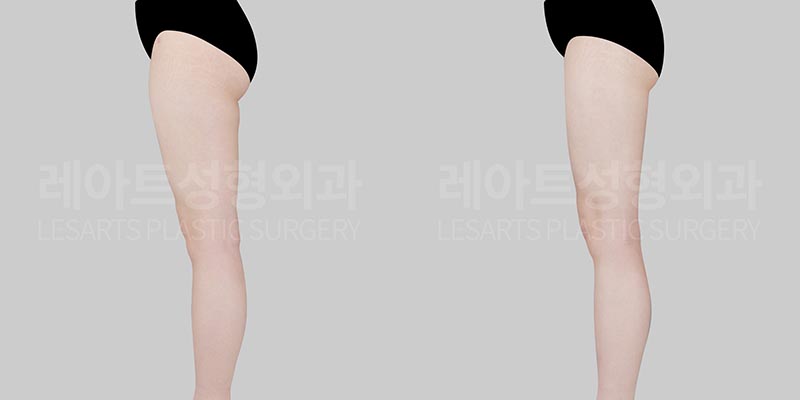
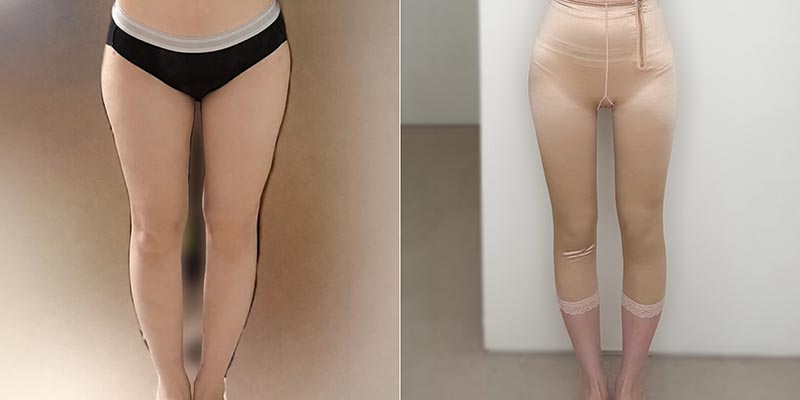
(Photos taken two months after surgery
under the same lighting and environmental conditions.)
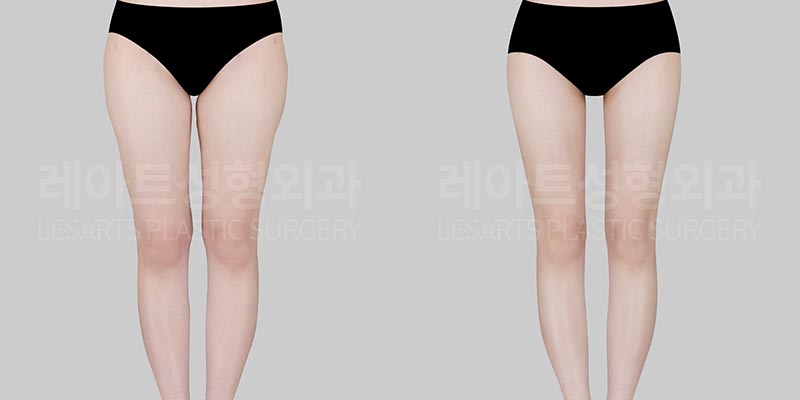
After surgery, the previously uneven inner thigh contour became smoother, creating a more balanced appearance between both legs.
In particular, the inner thigh gap formed a smooth, consistent curve, creating a straighter and slimmer leg line that appears more defined when wearing tight pants or skirts.
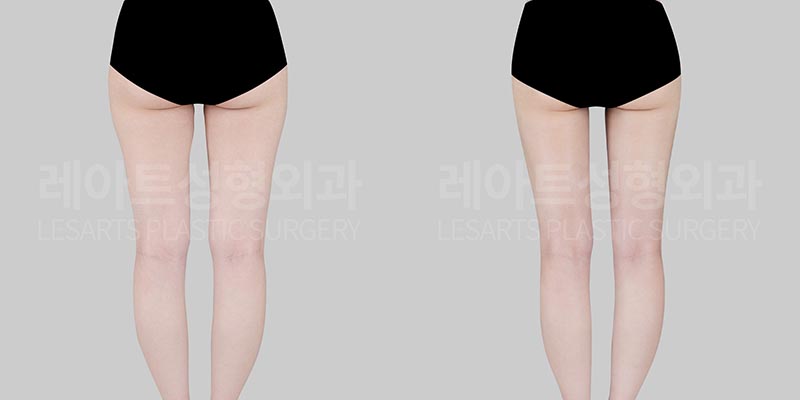
Correction of Inner Thigh Asymmetry After Thigh Liposuction – Dr. Seo Yongseung, Lesarts Plastic Surgery
The previously protruding outer thigh contour was also refined,
creating slimmer and smoother-looking thighs.
Despite being a revision procedure,
the thigh contour was precisely refined
without the skin irregularities or sagging
that had been a concern.
The patient was also highly satisfied, saying,
“I feel confident about my leg line again.”
Even if liposuction creates the contour you wanted,
fat can accumulate again if proper weight management
is not maintained after surgery.
Liposuction is not simply about reducing size
while keeping the body’s original proportions.
It involves adjusting the amount of fat in different areas
to create a more balanced and attractive contour.
Therefore, if weight is gained and the remaining fat cells enlarge,
areas where more fat was intentionally preserved may become more prominent,
potentially making the overall contour appear uneven again.
In other words, it is important to remember
that the idea that “liposuction means I no longer need to manage my weight”
is simply not correct.
Liposuction is best used to remove stubborn fat
that remains after a certain amount of weight loss,
or as motivation when excess fat makes it difficult
to begin managing your weight.
If your thinking is,
“I don’t want to diet, so I’ll just solve it with liposuction,”
I would not recommend liposuction.
Of course, maintaining the same motivation and lifestyle
after liposuction is not always easy.
Weight management may become difficult over time,
and some patients may eventually consider revision surgery
even after having undergone liposuction once,
as in this case.
Revision liposuction requires more careful diagnosis
and surgical planning than the initial procedure.
Most importantly, the previous surgical result should be evaluated carefully
to determine why certain concerns remained
or why contour problems developed again.
If you have already undergone liposuction
but still have concerns about your body contour,
please contact Lesarts Plastic Surgery.
We will carefully reassess your condition
and review your options from the beginning.
FAQ
Q1. Why might thigh liposuction revision be needed?
Revision may be considered when asymmetry, uneven contours, or residual fat remain after a previous procedure.
Weight gain after liposuction can also enlarge remaining fat cells and make contour irregularities more noticeable.
Q2. Can thigh asymmetry be completely corrected with revision liposuction?
Revision liposuction can improve visible asymmetry, but perfect symmetry cannot always be guaranteed.
The surgical plan should balance symmetry correction with the desired reduction in thigh circumference.
Q3. Why is ultrasound important before thigh liposuction revision?
Ultrasound helps evaluate the remaining fat thickness in different areas of the thighs.
This allows the surgeon to determine whether visible asymmetry is actually caused by differences in fat volume.
Q4. Is thigh liposuction revision more difficult than the first surgery?
Yes. Previously treated areas may have firmer tissue and uneven remaining fat layers.
Revision therefore requires more detailed assessment and a carefully customized surgical design.
Q5. Can weight gain affect the results after liposuction?
Yes. Liposuction removes fat cells, but the remaining fat cells can still enlarge with weight gain.
Maintaining a stable weight is therefore important for preserving the contour achieved through surgery.
▼ Visit Lesarts Plastic Surgery in Gangnam, Seoul, Korea ▼