
Liposuction and Fat Grafting – Why Liposuction Alone May Not Be Enough to Complete the Body Contour
Why might fat grafting be needed together with liposuction?
Liposuction can reduce excess volume, but it may not fully correct areas that naturally lack volume.
In these cases, fat grafting can fill depressed areas while liposuction reduces surrounding fullness,
helping create a smoother and more balanced body contour.
[ Learn More About Liposcution at Lesarts Plastic Surgery ]
[ Learn More About Fat Grafting at Lesarts Plastic Surgery ]
Written by Dr. Yongseung Seo, Lesarts Plastic Surgery
This article was written directly by the attending surgeon.
※ Unauthorized reproduction, editing, or redistribution is prohibited. ※
Some patients who visit a clinic considering liposuction
want to reduce their overall body size while also being concerned about a specific area that appears noticeably hollow,
making the overall body contour look less balanced.
Removing fat from protruding areas can often reduce the difference in volume
and naturally soften the appearance of nearby depressions.
However, liposuction alone may not be enough to create a completely smooth contour,
so autologous fat grafting may also be needed
to restore volume in areas that appear deficient.
Reducing excess volume and adding volume where needed
often work together to create a more balanced body contour.
The patient introduced in this case had a relatively slim upper body,
but had long been concerned that persistent thigh fat made her overall body proportions appear unbalanced.
She visited Lesarts Plastic Surgery hoping to reduce the overall volume of her thighs and hip line,
while also improving the hollow appearance of the lateral hip area.
[Patient Information]
Age: Late 20s
Height: 153 cm
Weight: 46.3 kg
BMI: 19.8 kg/m²
Body Fat Percentage: 25.8%
※ Liposuction results may vary between individuals,
even among patients with similar body measurements and characteristics.

Before Thigh Liposuction and Hip Fat Grafting
[Consultation and Diagnosis]
“No matter how much weight I lose, I lose volume from my breasts first,
but the fat on my thighs always seems to remain.
People often tell me I look slim based on my upper body,
but my thighs stay the same, so I’ve always been concerned about my body proportions.”
Compared with her upper body, the patient had persistent fat accumulation in the thighs,
which had long made her feel that her overall body proportions were unbalanced.
She wanted to reduce the overall volume of her thighs and hip line,
while naturally filling the hollow appearance of the lateral hip area.
On visual examination, the inner thighs were almost continuously touching
from the upper thighs down toward the knees,
giving the legs an overall heavier appearance.
From the back, prominent saddlebags on both sides
made the contour from the pelvis to the thighs appear wider.
From the side, the thighs formed a gently rounded, thicker curve
from below the pelvis down toward the knees,
further emphasizing the overall thickness of the legs.
Ultrasound Examination
Outer thighs (saddlebags): 32/23 mm
Inner thighs: 16/17 mm
Front thighs: 12/14 mm
Back thighs: 9/10 mm
Knees: 13/11 mm
Ultrasound examination showed relatively thick fat layers throughout the thighs,
with a particularly noticeable difference between the left and right outer thighs,
measuring 32 mm and 23 mm.
Because there was a clear difference in fat volume between the two sides,
we explained in advance that we would aim to improve the symmetry as much as possible,
but that perfect left-right symmetry might not be achievable.
The inner thighs also contained a relatively large amount of fat,
but because the skin in this area was thin, we explained that mild wrinkling related to skin laxity
could develop after reducing the underlying fat volume.
The area below the buttocks already had a long and clearly defined infragluteal fold.
As the volume of the saddlebags decreases,
this existing fold may appear relatively lower or more prominent.
Because further emphasizing an already long fold could negatively affect the overall contour,
we recommended preserving the fat in this area rather than performing liposuction there.
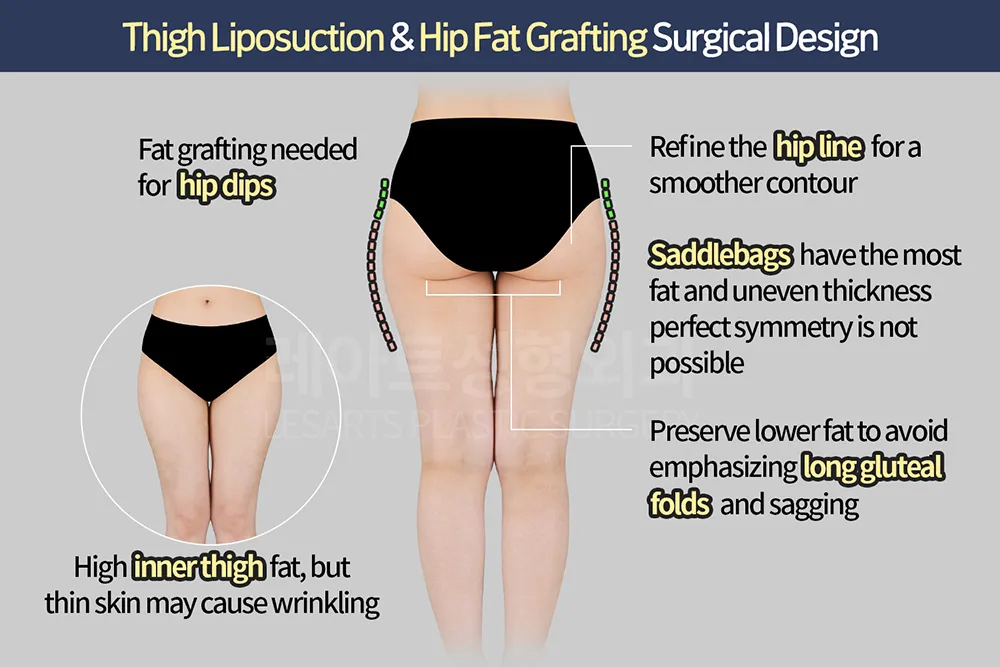
Thigh Liposuction and Hip Fat Grafting Surgical Plan – Dr. Yongseung Seo
[Thigh Liposuction and Hip Fat Grafting Design]
For this patient, the surgical plan focused on reducing overall lower-body volume
while creating a smoother and more balanced hip contour.
✔ Outer thighs (saddlebags)
The outer thighs had the greatest amount of fat
and also showed a noticeable difference between the left and right sides.
Liposuction was planned to reduce this excess volume
while creating the smoothest possible transition from the knees to the pelvis.
✔ Hip line
The hip line was also contoured
to make the transition into the outer thighs appear lighter and smoother.
✔ Inner thighs
The inner thighs contained enough fat for meaningful volume reduction.
However, because the skin was relatively thin,
the possibility of postoperative wrinkling was explained in advance.
✔ Area below the buttocks
The existing infragluteal fold was already relatively long and well defined.
To avoid making this fold appear more prominent,
we planned to preserve the fat in this area rather than perform liposuction.
✔ Lateral hip fat grafting
Autologous fat harvested from the thighs was planned for grafting into the hollow lateral hip area,
helping the surrounding contours connect more naturally and smoothly.
[Before and After Thigh Liposuction and Hip Fat Grafting]
(Photos taken 2 months after surgery
under the same lighting and environmental conditions.)
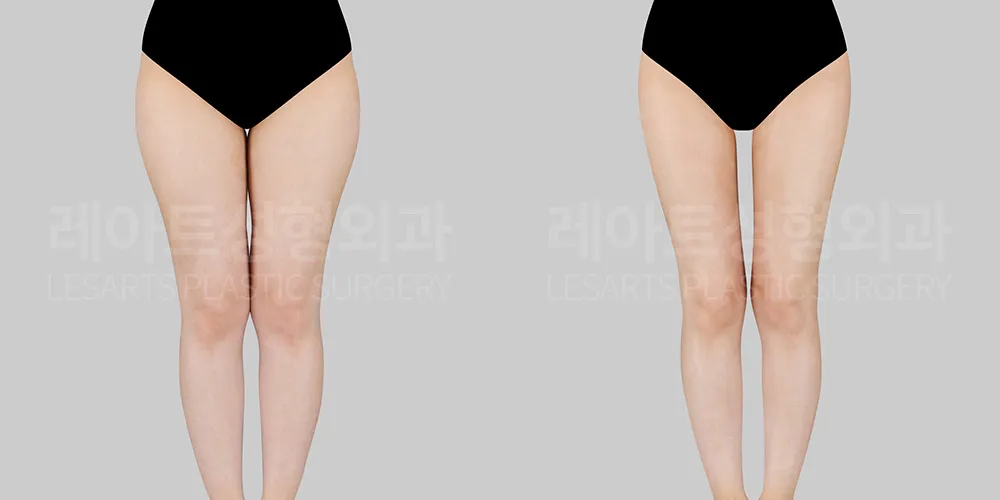
Changes in Thigh and Hip Contour Before and After Thigh Liposuction and Hip Fat Grafting – Dr. Yongseung Seo, Lesarts
Before surgery, the thighs appeared to touch almost completely when viewed from the front,
with very little space between them.
After surgery, a natural gap developed between the thighs,
creating a lighter and more defined overall leg contour.
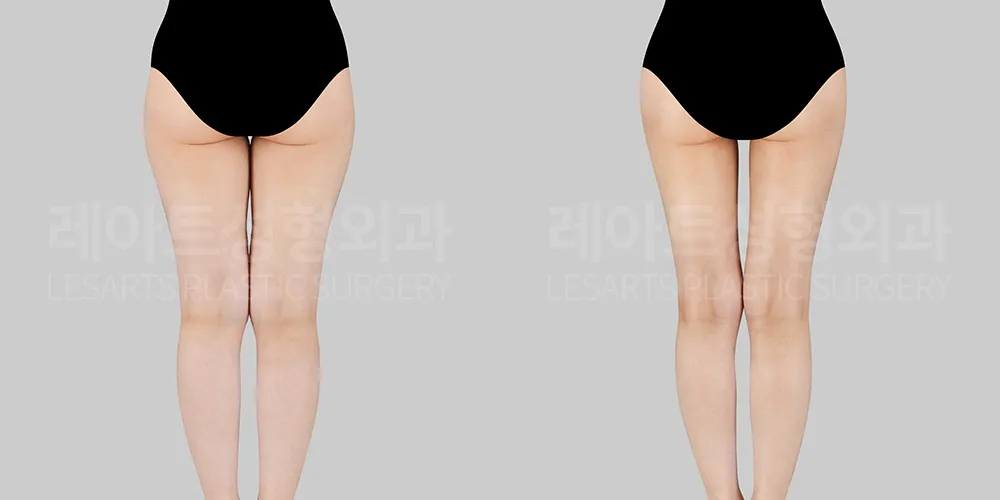
Changes in Thigh Contour After Saddlebag Reduction – Lesarts Plastic Surgery
From the back, reducing the outer thigh fullness created a much smoother transition
from the pelvis down to the thighs.
The natural contour below the buttocks was also preserved,
maintaining its preoperative shape without making the infragluteal fold more prominent.
As explained before surgery, some left-right asymmetry in the outer thigh area remained,
but the patient did not find the remaining difference particularly concerning.
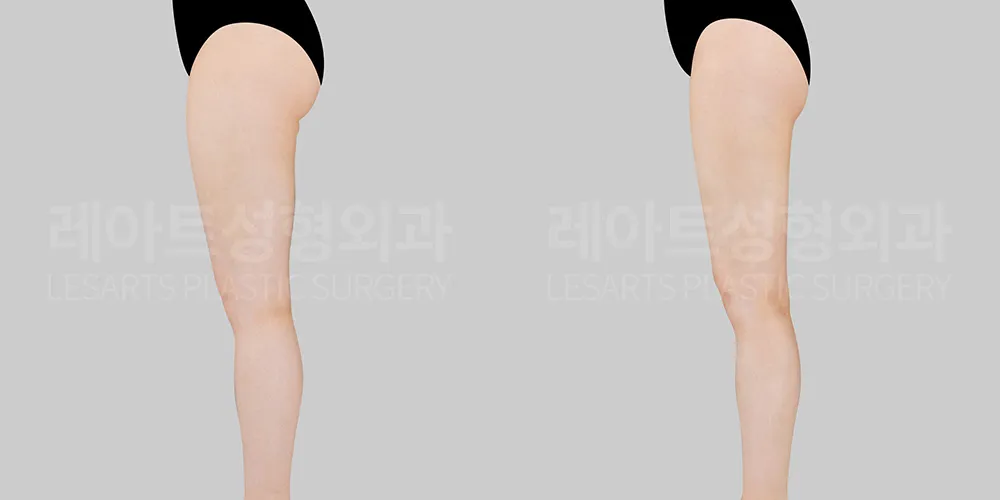
Changes in the Front Thigh Before and After Thigh Liposuction – Dr. Yongseung Seo, Lesarts
When viewed from the side, the previously prominent front thigh contour
became noticeably flatter and less pronounced after surgery.
As a result, the overall leg line developed
a smoother and more natural curve.
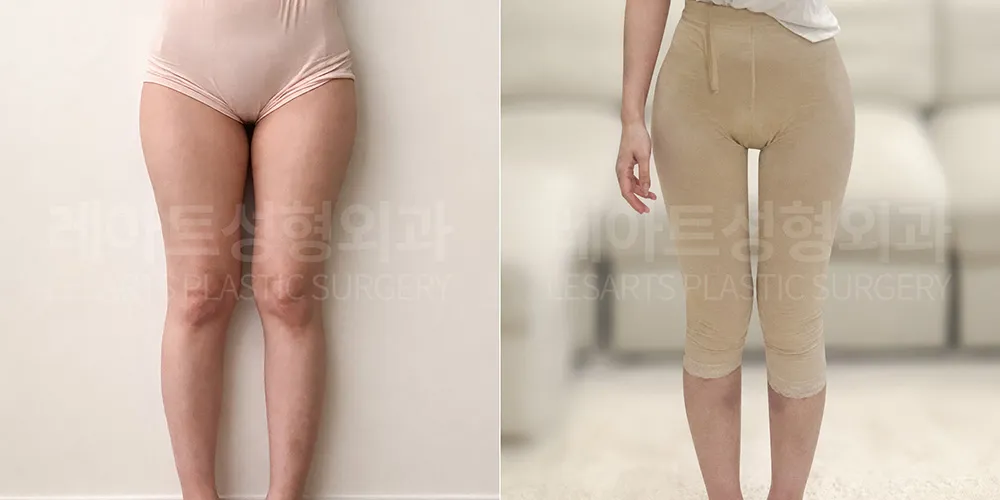
The patient experienced some discomfort from swelling
during the early recovery period after surgery.
However, she later told us that she was very satisfied
because her thighs no longer rubbed together even when wearing leggings.
Although only 2 months have passed and the recovery process is not yet complete,
the patient is already satisfied with the changes.
We explained that further improvement can be expected
as the remaining swelling subsides and the final results become more apparent.
Lesarts Thigh Liposuction + Hip Fat Grafting Case
View More
▼▼▼
Liposuction is a procedure that removes existing fat,
but for some body types, fat removal alone may not be enough to create a balanced contour.
In these cases, overall volume can be reduced while hollow areas are filled with fat grafting,
helping the surrounding contours connect more naturally
and creating a smoother, more balanced silhouette.
Without a careful evaluation of individual factors
such as left-right asymmetry and skin thickness,
patients may experience results that differ from what they expected or intended.
If you have been concerned for a long time about the contour of your thighs or hips,
or about areas that appear noticeably hollow due to a lack of volume,
please feel free to consult Lesarts rather than trying to determine the best approach on your own.
We will help you find an appropriate approach
through a careful evaluation and individualized surgical planning.
FAQ
Q1. Why is liposuction alone sometimes not enough to improve the body contour?
Liposuction removes excess fat, but it cannot add volume to naturally depressed areas.
When both excess and deficient volume are present, combining removal and grafting
may create a smoother overall contour.
Q2. Which areas were treated with liposuction in this case?
The surgical plan focused on the thighs and hip line,
particularly the outer thighs, inner thighs, and areas where excess volume
made the lower body appear heavier.
Q3. Why was fat grafting performed on the lateral hip area?
The lateral hip area appeared depressed compared with the surrounding contour.
Fat harvested during thigh liposuction was grafted into this area
to create a smoother transition between the pelvis, hips, and thighs.
Q4. Can thigh liposuction completely correct left-right asymmetry?
Not always. Differences in fat thickness and body structure may remain even after surgery.
In this case, preoperative ultrasound showed a noticeable difference in outer-thigh fat thickness
between the left and right sides.
Q5. Why was liposuction avoided below the buttocks in this case?
The patient already had a long, defined infragluteal fold.
Removing additional fat from this area could have made the fold appear more prominent or sagging,
so the existing volume was preserved to maintain a natural contour.
▼ Visit Lesarts Plastic Surgery in Gangnam, Seoul, Korea ▼