Gynecomastia Medical Column: “I Only Have Puffy Nipples—Is That Still Gynecomastia?” The Definitive Solution Beyond Nipple Covers
Can Puffy Nipples Be a Sign of Gynecomastia?
Yes. Even when the entire chest does not appear enlarged,
glandular tissue beneath the nipple and areola
can push them outward and create a puffy appearance.
[ Learn More About Gynecomastia Surgery at Lesarts Plastic Surgery ]
Written by Dr. Jihoon Moon, Lesarts Plastic Surgery
This medical column was written directly by the attending surgeon.
※ Unauthorized reproduction, editing, or redistribution is prohibited. ※
During my gynecomastia consultations,
I meet many patients every week.
As the weather gets warmer
and thinner clothing becomes more common,
there is one concern
I hear more than any other.
“My entire chest doesn’t look enlarged.
I just want to fix my protruding nipples.”
When people think of gynecomastia,
they often imagine a noticeably enlarged chest
that resembles a female breast.
However, in actual clinical practice,
many patients are far more distressed
by enlarged or protruding nipples and areolas—
commonly referred to as puffy nipples or puffy areolas—
than by the size of the chest itself.
In this article,
I’ll explain why puffy nipples develop,
and discuss the medical treatment options
that address the underlying cause
rather than simply hiding the appearance.
1. Hiding It Again and Again—One of the Most Memorable Cases in My Practice
To conceal nipples that stand out
through thin T-shirts,
many men rely on
a temporary solution:
nipple covers (also called nipple patches).
Today, these products are easy to purchase
at drugstores and online,
making them a common choice.
However, from a medical perspective,
they can raise significant concerns,
especially for individuals
with sensitive skin
or underlying skin conditions.
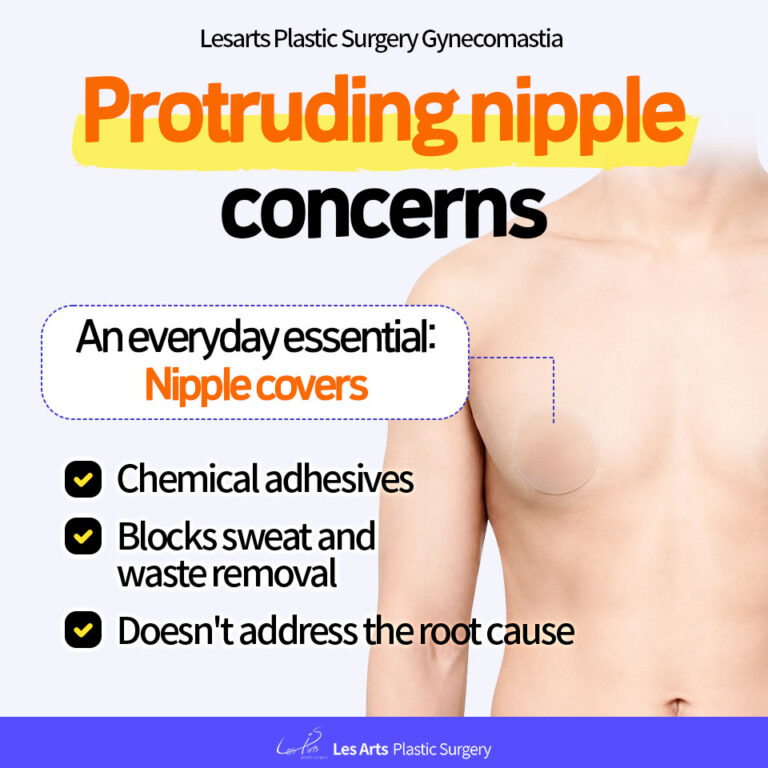
Are Nipple Patches Safe for Protruding Nipples? – Lesarts Plastic Surgery
One patient, in particular,
has remained with me.
He was a young man with gynecomastia
and severe atopic dermatitis.
Embarrassed by his protruding nipples,
he wore highly adhesive nipple patches
every single day
to hide them.
For patients with atopic skin,
the skin barrier is already compromised,
making the skin extremely sensitive.
Repeatedly applying and removing
strong chemical adhesives,
while trapping sweat and skin debris beneath the patch,
can place significant stress on the skin.
Eventually,
he developed chronic contact dermatitis.
Persistent itching led to repeated scratching,
resulting in hyperkeratosis,
where the skin became thickened and hardened,
along with chronic hyperpigmentation,
leaving dark, uneven discoloration.
I still remember
how discouraged he looked
during his first visit.
Temporary concealment methods
not only risk damaging the skin,
but also fail to address
the underlying cause.
This is why an accurate diagnosis
followed by the appropriate medical treatment
is far more important
than simply covering the problem.
2. Two Causes of Protruding Nipples and How They Are Diagnosed
Protruding nipples or areolas
generally fall into one of two categories.
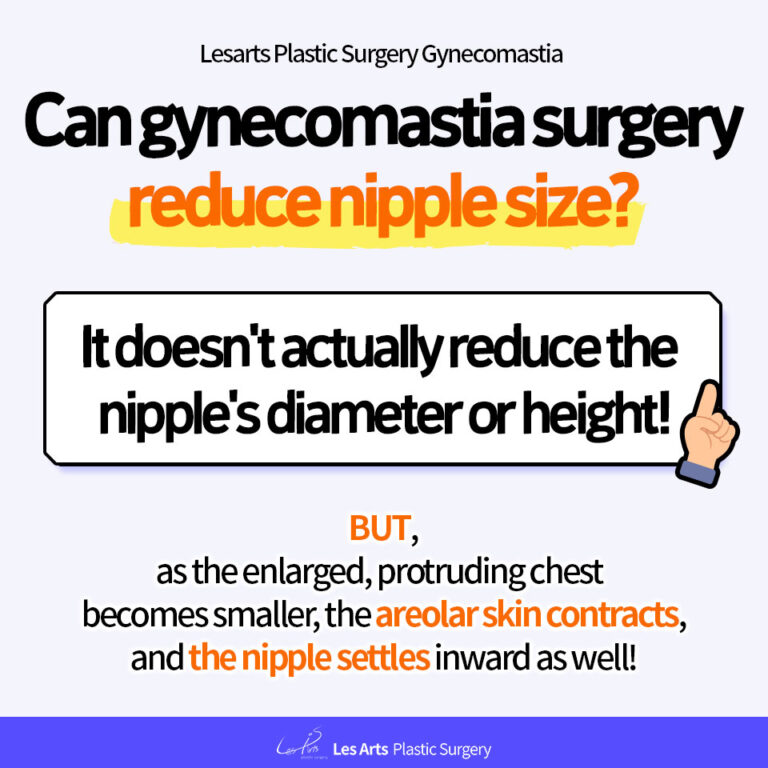
Enlarged and Protruding Nipples Caused by Gynecomastia – Dr. Jihoon Moon, Lesarts Plastic Surgery
① Naturally Enlarged Nipples (Large Diameter and Projection)
In some patients, the problem is not enlarged breast tissue but the nipple itself.
The skin and fibrous tissue that make up the nipple may naturally develop
with a larger diameter and greater projection due to congenital or acquired factors.
Because the nipple tissue itself is enlarged,
reducing body fat through diet or exercise will not make the nipple smaller.
② Glandular Tissue Enlargement (True Gynecomastia)
In many cases, only the nipple and areola appear to protrude.
However, high-resolution ultrasound often reveals firm glandular tissue
beneath the nipple that pushes it outward.
As the gland enlarges, the nipple and areola become elevated,
creating the characteristic puffy nipple appearance.
For this reason, a high-resolution breast ultrasound
is essential before determining the appropriate treatment.
By evaluating the amount and distribution of glandular tissue beneath the nipple,
along with the thickness of the surrounding fat layer,
we can accurately distinguish between simple nipple hypertrophy
and nipple protrusion caused by gynecomastia.
3. Solution One: Mammilloplasty to Reduce Nipple Volume
If ultrasound confirms that there is little or no glandular enlargement,
and the protrusion is caused solely by an oversized nipple,
mammilloplasty may be the most appropriate treatment.
✔ Procedure: A wedge-shaped portion of the enlarged nipple is carefully removed,
and the remaining tissue is meticulously reconstructed
to create a smaller, more balanced nipple.
✔ Benefits: This procedure reduces both the diameter
and the projection of the nipple.
✔ Advantages: The incision is placed along the natural border
or skin folds of the nipple,
making the scar barely noticeable over time
while preserving nipple sensation as much as possible.
4. Solution Two: Gynecomastia Surgery to Address the Underlying Cause
If ultrasound demonstrates significant glandular tissue beneath the nipple and areola,
and this tissue is determined to be the underlying cause of the protrusion,
the appropriate treatment is gynecomastia surgery,
which combines glandular tissue excision with liposuction.
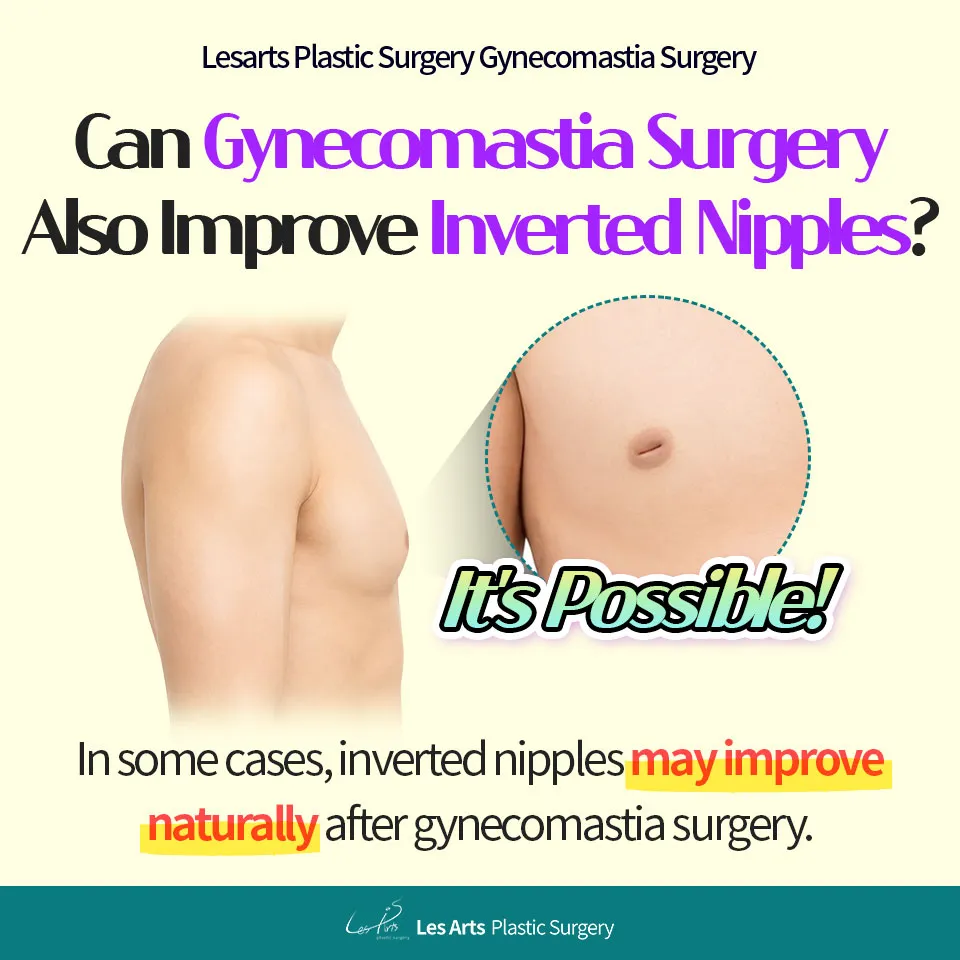
“Will Gynecomastia Surgery Make My Nipples Smaller?”
Strictly speaking, gynecomastia surgery does not physically reduce
the diameter or height of the nipple itself.
However, patients often notice a dramatic visual improvement
because the underlying space-filling effect is eliminated.
Changes in Nipple Appearance After Gynecomastia Surgery – Dr. Jihoon Moon, Lesarts Plastic Surgery
Once the enlarged glandular tissue and surrounding fat
that had been pushing the nipple and areola outward
are removed during surgery,
the space-filling effect disappears.
As the pressure beneath the areola is released,
the surrounding skin naturally contracts,
resulting in skin shrinkage over time.
This process can produce the following improvements:
1. A Smaller Areola
As the surrounding skin contracts,
the previously stretched areola gradually becomes smaller,
creating a more proportionate appearance.
2. Natural Nipple Retraction
Without the underlying glandular tissue pushing it outward,
the protruding nipple naturally settles back,
resulting in a flatter, firmer,
and more masculine chest contour.
In other words,
even without surgically reducing the nipple itself,
removing the underlying source of pressure
can create a noticeably flatter,
more natural-looking male chest.
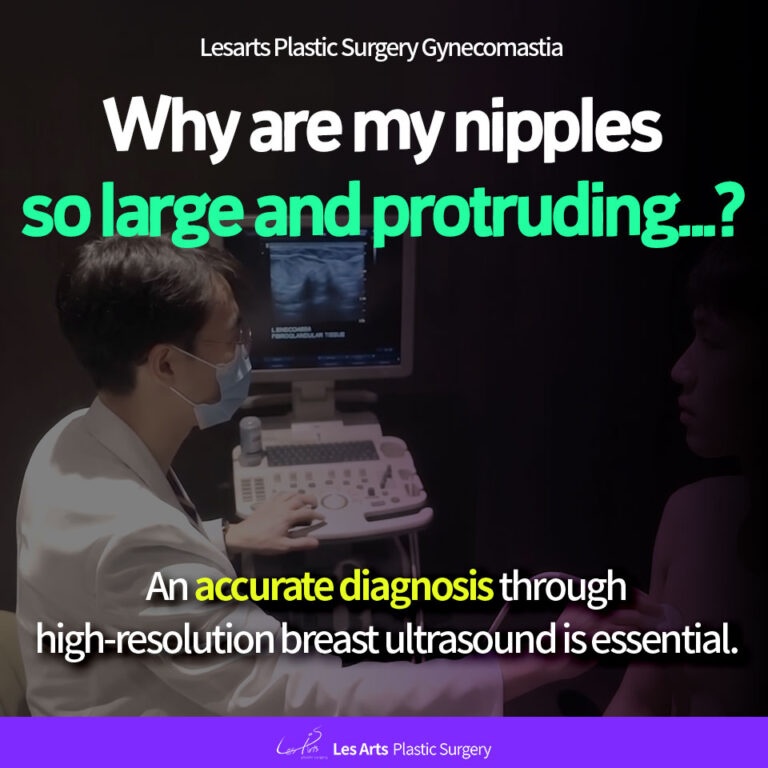
Preoperative Ultrasound Examination for Gynecomastia – Lesarts Plastic Surgery
5. Conclusion: Choosing the Right Treatment for You
Protruding nipples are more than
a cosmetic concern.
For many men,
they can lead to significant emotional distress,
reduced self-confidence,
social anxiety,
and even skin damage caused
by repeated attempts to hide them.
The most important step
is identifying the true cause
of the protrusion.
Is it simply because
the nipple tissue itself is enlarged,
or is it being pushed outward
by enlarged glandular tissue beneath the skin?
This cannot be determined
by looking in the mirror
or examining the chest yourself.
A high-resolution breast ultrasound
is essential
to make an accurate diagnosis
and choose the most appropriate treatment.
Stop hiding behind adhesive tapes
or nipple patches
that can damage your skin.
With an accurate diagnosis,
whether you need mammilloplasty
or gynecomastia surgery,
there is a safe and effective medical solution
to address the underlying cause.
If you have concerns about protruding nipples
or gynecomastia,
we welcome you to visit us
for a professional consultation.
FAQ
Q1. Can puffy nipples occur without an enlarged chest?
Yes. Even if the chest appears relatively flat, enlarged glandular tissue beneath
the nipple can create the appearance of puffy nipples,
which is a common presentation of gynecomastia.
Q2. Will dieting or exercising make puffy nipples disappear?
Not if the protrusion is caused by enlarged glandular tissue or naturally enlarged nipples.
While weight loss can reduce body fat, it cannot remove glandular tissue
or reduce the size of the nipple itself.
Q3. How can I tell whether I need mammilloplasty or gynecomastia surgery?
A high-resolution breast ultrasound is the most reliable way to
determine whether the protrusion is caused by enlarged nipple tissue or
underlying glandular tissue, allowing the appropriate treatment to be selected.
Q4. Does gynecomastia surgery make the nipples smaller?
The surgery does not physically reduce the nipple itself.
However, removing the underlying glandular tissue often allows the nipple
and areola to flatten naturally, creating the appearance of a smaller, less prominent nipple.
Q5. Are nipple patches a permanent solution for puffy nipples?
No. Nipple patches only conceal the appearance temporarily.
Long-term use may irritate the skin, especially in people with sensitive skin
or conditions such as eczema, while the underlying cause remains untreated.
▼ Visit Lesarts Plastic Surgery in Gangnam, Seoul, Korea ▼