
Abdominoplasty in Gangnam: how to choose between mini and full abdominoplasty for lower abdominal folds

Patient Registration Info
| Age | Weight | Height | BMI |
|---|---|---|---|
|
40s |
53kg |
163cm |
20 |
Surgical site
Surgical site : Abdomen, M-Type, Rectus Muscle Repair, Umbilicoplasty | Liposuction : 1,700cc
Would a Mini Tummy Tuck Be Enough If Only the Lower Abdomen Appears Saggy?
Even when wrinkles or folds appear to be concentrated
only in the lower abdomen, the actual skin laxity
may extend from the upper abdomen.
In addition, a mini tummy tuck does not necessarily
mean that the incision will always be short.
The surgical approach should be determined after evaluating
where the skin laxity begins, how much excess skin needs
to be removed, and the extent of rectus diastasis.
When considering a tummy tuck, some patients
initially think about a mini tummy tuck because
they are concerned about having a long incision.
ㅤ
Rather than extensively correcting the entire abdomen,
they may want to remove only the folded skin
in the lower abdomen through a shorter incision.
ㅤ
However, a mini tummy tuck does not always
result in a shorter scar.
ㅤ
Even if the sagging appears to be limited to the lower abdomen,
lax skin may actually extend from the upper abdomen
and shift downward, accumulating in the lower abdomen.
The length of a tummy tuck incision is also not determined
simply by the name of the procedure. It is related to the actual
extent of excess skin that needs to be removed.
ㅤ
Even when sagging is limited to the lower abdomen,
the incision may be longer than expected if a large amount
of skin needs to be removed.
ㅤ
This patient also initially preferred a mini tummy tuck
because she was concerned about a long incision.
ㅤ
However, after evaluating the actual condition of her abdomen,
an M-type full tummy tuck was considered necessary.
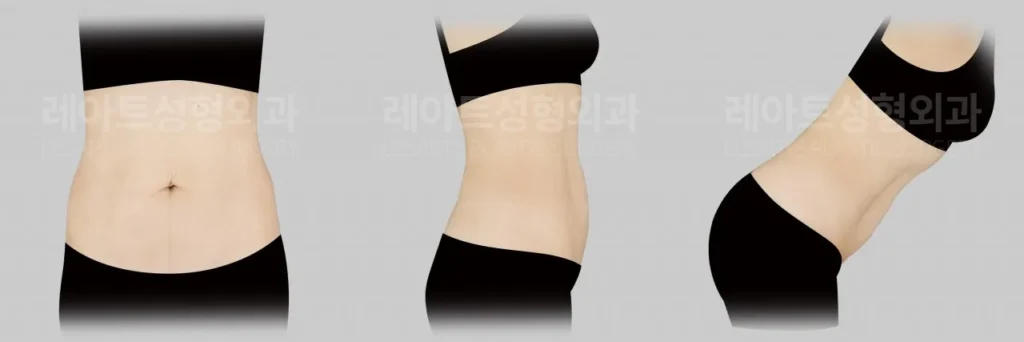
[Preoperative Upper Abdominal Skin Laxity and Lower Abdominal Condition]
[Patient Information]
Age: 40s
Height: 163 cm
Weight: 52.9 kg
BMI: 19.9
The patient had experienced two vaginal deliveries.
She also had a history of significant weight changes
and previous abdominal liposuction.
ㅤ
Based on her overall body shape,
she did not have a particularly large amount of abdominal fat.
The main concern was the condition of the skin and abdominal wall.
ㅤ
Skin elasticity had decreased from the upper abdomen,
leaving the skin loose and sagging. Rectus diastasis also caused
the abdominal wall to protrude forward, making the abdomen
appear heavier than her actual body shape.
When she bent forward, the remaining loose skin
shifted downward toward the lower abdomen.
This made the multiple skin folds even more noticeable.
[Why a Full Tummy Tuck Was Chosen Instead of a Mini Tummy Tuck]
The patient initially wanted
an S-type mini tummy tuck.
ㅤ
However, the examination showed that correcting
only the area below the belly button would not be enough
to achieve the desired improvement.
ㅤ
Because the skin laxity extended from the upper abdomen,
tightening only the lower abdominal skin would leave
the excess skin above the belly button uncorrected.
ㅤ
The rectus diastasis was also not limited
to the lower abdomen. The upper abdominal area
needed to be corrected as well.
ㅤ
We therefore explained that an S-type mini tummy tuck alone
would not be sufficient to fully address the skin laxity
above the belly button and the rectus diastasis
in the upper abdomen.
After a detailed consultation, the patient decided
to undergo an M-type full tummy tuck combined with
abdominal wall tightening and umbilicoplasty.
ㅤ
For this patient, the priority was not simply
to make the incision shorter. It was to determine
how much of the overall abdominal area that concerned her
could actually be improved.
[Changes in the Skin Around the Belly Button and Lower Abdominal Contour 1 Year and 10 Months After Tummy Tuck Surgery]
Let’s compare the results
1 year and 10 months after surgery.
ㅤ
Before surgery, loose skin around the belly button
extended downward, creating an uneven contour
from the upper to the lower abdomen.
ㅤ
After surgery, the excess skin was removed,
creating a smoother and more natural abdominal contour
from above the belly button to the lower abdomen.
ㅤ
The wrinkles around the belly button were also reduced.
As the downward skin laxity was corrected,
the central abdomen appeared flatter and lighter than before.
ㅤ
Residual fat around the belly button and waistline
was also reduced with abdominal liposuction.
ㅤ
In addition, the belly button, which had appeared horizontally
stretched due to skin laxity, was reshaped into a vertical form
and positioned at the center of the abdomen.
This helped create a more natural-looking
and defined waistline.
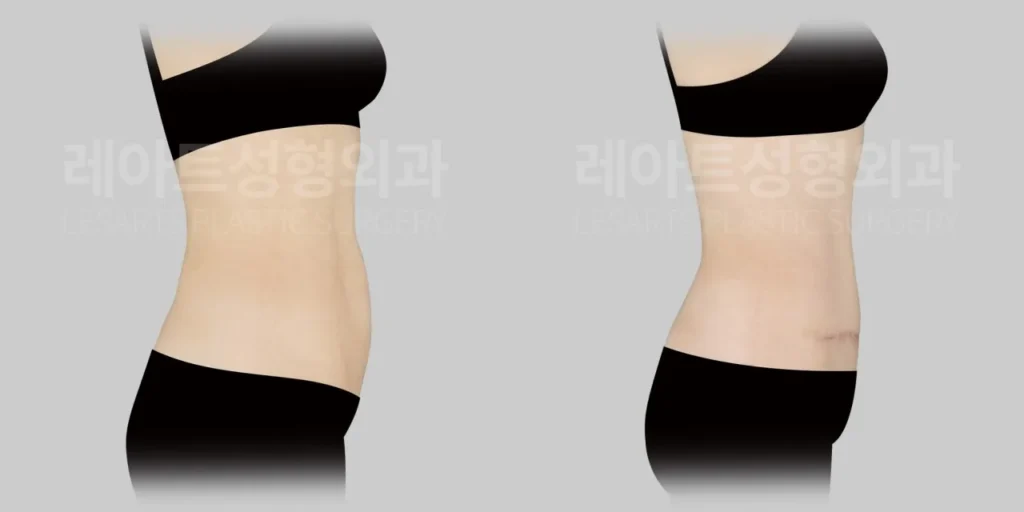
[Changes in Anterior Abdominal Projection and Lower Abdominal Contour from the Side View 1 Year and 10 Months After Tummy Tuck Surgery]
From the side view, the change in the shape
of the anterior abdomen after rectus muscle repair
can be seen more clearly.
ㅤ
Before surgery, the abdominal wall projected forward,
giving the entire abdomen a rounded and protruding appearance.
ㅤ
After surgery, the separated rectus muscles were tightened
to restore support to the abdominal wall. This created
a firmer contour from the upper to the lower abdomen.
ㅤ
In particular, the forward projection of the lower abdomen
was reduced, creating a flatter and smoother
anterior abdominal contour from the side.
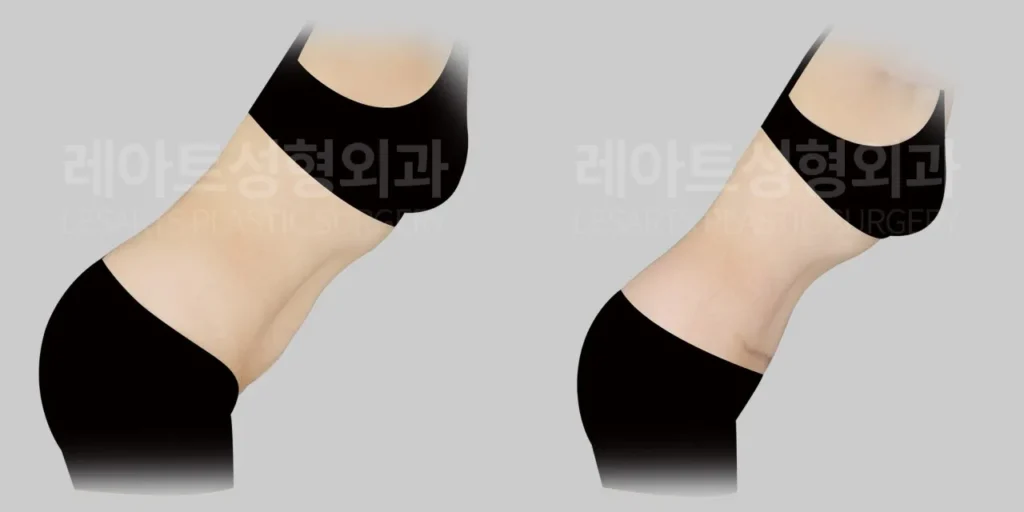
[Changes in Lower Abdominal Skin Laxity and Folds When Bending Forward 1 Year and 10 Months After Tummy Tuck Surgery]
In this patient, the degree of skin laxity
became more noticeable when bending forward.
ㅤ
Before surgery, bending at the waist caused the loose skin
to gather toward the lower abdomen,
creating deep folds.
ㅤ
The abdominal wall also lacked sufficient support,
causing it to shift downward and bulge forward.
ㅤ
After surgery, the amount of excess skin gathering
in the lower abdomen was significantly reduced,
even when bending forward.
The abdominal wall also remained firmer than before,
with less forward bulging.

[Lower Abdominal Incision Scar Recovery 1 Year and 10 Months After Tummy Tuck Surgery]
One of the patient’s biggest concerns
before surgery was the scar.
ㅤ
Because she chose a full tummy tuck,
she was also concerned that the incision would be longer
than with a mini tummy tuck.
ㅤ
After surgery, she continued to receive regular laser toning
around the lower abdominal incision
and the belly button.
ㅤ
At 1 year and 10 months after surgery,
the scar can be seen gradually fading,
particularly from both ends of the incision.
ㅤ
The incision itself is also positioned where it can be
naturally covered by underwear.
The patient reported that the scar rarely causes
significant discomfort or concern in her daily life.
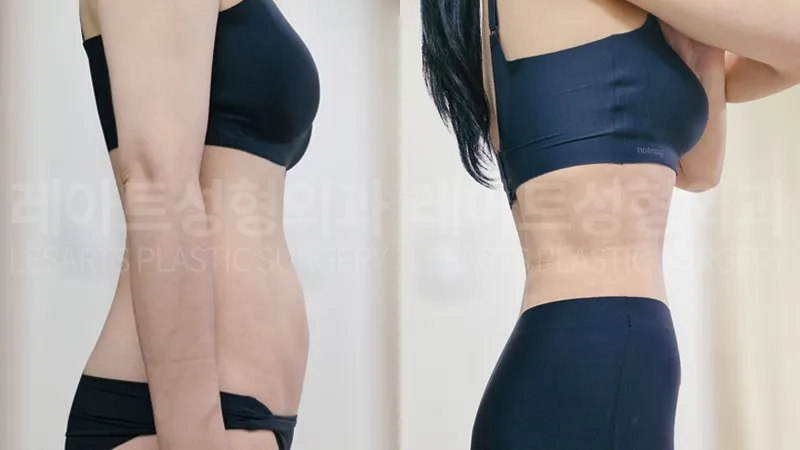
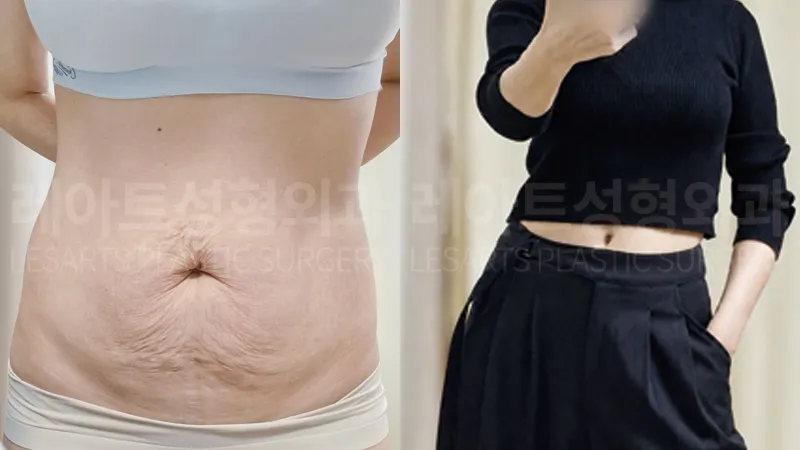
[Before and 2 Months After Tummy Tuck Selfie Comparison]
Early changes can also be seen
in the photos taken by the patient herself.
ㅤ
Before surgery, the lower abdominal skin projected forward,
creating noticeable thickness through the center of the abdomen.
At 2 months after surgery, the volume of the lower abdomen
had decreased, creating a lighter and more defined waistline.
ㅤ
Although this was still an early stage of recovery
and the surgical area had not fully stabilized,
the abdomen already appeared firmer than before
even in everyday postures.

[Before and 5 Months After Tummy Tuck Selfie Comparison]
At 5 months after surgery, the abdominal contour
had settled into a more natural shape.
ㅤ
In the photos taken by the patient herself,
the loose skin around the belly button and lower abdomen
had been reduced, and the waistline appeared more naturally defined.
ㅤ
The reduction in central abdominal thickness
and skin folds was also noticeable
even in everyday clothing.
ㅤ
At her initial consultation, the patient preferred
a mini tummy tuck because she was concerned
about having a long incision.
ㅤ
However, examination showed that the skin laxity
was not limited to the lower abdomen. Skin that had lost elasticity
extended downward from the upper abdomen.
Rectus diastasis was also present in both the upper
and lower abdomen, making it difficult to achieve
the desired degree of correction with an S-type mini tummy tuck alone.
ㅤ
Therefore, an M-type full tummy tuck was performed
together with abdominal wall tightening
and umbilicoplasty.
ㅤ
At 1 year and 10 months after surgery,
the excess skin around the belly button and lower abdomen
had been reduced significantly.
The multiple folds that had formed in the lower abdominal skin
when bending forward were also greatly reduced.
ㅤ
Rectus muscle repair also helped create a firmer abdominal wall
that no longer projected forward as much as before.
The lower abdominal incision, which had been
the patient’s biggest concern, was also healing
in a position that could be covered by underwear.
ㅤ
When choosing a tummy tuck procedure,
the shortest possible incision is not necessarily
the most important consideration.
ㅤ
The priority is determining how much of the area
that concerns the patient can actually be corrected.
ㅤ
Even if the sagging appears to be limited
to the lower abdomen, skin laxity may actually begin
in the upper abdomen.
The appropriate surgical approach may also vary
depending on how far the rectus diastasis extends.
If you are considering a mini tummy tuck
or a full tummy tuck, it is important not to compare
incision length alone.
The location where the skin laxity begins,
the amount of excess skin that needs to be removed,
and whether the abdominal wall also requires correction
should all be evaluated before determining the appropriate
extent of surgery.
Mini Tummy Tuck & Full Tummy Tuck FAQ
Mini Tummy Tuck & Full Tummy Tuck FAQ
Q1. Is a mini tummy tuck enough if only the lower abdomen is sagging?
Even if the sagging appears concentrated in the lower abdomen,
the actual skin laxity may extend from the upper abdomen.
The surgical approach should be determined after evaluating
where the skin laxity begins and how far it extends.
Q2. Does a mini tummy tuck always result in a shorter scar?
Not necessarily. If a large amount of skin needs to be removed
from the lower abdomen or the sagging extends across a wider area,
the incision may also need to be longer.
Q3. Can a mini tummy tuck correct rectus diastasis in the upper abdomen?
The area that can be corrected depends on the surgical approach
and the current condition of the abdominal wall.
In this patient, rectus diastasis extended into the upper abdomen,
so an M-type full tummy tuck was chosen.
Q4. Is the belly button also reconstructed during a full tummy tuck?
With an M-type full tummy tuck, where the skin is repositioned
over a wider area, the belly button may also need to be reshaped
and repositioned as part of the procedure.
Q5. Do tummy tuck scars fade over time?
Scar healing varies from person to person.
This patient received regular laser toning around the incision
and belly button, and at 1 year and 10 months,
the scar had begun to fade from both ends.
▼ Visit Lesarts Plastic Surgery in Gangnam, Seoul, Korea ▼